Far from the palatial white cubes of Chelsea or the intimate townhouse spaces of the Upper East Side is a different type of gallery space – one that serves as a reminder of an earlier moment in the art world, and yet persists into the present – the SoHo loft. In his debut solo exhibition, Sam Spillman has created work that probes at this history in In Case Of Sam Spillman at Ulterior Gallery.
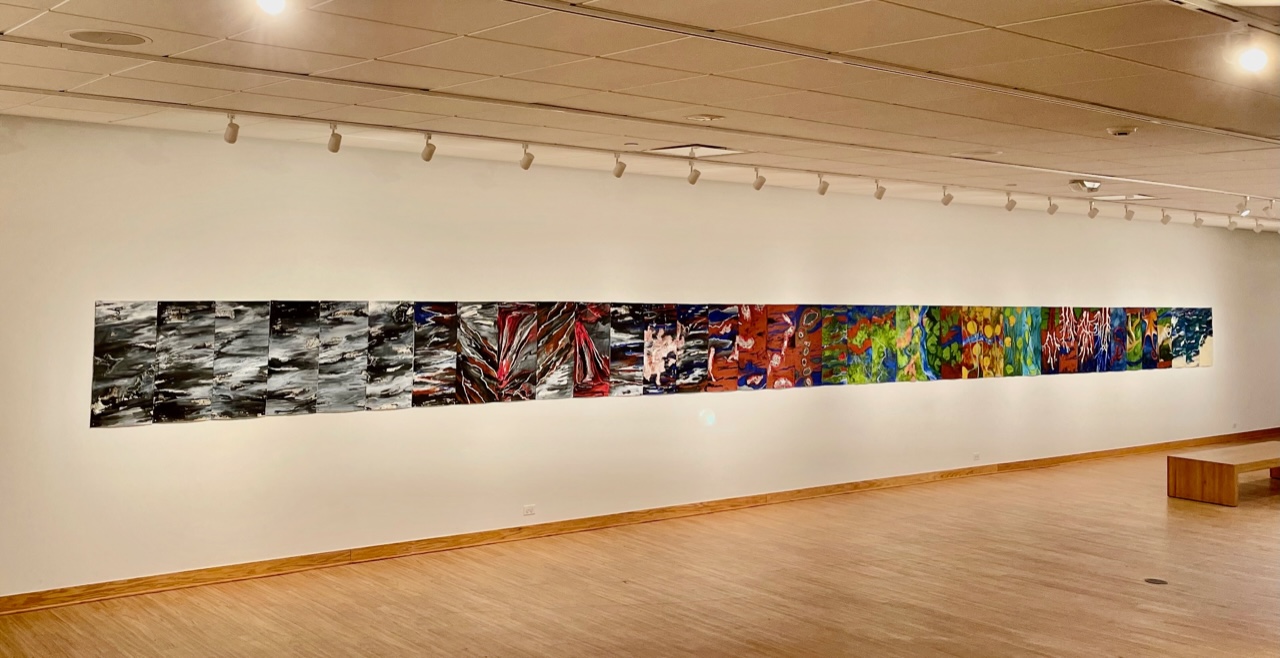
Susan Hoffman Fishman, In the Beginning There Was Only Water, 30 in. x 50 ft., acrylic, oil pigment stick and mixed media on paper, 2021, Installation view at Janice Charach Gallery, West Bloomfield, Michigan
During the height of the COVID-19 pandemic, from 2020 through 2021, eight women artists from the Midwest and the East Coast of the United States came together via Zoom to read and discuss All We Can Save: Truth, Courage and Solutions for the Climate Crisis, edited by Ayana Elizabeth Johnson, Ph.D. and Katharine K. Wilkinson, Ph.D. The book contains essays and poetry by a cadre of diverse women policy wonks, scientists, writers, journalists, lawyers, activists, and others who address the most critical existential issue of our time with the intention of offering different ways to effect change and mend the significant damage that we have caused to the Earth. The artists’ responses to the essays form the exhibition Climate Conversations: All We Can Save. The exhibition runs through June 30th, 2022.
Michelle Weinberg, A Personal Situation, graphite and colored pencil on paper, 20 3/4” x 16″
The two-person exhibition Shuffling Liminal Episodes atProject: ARTspace features drawings by artists Leslie Kerby and Michelle Weinberg, whose works on paper and vellum resemble snapshots of settings, some of specific places, some imagined, capturing an arrested moment from daily life. Both storytellers at heart, the two artists draw objects as protagonists in their visual tales. A desolate bench, a studio table with a lamp, a tiny figure stepping out of a big house —random belongings, furniture, activities of daily life come to the forefront, projecting an inner life while also hinting at human life outside their inanimate existence—always with a lingering whiff of humor. Kerby and Weinberg also share a collage aesthetic which works well to unify their fragmented narratives.
The curatorial team held a fascination with exploring and activating the ceiling, corners, and floors of Equity Gallery via the works that comprise Making Sense Without Consensus. Here are 2 examples of this; on the left, Linda King Ferguson’s work stretching downward to the floor; and on the right, Diogo Pimentão’s work installed to live and extend around the corner of a gallery wall.
Now on view at Equity Gallery in the Lower East Side is a notable group exhibition, cogently titled Making Sense Without Consensus, with works by 14 remarkable artists and 3 astute curators at the helm. The exhibition statement says that these artists explore reality through fragmented connections and geometric materiality, “investigating whether the linearity of time is real or if past and future overlap.” In further absorbing what this exhibition might represent, I also want to offer an illuminating quote from The Radicant (2009), an essay by celebrated curator and critic Nicolas Bourriaud. This thought piece provides context for the development of Making Sense Without Consensus:
“In ordinary language, ‘modernizing’ has come to mean reducing cultural and social reality to Western formats. And today, modernism amounts to a form of complicity with colonialism and Eurocentrism. Let us bet on a modernity which, far from absurdly duplicating that of the last century, would be specific to our epoch and would echo its own problematics: an alter modernity …”
Pritika Chowdhry. What the Body Remembers, 2008. Paper pulp, mason stains. 6 ft. x 3 ft. x 10 ft. installed dimensions. All photographs courtesy of the artist.
On India’s 75th year anniversary, the horrors of the Partition cannot be forgotten. Yet despite the atrocities committed against women, their experiences are often excluded from discussions of Partition’s impact. In What the Body Remembers and Queering Mother India, artist Pritika Chowdhry pushes back against this historical erasure. Revisiting two of Chowdhry’s installations for women’s history month, one is struck by the sensitivity and delicacy of her work alongside the urgency of her message.
In her solo exhibition Chat & Chew at DFN Projects, multi-disciplinary artist Melissa Stern features drawings, assemblages, and sculptures which probe into the surface of social decorum not only with a biting wit but also with a tender gaze. Her outlandish characters invoke in the viewer an unsettling tension between elusive simplicity of forms and deep psychological complexities. Couples stare or reach out to one another, mouthless faces seem to whisper—whether rendered with graphite, pastel, and colored pencils, or molded with clay, these figures form an array of characters we may interpret as archetypes in dreams or comic strips. They remind me of duos in a Becket play or characters in Saul Steinberg’s absurd universe—with Stern’s very own take. Stern’s protagonists express distinct attitudes and appear to have lots to say. Underneath the verbiage, you can sense a vulnerable core that is silent, on the verge of coming up to the surface.
Nishiki Sugawara-Beda, Installation view of Somewhere Around There, 2022. Photo courtesy of Maggie Pavao
It is perhaps in this state of “not knowing” that we first encounter the works in artist Nishiki Sugawara-Beda’s current solo exhibition Somewhere Around There, on view at the Amos Eno gallery. The exhibition, which presents works from the artist’s KuroKuroShiro series (‘black-black-white’ in Japanese), features dynamic shapes in shaded monochrome that seem to alternately emerge and recede from view. Faced with this shifting visual field, the viewer gradually develops a kind of intimacy with these unknown forms, opening up new possibilities for interpretation and engagement.
Staring at Kathy Butterly’s ceramic sculptures, I am overwhelmed by an urge to reach out and touch them. The marriage of color and form is perfectly wrought, shapes and colors inextricable yet sharply distinct. I want to trace my finger along that delicate whisper thin band of orange in Between Things, and feel the little bumps alongthe rim of Luminious Flow. I want to feel the change between matte and gloss surfaces and the weight of the sculpture in my hand.
InBlack Moves First, NYC-based artist Kim Dacres brings together eight new sculptures where all chess-like pieces depict solely black female figures, based on characters from the artist’s own life – mother, grandmother, sisters, aunts. The show is on view through January 2, 2022 at GAVLAK Palm Beach.
From line drawings and cutouts to wall reliefs and sculptures, lines shift forms throughout the group exhibition Drawing a Line at Five Myles. Curator Klaudia Ofwona Draber says she was inspired by the gallery founder Hanne Tierney’s vision to organize a drawing exhibition. Ofwona Draber’s interest in social justice and post-colonialism guided her choice of artists as well as the theme of the exhibition – drawing a line as an action of drawing boundaries, whether to protect personal boundaries in the quietude of one’s own home, or at the heart of a political conflict. “By drawing a line, we protect ourselves, our families and our communities from the violence and inequalities that are happening around us,” says Ofwona Draber.