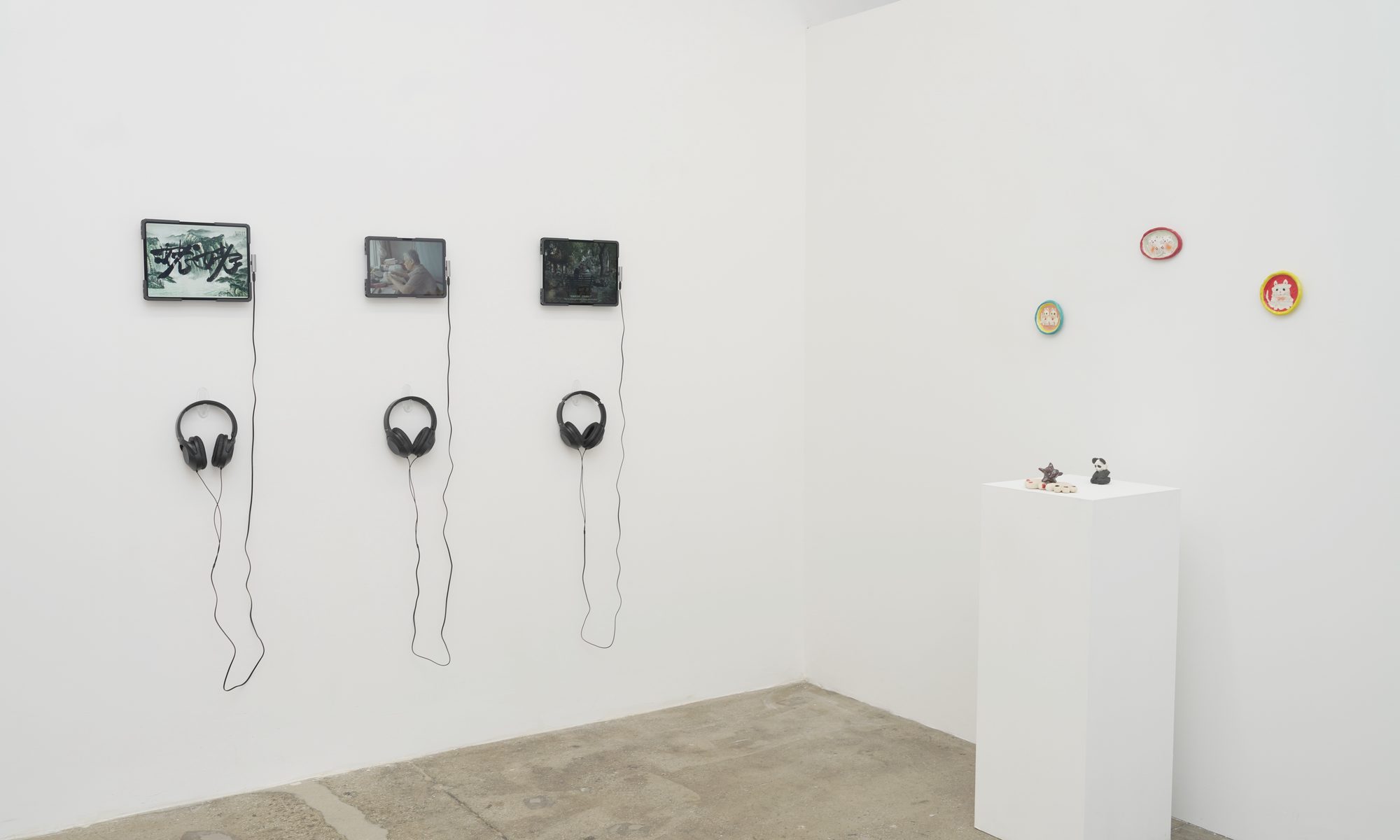
Is nostalgia really a safe space for us to process the uncertainty of the rapidly changing present? This Candy Has Teeth, curated by Shuhan Zhang, features five Chinese artists, Shengjie Jiang, Weican Wang, Jiaqi Mao, Yukun (Chloe) Ba, and Cindy (Zhaoyue) Chen, who move through childhood, memory, and nostalgia in different ways. Together, their works reflect our current desire for nostalgia, a desire that perhaps reveals just how uncertain the present feels. Yet the more we try to grasp onto the soft, safe, familiar places of the past, the more complicated those memories become. If you really delve back into them, they are also full of discomfort: moments of being forced to accept what happened, and the stiffness of a choke at the throat. As the curatorial text suggests, it is a “sensory misalignment”—an apple is sweet, yet hard to swallow.
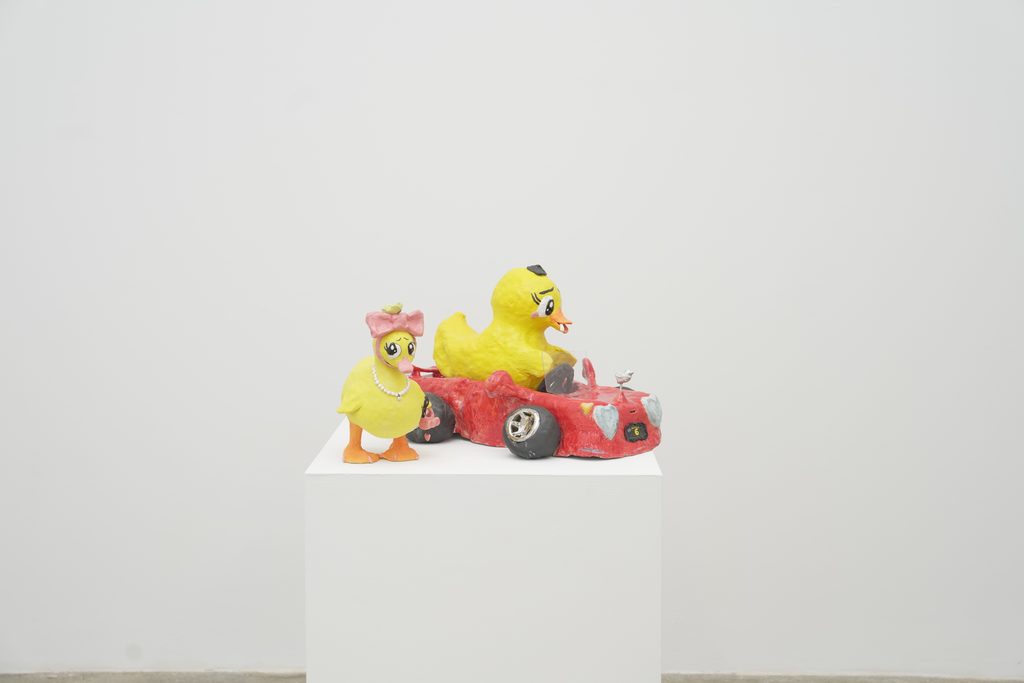
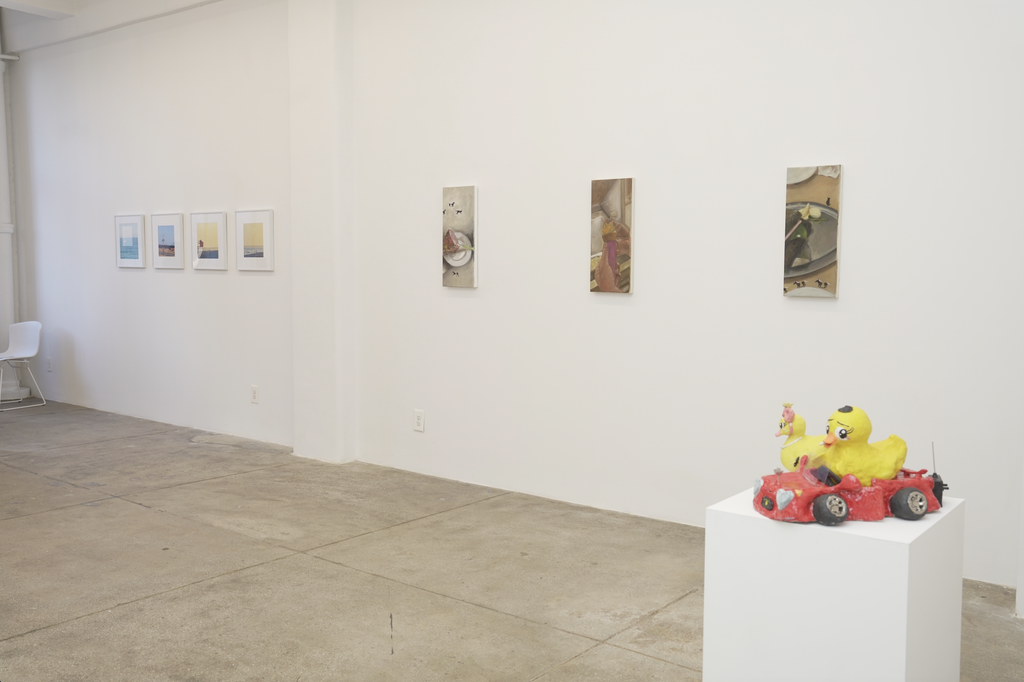
This feeling of misalignment manifests in the five featured artists in different ways. Cindy (Zhaoyue) Chen’s colorful, often comical ceramics directly respond to this duality. At first glance, Cindy references the aesthetics and characters she encountered as a kid. The highly saturated color tones and cute subject matter—ducks, cats, pandas—immediately bring your mind to a child’s room full of toys. Yet she manages to build funny and sometimes absurd stories into her “cute” characters. Ride with me Plz features two wide-eyed, wronged-looking characters: one driving a car with red heart-shaped lights and a cigarette in his mouth, while another duck, wearing a pearl necklace, holding a pink purse, and sporting a pink bow on her head, stands next to the car. The unexpected funny combination invites you to go back to childhood and remember the terrible little fights your parents might have had on the street, or perhaps an imagined couple’s fight as it might appear in a child’s mind.
Fuzzy Cats, on the other hand, reveals the artist’s Chinese cultural identity. A panda figurine is surrounded by ceramic plates inspired by Chinese red-and-white enamelware, as well as retro animal wall decorations. Using these symbolic cultural elements, Cindy Chen manages to pull us back in time, immediately reintroducing us to a familiarity we can no longer access.
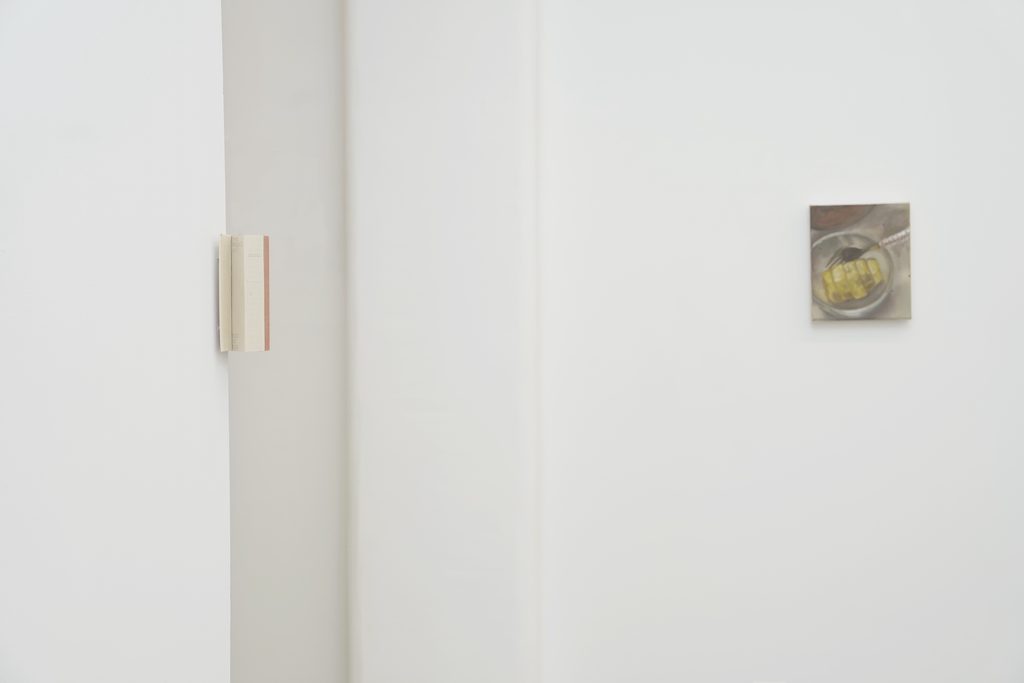
Shengjie Jiang’s nostalgic experience comes not from definitive cultural moments or memories, but from the most mundane moments of daily life. Her paintings usually feature a cropped image of a moment, whether it is freshly cut bread or a scoop into an ice cream cone. She uses small-scale canvases that invite you to lean in and really enjoy the intimate moment with her. You are experiencing a sensory journey, but at the quietest volume. Rather than basing her works on distant memories or personal milestones, she shines a light on daily moments, reminding us that nostalgia often begins with experiences we do not yet realize we will miss.
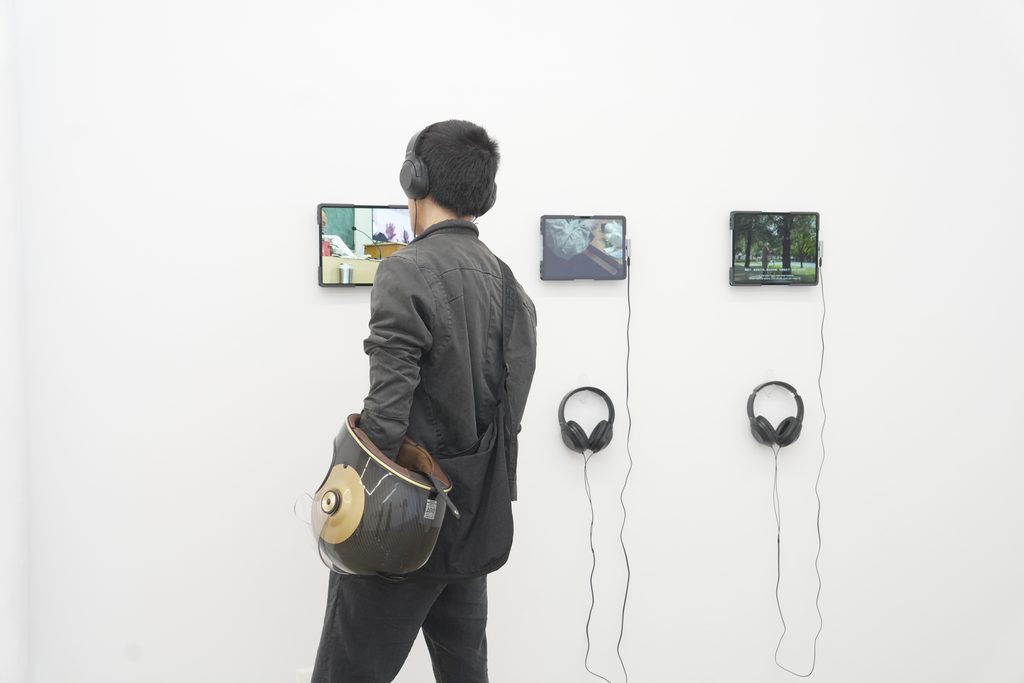
Jiaqi Mao’s Lao Lao, a three-channel experimental documentary installation, draws you in with a personal story about her Lao Lao (grandmother), who started painting in her 80s. “There must have been something that led my grandma to want to pick up her pens and paint in her 80s,” says Jiaqi. Through an intimate and careful documentation of a series of events that unfold when the artist visits home, you begin to see subtle hints of how Lao Lao’s choices were shaped by the personal and environmental nudges in her life. These choices also parallel Jiaqi’s own decisions and experiences as an artist. This sentimental piece is surely a tear-trigger, reminding you of the important people in your life whom you feel like you have known forever, but perhaps have never truly known at all.
Weican Wang’s works explore nostalgia as an aesthetic. Rather than basing her works on memorial objects or pictures, she finds moments in the present that resemble an idea of nostalgia. They feel like memories, but perhaps more like the aesthetic of a memory than an actual piece of one. The yellowish, low-resolution photographic imagery of Coney Island beach and the distant view of people along the shore create a dreamcore, almost unreal sense of familiarity. Her works invite you to remember those moments when you are trying to find your memories in a completely strange place. You know it looks familiar, but you also know you can’t go back anymore.
As if to help you safely get lost in your memories, Yukun (Chloe) Ba leaves two books installed along the sharp corners of the space, their pages opened like accordions to create soft cushions as you walk through. However, when you look closer, the colors of the pages seem to resemble pink bruises on the body, as if they document the pain of being trapped in your own memories, trying to find a way out only to bump again into the sharp edges.
Even though this show mainly focuses on memories from the past, I can’t help but feel it in my body in the present. The moments that seem to have passed, that we imagine no longer have a grasp on us, can continue to haunt us not only mentally but physically. They might not be here anymore, but they surely leave a trace of what we are becoming.
At a moment when the structures of the art world feel increasingly uncertain, there is also something quietly defiant about these artists and independent curators gathering together, renting a temporary space, putting on a show, and asking us to remember. Maybe in the future, I’ll look back and remember this remembering, and still feel the hardness of swallowing this moment in time. Sometimes, revolution happens in the quietest and softest place. Maybe the revolution is simply recognizing a past we can never reach again—not trying to hold onto its softness, but acknowledging its hard bites and continuing to show up and move forward.
About the writer: Sherly Fan is a writer and artist who received her MFA from Duke University. Drawing from her background in experimental documentary, performance art, and her ongoing exploration of “cute studies,” she approaches the art world with directness, honesty, and a sense of openness. Her writing is guided less by answers than by questions—philosophical, rhetorical, and reflective—inviting multiple ways of seeing and understanding. @sherlyfanstudio
Courtesy of CHINCHINART
Featured Image: This Candy Has Teeth, curated by Shuhan Zhang, 2026, image Courtesy of Weicang Wang