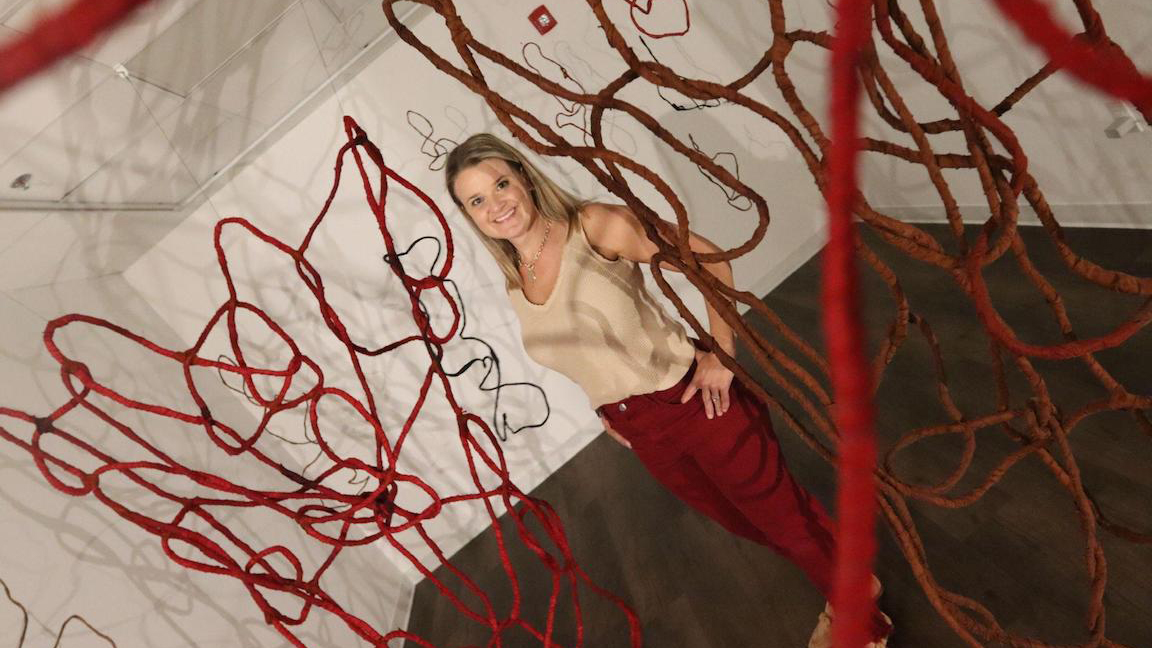
In her mid-twenties, Meghan Roghanchi began collecting art with her husband, engaging directly with artists and developing an interest in the relationship between artistic production and collecting. After raising three children to school age, she returned to a professional focus shaped by her long-standing engagement with art, education, and collecting. Drawing on these experiences, Roghanchi founded RAM Gallery, positioning it at the intersection of creative practice and collecting, with an emphasis on direct exchange between artists and audiences and an accessible, welcoming gallery environment.
Tell us about yourself and what brought you to initiate RAM.
Art has always had a presence in my life in one form or another. Growing up, art was my favorite subject in school, and at home, I would use found objects in my garage and borrow my dad’s tools to build “machines” that my younger brother and I would play with. I didn’t realize it at the time, but that was the start of my love for sculpture and experimenting with different materials. When it was time for college, I applied to the Mason Gross School of the Arts at Rutgers University, where I received a BFA in Visual Arts and enjoyed some of the most creative and collaborative experiences of my life.
I had amazing professors like John Yau and Rudy Serra, who taught me about materials, presentation, and the relationship between art and patron, which have been invaluable in my career as a gallerist.
In my mid-twenties, I married and, with my husband, started collecting art. We would head into the city on weekend mornings (the best way to beat traffic and find a parking space!) to explore. We would walk around Madison Square Park and Washington Square Park, and through the streets outside the Whitney and MoMA, to see artists painting and selling their work. We bought our first two pieces from an artist in Madison Square Park who was selling touristy paintings of the American Flag and the Statue of Liberty. It was the live painting he was working on that drew us to him, where our conversation led to him showing us his originals. He shared with us the stories behind them, the real-life encounters he had late at night in New York City. His unique style was dark, crass, and at times questionable, yet romantic. I could not wait to get them on our walls.
After having three babies and raising them to an age where they would be in school full-time, I was ready to get back to doing something meaningful to me. My lifelong love of art, my education, and my experiences with art led me to open RAM Gallery.
I love being at the intersection of the creative and collecting processes. When a buyer, especially someone just starting their collection, gets the opportunity to explore our space or have an intimate conversation with one of our artists, it makes me very happy. I love being able to tear down the pretensions and the intimidation that many people face when they walk into an art gallery.
What is your vision for the program?
RAM was conceived as a gateway to collecting art for people intimidated by the gallery experience, or who want to support the arts without traveling to NYC, and to find and introduce new and exciting artists to the public. The suburbs are thirsty for new and exciting contemporary art, and RAM is ready to provide it. We are a place designers can go for something different: a statement piece or a conversation starter. Because of our space, artists can say, “I have this new experimental series I would love to show you.” I have started to take that a step further, finding artists who are using materials in new ways and asking them to take one room in our three-room gallery and transform it through installation or an interactive, immersive piece. This allows our patrons the opportunity to become part of the art, triggering their other senses.

Tell us about the current show. Who are the featured artists, and what can we see at the exhibition?
Our current show, In The Shadow, is a group exhibition that focuses on the use of shadows at the forefront of a piece. Artists from diverse backgrounds who work with various media and techniques come together to use shadow as a medium to convey depth, define shape, and determine their space. In The Shadow showcases the work of eleven notable artists, including works by featured artists Judi Tavil, Krista Voto, and Kirti Sheoran.

At the center of the gallery’s front room are two ceramic sculptures on pedestals, next to a third, much larger, wall-mounted triptych by one of our featured artists, Judi Tavill. These three works explore how light and darkness interact across dimensional form. The hand-drawn surfaces create a dialogue between what’s tangible and what’s ephemeral. Each piece features intricate graphite networks applied over white-painted ceramic forms – a “cold finish” technique that allows Judi to build complexity through layers of drawing rather than traditional glazing.
The shadows cast by these biomorphic sculptures are not incidental; they are essential to the work’s function. As these forms twist and loop through space, the graphite creates dense areas of darkness that mirror and extend the physical shadows on the wall behind them. This creates a doubling effect where drawn and cast shadows converse and embody the entanglement Judi is chasing: the ways systems connect, overlap, and become inseparable.

Joining Judi’s ceramic sculptures in our front room are Rebecca Welz’s powerful welded steel wall sculptures, Koichi Yamamoto’s intaglios, and Nicholas Ruth’s photopolymer gravures. Koichi’s prints are created through incredibly detailed microscopic hand etching on copper plates, resulting in perfectly bisymmetrical compositions. Much like Judi’s sculptures, they draw on organic, biological forms. They pull you in closer with just the right mix of light and darkness, and a rhythmic flow in the etched marks.
The middle room of the gallery features some of our paper artists. Erik Waterkotte’s handmade paper pulp prints are inspired by his experiences at Bonaventure Cemetery in Savannah, GA. He uses the pulp itself to build layers where shadows reveal images. Kate Dodd repurposes strips from the Golden Book Children’s Encyclopedias, weaving them into 3D sculptures alongside snippets of text to create unexpected connections. Then there’s Kate Conlon with her laser-cut Yupo paper in Time Machine 002: Controls Before the Meltdown, creating fictional industrial scenes that only come alive through the shadows cast across them. Dodd’s pieces expand with the use of shadow, while Waterkotte lets shadows unveil the story.

As you make your way through the railroad-style space to our back room, the last piece that comes into view is by our second featured artist, Krista Voto, an interdisciplinary artist and professor based in Atlanta, Georgia. Her soft sculpture, The Validity of the Eggless Nest, is an interactive installation that invites viewers to participate. The suspended nests are meant to be gently nudged, activating shifting shadows that move across the space. As the forms sway, the audience’s own shadows merge with the work, allowing viewers to become part of the installation rather than passive observers.

Our third featured artist is at the beginning stage of her career, but is already making a name for herself in the functional art world. Her story of reinvention, a theme I’ve encountered in various forms since opening RAM Gallery over two years ago, lies at the heart of her practice and inspires one of her standout pieces. Kirti Sheoran stepped away from a highly successful role in a prominent finance firm to pursue her true passion for art. Midnight Bloom is inspired by the quiet resilience found in both nature and human experience. Handcrafted from black clay, the form was built slowly from the base upward using a pinching-and-layering technique, working in half-inch increments. Every fingerprint was intentionally preserved throughout the process. Shadows settle into these impressions, emphasizing the beauty of imperfection. Standing tall, Midnight Bloom represents the quiet power of persistence and serves as a reminder that even in darkness, there is room to bloom.

Complementing Krista and Kirti’s works are Meg Hitchcock’s vibrant 3D paintings, which give the exhibition color and command attention on our prized back wall. These pieces are positioned to catch your eye when you enter the gallery and slowly draw you deeper into the show. Linda Jacobs’s photographs document everyday scenes and architectural elements, revealing how shadows shape our perception and interaction with the world around us.

Continuing that appreciation for everyday beauty, Nicholas Ruth picks up on the street-sign themes from his photopolymer gravures in the front room and shifts to plaster reliefs. Working with plaster, he uses basic shapes and shadows, contemplating the juxtaposition of these man-made signs and the elements of nature that surround them. Whether casting literal shadows through darkness and light, the metamorphic shadows of life choices, current events, or socioeconomic status, In the Shadow thoughtfully explores the many layers of this theme.
How far in advance are you programming?
We are currently booking about a year out for solo shows. Some solo artists only have enough work for the front one or two rooms. Our third room is used for past artists with whom we have a great working relationship, for something they are experimenting with, or, possibly down the road, for a RAM original collaborative installation between me and Brittany Coburn, who’s a full-time sculptor, part-time gallery associate, and co-curator of In the Shadow.
Are you open to independent curatorial projects at your venue?
At this time, being the curator is my form of expression through the gallery. It’s my art form: laying out a show, installing it, lighting it, and telling the artist’s creative story. I have an amazing co-curator for some of our shows, Brittany Coburn. We work well together, bounce ideas off each other, and I have learned a lot from her. I would love to start working with independent curators someday as our little gallery continues to grow.
How do you see your venue in the context of the art scene in NJ?
RAM Gallery is attracting high-profile artists, which allows us to play in the “big leagues,” and I intend to take risks and continue on that path. We are eager to share experimental, thought-provoking work that engages and challenges art lovers, and Jersey is more than ready for it. We collaborate with artists to present their work as they envisioned. Their blood, sweat, and tears went into the creative process, so that is at the forefront of my mind when I lay out a show. With that said, this is art, and we are not saving lives. I only work with people who lead with respect and maintain a positive vibe, which many artists seek when they create art in the first place.
RAM Gallery will always be a place that greets you when you walk in the door, takes a no-pressure approach, chats for as long as you like, and welcomes you back anytime. It is a gallery where strangers become collectors and collectors become friends.
About the gallerist: Meghan Roghanchi, along with her husband Arjan, are the owners of RAM Gallery. Both grew up in Maplewood, NJ, and graduated from Columbia High School. Meghan went on to receive a BFA in Visual Arts from Mason Gross School of the Arts at Rutgers University. Forever a creative, Meghan has worked in video production and graphic design, builds furniture on the side, and occasionally takes commission work from family members and friends. She has a home studio filled with materials she has purchased for all the ideas she has and the pieces she will one day get to. In the meantime, she is raising three kids and exposing them to incredible art and art venues, where they meet inspirational artists. She is dedicated to creating a unique, welcoming gallery environment that focuses more on the art they present and how it is experienced rather than only on the bottom line. IG @artgalleryram
About the writer: Etty Yaniv is a Brooklyn-based artist, writer, curator, and founder of Art Spiel. She works in installation, painting, and mixed media, and has shown her art in exhibitions across the United States and abroad. Since 2018 she has published interviews and reviews through Art Spiel, often focusing on underrecognized voices and smaller venues. More about her art can be found at ettyyanivstudio.com and on Instagram @etty.yaniv
In the Shadow will be on display at RAM through February 22nd, 2026.
Featured artists: Nicholas Ruth @nicholashruth
Kate Conlon @kate_conlon_studio Erik Waterkotte @erikwaterkotte
Koichi Yamamoto @koichi_yamamoto Judi Tavill @juditavillart
Meg Hitchcock @meghitchcockartist Rebecca Welz @rebeccawelzsculpture
Krista Voto @kristavotoart Kate Dodd @katedoddstudio
Linda Jacobs @ljacobs100 Kirti Sheoran @kirtisheoranstudio