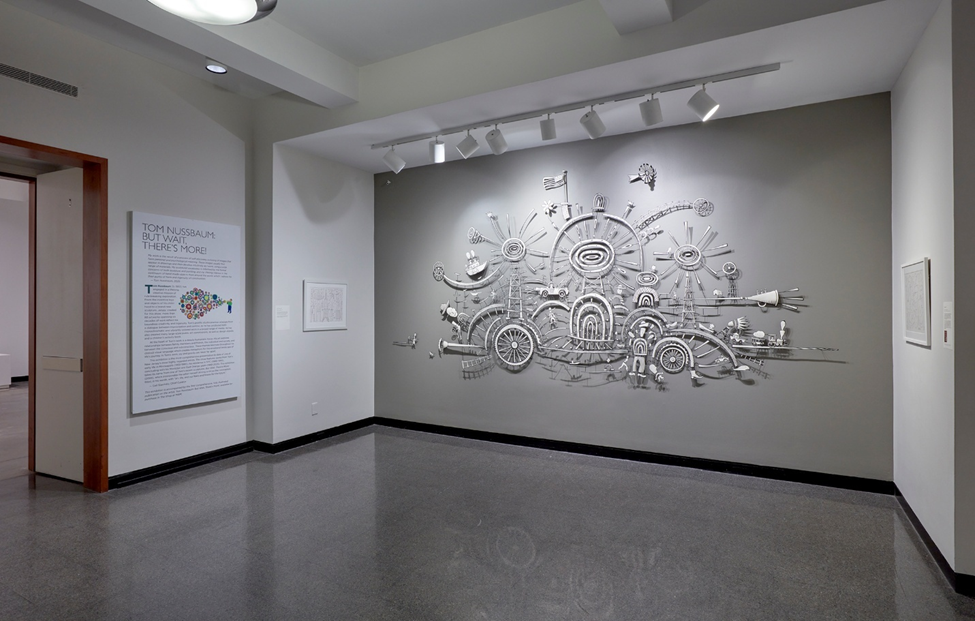
During her more than thirty years at the Montclair Art Museum, Dr. Gail Stavitsky, Chief Curator, has shaped the institution’s vision through exhibitions that deepen public understanding of art history while highlighting under-recognized artists. Her work extends beyond the galleries to publications that introduce new scholarly perspectives — including the recent catalogue accompanying Tom Nussbaum: But Wait, There’s More! In this interview, Dr. Stavitsky discusses her curatorial approach and the ideas guiding the Museum’s current exhibitions by Tom Nussbaum and Christine Romanell.
Tom Nussbaum: But Wait, There’s More! Includes over 80 works. Tell us about the genesis of this show. What guided your curatorial choices in selecting the works that best represent his evolution, and were there any phases you felt were especially important to foreground?
Tom Nussbaum is an underappreciated artist and former resident of my hometown, Montclair, whom I have known for more than 30 years. The genesis of this show goes back to 2022, when I saw a small retrospective of his work at the Metaphor Projects Gallery in Brooklyn. Tom and I worked together collaboratively to represent six decades of his prolific creativity. We both felt that it was important to foreground his current body of work from 2010 onwards. In fact, the show is named after his 2024 sculpture But Wait, There’s More!
Nussbaum’s work is known for its interplay of material, humor, and shifting spatial logic. What through-lines or conceptual anchors do you see connecting these varied bodies of work across time? Can we focus on two works you see as central to this show?
Tom Nussbaum’s humanist approach to making art is shaped by a complex blend of personal history, cultural references, universal symbols, and a distinctive visual language. His metaphorically rich work conveys the wide range of his interests through varied formal and thematic devices that unify his vast range of private and public artwork.
In his youth, Tom was encouraged in his creative pursuits by his father, mother, and siblings. Images from childhood, including an atomic model in his father Allen Nussbaum’s textbook and his mother’s gingerbread houses, have become ingrained in his memories and work. Tom also draws inspiration from a range of American and international architectural and industrial forms, such as houses, skyscrapers, and electrical transmission towers, as well as cars, trains, and boats. These vehicles, as well as wheels, hubs, and spokes, act as metaphors for life’s journeys. His early experience as a carpenter influenced his use of linear forms. The Human Figure and the Natural World: Tom’s juxtapositions of animal and human forms explore the connections between humanity and nature and serve as a metaphor for human relationships.
Naturally antagonistic pairings allude to the dual nature of humanity. Expressing a deep appreciation of nature, these artworks also reflect an inner journey of self-discovery. Visual language and Influences Tom’s vibrant artwork reflects a lifelong appreciation of Americana and Folk Art from around the world, which he has collected for many years. Tom’s admiration for such artists as Alexander Calder, Saul Steinberg, and H.C. Westermann has also inspired his distinctive and impactful use of color, form, and line, which enlivens and unifies his work.
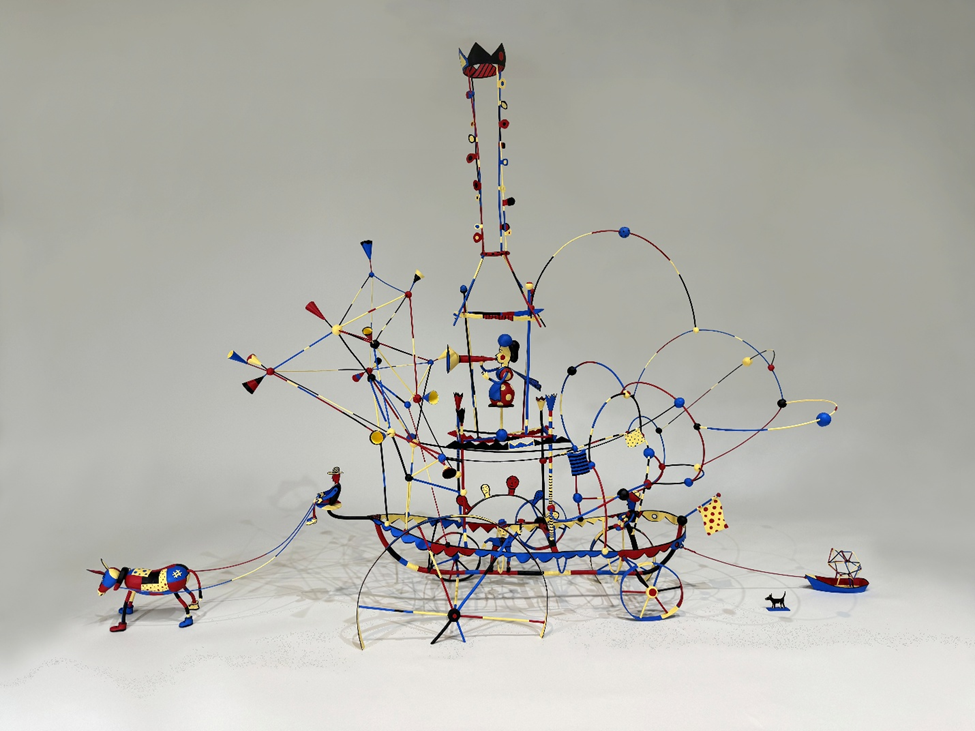
The title of the work But Wait, There’s More!, is in Tom’s words, “a reference to a carnival-barker’s pitch or a late-night television advertisement. The artist is precariously driving a wagon “filled with life, art, hopes, fears, and desires.” The donkey’s patchwork quilt body indicates that “we are in the world of the circus, and the comics, which is not real, just in case you were wondering.” The wagon wheels are of different sizes, and two appear to be sinking into the ground. Tom’s current partner, the artist Kate Dodd, is represented within a tower, blowing a trumpet like the Archangel Gabriel. Below her hangs the artist’s laundry “for all to see.” Tom’s grandson, Henry, rides in the back, followed by Tom’s beloved dog, Sparky, and a lifeboat holding Tom’s sculpture, Chair—a metaphor for art as a lifesaving practice.
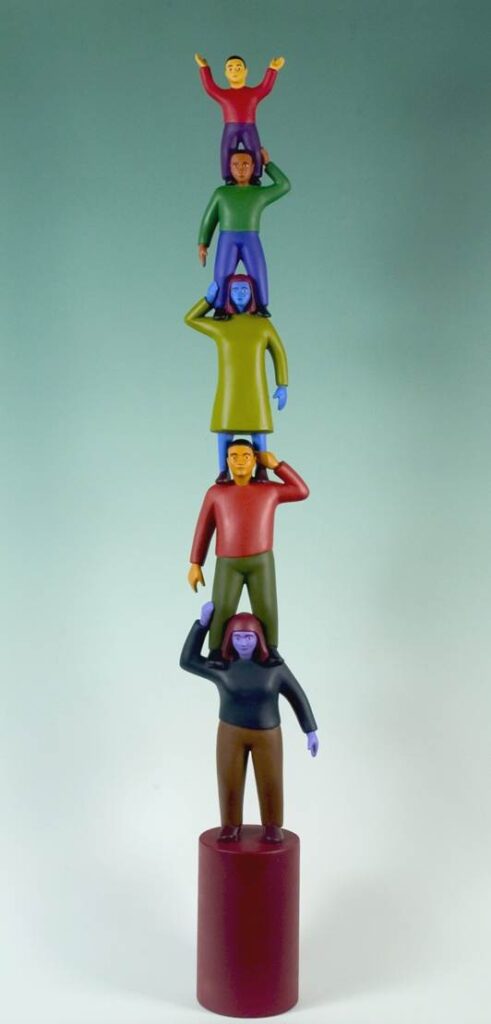
Family Totem #4, was originally conceived to represent the diversity of the Montclair community standing together in support of each other. A female figure carries the family on her shoulders. Tom deliberately mixes up the skin colors and maintains neutral expressions on the faces to emphasize the universality of the figures. “These are not meant to be specific individuals but are intended to represent the human race at large.”
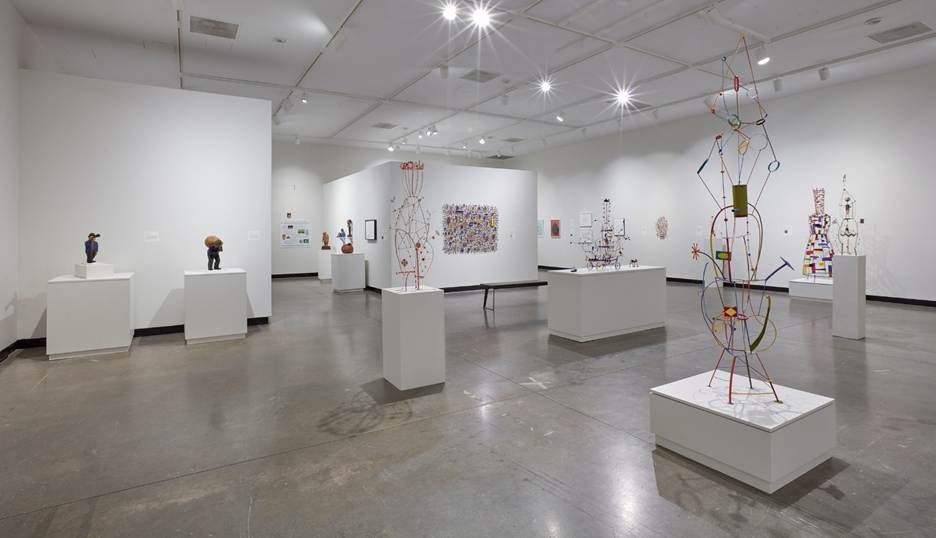
How did you think about the viewer’s experience as they moved through this retrospective? Can you share any curatorial decisions, such as layout and sequencing, that shape how audiences encounter the breadth of Nussbaum’s career?
The exhibition is presented chronologically, so I thought about the viewer exploring Tom’s work from ca. 1963, when he was ten years old, to the present. There were many curatorial decisions about how best to group the work and present its variety, while establishing thematic and visual links.
The other show you curated, Christine Romanell’s Sacred Transition, engages geometry, light, and dimensional play. How does Sacred Transition expand the museum’s dialogue around contemporary abstraction, and what connections did you see between her work and Nussbaum’s?
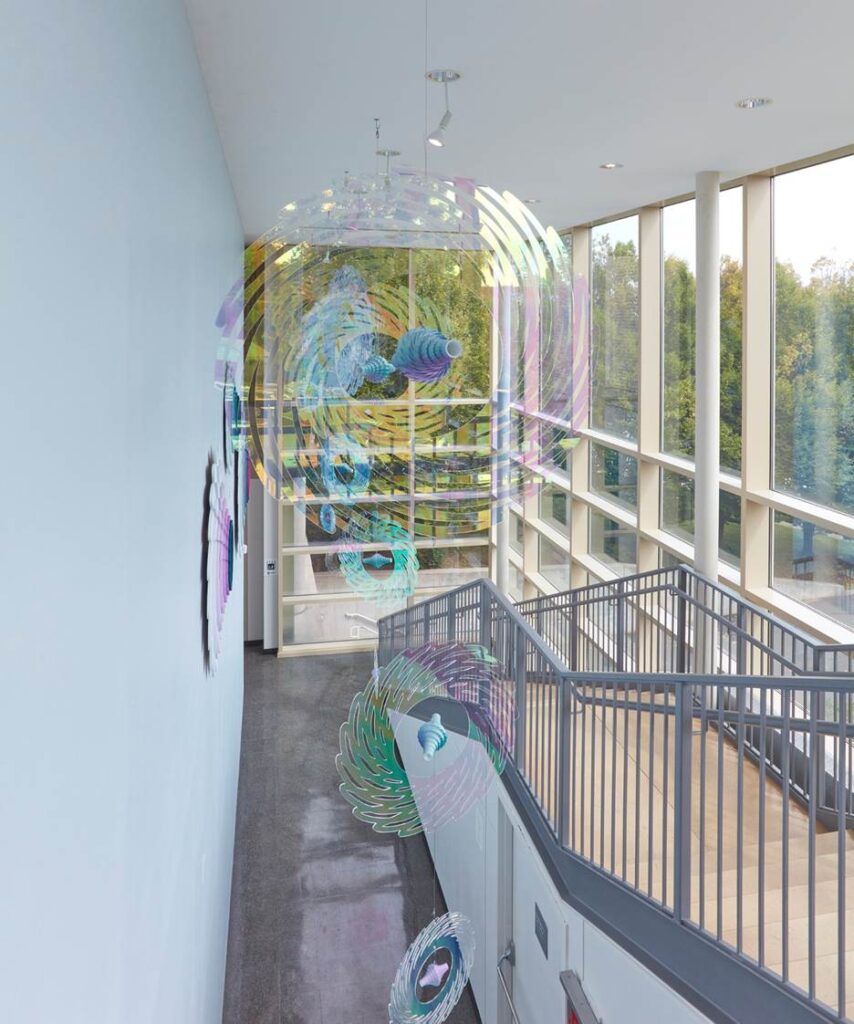
Christine Romanell is a longtime friend of Tom’s and considers him her mentor. They are both very active with the circle of artists who have studios at Manufacturer’s Village in East Orange. Sacred Transition expands the dialogue around contemporary abstraction through transforming the transitional space of Laurie Art Stairway into a vibrant, dynamic passage animated by principles of sacred geometry, or the belief that certain shapes and patterns found in nature hold symbolic and spiritual significance.
Merging art and science, Romanell aims to create an experiential journey bridging the physical and spiritual realms. Abstract, geometric 3D printed forms hang from the ceiling, creating a dynamic interplay of light and shadow. Reflections from laser-cut, plexiglass halos cast a spectrum of colors on the surrounding walls. Three wall works further enrich this environment with their spiraling forms, suggesting a continuous, mesmerizing rotation. Their soft, ethereal auras at the centers allude to light portals beckoning beyond to another reality.
Romanell’s work is rooted in applied design, akin to Islamic patterning, and employs self-similarity principles, where forms repeat at different scales, as seen in fractals. These patterns mimic the infinite variations found in nature and the cosmos to channel deeper meanings of transformation and transcendence. As sunlight interacts with the dichroic plexiglass and the 3D forms, a continuously changing environment of colors and patterns evokes a sense of infinite complexity and cosmic order.
Join us Dec 19 for the Art Spiel 2025 Brooklyn fundraiser featuring 200+ artists’ works RSVP here
About the curator: Dr. Gail Stavitsky has has curated at the Montclair Art Museum over 200 exhibitions, including Cézanne and American Modernism, Will Barnet: A Timeless World, Matisse and American Art, and many others. Dr. Stavitsky has served as Curator of Collections and Exhibitions from 1994-1998 and as Chief Curator since 1998.
About the writer: Etty Yaniv is a Brooklyn-based artist, writer, curator, and founder of Art Spiel. She works in installation, painting, and mixed media, and has shown her art in exhibitions across the United States and abroad. Since 2018 she has published interviews and reviews through Art Spiel, often focusing on underrecognized voices and smaller venues. More about her art can be found at ettyyanivstudio.com and on Instagram @etty.yaniv
Related Articles:
https://artspiel.org/singing-in-unison-part-12-painting-in-space/
https://artspiel.org/fran-shalom-everyday-improvisations-at-kathryn-markel
https://artspiel.org/flora-yukhnovich-four-seasons-at-the-frick-collection-cabinet-gallery
https://artspiel.org/samuelle-green-a-human-vocabulary-with-steel/
https://artspiel.org/frances-smokowski-at-cavin-morris-gallery