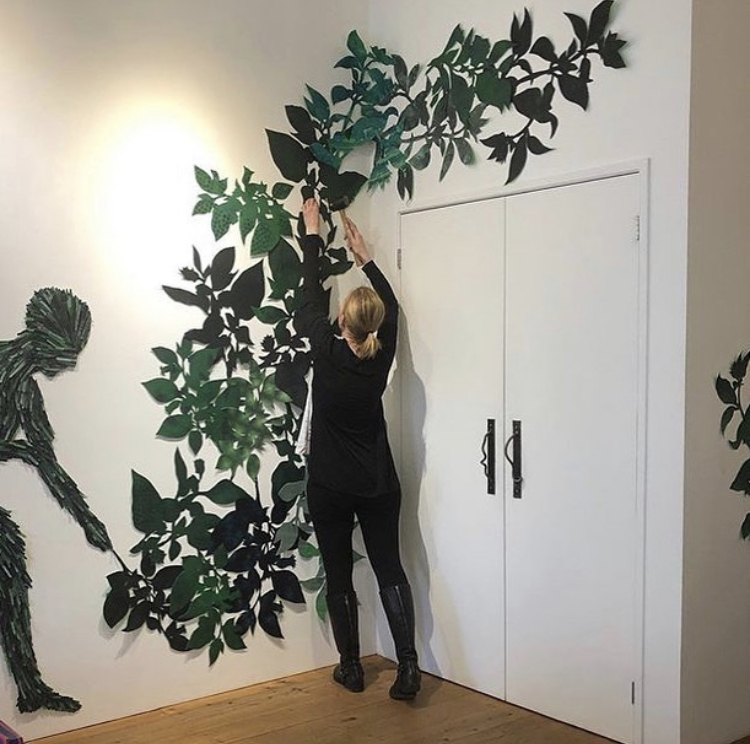
In Steven Pestana’s imaginative mixed media installation at Peep Space, light, shadow, projection and reflection integrate through poetic transitions and passages. The show runs from May 20th through June 19th, 2022.
Hovey Brock at work on Crazy River, 2019, acrylic on panel, 30” x 40,” a work from his Crazy River series.
Hovey Brock’s current paintings are part of Crazy River, a larger project he has been developing since 2017. The paintings are based on his life-long relationship to the West Branch of the Neversink, which runs between Ulster and Sullivan counties in New York state. The project also includes text and videos, drawing on the artist’s experience and stories about the West Branch and the western Catskill mountains handed down through his family.
To kick off the Dumbo Open Studios Weekend in late April, Platform Project Space opened MOD, a five person show commanding strong appeal, curated by Sharon Butler. As the title and press release indicate, modularity, modernism and mods, or modifications in contemporary gaming, are all potentially at play both in the individual works and together as an installation. Each artist’s contribution holds a single wall or area in a small room that’s comfortable, easy, and open. The formal language of color and shape is nuanced to suggest personal and organic qualities and intimate spaces. No mystery here. Instead, curiosity openly hovers in close examinations of the human touch, in the detail and care given to small moments.
Installation view of The Agreement: Chromatic Presences, curated by William Corwin at Zürcher Gallery. Photo: Adam Reich. Courtesy of Zürcher Gallery NY/Paris.
I’ll start with a question: does a critic have an obligation to propose a solution to an enigmatic puzzle an exhibition might pose? What has led to this, is reading William Corwin’s catalog essay for The Agreement: Chromatic Presences, in which he ignores recounting the history of sculpture and color—deemed for a very long time to be irreconcilable like fish and cheese. It is now common knowledge, sculpture till the time of the renaissance was largely polychromed, but a neo-classical notion of purity and essentialism came to be imposed upon it to differentiate it qualitatively from painting. As a result, sculpture came to be limited to the colors of its materials—marble, bronze and wood. In the West, this formalism was institutionalized by the Enlightenment’s and was the excepted norm until the mid-20th century, when art’s traditional forms began to morph. Consequently, we must ask if there is a more contemporary issue concerning color and form at the heart of Corwin’s The Agreement: Chromatic Presences, and if so, what might it be?
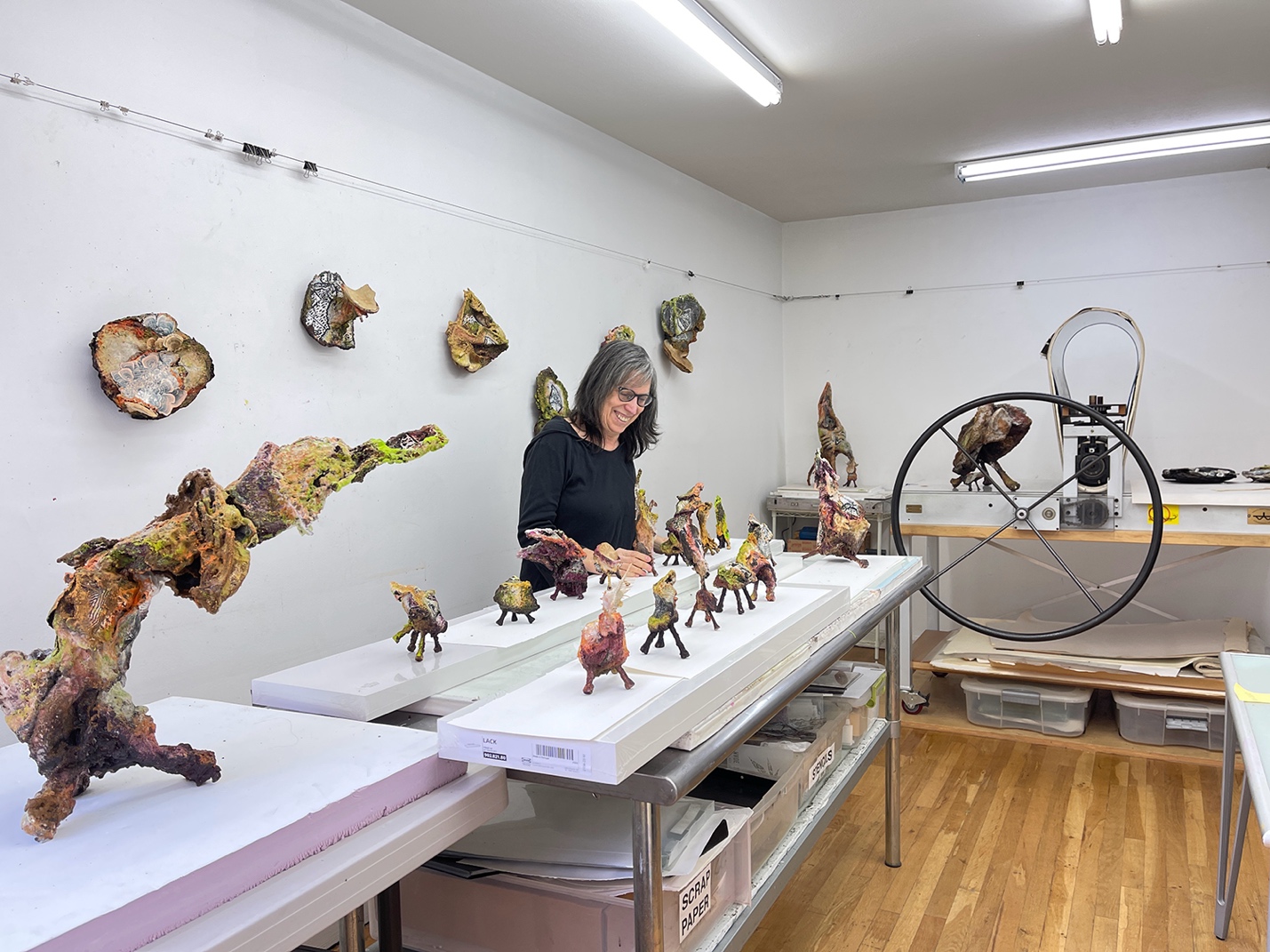
Susan Rostow in her studio, Brooklyn, New York, photo courtesy of Carole d’Inverno
Susan Rostow’s sculptures resemble archeological artifacts with biomorphic characteristics, inviting us to probe into their origin, meaning and what they are made of. Textures of abrasive material such as clay and moss-like surface, along with graphic symbols such as linear markings of shore tides and other signifiers from old maps, fuse into hybrid forms where the lines between past and future, what is natural and what is fabricated, are seamlessly blurred.
Far from the palatial white cubes of Chelsea or the intimate townhouse spaces of the Upper East Side is a different type of gallery space – one that serves as a reminder of an earlier moment in the art world, and yet persists into the present – the SoHo loft. In his debut solo exhibition, Sam Spillman has created work that probes at this history in In Case Of Sam Spillman at Ulterior Gallery.
Installing “Belladonna” piece at Village West Gallery in Jersey City, March 2020. Photo courtesy of Michael Endy
Artist Anonda Bell reflects in her mixed media installations on a range of complex notions—from exploring different ways women have been perceived throughout history to environmental concerns. The entry point to her projects include homages to historical figures like the American feminist Charlotte Perkins Gilman who protested in her book Yellow Wallpaper the oppression of women at the end of the 19th century, and the Australian Lindy Chamberlain who was falsely charged with murdering her baby; references to cultural trends in psychology related to women’s anxiety and Hysteria; or environmental concerns referencing Biophobia and extinction.
Tip of the Iceberg by Amanda Maciuba, Jen Morris, Jessica Tam, dimensions variable, vinyl on glass and wall, 2021
This month, I have a wonderful interview with three artists for you. Amanda Maciuba, Jen Morris, and Jessica Tam are all visual artists working in different mediums. However, they share a fascination with how ecological language (surge, spike, wave, etc.) has worked its way into news reports’ descriptions of large phenomena such as crowds, pandemics, and political movements. They recently closed a show at the A.P.E., Ltd. Gallery in Northampton, Massachusetts titled WAVE/SURGE/SPIKE.
Daniel Wiener, Six Custodians, 2021, Apoxie-Sculpt and dispersed pigments, 12.5” x 29” x 29”, photo courtesy of Daniel Wiener
The exhibition, At Home with Scallywags and Raspcallions, brings together Daniel Wiener’s work from the past 12 years. It focuses on his sculptures which also have a practical domestic use. As he says—the tables, stool, benches and bowl are familiar objects but in my hands, as with all of my work, they still uncover subconscious inner demons.
Portrait of Chellis Baird in her studio. Photo courtesy of the artist
Chellis Baird’s work bridges the fine line between painting, sculpture and textile work, which is no easy feat. Baird’s sculptures require that extra layer of attention in order to really take in all the details: bright colors interwoven with gold accents, as well as the hint of foreign materials bulging from underneath. Her current exhibition, The Touch of Red, explores the significance of the color red in Baird’s practice. The color red is Baird’s favorite color, and holds much significance to her. The color conjures a wide range of symbols, feelings and history, including the contrasting emotions of love and pain, as well as symbols such as good luck, war and seduction. For this exhibition, Baird developed a shade of red with local suppliers in New York and Georgia and also developed her first metal and rosin works titled Serpentine and Flirt with the assistance of a foundry in Long Island City. The exhibition is up through April 8th at the National Arts Club.