At a certain point in one’s life, they stop making new marks or registering new memories. All that remains is a fluid, ever-changing assemblage of the fragments from the past. I would call it no stagnation: it is rather a moderate manner of growing at a different pace.
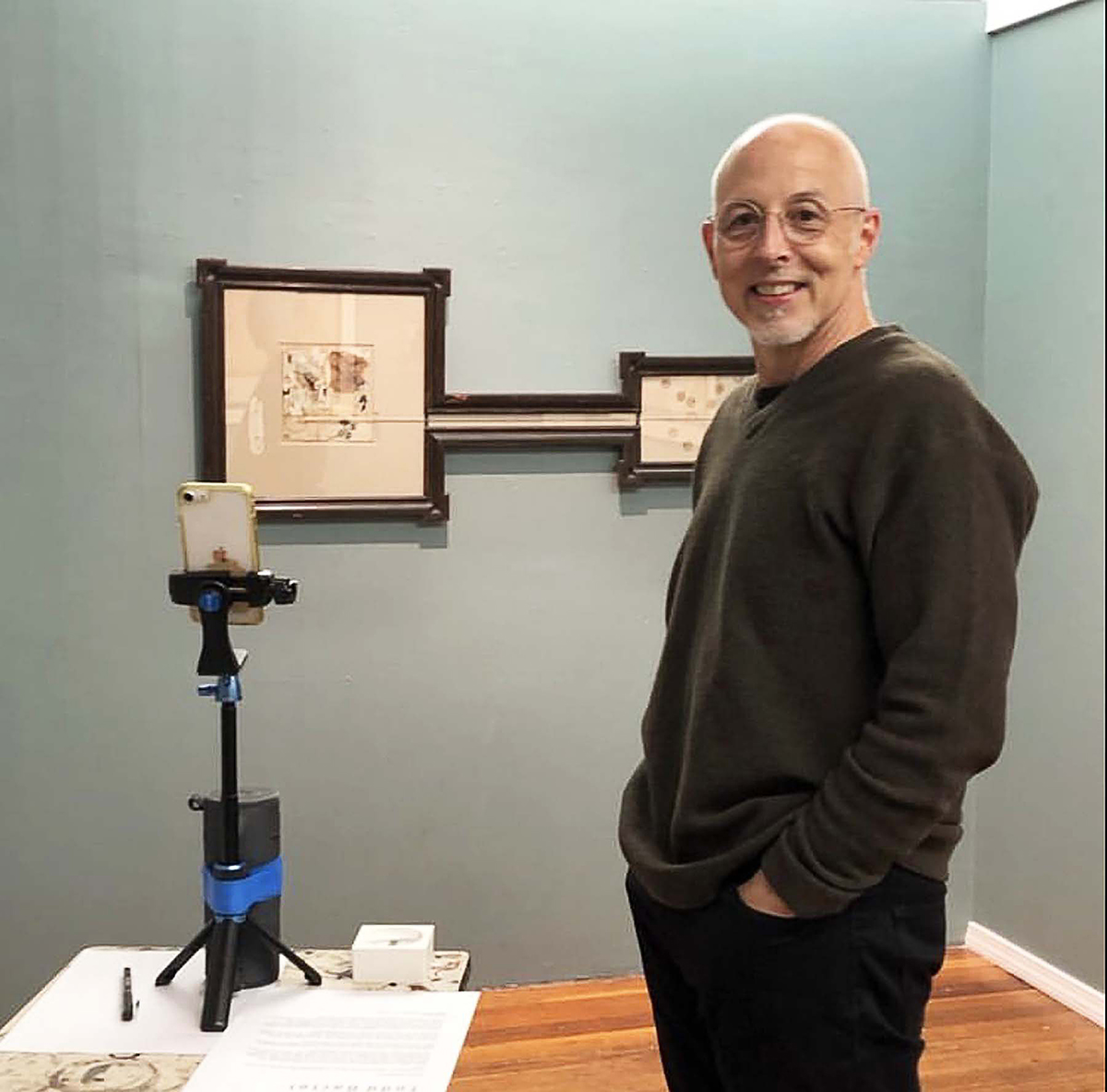
Todd Bartel in front of Pollination of Devonia, (Synterial series), 2002, gallery talk, L(and) exhibition, Room 83, Watertown, MA, photo courtesy of Ellen Wineberg
Todd Bartel came to serious collage because of an assignment he received on the first day of his first class as a freshman at RISD. He recalls the desks were strewn with magazines, and as soon as the course started, Professor Hardu Keck gave the students a prompt, “Create five collages that work with the following sentence: Surrealism is the chance happening of finding an umbrella and a sewing machine on a dissecting table.” Keck did not mention he was quoting Andre Breton, who was quoting Comte de Lautréamont (Isidore Lucien Ducasse). He expected his students to work with the strangeness of visual combination and found imagery. That was Todd Bartel’s introduction to Surrealism and chance coupling. He fell in love with collage immediately, coming up with forty-five collages by the first week. One of the key elements that draws him to collage is that it can involve a vast array of analog and digital technologies. “I consider myself an Omni-coupler,” he says.
As an abstract artist, Jeanette Fintz has long been interested in the contrast of hard-edged planar geometry (circles, squares, hexagons) existing within an atmospheric field where shapes can float or hold the plane, in a space that appears expansive, transient and increasingly released from the canvas’s edge.Of her newest body of work currently on view through August 1st at Carrie Haddad Gallery in Hudson, NY, she explains “these paintings are about giving structure to something intangible, ephemeral, in-flux or conversely, revealing the dissolving of structure that has been.” The following is the artist in conversation with writer and art critic, Carter Ratcliff, to discuss her influences and process.
Thomas Motley in conversation with Elisa Lendvay and Sara Cardona
Installation view, Meridian, Haggerty Gallery, photo courtesy John Watson
The unique design and location of the Beatrice M. Haggerty Gallery at The University of Dallas proved a most fitting space for the exuberant content of Sara Cardona and Elisa Lendvay’s exhibit, titled Meridian. Picture a giant treehouse, spanning the edge of a steep ravine, extended over a leafy canopy of thick post oak trees. From the gallery’s atrium entry, visitors enjoy a dramatic bird’s-eye view of a sylvan campus below. Under gallery director John Watson’s sculptor’s eye, Cardona’s and Lendvay’s lively celebration of nature, a Gaia shout-out, projected joyous meridian energy-lines from gallery to surrounding woods. Meridian expressed the artists’ shared interests in earth’s natural shapes and cycles, regeneration of discarded or out-of-fashion cultural designs and hardware, and celebration of movement, of dance.
In her drawings, murals and paintings, Japanese born, and Brooklyn based artist Naomi Kawanishi Reis, utilizes paper and fabric to make idealized spaces, ranging from utopian architecture of modernism, gardens, and more recently, still life in domestic spaces. In this recent body of work, Reis starts with photographs taken by her mother of her ikebana arrangements displayed outside the family home in Kyoto. Reis downloads the images from the family online chat, the link that has connected her diasporic family across oceans.
Test Kitchen, Carolyn Case’s show at Reynolds Gallery in Richmond, Virginia, consisted of 4 oil paintings on panel along with 8 pastel drawings. Hefty brush strokes fill the surface area of the oil paintings. The painterly process involves a buildup of incremental adjustments, the layers of paint applied one by one until the shapes solidify into a kaleidoscopic arrangement; one nudge and the elements will shift accordingly, morphing the image into an entirely new pattern. Each of the paintings gives the impression of a specific time of day, indicated by the character of light and color playing across the space. Monet’s Water Lilies come to mind. But in place of Monet’s serene refuge, Case’s light lingers over a sink full of dirty dishes.
Stronger than Dirt: Melissa Stern at the Lockwood Gallery, installation shot
Walking into The Lockwood Gallery in Kingston NY one is instantly transported into another Universe. One populated by people and things who clearly are living in a world parallel to ours, but profoundly different. Smiling figures stand tall, grinning at the world, while all the time missing a limb or two. Or having their feet nailed to the ground. Images from vintage magazines merge seamlessly with Melissa Stern’s drawings. Her world is populated with folks who exhibit a stubborn resilience in the face of cosmic obstacles. Hence the exhibition’s title – Stronger Than Dirt.
Keisha Prioleau Martin, Head Over Handlebars, 2020, acrylic on paper, 10 x 13.5 inches, photo courtesy of the artist
In March 2020 the New York art world shut down and soon went online for exhibition opportunities. Like many artists, Mike Childs was furloughed from his job, and stayed at home, drawing as well as supporting his 6th grade son. To foster a sense of community, he reached out to fellow artist and curator Melissa Staiger to see if she was interested in combining their skills. They came up with the idea to create an online group of artists who worked on paper. The collective identity of this group was envisioned as eight individuals who reflect the creative New York community and exhibit a compulsive nature towards the making of images. Childs referred to these image makers as “producing work via a stream of consciousness in the modernist literary tradition”. In referencing this type of creative approach, Staiger immediately seized on the word to title their project Streaming, referring both to a creative thought process and the online reality of contemporary artistic existence. This led to the creation of the website https://s-t-r-e-a-m-i-n-g.com, which was the foundation for the current exhibition at Stand 4 Gallery.
The group exhibition at Stand4 Gallery, brings together work by Mike Childs, Deanna Lee,Keisha Prioleau-Martin, Rafael Melendez, Benjamin Pritchard, Sharmistha Ray, Melissa Staiger, and Julie Torres. The show runs through July 10th.
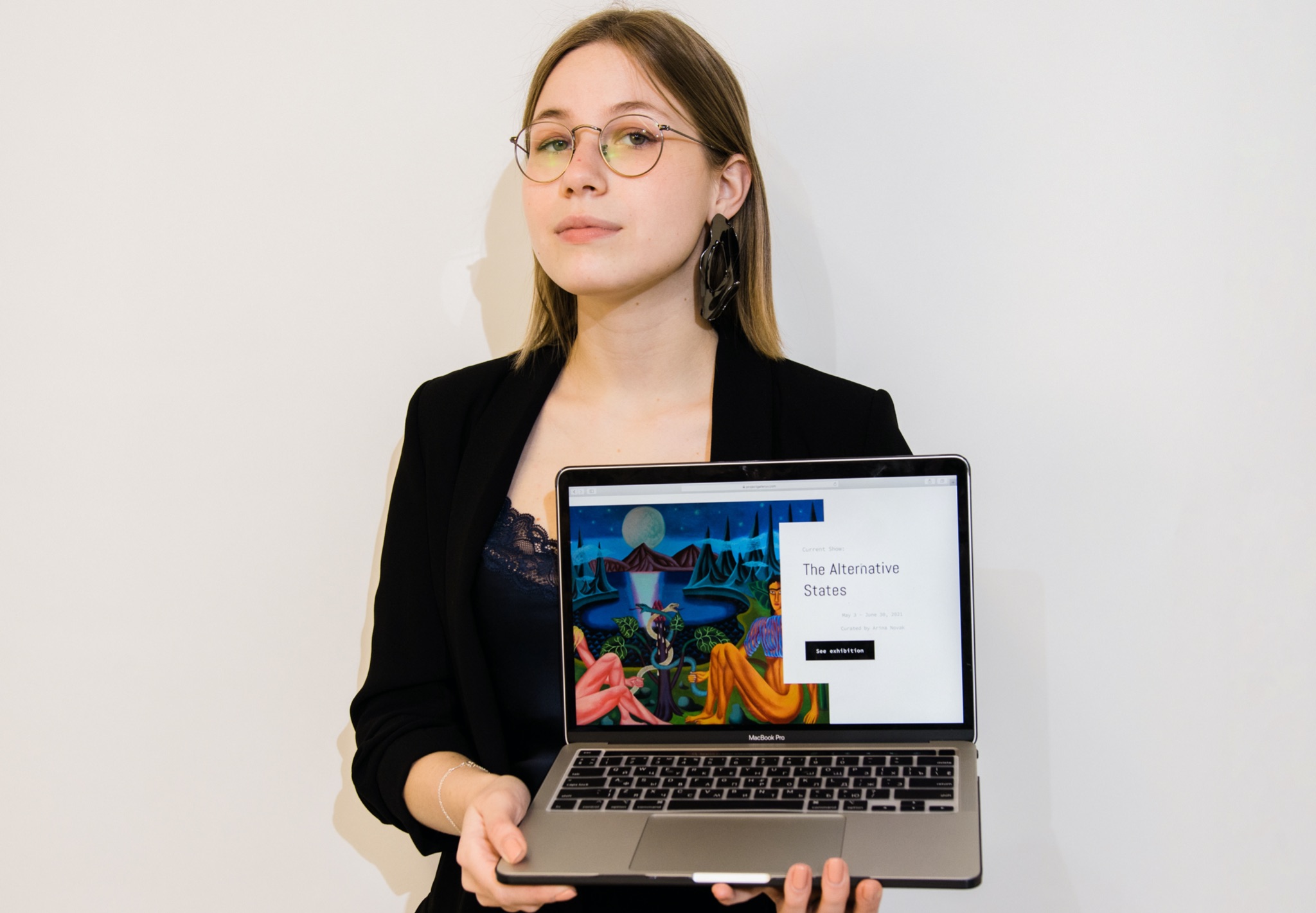
Arina Novak is holding a laptop with the main page of The Alternative States displayed on the screen. Photo courtesy: Robert Oliver
The Alternative States is a virtual exhibition at Project Gallery V on view from May 3 through June 30, 2021. Inspired by a condition of daydreaming, the show explores the alternative states of mind where one finds solace in creative freedom and ethereal fantasies.
Clive Knights in his studio, Portland, Oregon, 2021, photo courtesy of the artist
Clive Knights practices architecture and art, in particular mixed media and monotype printmaking. He holds professional architectural design undergraduate and graduate degrees from Portsmouth Polytechnic, UK, and a Master of Philosophy in Architectural History and Theory from Cambridge University. Clive has taught architecture since 1984 and was a full-time lecturer at Sheffield University for six years before moving to Portland State University in 1995 where he currently resides as a professor and director of the PSU School of Architecture. His primary areas of interest include the cultural meanings of architectural representation understood through the phenomenology of the human body, with particular reference to the writings of Maurice Merleau-Ponty; the revelatory capacity of metaphor in poetic work; and speculations in architectural design studio pedagogy. Publications include many journal articles and book chapters on the theory, history and pedagogy of architecture.