In Dialogue
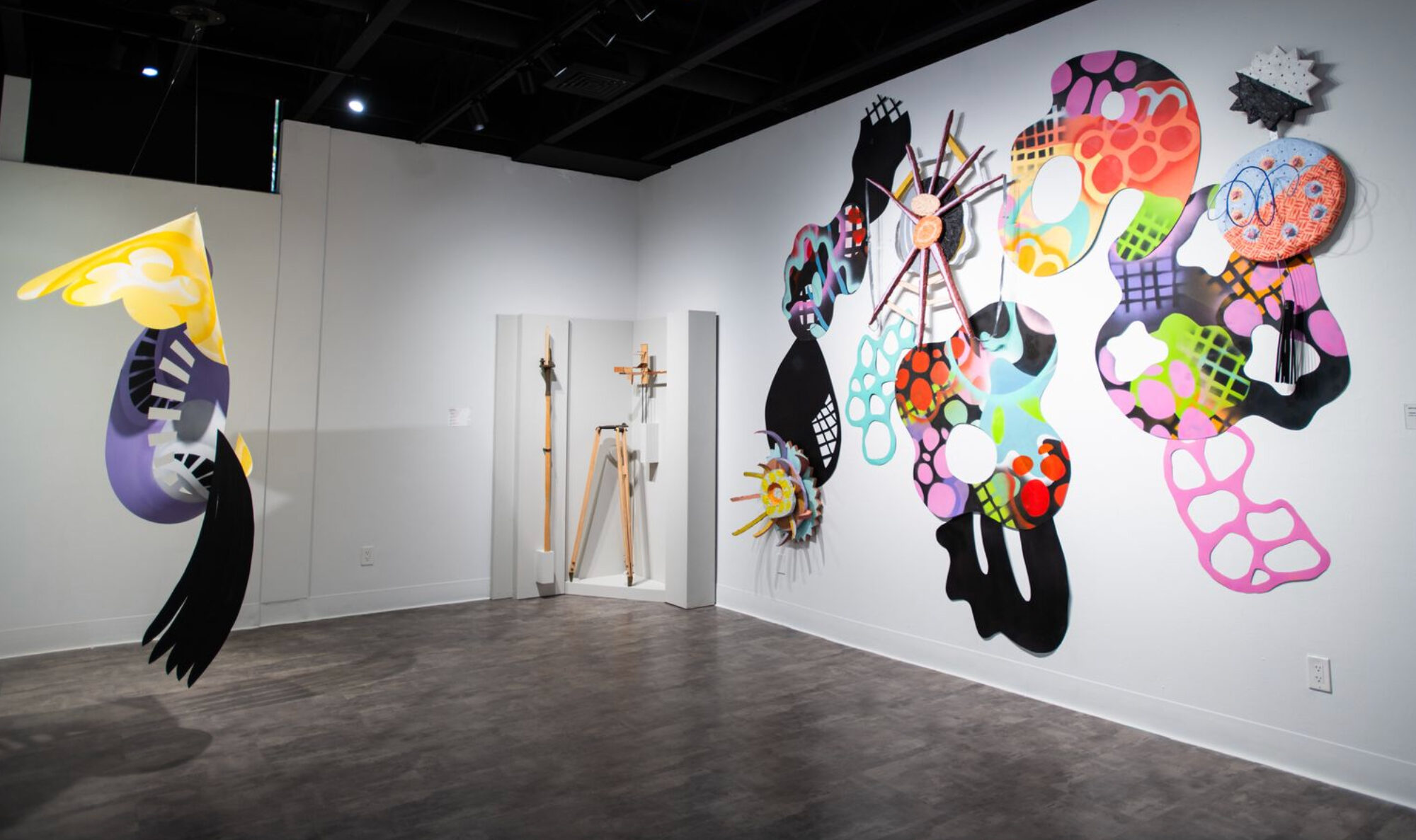
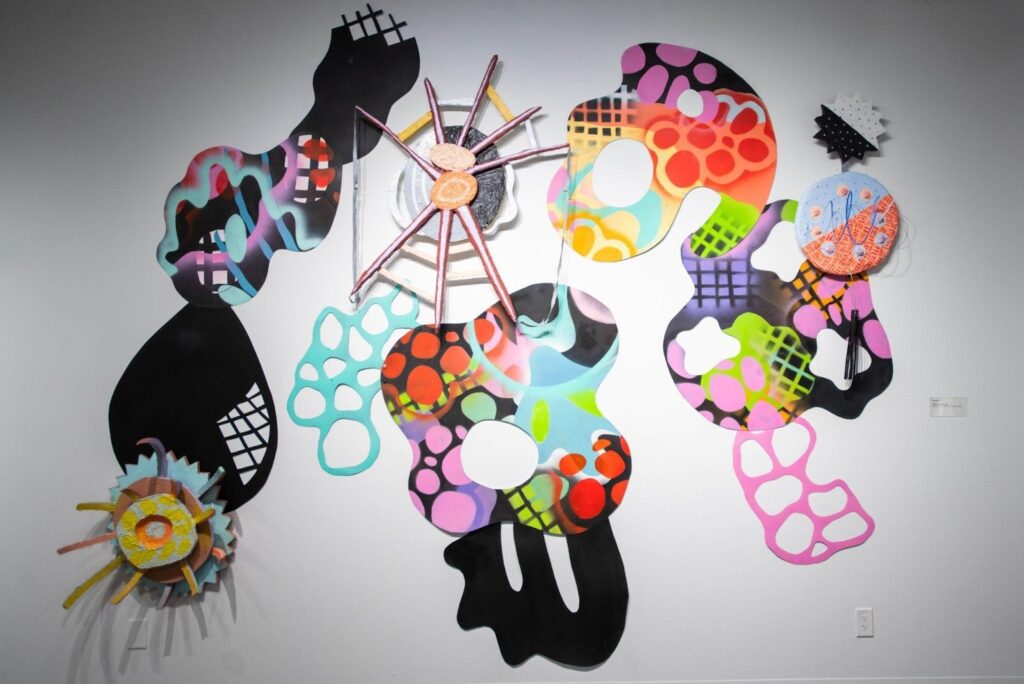
Adria Arch and Keith Wiley had never met before working on Still / Moving, their exhibition at the San Luis Obispo Museum of Art. Living on opposite coasts—Arch in Boston and Wiley in Atascadero—they developed the project from afar, connecting through shared images, ideas, and a common interest in movement and form. In the exhibition, Arch’s bright paintings and hanging shapes reach outward with color and rhythm. Her flowing, curving forms feel energetic and playful, as if they are moving through the air. Wiley’s portal-like sculptures draw viewers closer. Built from small marks and quiet details, they invite pause and careful looking, with openings that pull you inward. Emma Saperstein, the exhibition curator, discusses her curatorial vision and reflects on the museum as a venue for this project.
What drew you to pair Adria Arch and Keith Wiley for Still / Moving when they had never met and worked on opposite coasts? How did you envision their work would be in conversation before seeing them installed together?
Adria and I met several years ago while she was visiting family on the Central Coast. I was drawn to the organic shapes, color, and dynamism in her practice and felt it would be a welcome work for our audiences. Keith’s practice was introduced to me by a colleague at the University, and they both had exhibitions scheduled at SLOMA, in the former McMeen Gallery, which was transformed into a lobby in 2024. This change in how our spaces were used impacted the exhibition’s schedule, and while I was adjusting it, a lightbulb went off that their work would make an interesting dynamic together. I was excited to suggest the idea to them and thrilled that they were both amenable to it.
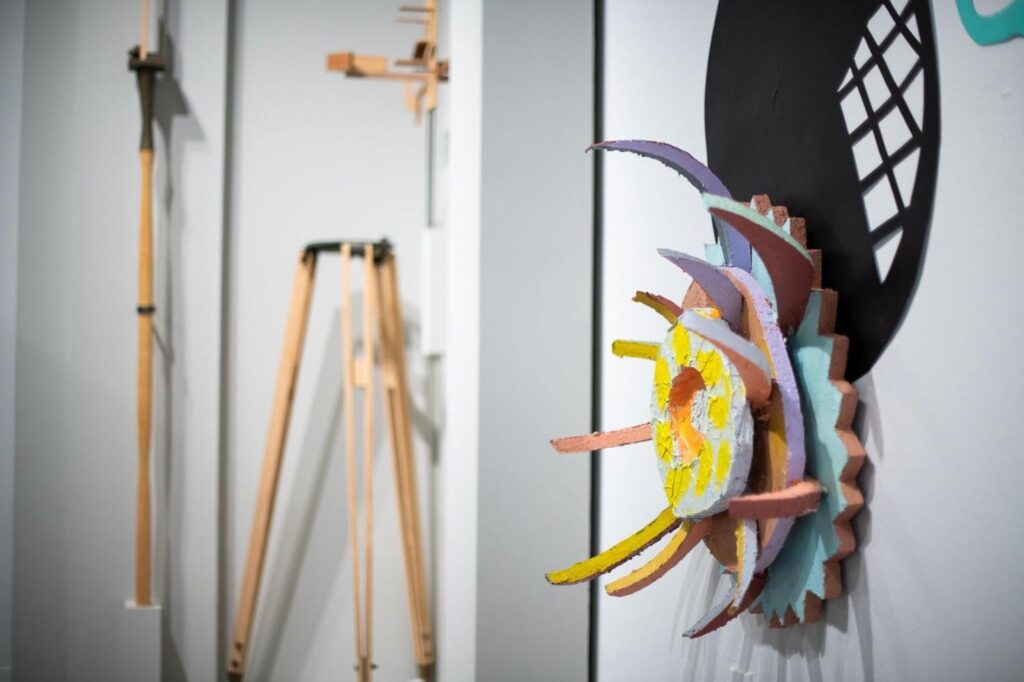
The exhibition description states the work explores “the space between intimacy and energy—between careful handmade detail and wide, expressive motion.” Can you talk about how this manifests differently in Arch’s expansive, colorful forms versus Wiley’s intimate, portal-like sculptures?
I love the opposites that lead to similarities in both of their practices. Keith’s works are like miniature worlds, extraterrestrial, bizarre, obsessive, neurotic. His diverse and focused use of materials is evident throughout his work. Adria’s work takes up space and is not precious in the way Keith’s is; her practice is full of flow, energy, and motion. In the end, both of their works are expansive, Keith’s in the micro-world, Adria’s in the macro. The connection between their work is most evident in the two smaller wall works hung adjacent to each other on the gallery wall – a happy and fortuitous accident of parallel shapes and motion.
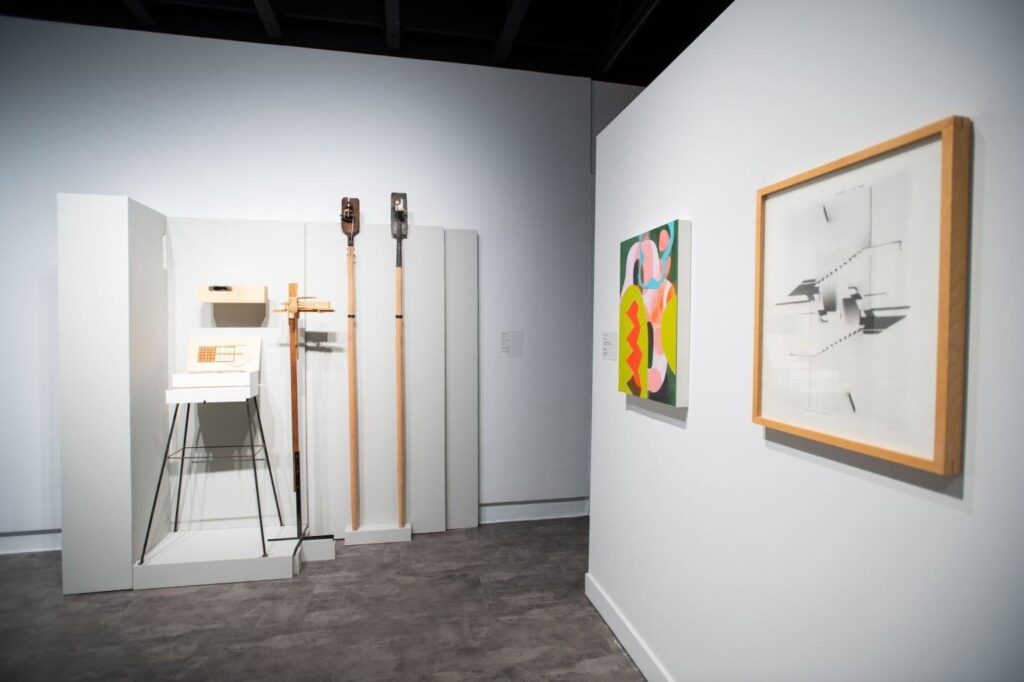
Arch’s flowing, curving shapes extend outward with color and rhythm, while Wiley’s portal-like sculptures draw viewers inward through their openings. How did you approach the spatial choreography of the exhibition to honor these opposing directional forces?
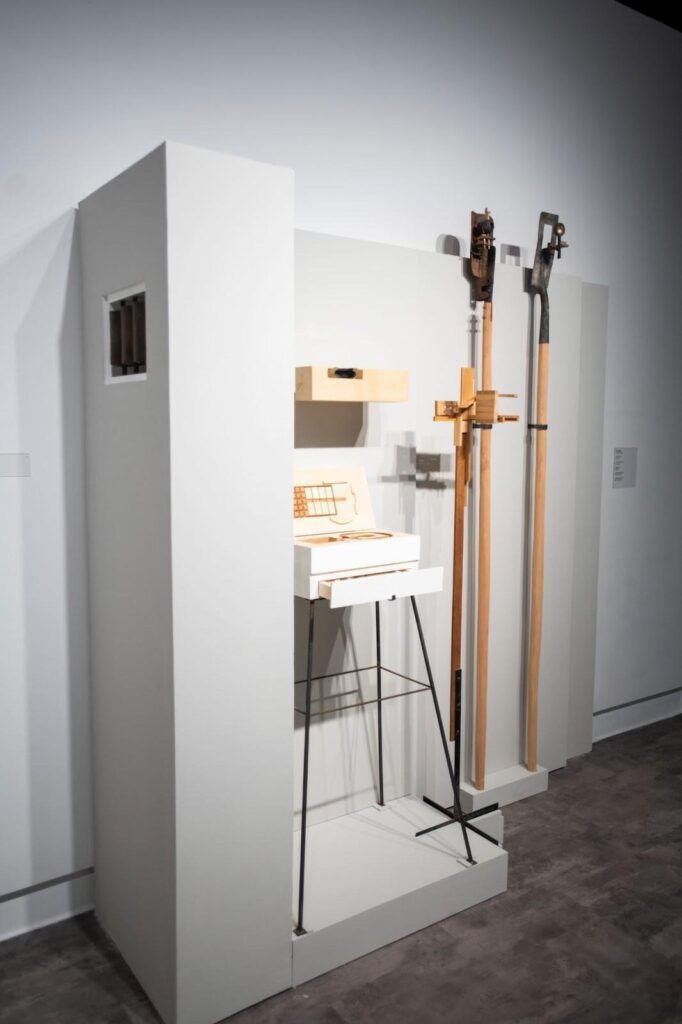
Installing this exhibition was great funand very collaborative. Keith and Adria spent countless hours in dialogue with each other – negotiating space and ensuring their work honored each other’s practices. Keith built elaborate portal-like “sets” that his smaller work fit perfectly into – making it easy to install the week of, and to plan around and within as we determined which works of Adria’s would be included. Thankfully, her practice is one of abundance, and she sent extra work for us to lift up in the space to see what felt the most comfortable. When designing exhibitions, there is a lot of intentional planning, but some improvisation as well. During installation week, we worked well together to make decisions and shape the show into its final iteration. I wanted each artist’s work to feel honored, and I wanted to invite our audiences to draw their own conclusions and connections regarding the relationships between their work.
The show explores how “movement can exist inside structure, and how moments of stillness can feel alive.” How did the artists’ remote collaboration “through images, ideas, and their shared love of movement and form” shape the final exhibition?
Adria and Keith really leaned into the collaboration – I truly could not have asked for more thoughtful collaborators. I was excited to see how they celebrated the collaboration and leaned into the ways the relationship between their work could be drawn out. During the year leading up to the show, we met as a group every couple of months, with Keith and Adria in dialogue a little more frequently. As the show approached, we connected more frequently to determine specific works, finalize logistics, and title the exhibition. In its final form, the exhibition celebrates diverse practices, intimacy, and expansion. Their geographic diversity also supported the exhibition – Keith’s local roots and community made the opening a real party, and Adria brought new ideas and performance! A meaningful part of the opening celebration.
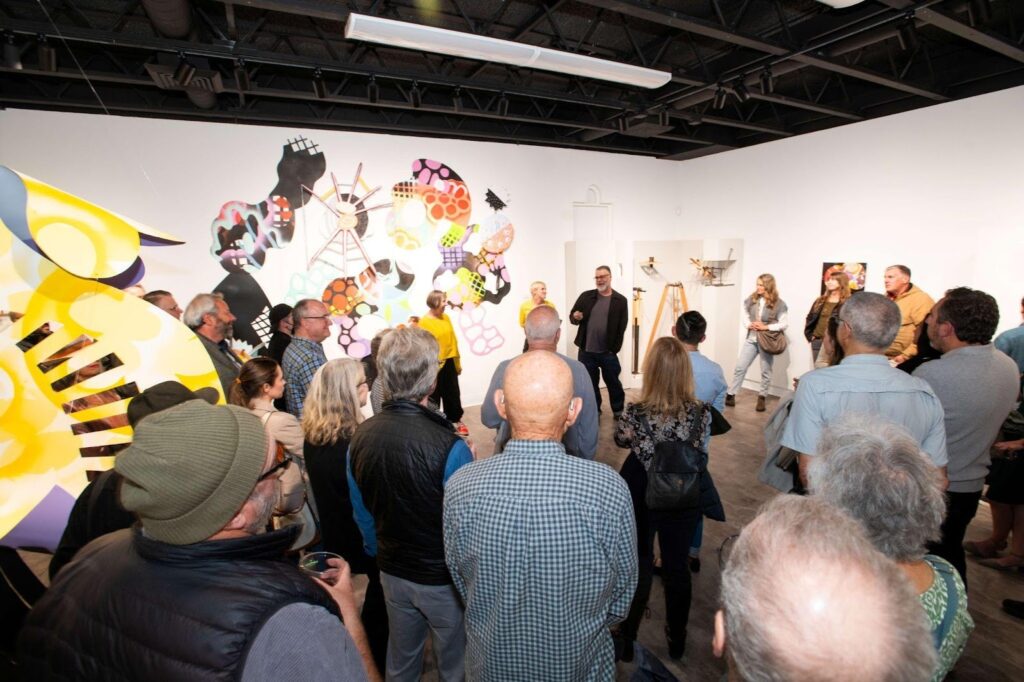
The work becomes a dialogue between contrasting elements: small and large, heavy and light, stillness and motion, creating a space where calm and motion coexist. Were there any surprising discoveries or connections that emerged once the works were physically installed together that you hadn’t anticipated during the planning process?
I am interested in how Adria and Keith’s work impacts the body. Scholars talk about kinaesthetic perception in abstract artworks – how the body has to move to engage and absorb those works. In Adria’s work, especially the large wall works, your body automatically moves back and takes up space to see the whole installation. With all three of Keith’s works, you crouch and curl over the installations to see the intricate details. I love it when seeing art forces an embodied experience, and this show does that really well.
Tell us about SLOMA as a venue. What are you looking for when you curate exhibitions, and what can visitors expect from your programming in 2026?
We have a lot going on at SLOMA with our forthcoming expansion, opening in the new space in mid 2027! 2026 has some fantastic exhibitions planned by local and national artists, and we are ending the year with a SLOMA collection celebration as the last exhibition in this era of SLOMA’s life at 1010 Broad Street, which, in the expansion plans, will be transformed into an education center. This balance between local and non-local, and diverse mediums from contemporary surrealist paintings, to film and photography, to conceptual works and installation, makes this year an exciting one for SLOMA. I am particularly excited for the next exhibition in the Nybak gallery, where Adria and Keith’s show was hosted by New York-based artist Peter Krashes. Lots to expect and be excited for at SLOMA in 2026!
About the curator: Emma Saperstein’s diverse experience includes serving as studio manager to artist Titus Kaphar and nearly a decade of administrative, editorial, and curatorial projects in arts and publishing communities. From 2016-2021, she worked as Curator of the Harold J. Miossi Art Gallery at Cuesta College and as the Global Portal Curator for Shared Studios, managing complex dialogue-based programming projects with the UN, BBC, the Obama Foundation, WGBH, and more. She has guest-juried exhibitions and public arts projects in California and beyond. Emma holds a Master’s Degree from Cal Poly in Educational Leadership with a thesis focused on the gallery as a teaching space and access in the educational gallery, and a Master’s Degree in Curating from the University of Aarhus in Denmark. She currently serves as Chief Curator at the San Luis Obispo Museum of Art.
About the Writer: Etty Yaniv is a Brooklyn-based artist, writer, curator, and founder of Art Spiel. She works in installation, painting, and mixed media, and has shown her art in exhibitions across the United States and abroad. Since 2018, she has published interviews and reviews through Art Spiel, often focusing on underrecognized voices and smaller venues. @etty.yaniv