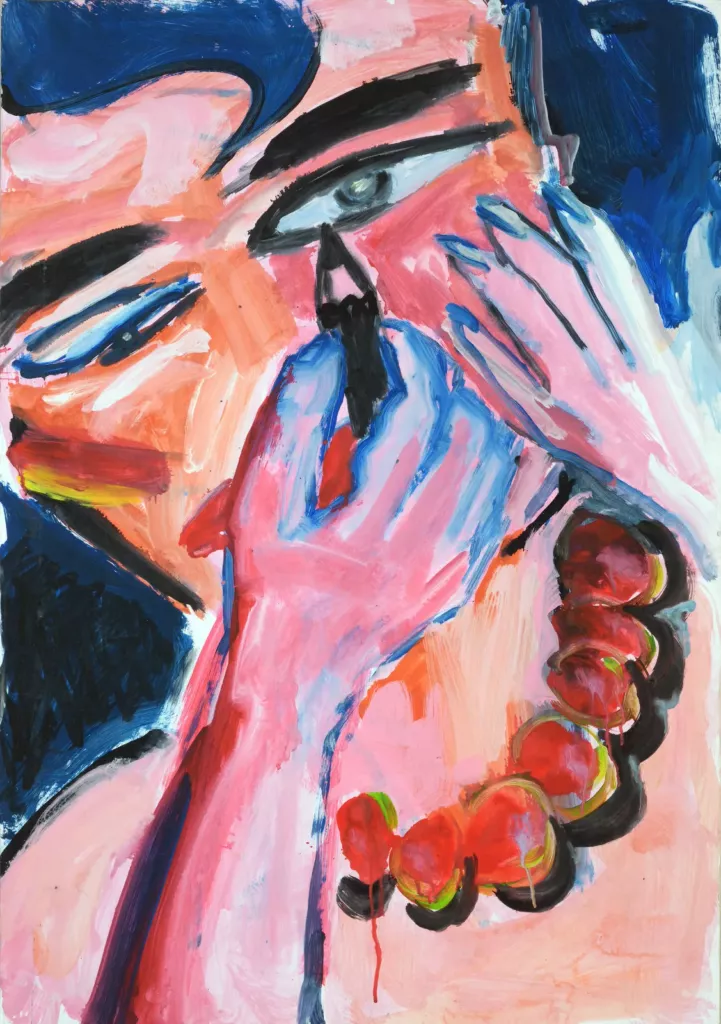
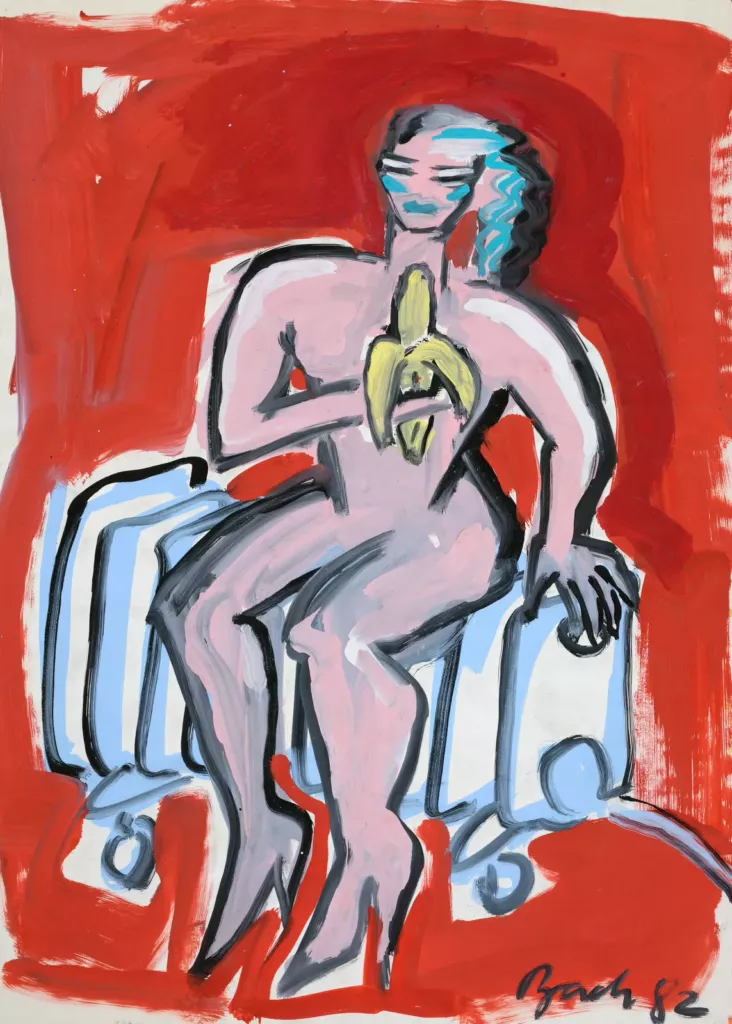
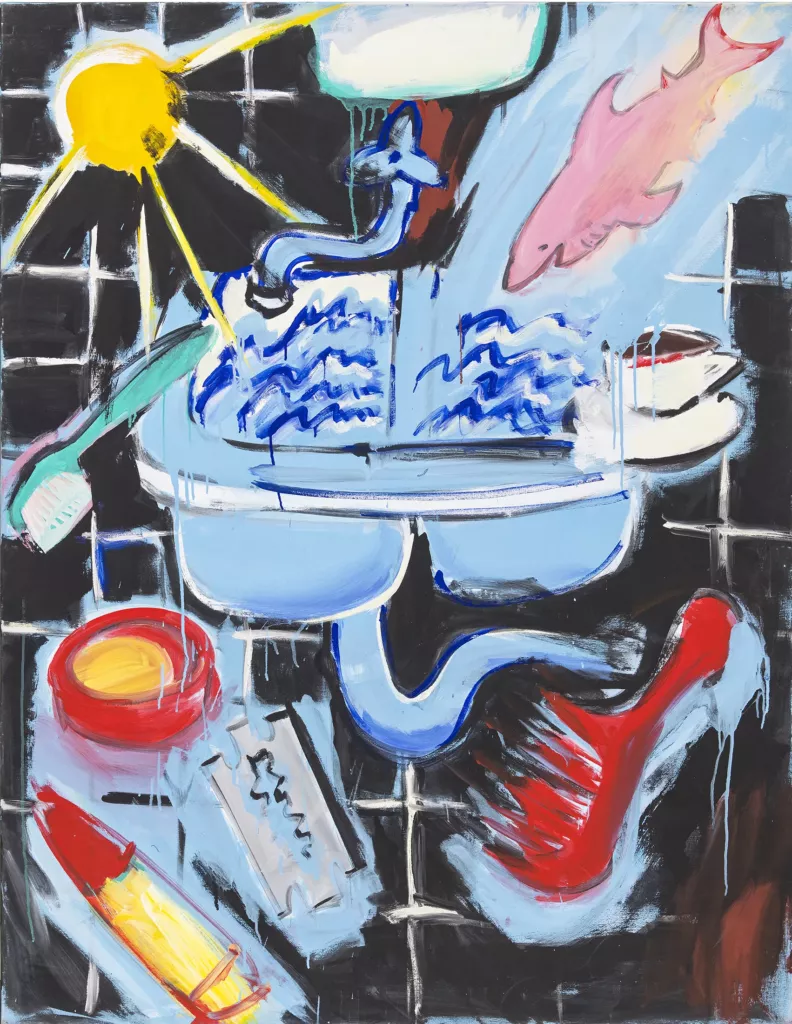
In the context of the global feminist art of today there are a few trailblazers who continue to work and dazzle with their exuberance. Immediacy and mastery of visual resolution signal such fast-paced and intuitive artists. German-born Elvira Bach is one of them. Bach has created a striking painterly style that catches the eye and stimulates further contemplation. For a viewer, Bach’s expressiveness establishes an immediate and deep bond with the traditions of the German Expressionism, embodying in her paintings the Expressionists’ core principle – namely, depicting the artist’s inherent conflicts within the society and within herself. For Elvira Bach urgency of expression, empathy, and visual projection of deep inner strength are important attributes.
Bach’s early pieces from her school years at Hochschule der Künste were influenced by her teacher Hann Trier, a close collaborator of Joseph Beuys who later became Director of Berlin University’s Fine Art Academy and in 1967 started the monumental task of replacing the war-damaged ceiling paintings at the Charlottenburg Palace. Bach’s paintings from this period give a sense of chaotic harmony that later blossomed and became more controlled.
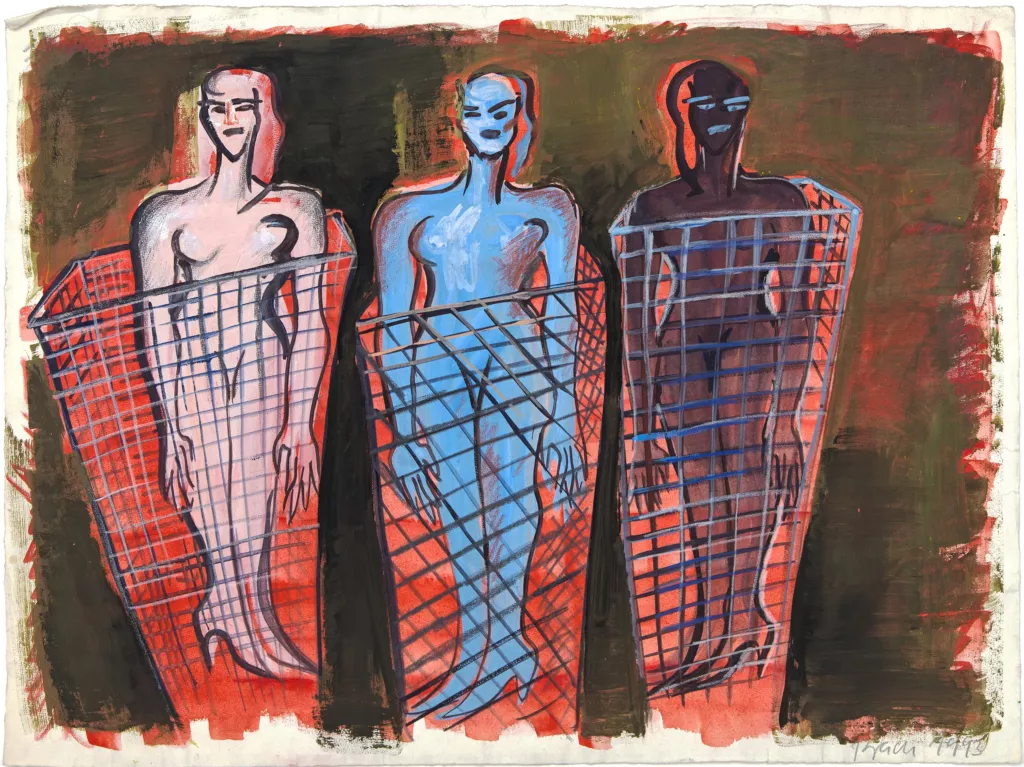
Elvira Bach’s chaotic harmony became even more pronounced when as part of the Junge Wilde (Wild Youths) movement, along with other artists like Jorg Immendorff, she learned to bravely challenge the normative representations that dominated the day. Wild Youths challenged the prevailing trends of the art world by reasserting forms and styles that were deemed antiquated. In the wider art historical context Wild Youths corresponded to anti-establishment movements of the period such as neo-Expressionism in the US, Transvantguardia in Italy, and Figuration Libre in France. Elvira Bach was one of only few women within this movement and as such was able to effectively portray the zeitgeist for the traditional feminine archetype. After her participation in the famed Documenta 7 under artistic director Rudy Fuchs in 1982, Elvira Bach rapidly gained national and international recognition, becoming one of Germany’s well-known painters.
A deep current of Bach’s works lies in the dichotomy between feminine strength and weakness, independence and subservience. By underlining the sexual power and femininity of her portrayed subjects, Bach used her own inner freedom as a starting point to establish her presence in global art history. Similar to other female painters of the 20th century such as Marlene Dumas, Maria Lassnig, and Judith Bernstein, Bach insists on pinning down the multifaceted nature of the modern woman based on her own experience, as the artist puts it: “The light as well as the shadow of the world are belonging to the act of being human – for men and women. I paint myself and my life… I simply put the female in the limelight.”
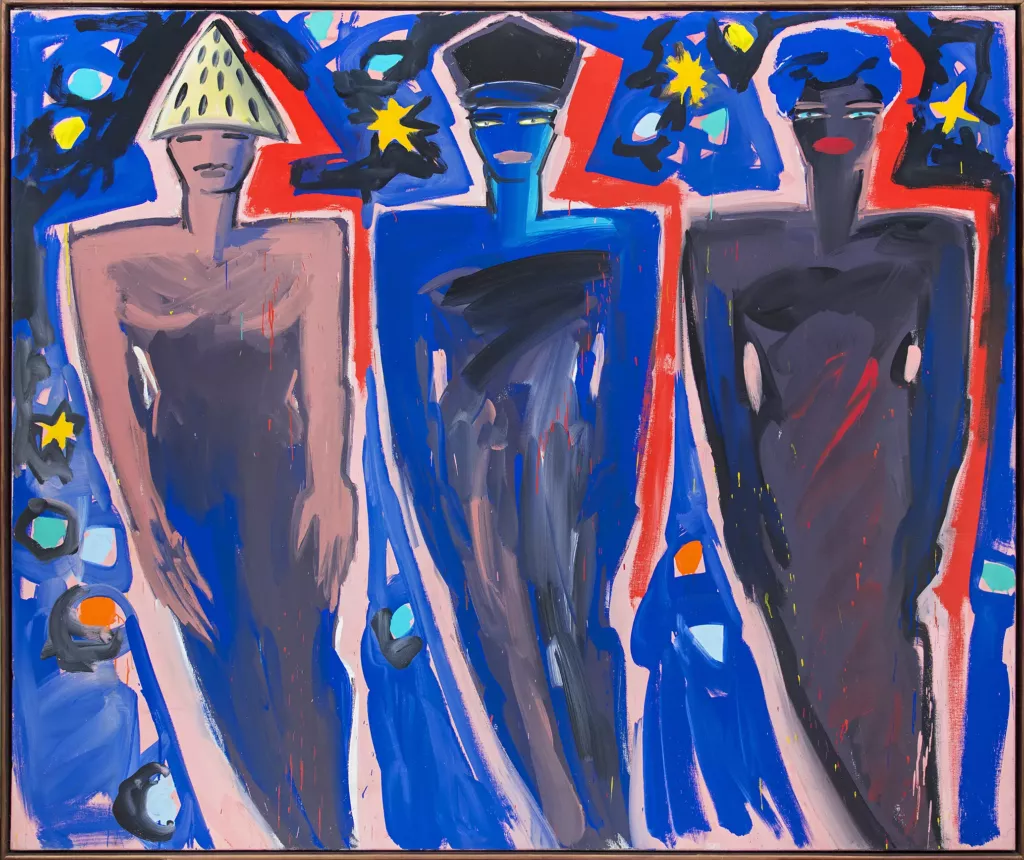
When asked to consider visual pleasure as a hallmark of her style, Bach says that her figures are marked by complexity and they are often attractive “in their dresses, decorated with flowers, symbols, the cigarettes, the vine, with kith and kin and cat… But I am not referring to the eroticization and sexualization of the women – this just happens intuitively throughout my experiences, observations, my inner world.”
One such appealing character is front and center in “Nur eine Schlange” (Just a Snake), 1982. Utilizing relatively muted hues of pink, beige, white, yellow, with some hints of blue undertones, this painting probes archetype of the first woman tempted by the snake. However, unlike the original story of Eve, the snake, although looking menacing, the woman is standing strong with her squared shoulders and raised hands. Eve interlocks her gaze with the snake and there is something erotic between them but her nudity is secondary. The snake and Eve seem to share the moment that does not diminish any of them or foretells the outcome. As in other paintings Bach underlines the ambiguity and multifaceted nature of gender, attraction, and femininity.
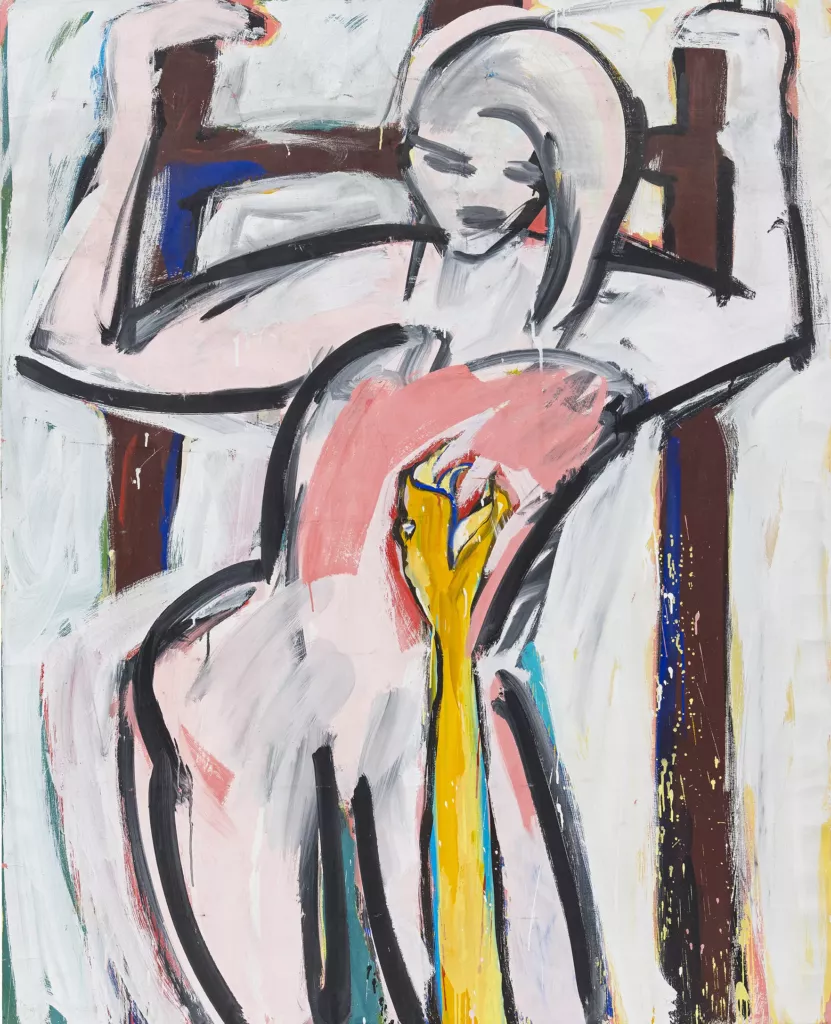
Elvira Bach’s works provide a compelling and timely lens on the meaning of a powerful woman, her desires, and needs. Bach’s women are not looking for excuses and are completely open to new experiences. Yet, simultaneously they are also full of nuances, melancholy, sorrow, fear, and loneliness, as well as passion, joy, and self-revelation. These compelling figures can be associated with archetypal figures of Eve, snake charmers and Femme Fatale. Her women are sophisticated, ambitious, and absolutely contemporary, inhibiting the world of current challenges, schedules, and increasingly fast pace. Intuitively, we are excited to see this raw feminine power.
All photos courtesy of the artist
curator, 2019 Curator in residence for Kunstraum,Brooklyn.
Nina Mdivani is a Georgian-born and New York-based writer and independent curator, 2019 Curator in residence for Kunstraum,Brooklyn.