Artists Anna Boothe and Nancy Cohen met more than twenty-five years ago, and that serendipitous meeting grew into a lasting collaboration. Confluence, their current show at UrbanGlass, features their new body of work. It grew out of joint research and material studies they began in 2024 during a Creative Glass Fellowship at WheatonArts in Millville, New Jersey, where they studied the region’s glassmaking history from the 18th century to the present, with emphasis on how the industry affected the local ecology, waterways, and inhabitants. As Dr. Ferris Olin notes in the exhibition essay, glassmakers settled along the Maurice River for the quality of its sand and its route to market. The industry grew alongside Philadelphia’s pharmaceutical companies and their need for glass containers, which helps explain why scientific glass is prominent in this work.
A sense of interconnectedness among nature, science, history, and the artists themselves runs as an undercurrent through the wall-mounted, freestanding, and suspended sculptures in this extensive show. The pieces are made primarily of recycled and repurposed glass. The artists sifted through the barrels of discarded fragments in WheatonArts’ “glass graveyard,” and Chemglass, a scientific-glass manufacturer in nearby Vineland, gave them a van-load of seconds: tubes, beakers, flasks, and vials.
Boothe and Cohen exploit glass’s ability to shift between fluid and solid as it melts, transforming the rigid, hard-edged forms of scientific apparatus into the curves of the natural world. They carved the outline of the Maurice River into a wooden panel and pressed ropes of hot glass into it to create river-like ribbons, a process that took at least five people working in quick coordination in front of WheatonArts’ public audiences. They also cast forms in 19th-century pressed-glass molds, worked a 19th-century glass press, and fired some pieces with copper carbonate inside, producing X-ray-like drawings.
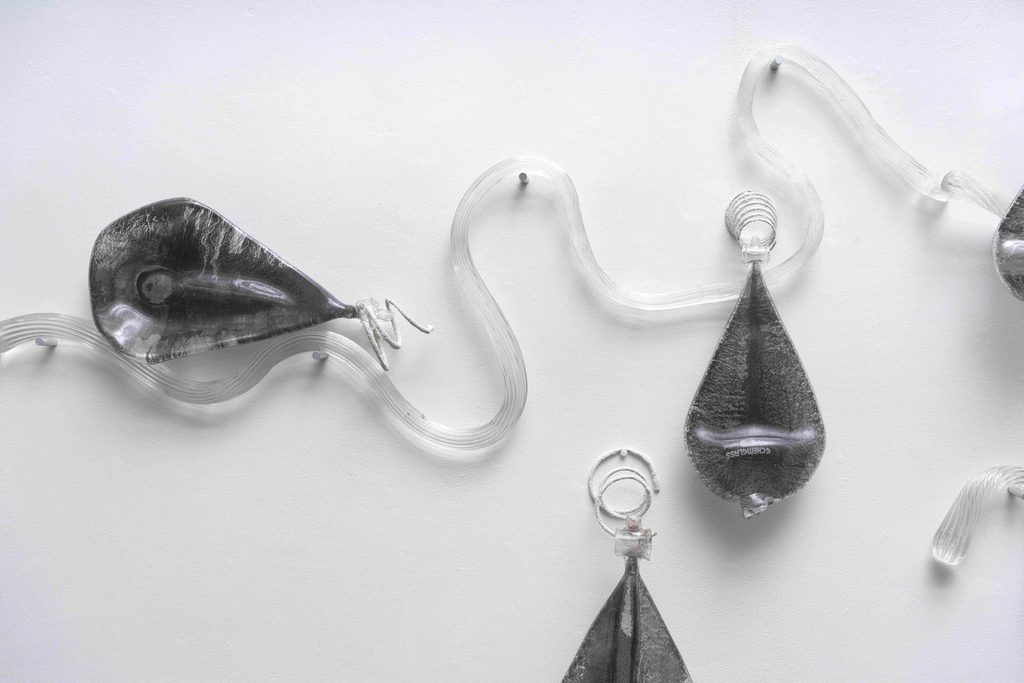
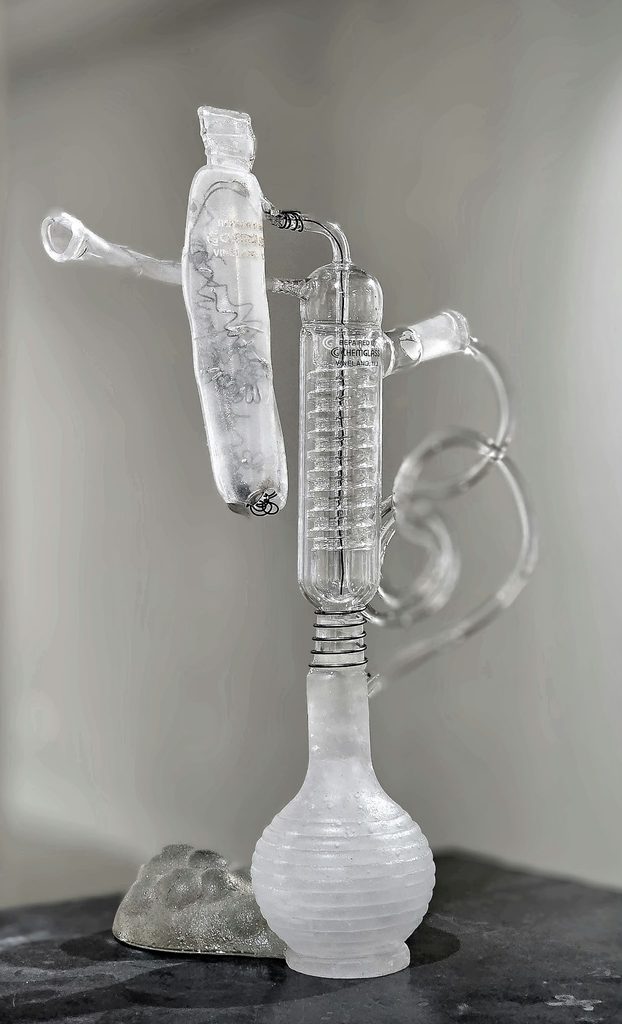
And then there is the question of beauty. Glass is a particularly alluring medium, and an artist who yields to its overpowering beauty can end up locked in shallow glamour. This duo does not fall into that trap. The work is beautiful, at times stunning, but also daring. Found scientific glassware (bell jars, lab flasks, funnels, coiled condensers), combined with wire, epoxy, and copper mesh, is transformed into uncategorizable objects that seem to have some mysterious function we cannot decipher. They are unabashedly pleasing to the eye, yet also strange and funky.
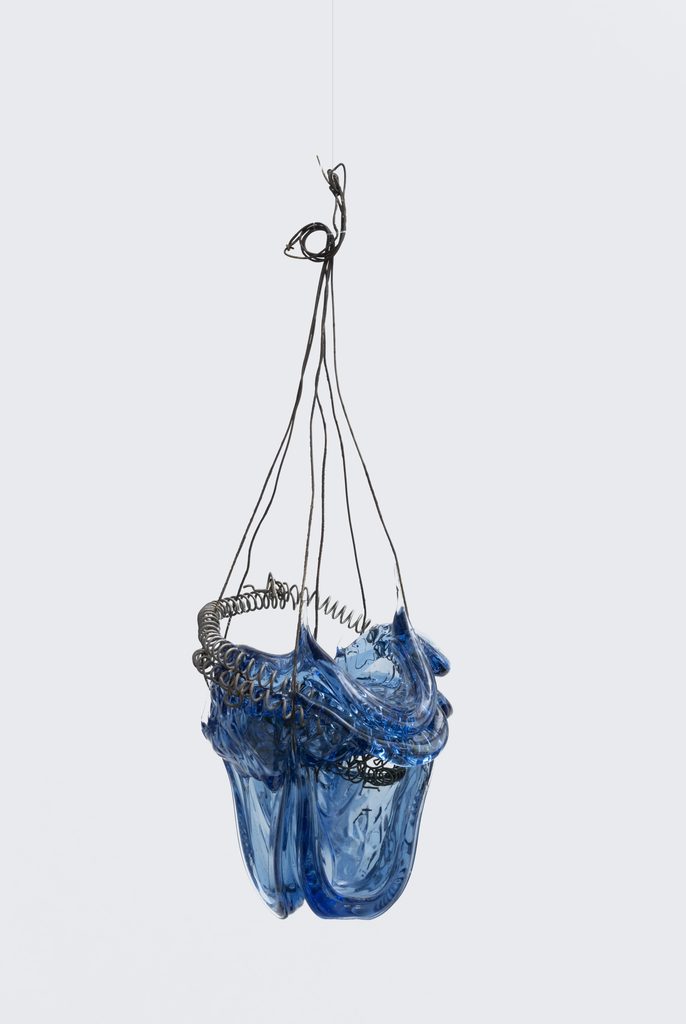
Lagan, for instance, pairs a voluminous, Murano-like blue glass base with small linear coils ringing around it, light and prickly, all suspended from a flimsy triangular wire with a curly loop at the top. In maritime usage, lagan refers to goods thrown overboard from a ship, often one in distress, and marked with a float so they can be recovered later. The title carries a hope of return, and here these discarded objects, their functions long gone, have indeed been recovered. Lagan is absurd and utterly convincing.
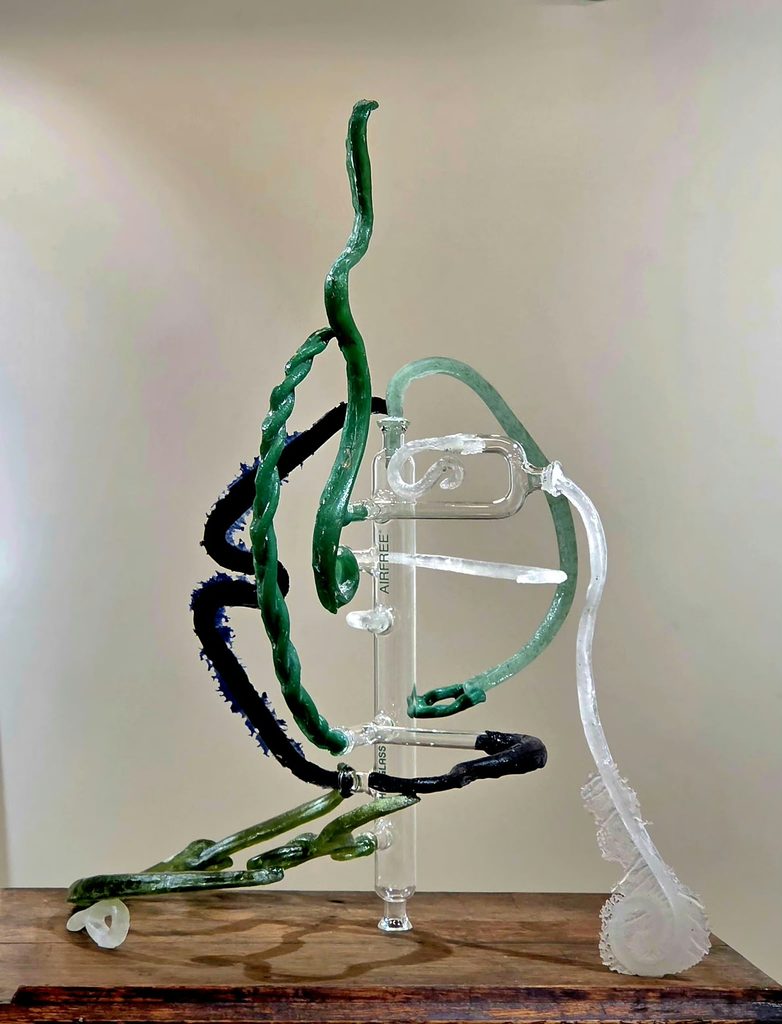
The Invention of Sound is a creature-like vertical piece. Unlike Lagan, it is nearly colorless, animated by strong curving lines, coils, and rings of glass and metal. It is unclear whether the artists had in mind Benjamin Franklin’s armonica of the 1760s, with its nested bowls spun on a rod and played with wet fingers, or the early 20th-century vacuum tube, developed from the glass light bulb, which amplified electrical signals and made radio possible. Still, we can imagine these two instruments converging here to make a new sound of silence.
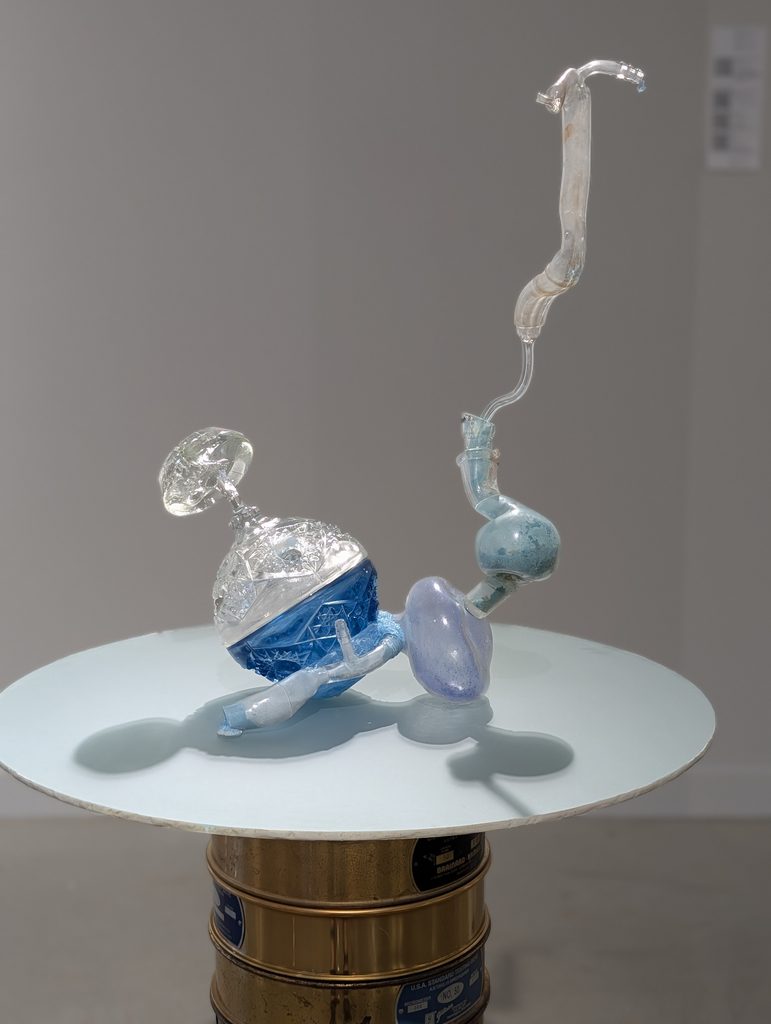
On Balance introduces a sense of danger. It brings to mind the balancing acts in Fischli and Weiss’s seminal video The Way Things Go, where objects roll, fall, and explode in a chain reaction of small catastrophes. Here, it is the precarious, suspended moment before the fall. We can almost hear the glass about to shatter.
The sculpture pairs industrial glass with replicas of familiar domestic objects: pressed-glass “candy dishes” the artists made at WheatonArts using a 19th-century mold and a press of the same era. Such dishes were once found in ordinary households, modest stand-ins for the hand-cut glass collected by the wealthy, much like the sherry or perfume bottles we may remember from our older relatives’ homes. A small peephole offers a glimpse inside the heavy candy-dish section, while heat-altered scientific apparatus rises from it in a light, lilting gesture.
The whole assemblage perches, like a parlor table, on a thick sandblasted glass disc set atop a column of interlocking soil-testing sieves. Salvaged from a closing business, the sieves are the kind the artists used to sort crushed glass for their castings, and, like the old mold and press, relics of an outmoded technology. Together, these timeworn parts form an odd entity, with one foot in the past and the other on the verge of leaping into an unknown, potentially dangerous future.
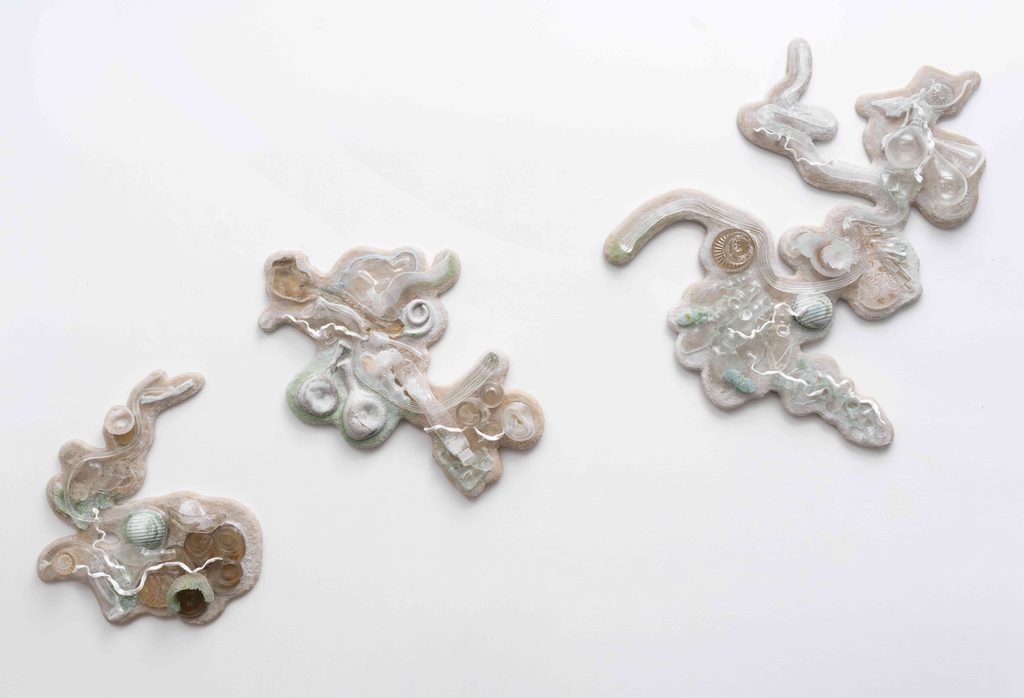
Confluence also features wall-sprawling pieces, such as the three-part Silted Archive, which reads like a field of finds from a river bottom. Like a fossil, it holds worn-down debris, yet that debris seems forever shifting, settling and loosening again, a record of history in motion. We can make out traces of early American glass (nursing bottles, cut-glass vases, and other bottles), scientific apparatus, and warped electrical insulators, as if hauled up from the riverbed and reshaped by time and water. It is also the fullest catalogue of the duo’s techniques in the show, combining kilncasting, sandcasting, flameworking, slumping, and solid-working. The nursing-bottle shape recurs throughout. The artists were both fascinated and horrified when they first saw these vessels at Philadelphia’s I-95 Archaeological Center. They reproduced them in clay and used the replicas as molds for sand- and kilncast forms, a process that, they say, brought them directly into the lives of the people who once used these objects.
Ultimately, the art objects we encounter in Confluence reflect the synergy of the artists’ process, one in which, Olin writes, “individual egos and styles are left outside the studio doors,” and accidents are welcomed as new possibilities. The artists say the key to their collaboration is “taking risks in ways that eclipse what we do in our individual studios and in doing so employ atypical combinations of methods and materials.” It is the pairing of unexpected materials and bursts of bold color that give this body of work both its edge and its buoyancy. These meetings of unlike things are the show’s truest confluence: like the waters that converge by WheatonArts, history, science, ecology, and the artists’ hands flow into one, drawing us in.
Confluence by Anna Boothe and Nancy Cohen at UrbanGlass runs through November 1st, 2026, Robert Lehman Gallery, 647 Fulton Street, Brooklyn, NY 11217
UrbanGlass @urbanglass_nyc
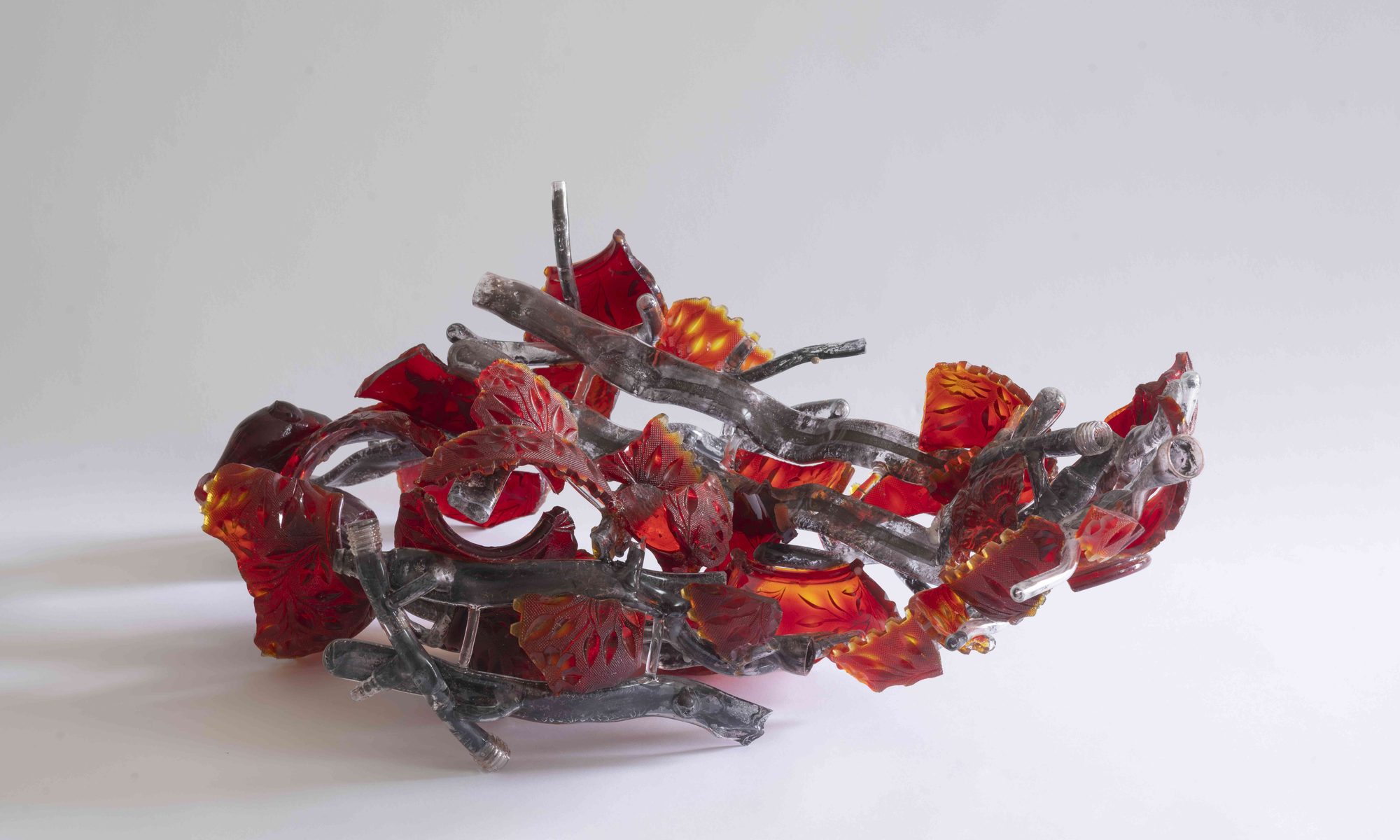
Featured Image: Nancy Cohen and Anna Boothe Breach, 9 x 27 x 15 inches, Glass, 2026. Third View. 9 x 27 x 15 inches. Photo credit of Edward Fausty