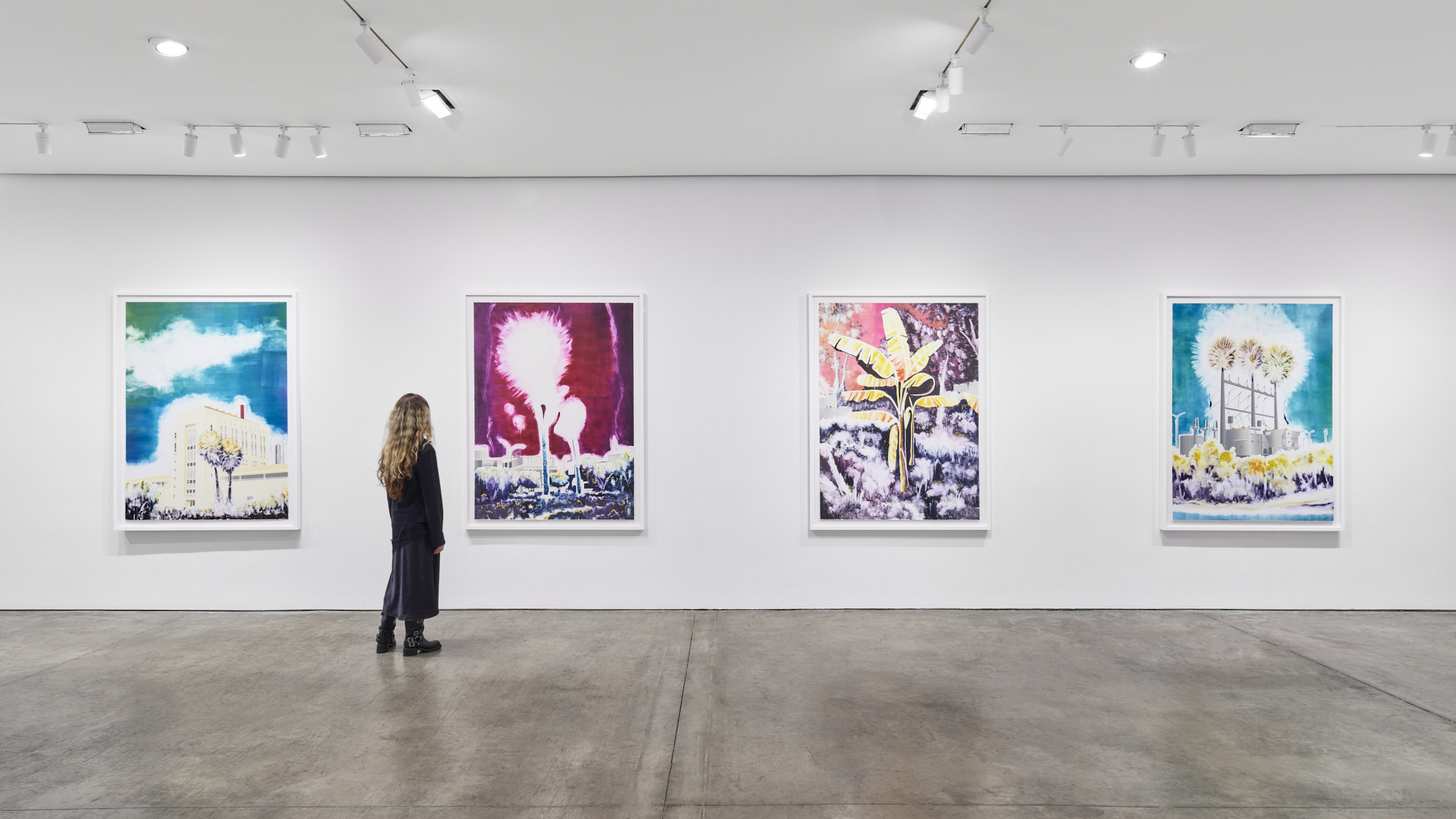
At first glance, Gamaliel Rodríguez’s monoprints look like postcards of tropical lands: saturated palms and skies that evoke Caribbean tourism imagery. The paradise turns more industrial and quite specific as you look longer: an ethanol plant in Medina, New York, the Bacardi distillery in Cataño, Puerto Rico. Following Rodriguez’s first solo show with Pace Prints, we discussed this new body of work.
Your relationship with the gallery began with The Town with Cloud Trees in 2025. How did it lead to committing to a full body of monoprints?
The idea of working and collaborating with Pace Prints came from Aaron Levi Garvey, Director of the Art Museum at WVU, who encouraged me to create a print to benefit the printing department. He contacted Jacob Lewis, owner and CEO of Pace Prints and an alumnus of the printing department, to see if he was willing to help. He sent two magnificent master printers from Pace Prints printshop in New York City who specialize in lithography, Nina Dine and Ruth Lingen. We did the edition of The Town with Cloud Trees. As soon as I started working with them, I saw the great chemistry between the printers’ knowledge and my art practice, and I also saw also the potential to make a nice body of work with them.
Drawing has always been the foundation of your practice, particularly your use of ballpoint pen. What drew you to translate that meticulous mark-making into printmaking, and what became possible in this medium that wasn’t before?
Yes, I used to work only in ballpoint pen to create the illusion of drypoint, which is another printing method. But over the past few years, I have evolved into more of a brush-and-watercolor technique to have more freedom. I was really craving more color, so I went for it. I have no fear of changing my practice out of fear of not creating a unique style. I prefer to use the right technique to represent my ideas, and in this case, monoprint was the right choice. It was also a great mental challenge because of the ink and its application on the plate.
It reacts in its unique way. I was using brushes and a rag to add and remove ink. But the magic happened in the press and in the hands of the master printers.
Your process here begins with photographic source material, much of it captured by you while running through the landscapes you depict. Can you talk about that practice of moving through a place on foot, and how it shapes what you notice and later choose to photograph?
My studio is in Cabo Rojo, Puerto Rico. I have a space in the Bronx, but it’s more for storage. Cabo Rojo is in the southwest of the main island. Thanks to running there, I’ve got great scenes that I can come back to later and photograph particular spots I just discovered. I try to get an initial idea at the spot I just found, then transform it into my own creative language. Colors change, and an illusional image is created. It’s like taking a snapshot in my mind of that moment.
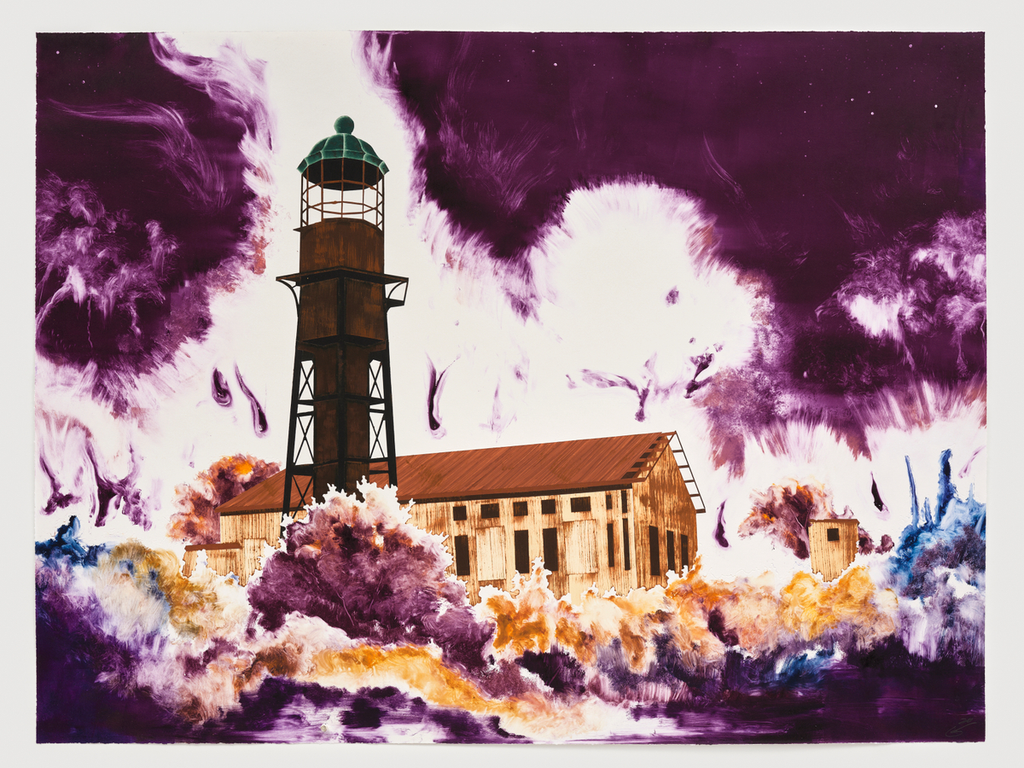
46 3/4 x 62 3/4 inches
You paint directly onto the printing plates and then selectively remove pigment so the paper itself reads as light. How did you arrive at this subtractive method, and what does working with the master printmakers at Pace add to it?
I did monoprints at school before, but never on this scale or level. So it was a great challenge. I love printmaking, and seeing how the print masters work there is mind-blowing. They know how to transform your idea into reality. The master printers developed a technique to recreate the architectural elements of my artworks. They surgically cut and paste templates, applying color to a tiny template.
I learned a lot about the process — how, with just two brushes and a rag, I could add and remove ink as a technique to create detail. It’s not easy to just walk into a place or studio and start working. For me, the process is very intimate. I’m not comfortable working in public or with people in my studio. I work alone. But I put on salsa music, and I can create a feeling that I’m in Cabo Rojo. It feels so much better.
These monoprints exceed four feet. How did working at this scale change your relationship to the image and to the density of detail in your work?
We can make them bigger, ha! But we don’t have a bigger plate. I love working at a large scale. I think this is just the beginning of something better. I’m never satisfied with what I’ve made, and usually not with the size either. I’ve done drawings that are 60 feet long by 6 feet high, so scale is no problem at all.
Can you tell us more about the sites you depict in this body of work and what drew you there?
These images basically reflect my journey over the past two years. I’ve been traveling a lot thanks to art. The ethanol plant in Medina was a commission for the Medina Triennial; the curators Kari Conte and Karin Laansoo invited me to participate and visit the plant. I selected places tied to childhood or memories, like the places I grew up around — Bacardi in Cataño, PR, or Sierra Bayamon with its two glowing palm trees. Even though the images come from photographs I take almost every time, I then transform the image. I add almost a surrealistic interpretation of my thoughts and of why I selected the images in the first place.
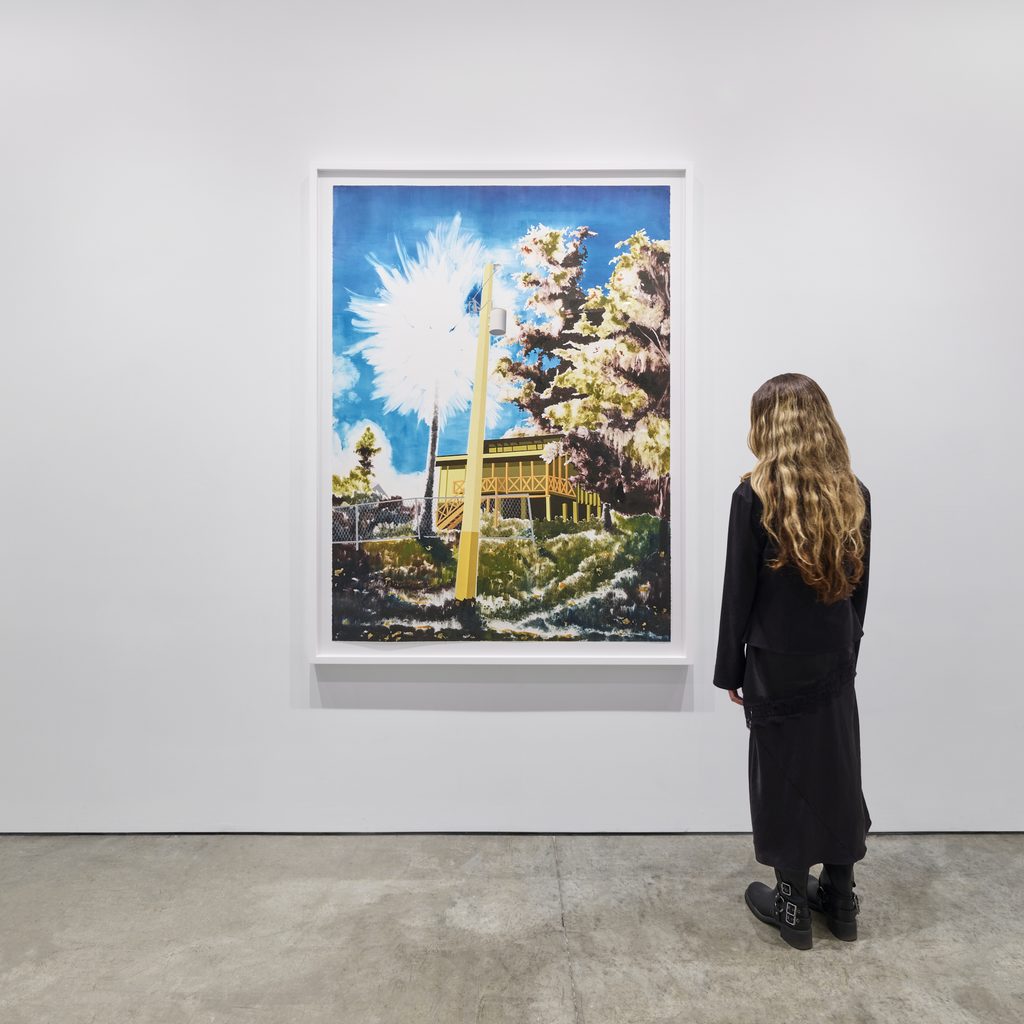
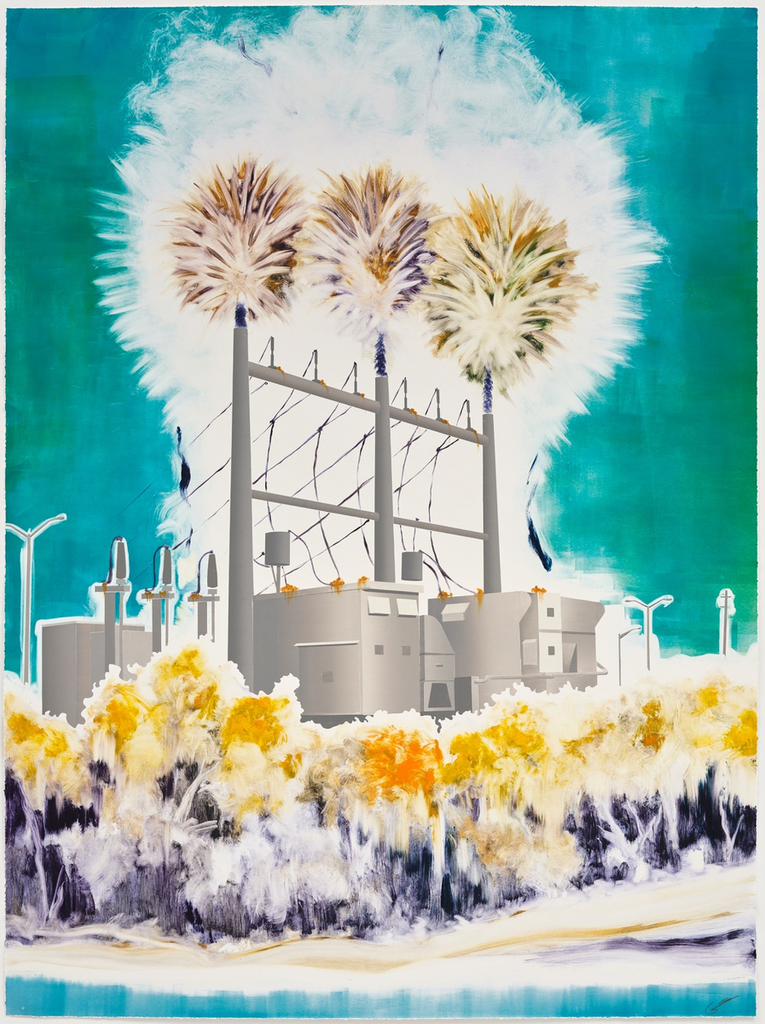
Your palette recalls vintage travel postcards and tourist advertisements, then it’s unsettled. What interests you about working with this visual vocabulary, especially in relation to Puerto Rico and the wider Caribbean?
For decades, Puerto Rico and the Caribbean have been sold to the world as a paradisiacal place — the perfect place to vacation. But visiting and living there are two completely different experiences. It can be difficult as well. There’s also the way we’re seen by other countries in the region — as Americans, when we’re so Caribbean in heart and soul, like the rest of the Antilles. We share almost the same gastronomy, languages, skin color, culture, various religions, etc. Our cultural roots run very deep into our everyday lives.
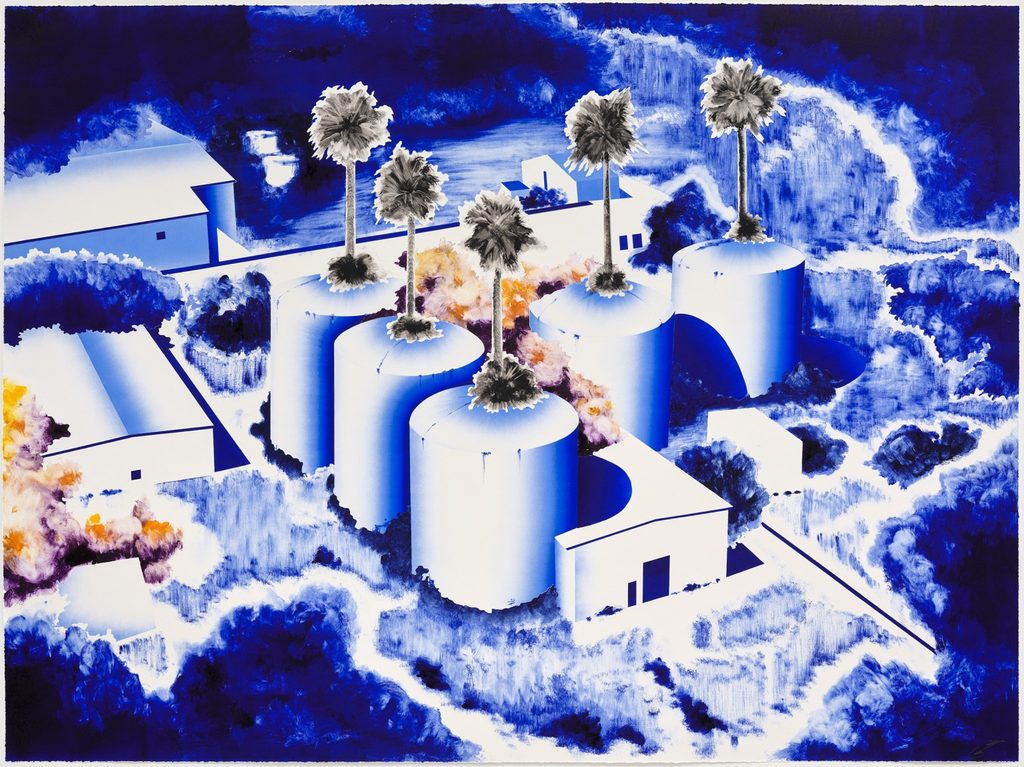
The work in this exhibition evokes a sense of power: Industrial infrastructure hinting at the systems that shape land and labor. How do you hold those forces together in a single image?
I don’t have a clear answer for that. I’m not even sure I’ve achieved it. But I’m always intrigued by the notion of the word “power” — biological, natural, political, religious, military, etc. It can leave a mark on humanity, both in good ways and bad. It makes me think of how fragile we really are, and how we can take for granted what we have, or don’t have.
All photos courtesy of Pace Prints unless otherwise indicated.
Featured Image photo by Garrett Carroll.
Gamaliel Rodríguez | Lo grabado de lo vivido (What is etched from what has been lived) Pace Prints | 536 West 22nd Street New York, NY 10011
September 10–October 10, 2026 @paceprints
Pace Prints’ exhibition coincides with a solo presentation at Rebecca Camacho Presents in San Francisco, on view September 3-October 24, and a long-term exhibition, Imagining an Archipelago: Art from Cuba, Guam, the Philippines, Puerto Rico, and Their Diasporas at the Colby Museum of Art on view through June 2027.
About the artist: Gamaliel Rodríguez is known for his richly saturated color palette and haunting landscapes that blur the boundaries between memory and place. Gamaliel Rodríguez pushes the boundaries of drawing through works that examine the enduring legacies of colonialism. His practice explores the fragility of social and physical infrastructure, and the evolving relationship between humankind and nature. Drawing on the landscapes of Puerto Rico and the Caribbean, Rodríguez places these forces in conversation with one another, using his distinctive visual language to reveal their shifting power dynamics. @gamaliel_artist
About the writer: Etty Yaniv is a Brooklyn-based artist, writer, curator, and founder of Art Spiel. She works in installation, painting, and mixed media, and has shown her art in exhibitions across the United States and abroad. Since 2018 she has published interviews and reviews through Art Spiel, often focusing on underrecognized voices and smaller venues. More about her art can be found at ettyyanivstudio.com and on Instagram @etty.yaniv