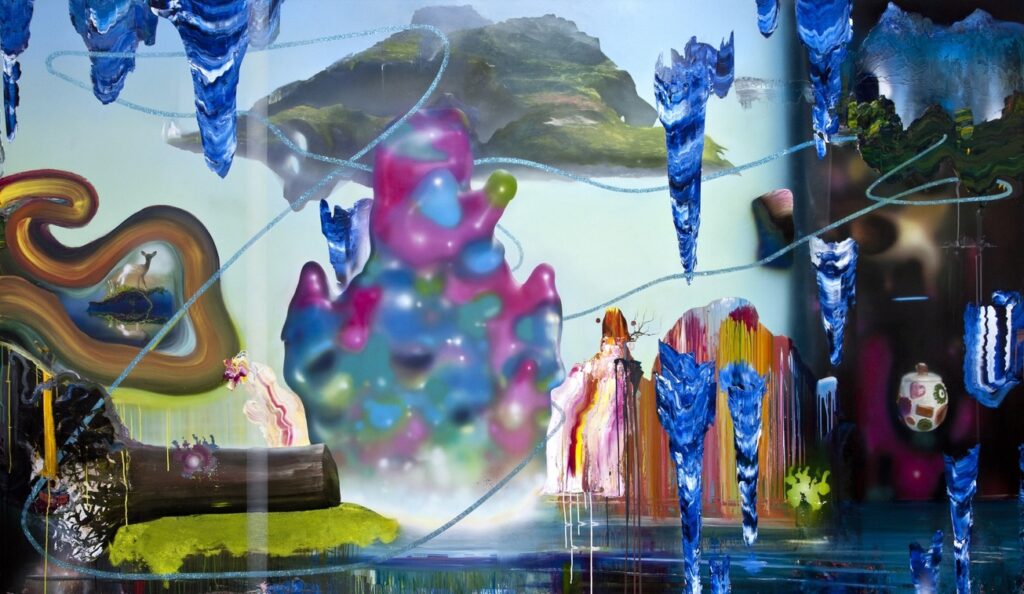
Across trippy, iridescent seas, massive, eerie interiors, and uncanny, translucent forms, Tom LaDuke composes intimate “letters” to the cultural ghosts that shaped him—poetic reflections on perception, memory, and the subtle currents of emotional drift.
Love letters straight from your heart
Keep us so near while apart
I'm not alone in the night
When I can have all the love you write

–  Love Letters by Heyman and Young
Borrowing its title from the 1945 torch song later immortalized by Ketty Lester and woven into David Lynch’s noir classic film Blue Velvet, Tom LaDuke’s Love Letters, at Phase Gallery, opens with the suggestion of misdirected intimacy and perceptual slippage. The exhibition frames a suite of large, quasi-abstract paintings and three sculptures through the conceit of the love letter—private, elliptical, addressed as much to other art as to viewers. LaDuke’s “love letters” become homages to cultural touchstones across media: songs, paintings, films, and digital detritus that have shaped his sensibility.
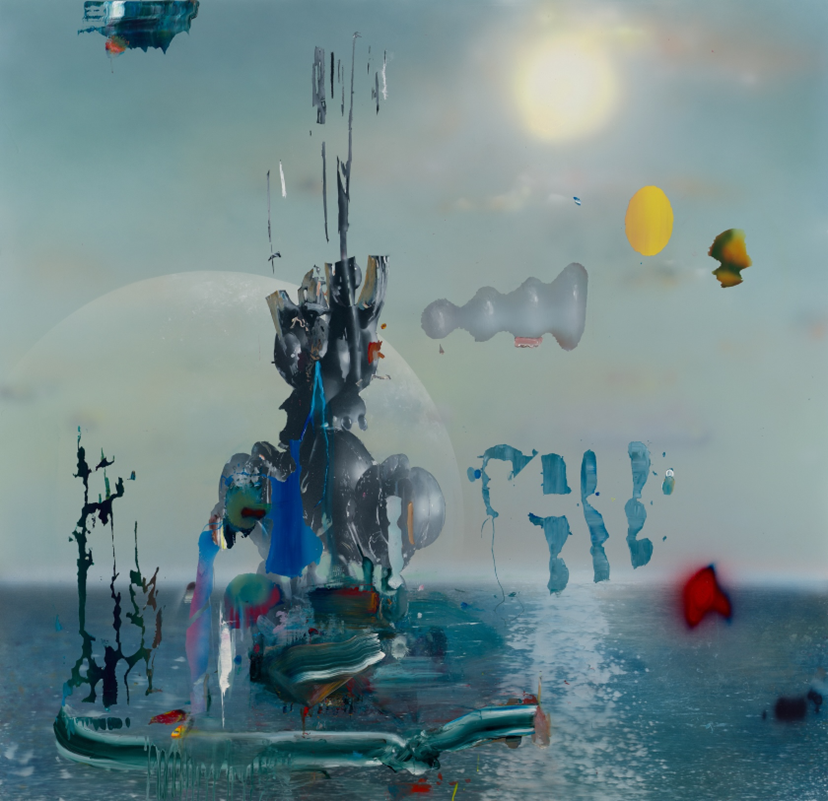
LaDuke’s work has long occupied a space between cinematic atmosphere and painterly construction, and critics have frequently noted his tendency to layer realities—digital, observational, and imagined—into a single visual field. Here, that mode takes on a quieter, more devotional tone. The large canvases feel like dream sets awaiting activation: vast, iridescent oceans and ghostly gallery interiors populated by outsized, brush-stroked vessels, nubs, and biomorphic containers. In Playback Ok Bottle Unknown (2023), buoyant, three-dimensional forms drift above a pearlescent sea as if dispatched on a reconnaissance mission. Their presence is neither metaphor nor narrative cue; rather, they behave like thoughts materialized—unmoored, half-articulated, suspended between recognition and opacity. But what are those thoughts? Perhaps they point toward our own unanswered transmissions: the sincere requests and routine submissions we send into the online digital ether, hoping for clarity from the machines we rely on to ease our burdens and fulfill our longings.
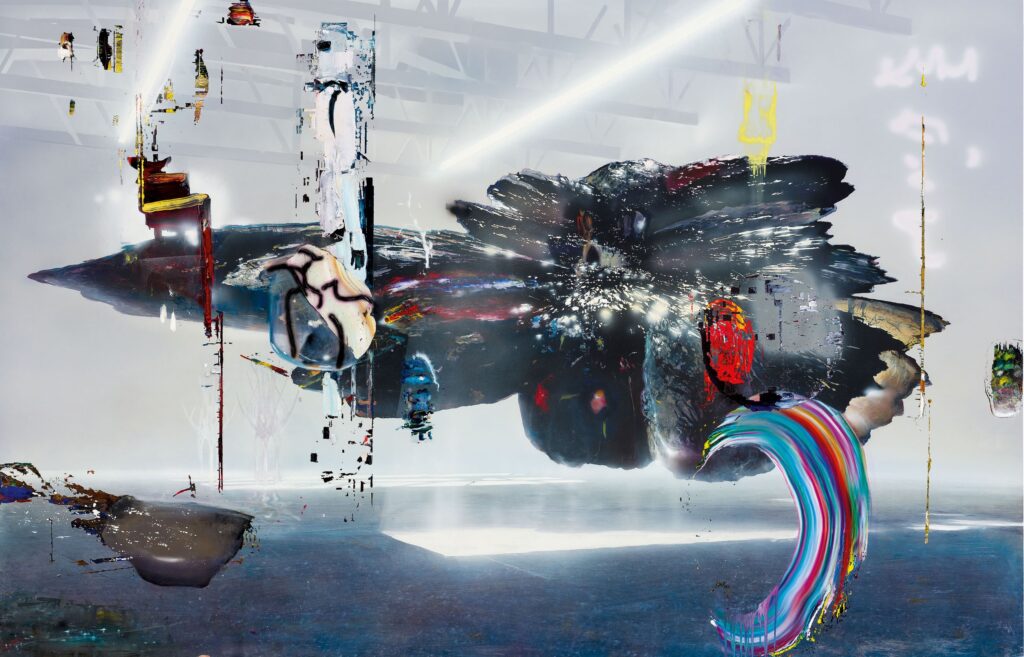
LaDuke’s references to pop music in work titles like Houses of the Holy and Future Proof—from Led Zeppelin to Massive Attack, respectively—are not conceptual anchors so much as emotional calibrations. His paintings operate like visual tracks: syncopated, atmospheric, tuned to mood rather than message. The surfaces, often described as “multi-channel,” maintain their cinematic restlessness. There is no stable vantage point; vision refracts, shifts, and recalibrates.
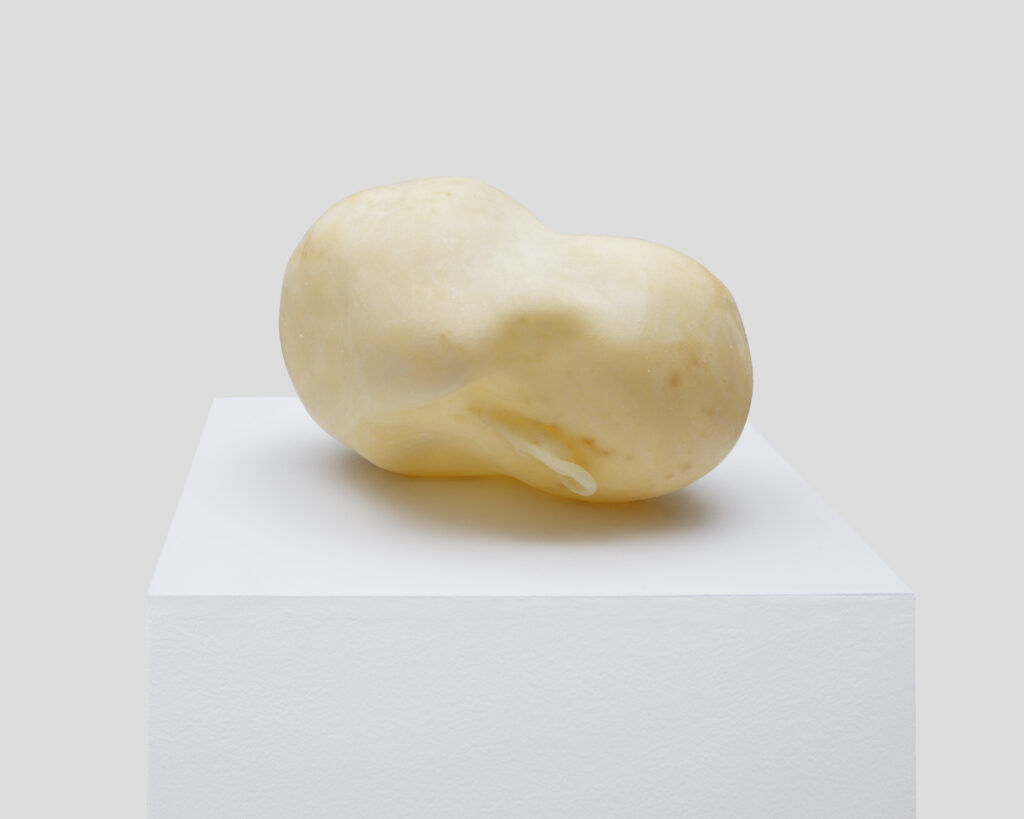
Two small sculptures ground the show with disarming precision. Ellipsis (2013), composed of salt and Super Glue, merges two skull forms cast from the artist’s head—one positive, one negative—into a single, egglike continuum. The ears, attached and mirrored in the same manner, recall Lynch’s use of a severed ear in Blue Velvet (a LaDuke film favorite) as an entry into forbidden experience and knowledge. The work, as La Duke notes, poses a philosophical riddle: if language exists outside the self and thought arises only through articulation, where does cognition actually reside? The sculpture renders this problem visible by staging a closed perceptual loop.
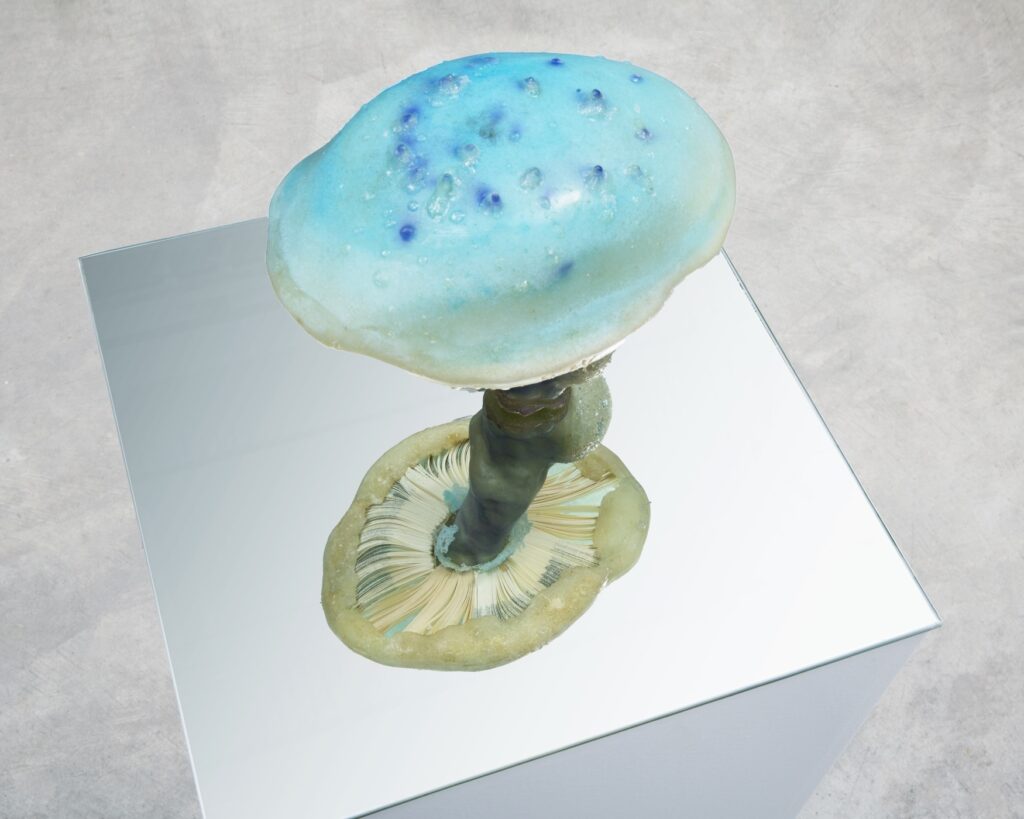
Unknown Unknow (2014), a luminous blue fungi-like form atop a mirrored pedestal, extends LaDuke’s interest in perceptual rupture. Its psychedelic reference is unmistakable (even though the piece is modeled after a poisonous mushroom), but the effect is less countercultural than phenomenological: a reminder that vision is not passive reception, but an event shaped by reflection, instability, and drift. I find it interesting that the mushroom gills of Unknown Unknow are made of book pages. These, and other content-laden elements that seem personally meaningful to the artist show up in virtually all the works throughout the show, obscured only enough to prevent a literal reading, but which never shake us, as viewers, from the path of the seeker.
What distinguishes Love Letters from LaDuke’s earlier exhibitions is its shift in emotional key. The paintings are less declarative, the sculptures more intimate. Taken together, the works operate as correspondences—messages addressed to the unstable terrain between perception and comprehension, as well as to the lineage of artworks and cultural objects that continue to echo through LaDuke’s practice.
In our current technologically overdriven moment, defined by contested realities and mediated seeing, Love Letters suggests that clarity may be overrated. LaDuke offers instead an art of suspended attention: an invitation to inhabit the gap between what we sense and what we can articulate. His love letters are not declarations of certainty but acknowledgments of shared perceptual fragility, addressed to anyone willing to linger where meaning almost arrives.
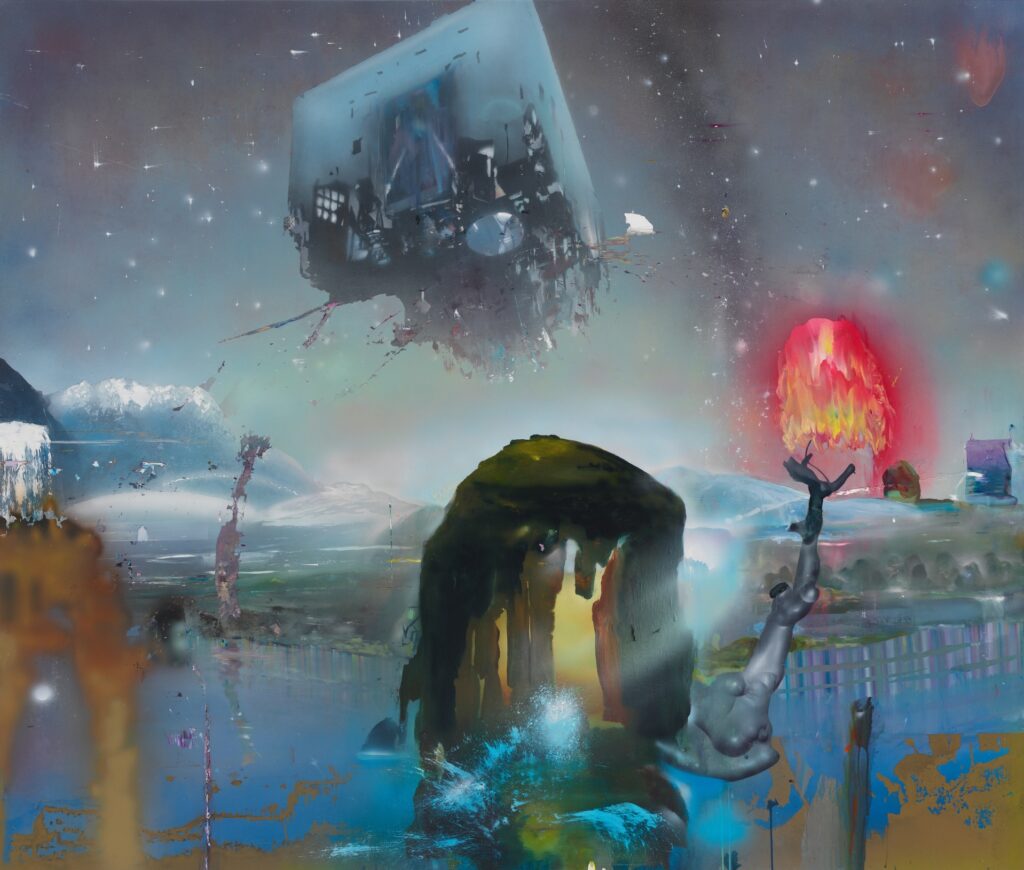
Tom LaDuke, Future Proof, 2023, Acrylic and canvas over panel, 68” x 80”
Tom LaDuke: Love Letters
November 22-December 27, 2025
PHASE Gallery
1718 Albion Street
Los Angeles, CA 90031
Join us Dec 19 for the Art Spiel 2025 Brooklyn fundraiser featuring 200+ artists’ works RSVP here
About the writer: Stephen Wozniak is an art critic, artist, and actor based in Los Angeles who has written feature articles, exhibition reviews, and conducted interviews for Artillery, Observer, Whitehot Magazine of Contemporary Art, The Baltimore Sun, and other publications, as well as critical essays for major commercial galleries and museum exhibition catalogs. Wozniak is also professional actor who has performed principal roles in Star Trek: Enterprise, CBS’ NCIS: Los Angeles, NBC’s American Dreams, and the double Emmy Award-nominated Beyond the DaVinci Code, among others. He graduated with a B.F.A. from the Maryland Institute College of Art and attended Johns Hopkins University in Baltimore, Maryland.