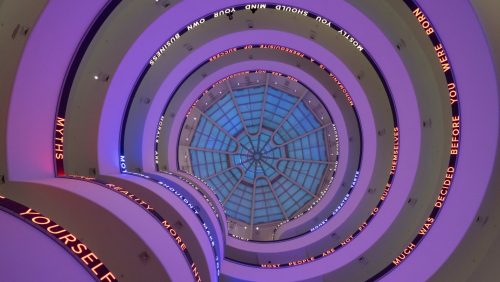
Walls of the Guggenheim Museum bathed in a purple glow. A scrolling LED text installation winds up the ramps of the Guggenheim Museum, displaying texts written and curated by the artist, leading to a blue sky beyond the oculus.

Jenny Holzer’s Hypocrisy

Opinion

“I want people to concentrate on the content of the writing and not ‘who done it.’ I want the work to be of utility to as many people as possible. And I think if it were attributed to me, it would be easier to toss.”

Quote by Jenny Holzer from Art21

Recently, I wrote an opinion piece on the suspect politics of Maurizio Cattelan’s show at Gagosian Gallery — it questioned why successful artists who make political claims for their work do not use their privilege to engage in direct political commentary and action rather than critique by analogy. I’m not suggesting they need to engage in social practices like Mel Chin or Tania Bruguera; I think artists like Cattelan can be more direct in their criticism or more like Theaster Gates, who acknowledges the contradictions and privilege that comes with his success to the degree that he openly differentiates between museums and institutional exhibits that permit him to experimentation and his gallery exhibits that afford him market engagement. Meanwhile, while those works have an implied politic, he is an activist who focuses on community development, which is realized through his Chicago-based Rebuild Foundation, which is a platform for cultural development and neighborhood transformation. This multifaceted approach enables Gates to navigate and influence both the art world and broader societal issues without collapsing one into the other.
Dreams of a Common Language: Elizabeth Duffy, Lu Heintz, and Anna McNeary In OVERLAP

Liz Maynard

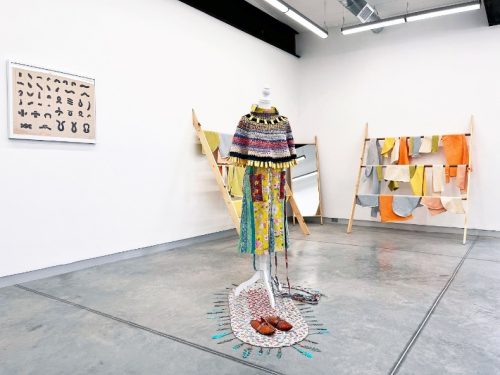
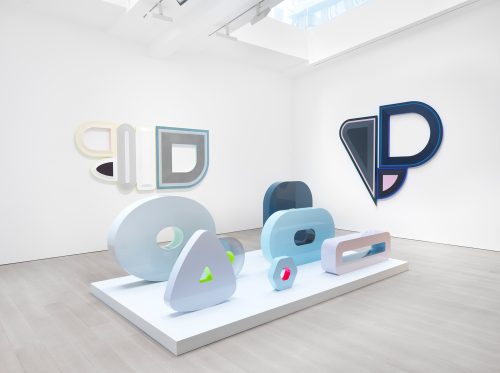
The rhymes, homophones, and translations between the work of Elizabeth Duffy, Lu Heintz, and Anna McNeary are object manifestations of “Dreams of a Common Language.” The exhibition at Overlap Gallery in Newport, RI, offers up sweet and salty juxtapositions of textile, prints, sculptures, and installations of Providence-based artists. It takes its title from Adrienne Rich’s 1976 volume of poetry, which ruminates on the possibilities of life liberated from patriarchal constraints and the feminist community emerging from speech in common. Duffy, Heintz, and McNeary explore textile not just as a shared (and often gendered) medium but as a conceptual framework.

Beverly Fishman’s Greatest Emergency

Beverly Fishman, I dream of Sleep, 2020. Installation. Courtesy of the artist and Miles McEnery Gallery

This is part of a series of articles for the upcoming exhibition, The Greatest Emergency at the Circulo de Bellas Artes of Madrid. The exhibition is based on Santiago Zabala’s book, Why Only Art Can Save Us: Aesthetics and the Absence of Emergency. In this exhibition, ten contemporary artists rescue us into our greatest emergencies, that is, those we do not confront as we should. Each article in the series will contextualize these artists’ practices and explore how they are linked to Zabala’s aesthetic theory and the exhibition’s themes. The first article in this series highlights the work of American artist Beverly Fishman.

Unlike many art historians and art critics, philosophers do not look for works of art that are necessarily beautiful or interesting. Most of us—at least those educated in the continental tradition of Hegel, Nietzsche, and Arendt—instead look for works that disclose a theoretical stance. Martin Heidegger’s writing on Van Gogh’s shoes paintings, Arthur Danto on Andy Warhol’s Pop Art, and Jacques Rancière on Alfredo Jaar’s photographs are paradigmatic examples. This does not mean we do not care about the artist’s effort in creating such work; rather, we focus more on whether the work discloses an aesthetic notion, political idea, or anthropological concept that has meaning for society at large. Artists, for us, have the same ontological purpose as scientists or politicians. A great work of art, new scientific discovery, or progressive policy can change people’s relationship with reality. If these works, discoveries, and policies change this relationship, it is not necessarily because they are “better” than others but because they touch our existence to a greater degree.

Whisperings from the Wormhole with @talluts

Some Thoughts About Portrait Artist of the Year, a British TV Show

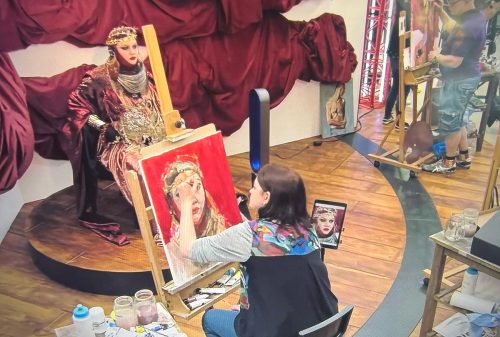
One of my guilty pleasures is binge-watching creativity reality shows, especially from the UK. We’ve got the Great Pottery Throw Down, where the judge, a great hulking potter in overalls with a Wallace and Gromit face, bursts into tears every time he sees a beautifully made ceramic. There’s Blown Away, a glass-blowing show with lots of macho folk blowing glass sweatily. And there’s Landscape Artist of the Year. But my all-time favorite is Sky Art’s Portrait Artist of the Year.

A close-up of a piece of art Description automatically generated

Ophelia Arc: we’re just so glad you’re home at 81 Leonard Gallery

In her 2014 essay Grand Unified Theory of Female Pain, Leslie Jamison examines the literary phenomenon of women’s suffering being depicted in almost luxuriating detail, as much an object of fetishization by men as it is a subject of shame by women. Jamison recalls a boyfriend accusing her of being a “wound-dweller,” or fixating on her own afflictions to an unhealthy, self-centered degree, to which she initially reacts with umbrage. Ultimately, she reworks this pejorative into an argument that women’s tragedy, disease and self-harm should be viewed through an empathetic lens, that women should be inclined to give themselves the space to “dwell” on their wounds as a pathway to solidarity and recovery.

A Tribute to Friendship at the Reinstitute

A Tribute to Friendship at the Reinstitute

Photo Story

Through their group show at Re Institute, Julia Kunin, Barbara Zucker, Meg Lipke, Catherine Hall, and Joanne Howard reflect on how a supportive community and friendship nourish the often solitary act of creating art. Their lives have intersected over many years, and their approach to art cross-pollinates on multiple levels.

Anna Gregor: Double Space at D. D. D. D.

In Dialogue

Anna Gregor often remarks, half in jest, that she wishes she were a poet. Poems, to her, come closest to immateriality; they exist in the mind and can be accessed anytime. In contrast, a painting is a unique object that must be seen in person, confined by paint, the artist’s technique, and the viewer’s presence. Gregor, a painter in New York City currently pursuing her MFA at Hunter, examines the divide between body and mind, material and immaterial, in her art. She sees a painting as having a dual nature: a physical object of paint sharing space with the viewer and an immaterial idea formed in the viewer’s mind. This mirrors the human condition, where body and mind coexist. Gregor says she often feels trapped by her physical form and its social labels—gender, age, race, and ability. Yet, she recognizes that her body is essential for her consciousness. For Gregor, making a painting is a confrontation with matter, a commitment to the material world while striving to go beyond its limits. Viewing a painting involves a similar struggle to find meaning in the artist’s creation. “ Without the physical painting, there is no idea. But without the idea, the painting is just inert matter,” she says. This intricate relationship is central to her solo show, Double Space, at D. D. D. D.

Maurizio Cattelan’s Hypocrisies

Maurizio Cattelan’s Hypocrisies

Opinion

The conjunction of art and politics is a confusing and often compromised enterprise. The commentator Ben Davis argues that as our society regresses under the politics of neoliberalism, such art serves a “compensatory role.” Much explicitly political art is either pedantic or satirical. There’s a long history dating back to the Incoherents and Decadents, the late 19th-century artists who embraced absurdity, irrationality, and the grotesque to protest against emerging bourgeois values and the academic practice of art. They used parody, satire, the carnivalesque, as well as didactic and pedantic jokes to expose cultural ideocracies and societal flaws. This was followed by the Dadaists in the early 20th century, who expressly mixed real-world politics and provocative, anti-art gestures with the intention of undermining social and artistic conventions and setting the groundwork for a social and cultural revolution. Since then, and as an avant-garde compliment to social realism, there has grown up a tradition of the trickster artist—pranksters using absurdity, parody, and gestures to scandalize and provoke their audiences.

Over-Compression in Ridgewood Open Studios, curated by Eunice Chen

featured exhibition

Over-Compression, a group show featured in Ridgewood Open Studios, is the culmination of Eunice Chen Yuyue’s curator-in-residence program at Level Gallery, supported by Rockella Space. From February to April 2024, Eunice visited over 20 artists in their studios at One Eyed Studios and Brown Bear Studios. The exhibition highlights the work of Brooklyn and Queens artists, including Christine Abraham, Luis Aguilera, Britt Harrison, Ben Blaustein, Alexander Brewington, Sir, King David, Karryl Eugene, Yunierki Felix, Joe Gray, Kristen Heritage, Jason Karolak, Teddy Lane, Sheila Lanham, Sfera Louis, Spencer Patrick, Jean Rim, Alejandra Rojas, Chimera Singer, Md Tokon, and Amanda Valle. Over-Compression is displayed across five galleries at One Eyed Studios, running from May 3rd to May 19th, 2024.

Marina Kassianidou: A Partial History

in conversation

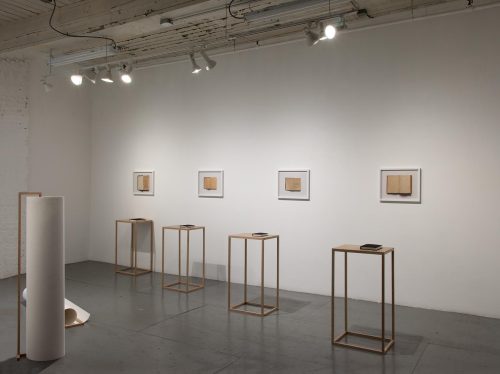
During her solo exhibition at the NARS Foundation, artist Marina Kassianidou spoke with Mary Annunziata, who previously curated Marina’s work, A Partial History, as part of the inaugural Immigrant Artist Biennial in 2020. In her exhibition at NARS, Marina presents new work inspired by her grandmother’s collection of 19th and 20th-century schoolbooks from Cyprus. On display are four photographs of selected pages from these books, four artist’s books that recreate the full original texts, and four large sculptural drawings. The show celebrates a call and response with ancestors’ material history, showcasing Marina’s time-intensive artistic process in which she works with surfaces found in her surroundings, such as walls, floors, fabrics, paper, and screens, and experiments with ways of marking that respond to the surface’s appearance, use, or history.