Jiwon Rhie: Suddenly, Images Explain Everything at La Mama Galleria

Jiwon Rhie often explores moments of deep personal depression, social misanthropy, and cultural alienation in her work. You would never know it, though, from first viewing. Walking into La Mama Galleria in the East Village, NY, visitors are greeted by the playful whirring sound of over a dozen mechanical toy dogs, each covered in exploding layers of colorful, fake flowers. The dogs walk across a blue moving pad, bumping into walls, each other, or the artificial boundaries Rhie erected. In the center of the moving pad, two quarter candy vending dispensers shake with the motion of encased and enflowered toys, which act, of course, unperturbed by their enclosures. Viewers are invited to borrow quarters from the gallery to dispense pods filled with custom keychains and temporary tattoos from the candy machines. Though only a corner of a room within a larger exhibition, Rhie’s Flower Dogs make it impossible to enter the gallery without stopping to smile, take a photo or video, and procure ones own custom keychain art.

Michal Gavish: Neuro Land at the American Association for the Advancement of Science (AAAS)

Michal Gavish: Neuro Land at the American Association for the Advancement of Science (AAAS)

Photo Story

In planning her new exhibition at the AAAS gallery, artist Michal Gavish envisioned painted images of neurons enveloping the spiral-shaped gallery space, extending upward, downward, along, and away from the walls. Following an extensive phase of research and creation, spurred by personal family tragedies, Gavish created Neuro Land, a field guide to neurons. She devoted a piece to representing each type, painting a set of larger-than-life nerve cells images on fabric and paper. Gavish later assembled these pieces layer by layer, echoing the scientific method used in constructing representations of the unseen—similar to how MRI technology captures internal snapshots in segments and reconstructs them in three dimensions. While engaging with this invisible realm, Gavish reflected on her former practice as a scientist, interrogating the expansive vistas revealed through IR, X-ray spectra, or under the electron microscope.

A room with a fireplace and a rug Description automatically generated

The Philosophy of Physical Existence at Tutu Gallery

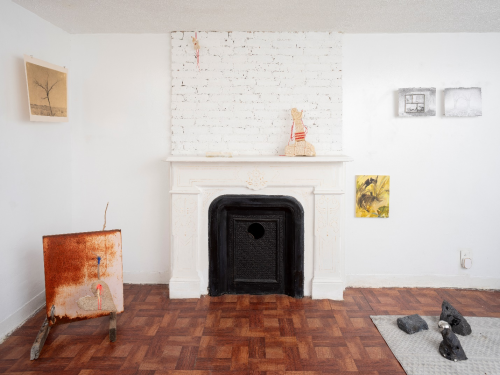
Installation view of Gentle Mist group exhibition at the Tutu Gallery, Photo Credit: Yulin Gu and Yuhan Shen

The exhibition titled Gentle Mist at the Tutu Gallery in Brooklyn could be mistaken for primarily being idea-driven, in which case the ideas precede artwork production, along the lines of artists working with clarity of vision, such as the Conceptual artist Sol Lewitt and the Minimalist artists Tony Smith and Robert Morris. However, upon closer examination of the works by this group of New York and Baltimore artists, we realize that the makers of the art objects are more intuitively engaged with their art. There is a great deal of trial and error and improvisation in the creative process, and the ideation and production processes integrate up into a complex maneuver or dance.

Mapping the Invisible at the Flinn Gallery

Mapping the Invisible at the Flinn Gallery

In Dialogue

Mapping the Invisible, the final show of the ’23-’24 season at the Flinn Gallery in Greenwich, Connecticut, showcases the work of Laura Battle, Jaq Belcher, and Amy Myers, each of whom contemplate and explore the mysteries of our existence through the lenses of science, math, and geometry. Co-curated by Francene Langford and Caren Winnall, the show runs till June 19, 2024. Langford elaborates on the curatorial process and highlights the work in this show.

A painting of a person holding a rope Description automatically generated

Lubaina Himid- Street Sellers at Greene Naftali

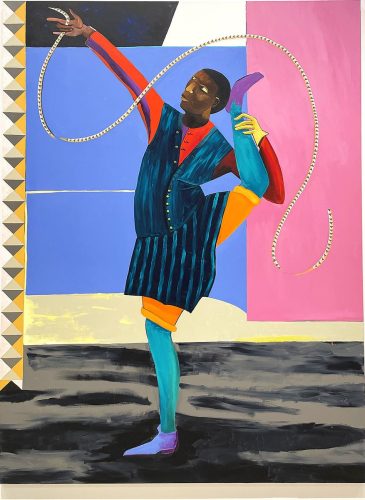
Rarely has there been a group of people as uniformly elegant and graceful as those who inhabit Lubaina Himid’s paintings, currently on view at Greene Naftali in Chelsea. Entitled Street Sellers, Himid has created a group of large, figurative paintings that pulse with vibrant color and life. These graceful, solo figures proudly present their wares to us–eggs, birds, musical instruments, and fish, as they move through the landscape.

A group of white bears statues Description automatically generated

Travelers, Liars, Thieves at Garrison

Photo Story

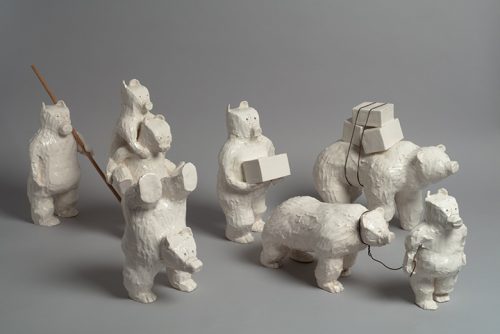
The three-person show Travelers, Liars, Thieves at Garrison presents the work of artists Margaret Lanzetta, David Packer, and Niki Lederer, who also curated the exhibition. Margaret Lanzetta’s paintings, crafted with acrylic on satin, cotton bedsheets, and sari fabric, explore the fusion of decorative traditions from various cultures, reflecting interconnectedness between cultural and political narratives. Niki Lederer’s artwork, made from repurposed discarded materials such as umbrella canopies and nylon threads, highlights environmental concerns. David Packer’s bear sculptures serve as a metaphor for personal, economic, and political upheavals. Collectively, the three artists re-imagine the world with united boundaries, new environmentalism, and migrating identities.

Sari Carel: A More Perfect Circle

Hot air

Artist and activist Sari Carel created A More Perfect Circle, a series of ceramic sculptures inspired by the single-use coffee cup, a ubiquitous object that brings into focus people’s daily experience of interacting with trash. Lentol Garden in Greenpoint, Brooklyn, hosts its first public art project that includes columns built of stacked ceramic forms and disks in the shape of plastic cup covers. The handmade, intentional, and individualized quality of each unit contrasts with the mass-manufactured coffee cup that inspires this project. Some of the drawings, experiments and observations that inform the installation are on view at the Greenpoint Library. A series of programs with 350Brooklyn and Climate Families NYC accompany the exhibition. Find out more here. The project is organized by KODA, a New York-based nonprofit arts organization dedicated to mid-career artists of diverse backgrounds. It is curated by Jennifer McGregor, who interviews Sari Carel for the Hot Air section in Art Spiel.

Womanhood 102: Lesley Bodzy and Katie Commodore Challenge Gender Norms

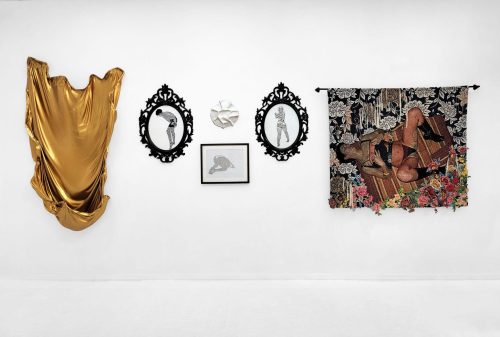
A golden, shimmering drapery cascades from the wall—the skin-like surface of Soft Embrace is from Lesley Bodzy’s experimental work with acrylic paint. She uses the liquid pigment as a sculptural material, shaped into a malleable cloth, reminding of Lynda Benglis’s poured latex on the floor or Eva Hesse’s visceral and alluring sculptures. The sensuous object evokes a tactile experience, an imagination of how touching it might feel, through looking. Matter surprises, entering a threshold between fluid and solid, elasticity and delicacy. Jamaica Kincaid’s 1978 story Girl tells a mother-daughter dispute about how a girl should behave. “…on Sundays try to walk like a lady and not like the slut you are so bent on becoming…” The mother’s advice seems endless and castigating, instructing every aspect of daily living. Side-by-side, Bodzy’s curved drapery recalls ‘how girls should behave,’ as it seemingly hides things beneath and its smooth surface presents an image of flawless elegancy, concealing feelings in a muted position.

Picks for June

Closing this week

Poignant moments of reflection burst from the seams in this week’s roundup of not-to-miss exhibitions across Manhattan. Exuberance, symmetry, and swathes of color bathe viewers in myriad ways through these must-see shows across New York City.

Judi Tavill: Entanglements at Ivy Brown Gallery

In Dialogue

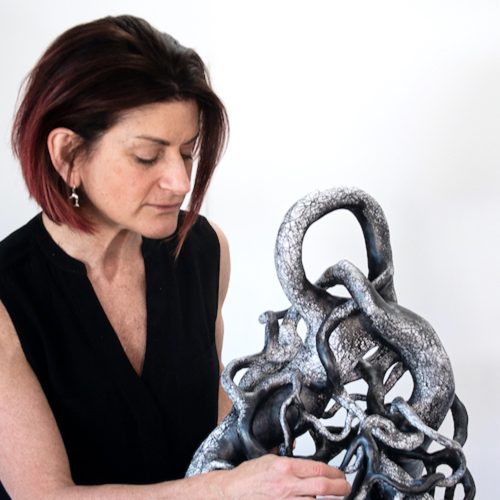
Entanglements, Judi Tavill’s solo show at Ivy Brown Gallery, unfolds a world of biomorphic abstractions. From intimate to immersive, her curvilinear ceramic sculptures feature intertwined graphite lines on the surface that seem to emanate from within and radiate outward. Tavill’s subsequent works on paper echo these forms, creating a captivating visual journey. Tangible forms of tree systems, mycelium networks, and biological structures intertwine with intangible psychological states, interpersonal relationships, and sociopolitical tension, entangling to form elaborate networks.