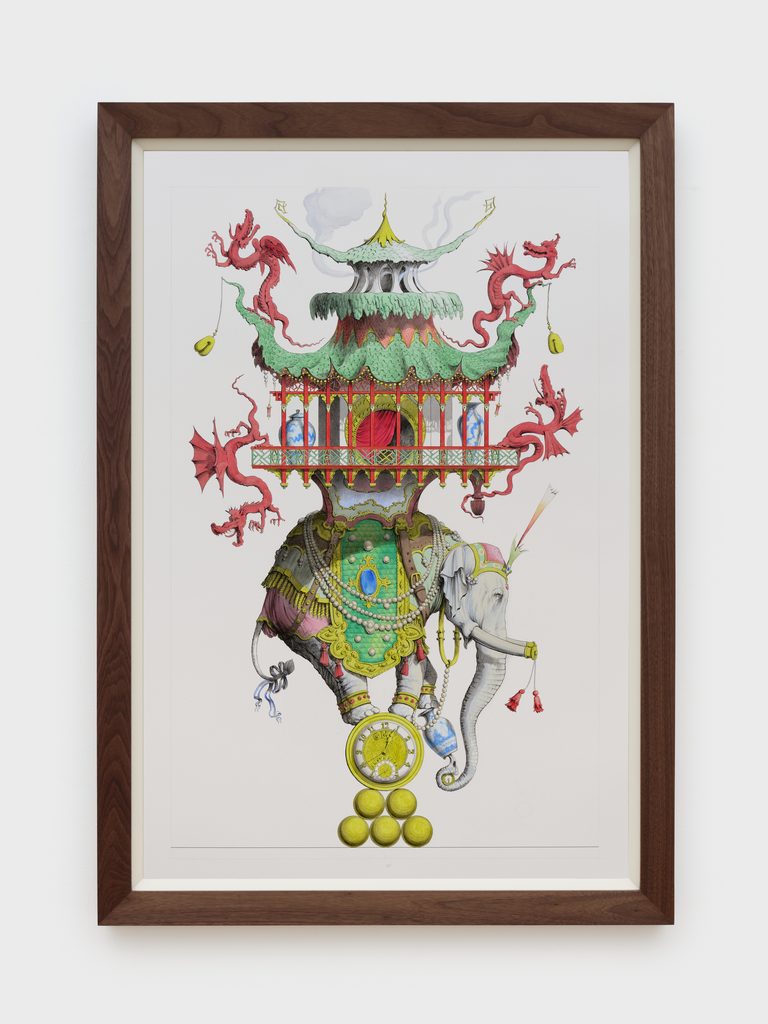
London-based Argentinian painter Pablo Bronstein draws a fantastic series of porcelain mantel clocks that he invents from period pieces and antiques. He renders each drawing meticulously, building it up with carved decorative extensions into a curious, fantastic object. In Emporium, for example, the pagoda roof ends in elongated curls, with four red dragons whose extremities are exaggerated. At the same time, he distorts these objects in space, partially flattening them into wide geometric projections that make them even more convoluted. The series is fascinating in its originality and in the many historical and contemporary interpretations it invites.
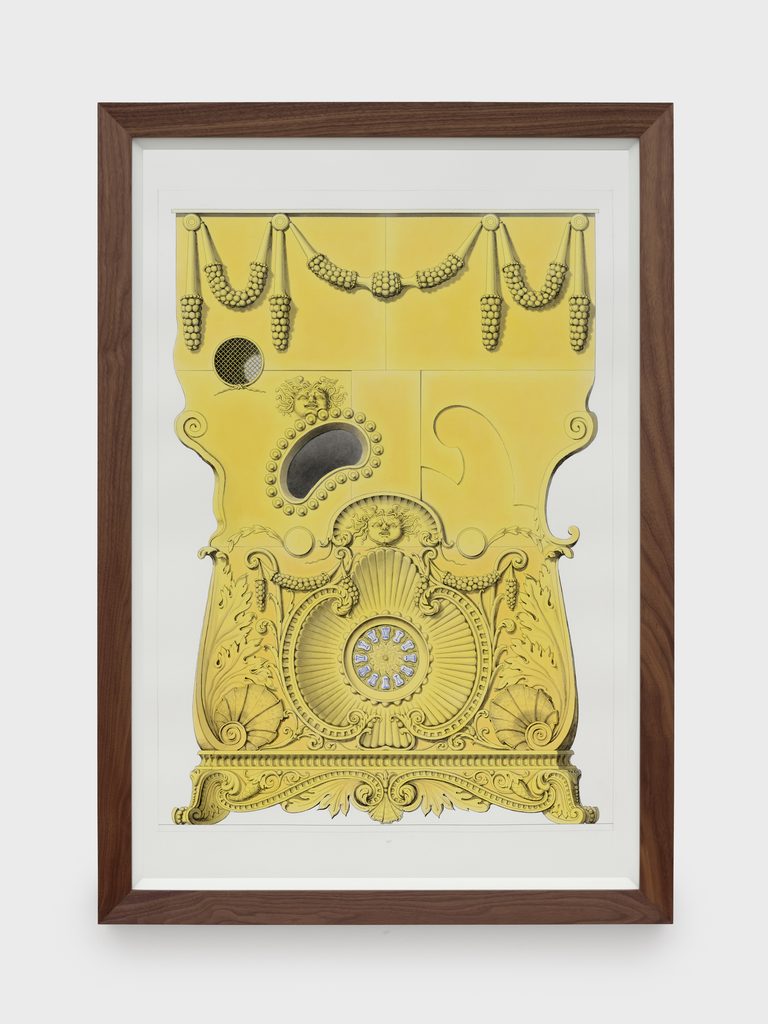
This visual transformation produces objects that appear mixed-dimensional, partly two- and partly three-dimensional. They recall antique world maps, whose flat graphic surfaces are often surrounded by illustrated mythological figures rendered in volume. In this way Bronstein offers an original view of these objects, letting viewers in on his secret tunnel vision and sharing an angle they were not aware of before. His monochromatic painting Prototype, for example, reads mostly as flat, except for a few shapes that are depressed below its surface. A central decorative shell frames a handless clock, and floral stems extend from its edges in negative relief. This Victorian clock is purposely confusing, looking realistic while at the same time turning into a flat diagram of itself.
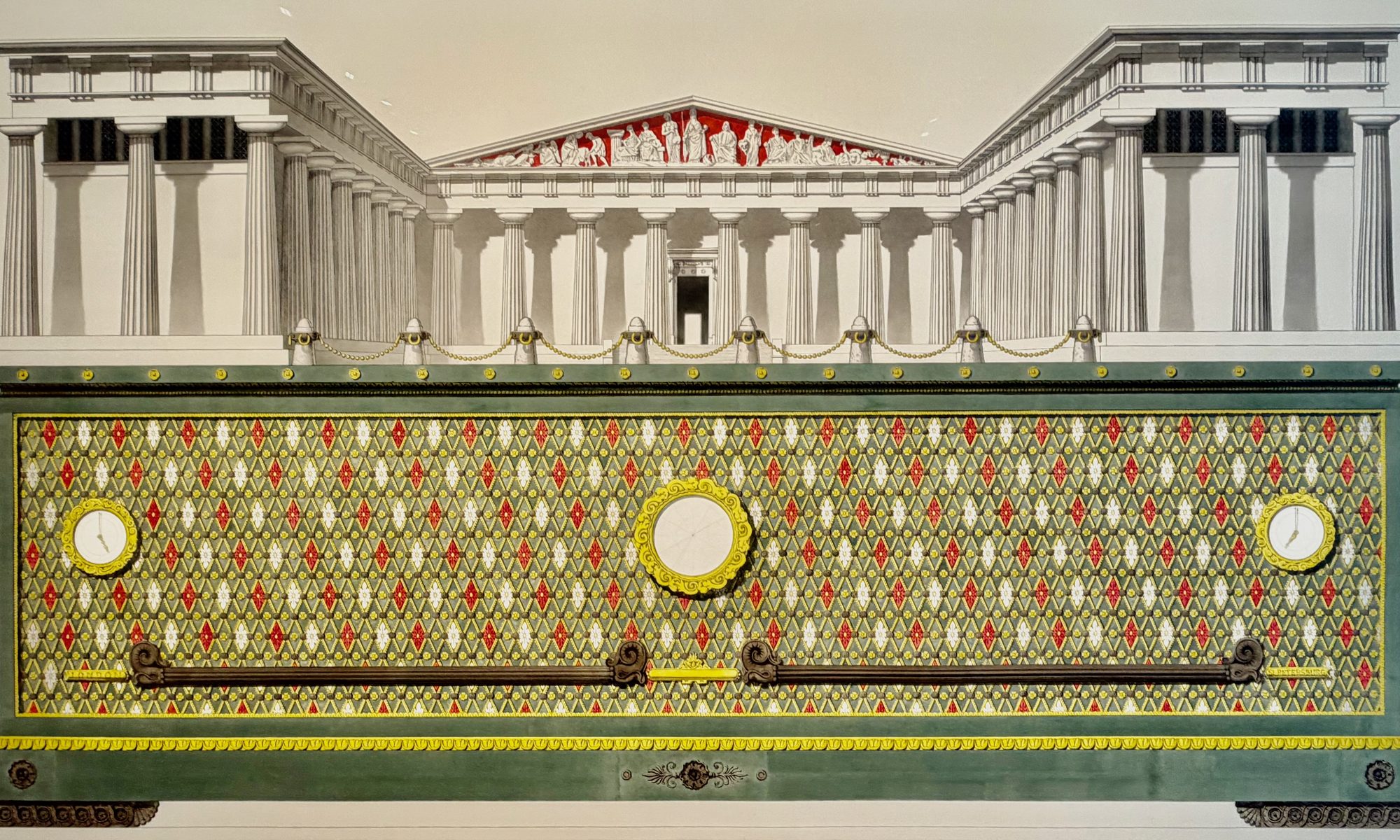
His realistic graphic style makes these mixed-dimensional objects believable. Bronstein draws them like a designer preparing a proposal. He uses basic old tools such as a ruler and a compass and keeps his practice within self-imposed boundaries that make up his visual vocabulary. His color follows the same approach: a small set of translucent acrylic inks, applied flatly and partially enhanced with even gray shading. His exact drawing style and precise, confident lines convince us that these are actual old clocks we might encounter in a museum. This is clearest in the largest work, Classical Triumphant, six feet wide, in which he places the clock beneath an imaginary neoclassical walled complex. The structure, rather than the clock, occupies most of the page, making it seem like an architectural display. He renders it in one-point perspective, its huge stone walls converging dramatically at the center of the composition. The rendering is so precise that the building seems like an actual historical palace. He even crowns it with a tympanum relief of Greek-style figures that we imagine must be a well-known artwork. Through this uncompromising exactness he leads us to believe we are looking at a real historical structure, and he grants himself a presumed authority to tell history.
Bronstein loves drawing these objects. This is evident in the way he basks in detail and in the slow, measured execution of each piece. I can imagine him as one of the old-time craftsmen sitting in his workshop, planning, crafting and refining an elaborately decorated clock in endless detail. From time to time he adds a humorous touch, perfecting each tiny part over months and years. His ornate objects show the pleasure invested in making them, and they lead us to wonder about the original makers and the elaborate procedures behind these over-decorated clocks. This beauty may not seem a good enough motivation to today’s art world, yet it links the work to contemporary craft and its recent rise to a central place in art practice. And here, too, he takes it further, coming full circle by returning craft’s diligence to the page and to painting itself.
Within his precise, almost mechanical strokes, his style is at the same time completely personal. Comfortable in perfect execution, he generates many ideas and inserts them through geometrical manipulations and the unrestrained decorativeness of his subjects. His choice of indulgent objects contradicts his modest restraint, and that very restraint grants him license to pursue a strange subject he simply loves. Instead of drawing actual museum pieces, he builds his clocks from imitations of imitations, adding whatever his imagination fancies. In this way he unapologetically embraces the love of kitsch he admits to finding in flea markets.
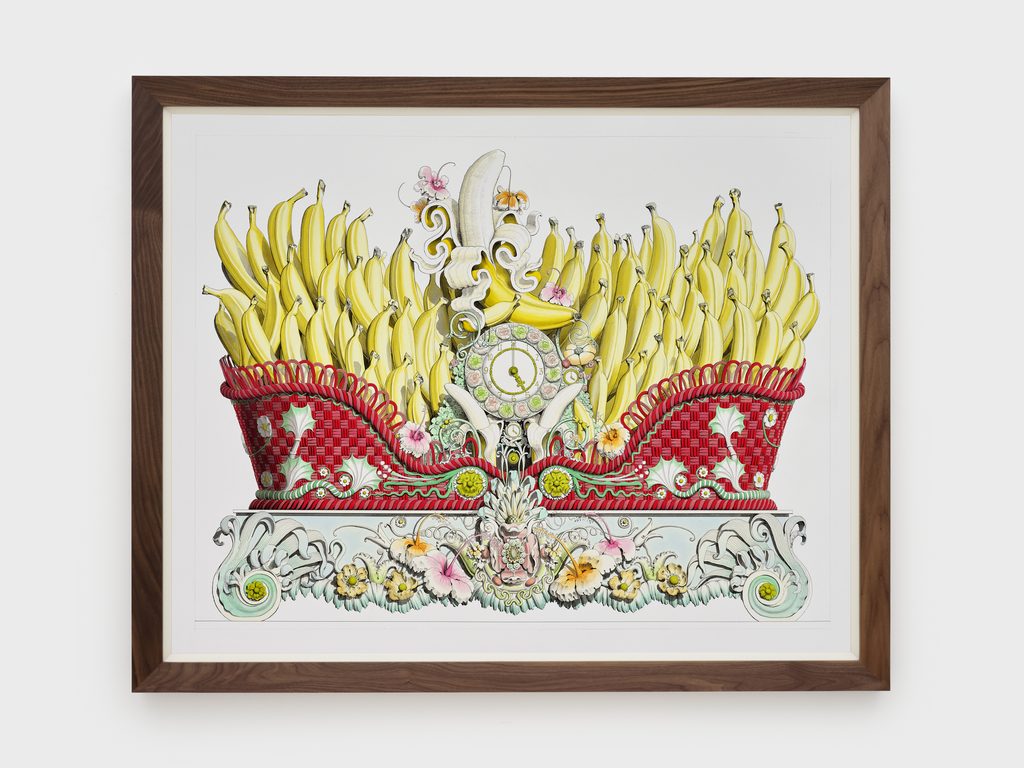
In Banana Basket, he embraces this excess. Here too, the clock itself is camouflaged by even more floral decoration topped by a gaudy red basket filled with yellow bananas arranged on both sides of it. Anthropomorphized, they stand upright, turning their stems toward the center, as if gazing at a much larger, half-peeled banana standing on a round clock, its peels winding in elaborate and even baroque curves. In this nonsensical object you can see the sheer desire for beauty for its own sake, for visual excess, and a humorous embrace of kitsch with an erotic undertone.
These absurd clocks also stir a nostalgic longing for the past. They recall empires on which the sun never set and which ruled over countless time zones, an era when geographical discovery made knowledge feel fresh and truth seemed absolute. The clocks are a ridiculous leftover of that imperial grandeur, and at the same time a trace of its simple excitement. Their antique appearance makes even the belief in measuring time nostalgic.
Their intricate excess also places the work within the story of Europe’s colonial plunder. Beyond these small drawings we are carried into a world of magnificent salons, crystal chandeliers, Eastern carpets and taffeta dresses, and ships that sailed for months carrying porcelain from China. Yet the works are not what they seem. These are not the luxury objects that witnessed colonialism, looting and conquest. They are their flea-market imitations, categorically kitsch in their excess, through which imperial taste trickled down into mass production.
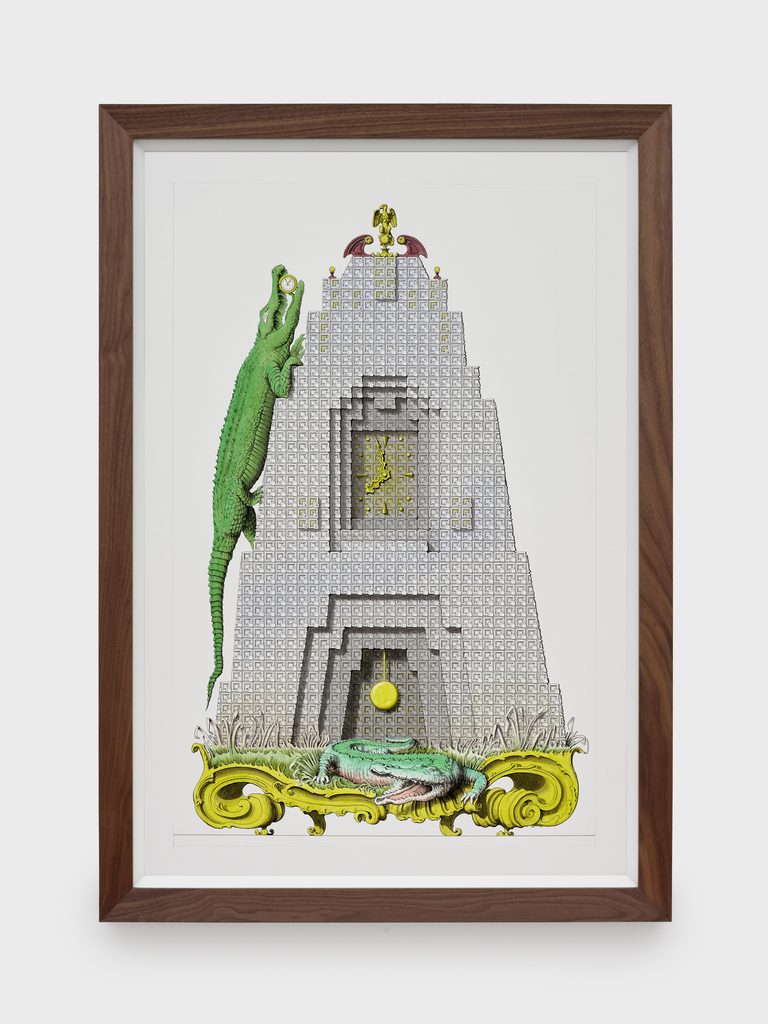
Bronstein draws an imaginary set of fancy clocks, status symbols that are all that remains of these empires. The clocks themselves, some handless, one set in the mouth of an enormous alligator, are small, barely standing out from the porcelain sculptures that enshrine them. In this way he makes the attempt to measure truth humorous. Time measurement, once absolute and a serious symbol of progress and power, is now visually overpowered by ornamental iterations and even caricature. Perhaps this is Bronstein’s quiet subject: the inevitable need to accept the disappearance of a once-obvious sense of truth.
And finally, none of these layers of interpretation would have had any value without the rare visual strength of the work.
Pablo Bronstein: Clocks, at Olney Gleason Gallery, 509 West 27th Street, New York, On view September 10- October 17, Tuesday–Saturday, 10AM–6PM
Make your tax-deductible donation today and help Art Spiel continue to thrive. DONATE
About the writer: Michal Gavish explores in her art and writing the world of art inspired by science, which connects to her previous career as a PhD research scientist. Over the past years, she wrote regularly for SciArt Magazine and SF Art News. In addition, she published several peer-reviewed articles, including an art publication at UK Intellect Publications and many research articles for scientific journals, including Science magazine. She has been working as an artist and art writer since she received her MFA from the San Francisco Art Institute in 2008. In addition, she teaches college art and science and lectures extensively on art history and on art in the Middle East, including several series at the Jewish Museum in San Francisco. @michalgavish