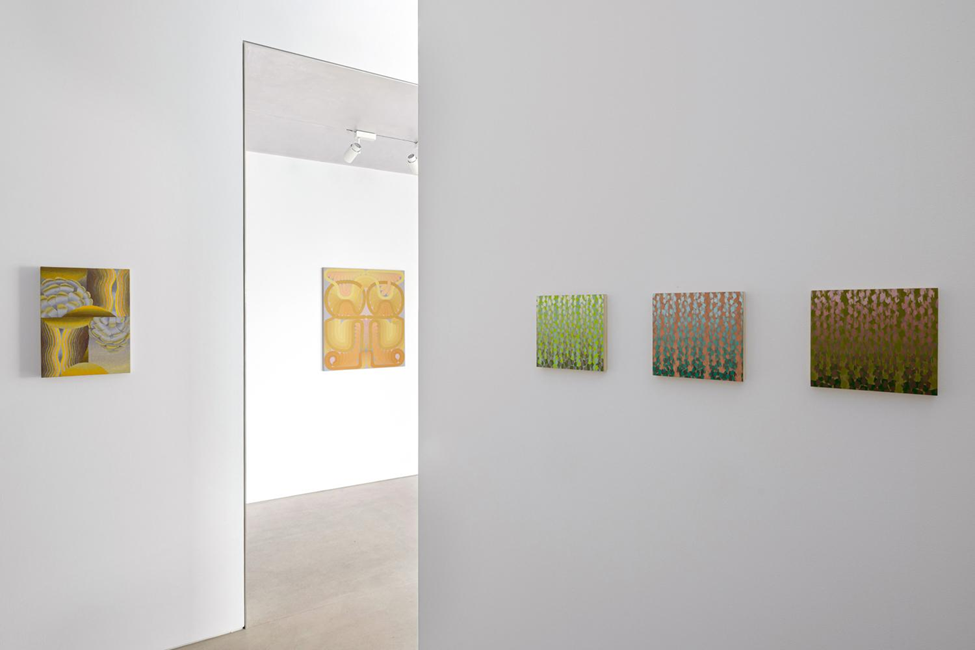
Walking into this show on a cold, blustery night, you are greeted by large windows illuminated out by gallery light. Inside, you are met with a collection of color, light, and energy. Each piece in the exhibition Spectral Evidence uses mainly acrylic to illuminate new spaces by dissolving edges, blending colors, and allowing gradients to calmly and smoothly envelope the space within the works. While each artist in the show has their own take on creating their own spaces, they use many conventions of painting and abstraction to create new forms and environments to experience, and each piece seems to flow well into the next. The gallery layout lends itself to a meandering space.
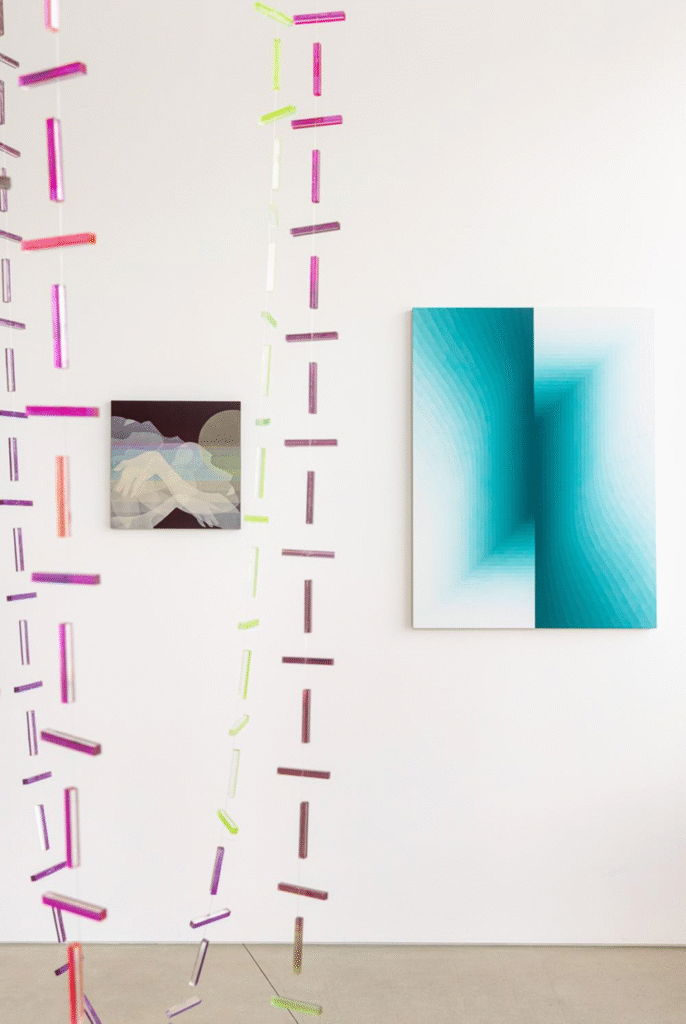
Spectral evidence becomes an interesting term within this exhibition as it still shows the presence of something, but it is barely there. Evidence of existence that is meant to be uncovered gradually. This evidence is shown through color, light, overlapping forms, space, and dissolved painting conventions, using color, line, and shape to soften the space and make it fleeting. To allow it to expand on its own. Such as the work of Audrey Stone, If If 3, seen through the suspended work of Joell Baxter. The shift between existence and the unknown, the soft and the rigid, is illustrated within Stone’s painting. Hit by a steady amount of light and a bit of distance away, the geometric lines that uphold the center of the work begin to radiate out and subtly fade into a blurred corner light. The gradients become transitions, and the energy carries into the other works around it. No matter where you step, viewing the work of the ceiling-suspended piece by Joell Baxter, you notice colors quietly collaborating and bouncing off one another.
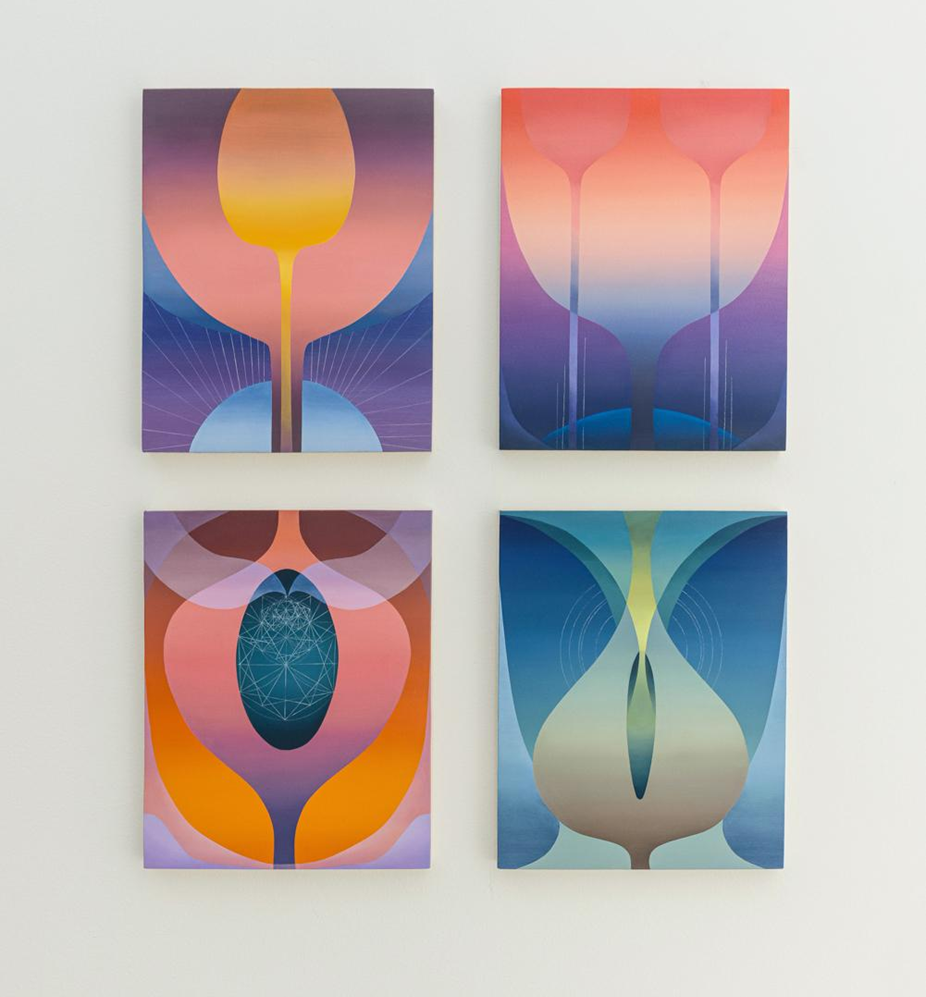
On the other side of the gallery, the paintings become celestial. The works of Minako Iwamura, especially the grouping in the side space, become a whole new space entirely. Using light and depth, Iwamura pushes the boundaries of acrylic paint and creates a smooth gradient space, one that I had mistaken to be oils at first. The smooth transitions blur any strokes and lines, allowing color and light to converge. The artist dissolves forms and illuminates new spaces and interactions within each piece, creating a futuristic or fantastical environment. With the colors and shapes interacting with the fine line drawn on top, the small pieces expand into a deeper space, a cosmic one. One that I want to step into and explore further.
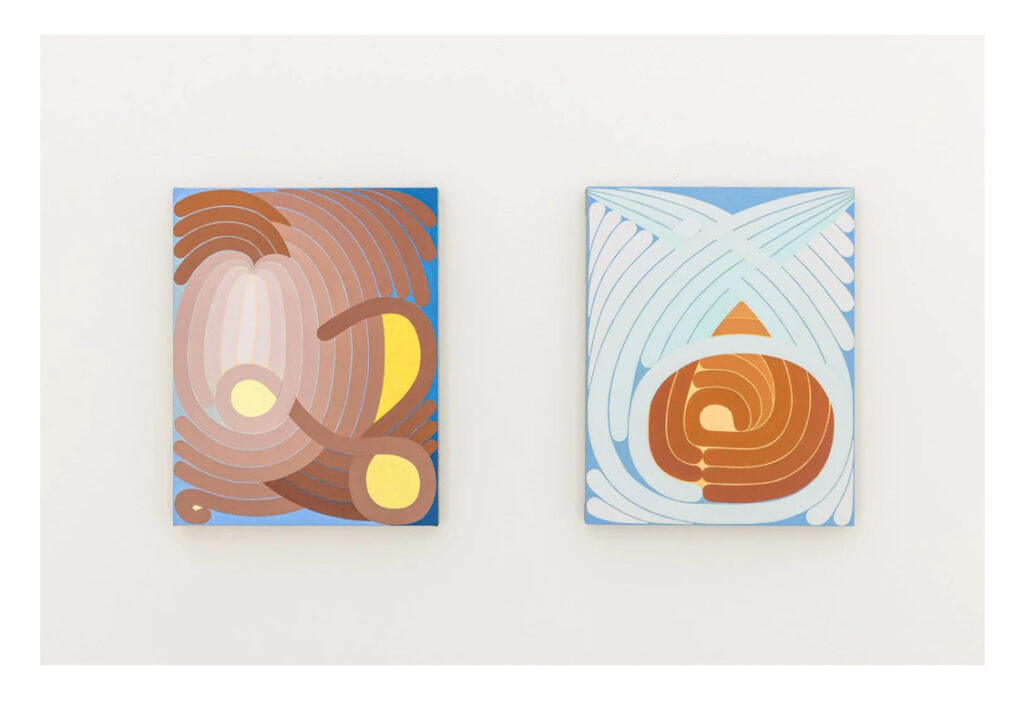
In many of these works, the edges of the canvas or panel are not a means of containment but a means of building shapes and forms that interact with one another within those edges. Such as the works of Jenny Kemp, titled Flounder and Kernel, in which edges blur, and the foreground and background merge into a single plane. Like the works of Iwamura above, the paintings can be entered through a deeper space, and the artist’s decisions are explored through minute details in line and form, and through a subtle shift in color. When given time to explore, these pieces offer a calm journey; one where nothing is forced, and everything seems to have its own flow and energy.
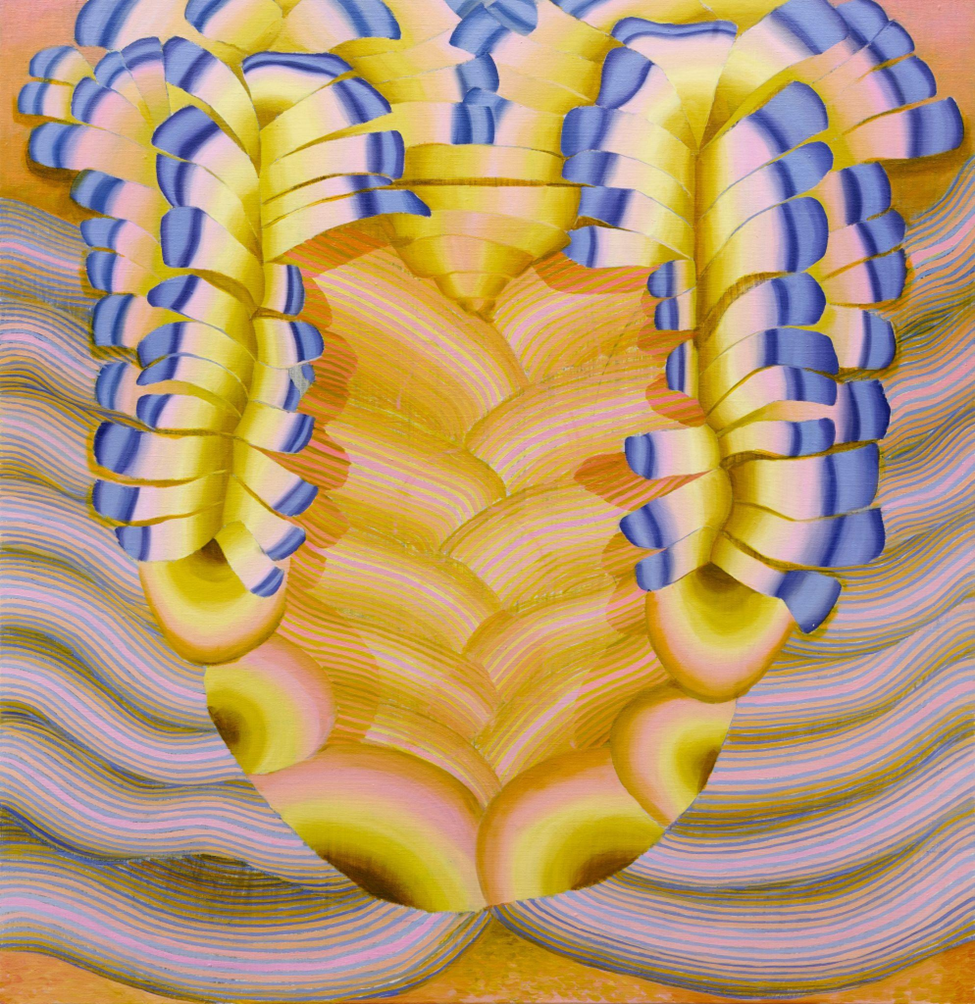
Each piece in this show takes time and patience to create. Layers are built upon or within each other. Colors converge optically, mixing. And many of these factors come together into a new space entirely, such as the work of Theresa Daddezio. The creation of the painting’s space is not rigid; it appears to evolve naturally, as if with the passing of time, without anything being forced. Inevitability becomes a calm progression forward. Daddezio offers an environment that appears both calculated and natural. Like the piece titled Spring Backwards, it carries both a calming and a blooming sensation. Using color transitions as a gradient, the forms within the piece grow like a flower, their petal-like shapes casting shadows on the shapes behind them. The piece itself becomes optically charged, as colors bounce off one another and flow alongside one another.
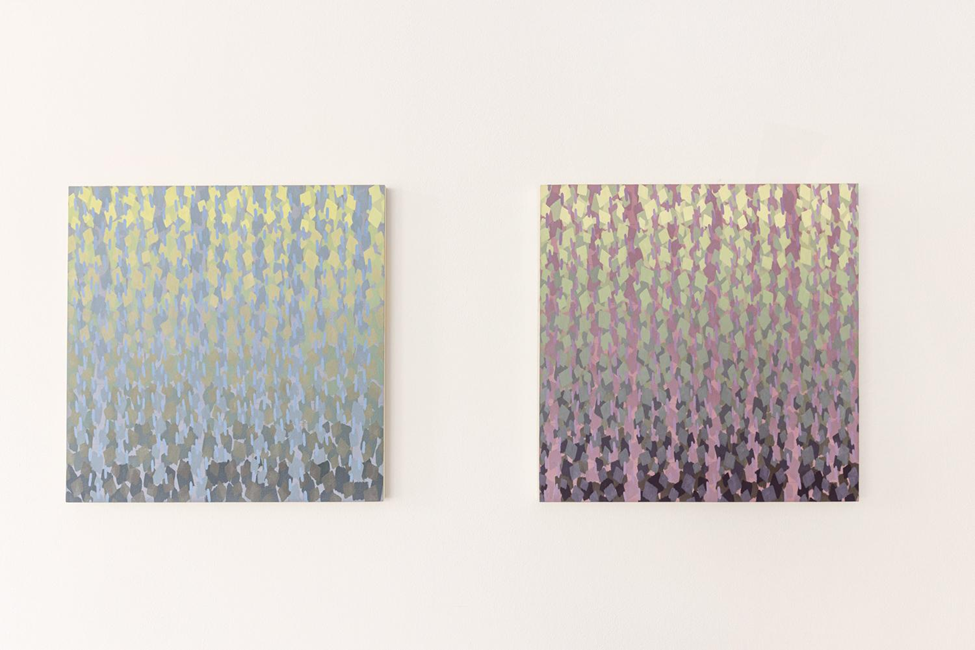
Optical color mixing is a strong foundation for this exhibition. Each artist’s use of color planes creates motion and a sense of growing light. The vibrations between colors, albeit subtle, also build up their own sense of space. Light emerges from behind, especially in Rachael Wren’s works titled Lifeline (purple) and Lifeline (blue). When I first approached Wren’s works, I assumed each shape was a painted gradient, but upon closer inspection, each individual shape was its own color plane. Each plane altogether created its own chain of gradation. While many of the works in this exhibition appear subtly and quietly, the energy reverberating from them is steady. The entire collection offers a deeper look into how effective color, light, and the presence of form can be. No matter how quiet or calm, the presence and the space it inhabits still remain.
All photos courtesy of Kate Glicksberg @kateglicksbergphoto
Join us Dec 19 for the Art Spiel 2025 Brooklyn fundraiser featuring 200+ artists’ works RSVP here
Spectral Evidence, @theshirleyprojectspace
Curated by Rachael Wren and Sarah Shirley May
Artists: Joell Baxter, Theresa Daddezio, Minako Iwamura, Marina Kappos, Jenny Kemp, Amy Lincoln, Audrey Stone, Rachael Wren
October 24 – December 13, 609 Washington Ave
Brooklyn, NY 11238
About the Writer: Taylor Bielecki lives in Gowanus, where her studio is, and works at Pratt Institute, where she earned her MFA, she also studied at Penn State, where she earned a BA in English and a BFA in Fine Arts. She finished as a finalist in the Kennedy Center’s VSA National Emerging Young Artist program for 2017; where she earned an award of Excellence. She has shown prints internationally in a print exchange in Australia and exhibitions in Dubai, India and the Glasgow School of Art. She has also shown paintings internationally in Gallery 24N, PhilaMOCA’s juried exhibitions in Philadelphia, Pa., Perry Lawson Fine Art in Nyack, NY, BWAC in Red Hook, and IW Gallery in Brooklyn. Taylor works periodically for Two Coats of Paint, TUSSLE Magazine and has joined Art Spiel as a contributing writer.