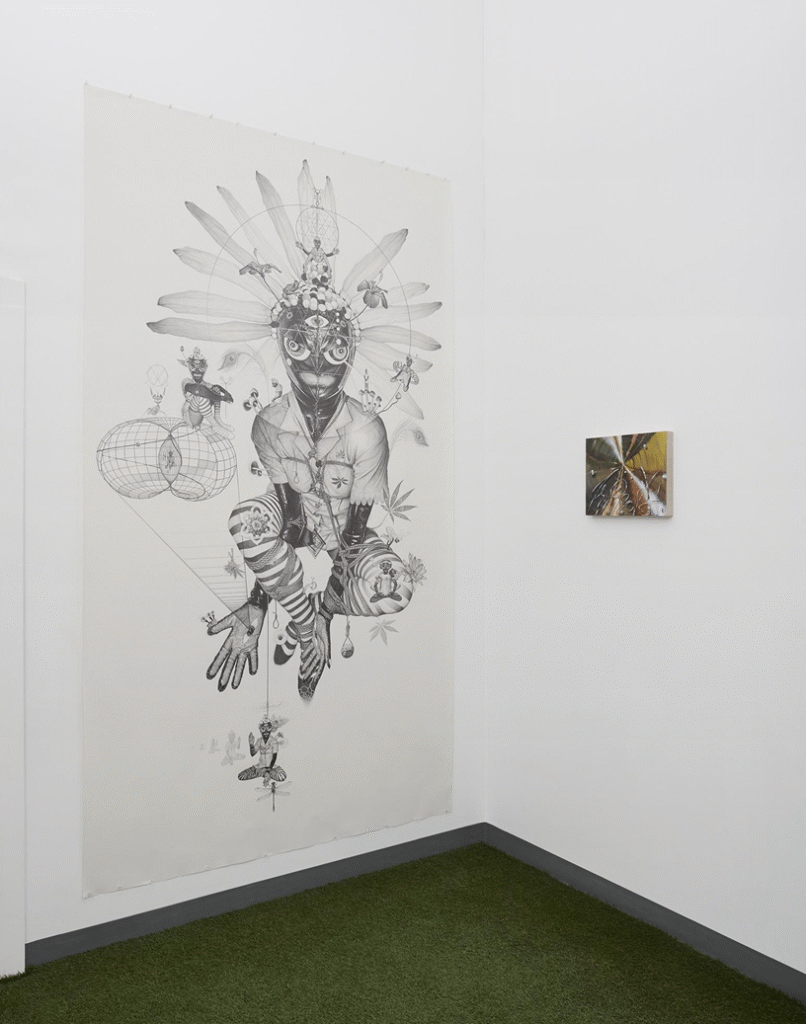
The artwork in Beamsplitter, a six-person show at Field of Play, functions as a series of portals. Named for a scientific device that both transmits and reflects light, Beamsplitter opens up spectrums of material, concept, and time. Using a mix of large and small works from artists across generations, curator David Shaw expands the Gowanus gallery’s 9 x 15-foot footprint into a dynamic array of gateways. The recurrence of circular forms and apertures presents a menu of windows to the artist’s interiority or world-view. Field of Play’s signature astroturf floor provides an idiosyncratic arena to home these loci.
Glimpsing the show from the hallway, we are greeted by the massive graphite figure pinned to the far wall. At first glance, the pristine white paper blends into the wall, making Gavin Wilson’s leather-masked subject appear to have teleported into the gallery; the plant life and schematic imagery around this humanoid shimmer like vapor trails wavering off this new arrival. Towering at over eight feet tall, our eyes come level to the cosmic being’s chest–a black hole where ropes emerge. These ropes bind the figure and descend into a noose. True to its title, Unnamed, Stable and True Penetrates Being with Sight in Hand, balances life with death; spiritual freedom with physical subjugation.
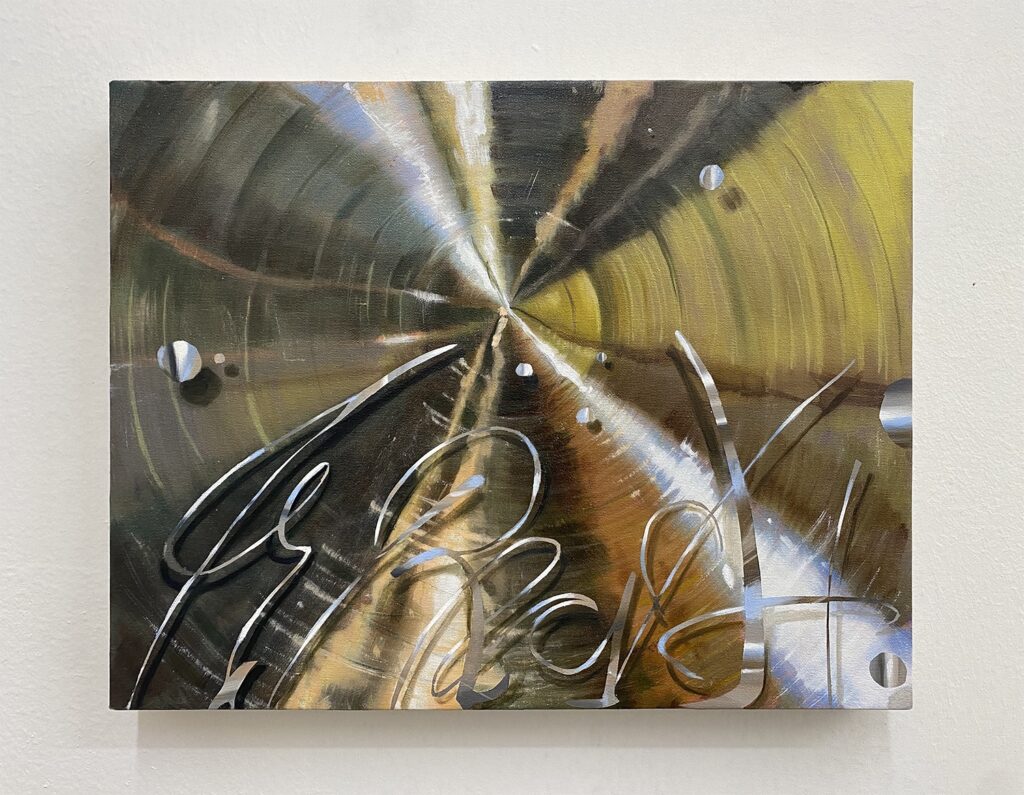
On the wall to the right, perfectly in line with that black hole of the heart, whirls the silvery disk of Bleap, an 11 x 14-inch painting by Lauren Anaïs Hussey. This work looks like a translucent record: the concentric grooves seem to obscure the light beams and earth tones of a sunlit morning. More certain are the small details that move towards the viewer. Water droplets propel forward, capturing near-light and casting shadows onto the mysterious disk. A line of script hovers glimmeringly at the bottom edge. Except when studied, this fluid gesture merely suggests letters more than spelling a word. Does it say “I’m Ready?” or am I falling for the painting’s trick? The title, Bleap—a censor, a placeholder, a word for a sound that implies a word of its own, confirms only the work’s paradox.
This visual riddle carries over to Kalina Winters’s neighboring painting, Red Mound. With her trompe-l’œil touch, Winters creates the illusion of a streaky blue surface, almost entirely covered by a protruding maroon field, like shapes cut into a red leather cushion. Due to their proportions, it’d be simple to call the sky-colored figure and blocky scribbles the work’s subject, and the red field the work’s ground. But to accept the proposition that the blue sits behind the red, then the blue is by definition the background. We are left oscillating between front and back, between words and meanings, while studying a unified whole.

Across the room, Winters has a second painting, Sitting in Light, a strangely whimsical diptych of toyish figures bathed in a buttery glow. The color scheme makes a nice call to Bleap, but the work feels like an off-key interlude. The dimensional space of this eerily cheery scene disrupts the exhibition’s planar anomalies.
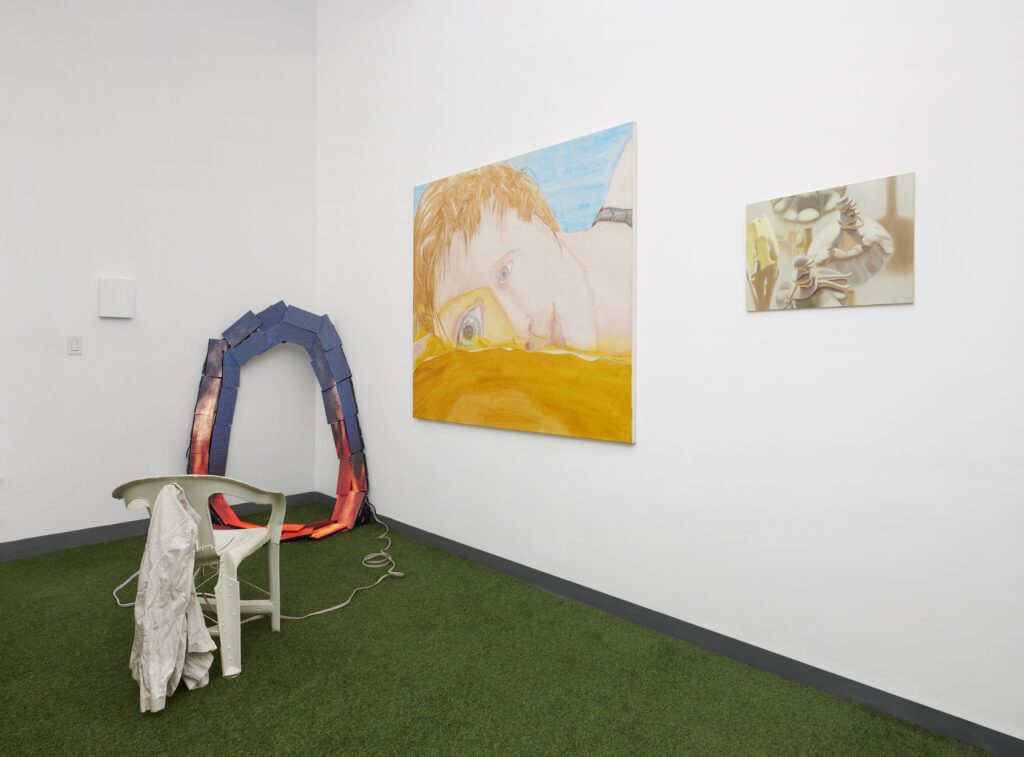
To the left hangs Sara on the Beach, a large portrait from 1998. In Scott Grodesky’s painting of a lady lying her head on the sand, the most immediate, arresting detail comes from the woman’s magnified lower eye. Its surveying gaze admits us into the painting, to notice the irregular coloration of sun-kissed skin painted in thin acrylic washes. The meticulous pencil work details the sheen and weight of her hair. This is a subject seen closely, as if we lie next to her face-to-face. But the distortion and coloration of the face’s lower half, melting into the yellow ochre ground, disturbs the serenity. The painting articulates the disconcerting mix of detachment and intimacy between artist and subject.
Inversely, a collaborative installation, Fire Ring and Geech Chair, occupies the adjacent space. Luke Murphy’s elliptically arranged LED screens rest between the walls and the faux-grass floor, like a wormhole beaming out of the corner. The devices display a randomly generated animation of flames. Humbly facing the high-tech blaze stands a lawn chair found and repaired by Michael Ballou. The endearingly ramshackle chair feels inviting and friendly, while the electronic ring of fire exudes a sinister, mesmerizing power, as if something may emerge from within the wheel. On the astroturf floor, the electronic chord encircles the seat, like a summoning circle. The wire and the chair share the same shade of beige gray, as does the coat hanging off the chair. That item–a last-minute addition–belongs to Murphy’s wife, adding an extra layer of coincidence and collaboration.
To sit in the chair and stare at the blinking blaze, we cannot evade the gaze of Sara on the Beach, her one big eye hovering in our periphery. To behold the huge bursts and small gravities of Beamsplitter, our own irises must expand and contract our pupils to modulate each artwork’s unique frequency. The result is a quiet chaos of multi-dimensional wonder.
Images courtesy of Masaki Hori and Field of Play
Join us Dec 19 for the Art Spiel 2025 Brooklyn fundraiser featuring 200+ artists’ works RSVP here
Beamsplitter at Field of Play
Curated by David Shaw
Featuring: Kalina Winters, Gavin Wilson, Lauren Anaïs Hussey, Luke Murphy/Michael Ballou, and Scott Grodesky
November 12th, 2025 – January 4th, 2026 Field of Play
56 2nd Ave, Suite 21, Brooklyn, New York 12215
About the writer: Queens-based artist Will Kaplan combines different mediums, techniques, and text to probe boundaries. In addition to his studio practice, he reviews new music and documents the city’s art scene. Kaplan has had several solo shows in venues such as Bob’s Gallery in Bushwick and on Governors Island. His work has appeared at Spring/Break Art Fair, the New Art Dealers Alliance, and Pete’s Candy Store. He has written for Two Coats of Paint, Passing Notes, and Foofaraw Press.