All photos by Catherine Kirkpatrick
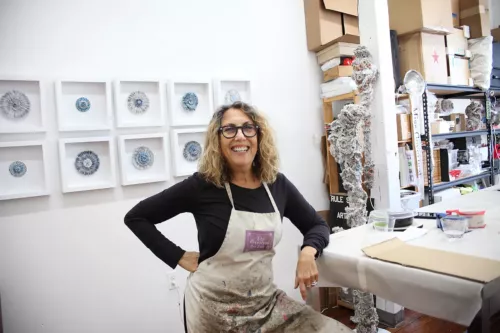
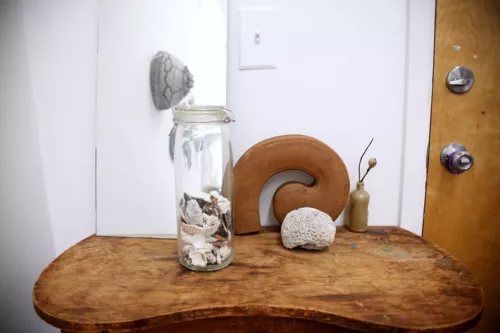
Just inside Jaynie Gillman Crimmins studio is a small table with a mirror, a piece of coral, and jar of shells. By the time you leave, you understand what they say about her inspiration and concerns. But they’re quickly forgotten as you go further, encounter the artist’s work and fall under its spell.
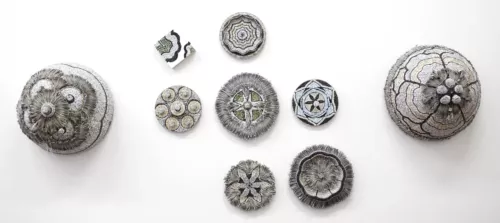
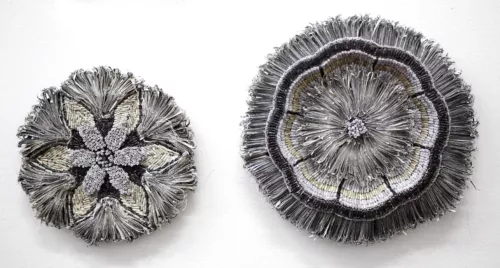
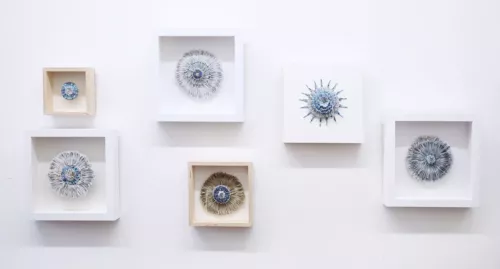
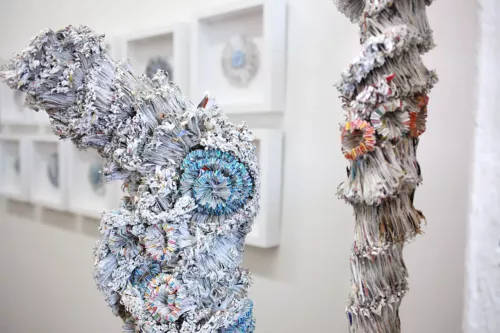
Crimmins’ pieces are small but commanding, conjuring exotic locales, but also creatures and structures of the natural world. Like fossils or discarded exoskeletons, the forms seem to have belonged once to living things, organisms with functions and cells that evolved over eons according to a very specific DNA. You feel with a little digging you could discover their kingdom, phylum, and species in a work of scientific reference. They cause you to wonder and make you think, raising questions about what they’re made of, how they were made and why. Because they seem so real, it’s a shock to learn they’re made from stuff we throw away–catalogs and junk mail.
Crimmins was born in Brooklyn, and has a B.S. in Art Education from Buffalo State College, and an M.A. in Art Education and Art Therapy from the College of New Rochelle. She taught art in public schools for more than twenty years, and like Ruth Asawa, one of her inspirations, believes in the power of art to heal and shape lives for the better. Like Asawa, she is also fascinated by lines, grids, and discarded material.
Prior to her shredding pieces, Crimmins did a series called Letting Go where people donated objects from an area of their life they felt was holding them back. The objects (including a wedding gown) were then deconstructed and worked into mixed media pieces, each titled with words taken from an interview Crimmins conducted with the participant. Very personal and respectful, very precise.
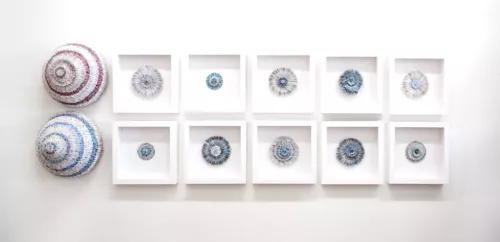
The body of work most closely associated with Crimmins began in 2009 when she was shredding her financial statements during the Great Recession. Fueled by her own anger and that of New York Times’ writer Bob Herbert who she said “spoke very movingly about what was happening to people in this downturn,” she began joining tiny bits of shred together. The first series was called Home Economics. Building a Blue Wall, inspired by the 2016 election and calls for border fortification to keep people out. For Crimmins, the political is intensely personal, though like a fantastic creature of the deep, message is always cloaked with rich visuals and a wealth of detail. Like nature, her art is deceptive and not simple.
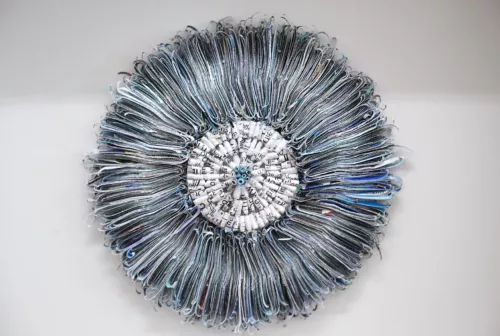
One theme that gallops through her work is “borrowing from the future.” Just as the recession was caused by human carelessness and waste, so too she realized, was the global environmental crisis. She did some research and learned that the high percentage of metallic ink used in catalogs enhances images, but doesn’t break down in the recycling process. Catalogs also promote “manufactured lifestyles” and siphon our attention. She began shredding them.
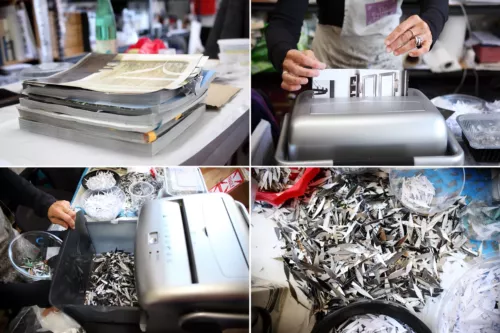
It is an art focused on the hot spot where ecosystems and political expediency collide. By pairing fragility and power, natural structure with artistic form, societal excess with individual economy and precision, Crimmins draws our attention to current issues. Unlike the shrill red state-blue state rhetoric, hers is a gentle discourse, welcoming and fun.
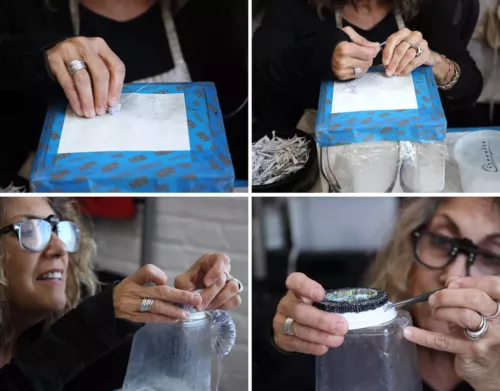
On her way to her studio in Bushwick, Crimmins walks from the Upper East Side to Union Square. It is a thinking and looking walk–no phone, no filter, no distraction–a time to take things in and lose herself in direct experience. At the studio, she tries to connect to what she saw. By taking time to think for herself, by being observant and “very present,” Jaynie Crimmins creates art that reflects a troubled world, yet is peaceful and uniquely her own.
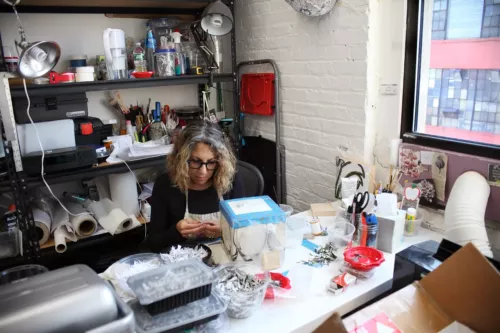
In November, Crimmins is curating a show called Civil Discourse at the Kibbee Gallery in Atlanta, and will be presenting her work at Transcender in Bushwick.
Catherine Kirkpatrick is a writer and photographer based in New York. She wrote the introductions to Meryl Meisler’s two books, and is currently working on an oral history about recent changes in photography.