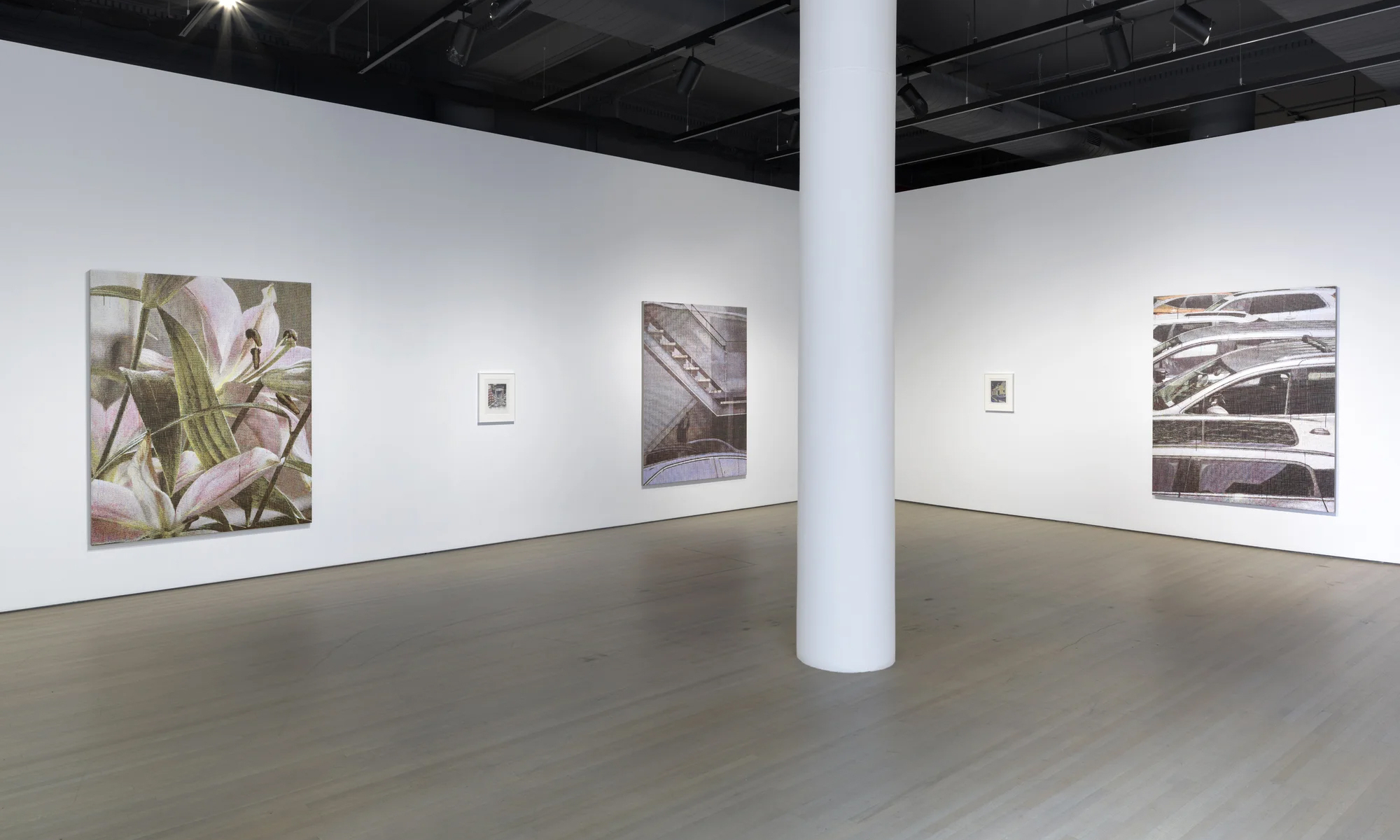
Looking at Asher Liftin’s work, the viewer might first ask, “Is this a textured surface? Is it purposefully pixelated? How is it pixelated?” As the viewer moves closer to these pictures, Liftin’s unique way of building the picture with lines rather than shapes becomes clear, using crosshatching – lines intersecting in different directions to create form and value. Another thought that follows: “Is it ink? Is it paint?” The uniformity of line makes the viewer think that this must be a drawing; however, the distinct paint drips that break the illusion of perfection suggest it is a painting instead. The short answer is both. Spoiler alert: the smaller works used colored pencils, while the larger works used acrylic ink and paint. But most importantly, why are these images so convincingly realistic?
Continue reading “Asher Liftin’s Lines Explored at 125 Newbury Gallery”Meet at the Ferris Wheel: Kathleen Beausoleil’s Plein Air Paintings Combine Psychology and Light
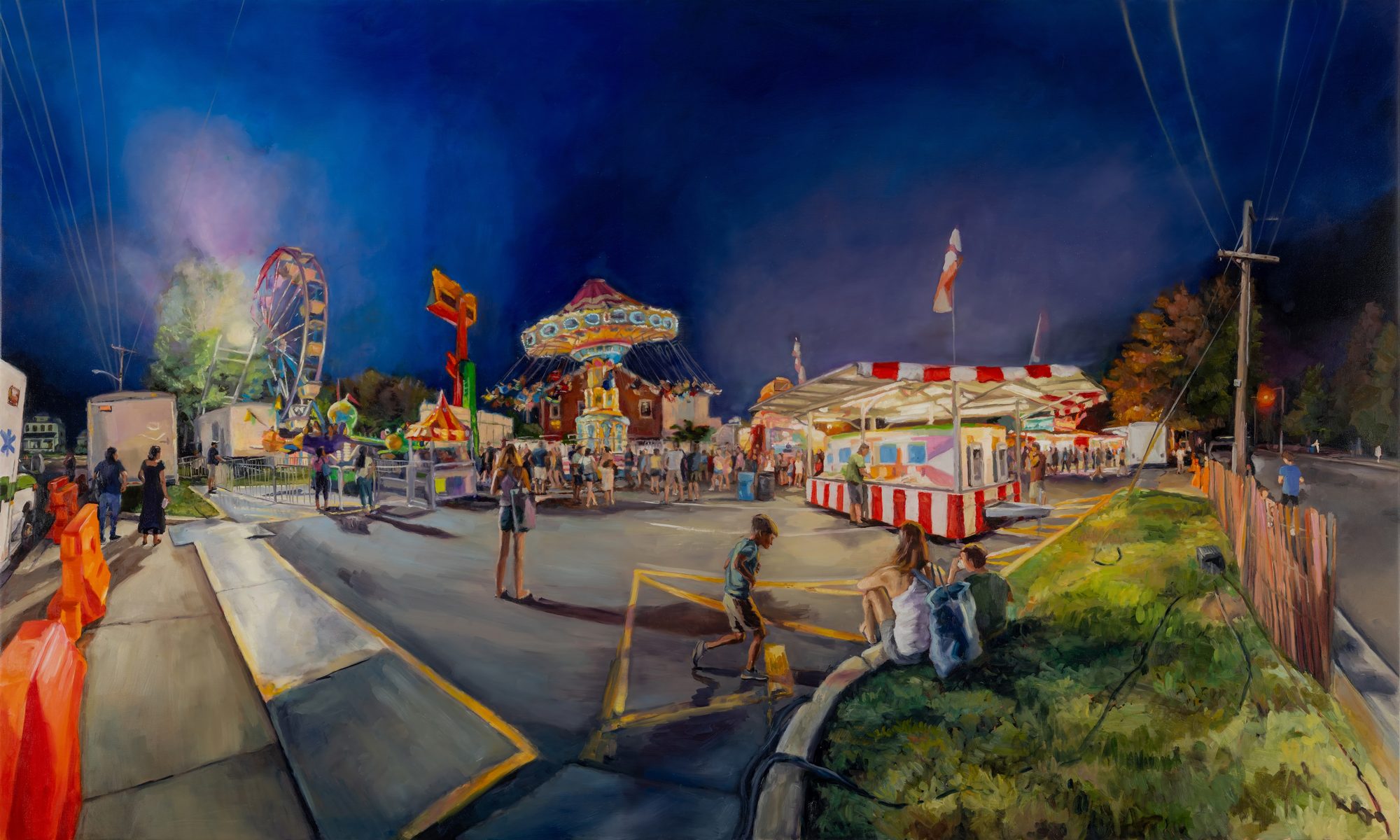
Painter Kathleen Beausoleil is enamored by her backyard, literally. The fair grounds and beaches that are synonymous to her home state, New Jersey, form her primary subjects. Visiting local fairgrounds each summer, she paints plein air, out in the open, and on view in her latest solo show at The Painting Center are works that beautifully capture the light, vibrancy, and togetherness of these places. After speaking with the artist, I understand that Beausoleil’s scenes are not only advanced in their painterly technique, but created through perspectives cleverly scaffolded by sociological terms around gathering and group behaviour.
Continue reading “Meet at the Ferris Wheel: Kathleen Beausoleil’s Plein Air Paintings Combine Psychology and Light”Cambridge-based Contemporary Landscape Painter Julia S. Powell in Conversation with MFA Boston Curator of Painting Katie Hanson
In Dialogue

Julia S. Powell, Kitchen Morning, 2024. Oil on canvas
MFA Boston Curator of Painting Katie Hanson visited the studio of the landscape painter Julia S. Powell. The resulting interview gives us an insight into Powell’s artistic process and her concept of a “fiction painter,” one that creates work at the intersection of abstraction and realism. Besides references to contemporary Impressionism, the interview addresses creating thickly-layered artworks that inspire introspection and acceptance of previous experiences—especially the unwanted ones. These layers serve as metaphors for embracing past struggles without regret. Powell’s work also provides an emotional refuge as a response to a chaotic and increasingly anxious life.
Keisha Prioleau-Martin: Recenter at Olympia

Recenter is a delightful return to Impressionism in many ways. Prioleau-Martin chooses for her subject matter decidedly impressionistic themes—moments at home, moments of introspection, and unrehearsed tenderness, all the casual yet poignant subject matter that marked painting’s initial move from the historic and fantastical to the everyday and human in the 1870s. She also employs the paint with a focus to capture the spur of the moment and the unexpected. Her small-scale ceramics, composed on the templates of stock sculptural types—odalisques, Rodin-like romantic poses, and busts, are, by virtue of their Lilliputian size and wit, Impressionist re-interpretations of dry classic forms. They start out as one thing and shift mid-stream into another: this is particularly evident in Prioleau-Martin’s bust Self-portrait (2024) which masquerades as a planter with fabric and wire vegetal tendrils emanating from her cranium along with her braids.
Continue reading “Keisha Prioleau-Martin: Recenter at Olympia”Contours and Strokes: Between Traditional and Contemporary Art Forms

When one looks at Franz Kline’s Abstract Expressionist paintings involving Gestural Abstraction, they cannot help but read a Chinese or Japanese character in calligraphic form. In fact, a relationship can be established between Kline’s “abstract” lines and marks from the calligraphic strokes of Sumi ink made by the masters of the traditional art form—Japanese calligraphy.
Continue reading “Contours and Strokes: Between Traditional and Contemporary Art Forms”Manet and Degas as Realists
Opinion

Technically, Edouard Manet (1832–1883) and Edgar Degas (1834–1917 are not Impressionists; instead, they are Realists whose works owe a debt to Gericault, Goya, and Daumier and the invention of photography. Unlike Monet, who sought solace and inspiration in nature, which can be seen as a reaction to the urbanization associated with the rise of the bourgeoisie, Manet and Degas instead embraced the industrialization and urbanization driven by bourgeois economic interests. They were unconcerned with the dehumanizing effects of rapid technological advancement. Realism is aimed at depicting scenes and subjects based on the everyday lives of ordinary people.
Continue reading “Manet and Degas as Realists”Whisperings from the Wormhole with @talluts
Midlife Big Bangs

As an artist, have you ever looked around and felt ancient, withered, and uncool? Well, this pep talk is for you, because we’re about to find out how later in life, big bangs can be the bravest and most creative big bangs of all.
Continue reading “Whisperings from the Wormhole with @talluts”