A room with black objects Description automatically generated

Tony Smith: Sacred Geometry at PACE

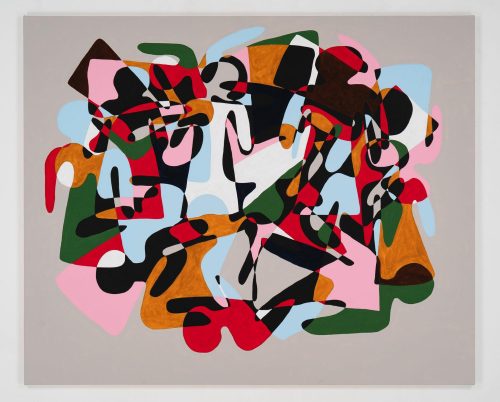
At the crossroads of architecture, painting, and sculpture, one encounters the awe-inspiring steel monoliths of Tony Smith (1912–1980). Tony Smith: Wall, New Piece, One-Two-Three showcases the evolution of the artist’s sculptural practice throughout the 1960s and 1970s.

A room with large screens Description automatically generated

Inner Landscapes | Paesaggi Interiori at MuSA Museum

featured exhibition

Inner Landscapes | Paesaggi Interiori, a video installation by Angelica Bergamini and curated by Alessandro Romanini and Maurizio Marco Tozzi, marks the beginning of a new season of multimedia work at the MuSA museum in Pietrasanta, a city in northern Tuscany, Italy. This installation artfully weaves together a rich tapestry of visual and auditory elements.

Questionable Roots: Mag Gabbert’s Sex Depression Animals

Questionable Roots: Mag Gabbert’s Sex Depression Animals

book review

With Sex Depression Animals, Mag Gabbert gives form to figment, credence to the mythic, substance to shadow, visibility to the unseeable, sacrality to the profane, and fertile grounding to the errant roots of language the poet jostles loose in various ways, transplanting them into revivified metaphors and ranging contexts.

A group of objects made out of wood Description automatically generated

A Garden Grows in the Meatpacking District

photo story

Sculptor Loren Eiferman has brought a veritable garden of strange to Ivy Brown Gallery this summer. Her meticulously fabricated wood sculptures create a fantastical garden of forms that are both biomorphic and often anthropomorphic at the same time.

Norte Maar’s CounterPointe10 – Sarah Pettitt and Shannon Harkins

Dance

The impetus for this series of conversations between a visual artist and a choreographer comes directly from my recent collaborative work with a choreographer as part of Norte Maar’s CounterPointe10. In this unique project a choreographer is paired with a visual artist to create together over two months a dance performance that integrates the two disciplines into a cohesive vision. Here is the conversation between artist Sarah Pettitt and choreographer Shannon Harkins.

A room with paintings on the wall Description automatically generated

Ashley Garret: Ambrosia at SEPTEMBER

Featured Artist

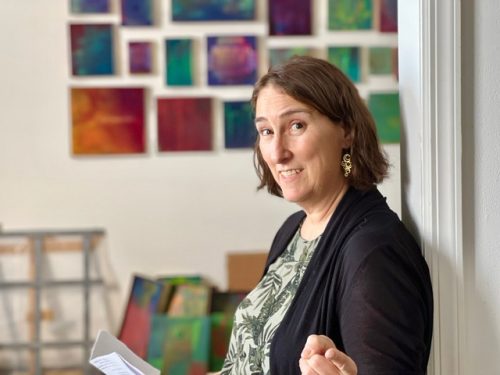
Ashley Garrett: Ambrosia, Garrett’s second solo show at SEPTEMBER in Kinderhook, NY, features a body of work she has made over three years—some evolved over years and others more quickly. Garrett has been working on large-scale 94 x 57-inch paintings on canvas since 2019. Garrett says that the weaving of brushstrokes creates a space that changes perspective between up and down, water and air. The gallery space also offers an experience of movement with sight lines through three distinct rooms. In the installation, small paintings on canvas can be seen from each corner of the rooms to the farthest corners of the gallery.

Dianna Frid: pre-knowing / un-knowing and Lucas Simões: Luscofusco at PATRON in Chicago

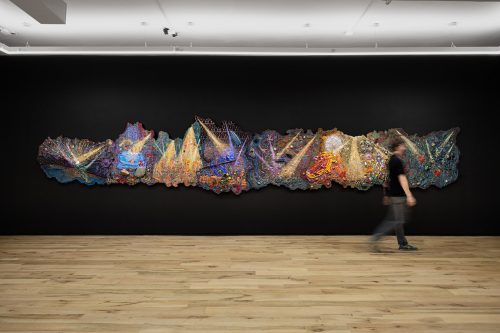
In two side-by-side solo exhibitions by artists Lucas Simões and Dianna Frid, both currently on view at PATRON gallery, the artists appear to pursue possibilities of meaning via symbolic pluralism; however, each artist could stand to learn from the approach of the other. In Luscofusco, Lucas Simões employs the metaphoric notion of twilight, positioned as the moment when light “shifts from presence to absence,” to examine persistent symbols recurrent throughout architectural history and their subsequent phenomenological shifts within unstable temporal contexts. In pre-knowing / un-knowing, Dianna Frid abandons linguistic text in its nominal sense, instead returning in her embroidered canvases to repeating patterns that form a material foundation for legibility – the marks made by the plunging and reemerging of the needle echo the repeating geometric shapes and fragments of Roman characters, allowing pattern itself to suspend the direct relationship between symbol and text. For both artists however, adherence to a dualistic approach to symbol and material, whether limited to form in the work of Simões or “text” in that of Frid, forms an impediment, preventing either from approaching the multiplicitous possibility they seek.

A person using a drill to drill a picture Description automatically generated

Time as Space: Alaina Enslen in The Summer Show at Carrie Haddad Gallery

Artist Profile

Around six in the morning, Alaina Enslen scales the steps of her Hudson Valley home to the attic where she works. Skylights invite brightness into the whitewashed studio. A hotplate rests upon a wax-spattered tabletop; she turns it on, waiting until it reaches about 170°F. After five minutes, the surface is finally hot enough to melt pigmented beeswax, an integral ingredient in her paintings. She collages in an 11-inch by 14-inch sketchbook, teasing out new ideas with pieces of fabric and leftover monotypes. “I set no expectations for the work,” the artist insists. “It’s all about experiment and play.”

Remnants of the Past As Omens of the Future at Turley Gallery

Why is home so important? Is it like religion, where we have faith that once we turn the key in the door and step over the threshold, we are safe from all those events that we believe cannot happen to us, orhappen in the place we call home? We now live in a world where the mundane, the environment we know as home is threatened. Common places are invisible because they are part of the warp and weft of our everyday existence. Our personal landmarks such as the library, the elementary school, and the ugly grocery store we quickly stop in, are no longer safe spaces. Self help and self care are great strategies for maintaining equilibrium, but may not extract the roots of our anxiety. Art obviously cannot solve these issues, but sometimes an artist who combines intellect, skill, and personal experience can act as the parakeet in the mine shaft.

Left: Pablo Picasso, 1920. © 2023 Estate of Pablo Picasso / Artists Rights Society (ARS), New York. Right: Hannah Gadsby, 2018. (Photo: Alan Moyle).

It’s Pablo-matic: Picasso According to Hannah Gadsby

Opinion

In our current era where historical and critical thinking are on the wane, one can’t complain about a show being ahistorical, but one can be faulted for lacking a cogent dialogue. Consequently, though mashing things together can produce interesting results, the parts must communicate with one another in a meaningful manner. Problematically, the exhibit, It’s Pablo-matic: Picasso According to Hannah Gadsby at the Brooklyn Museum resembles Gadsby’s stand-up comedy routine—it rambles from subject to subject, and in this case, its cohesion relies on the audience’s attempt to understand how it is all connected to the red-herring Picasso. Considering Gadsby has been put in the position of playing auteur in a medium she is unaccustomed to, one which is visual and not language-based, it might have been a more interesting exercise in a post-way of thinking to present solely the exhibition’s wall texts, or conversely just the works themselves without commentary rather than clinging to the conventions of theme based exhibitions.