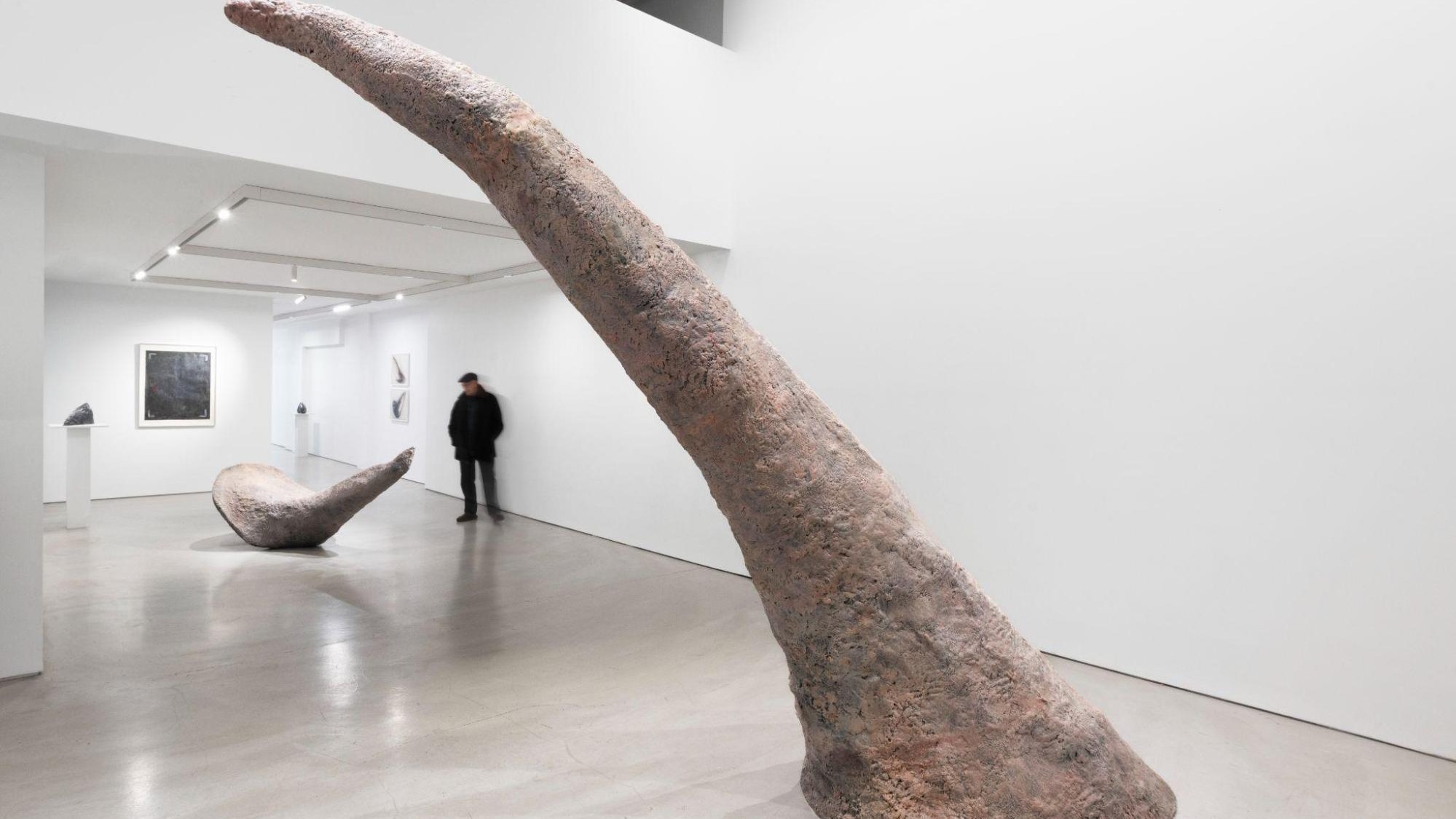
When I enter Nunu Fine Art in SoHo, New York, my body registers Mia Westerlund Roosen’s work before my mind does. Two tall forms, Heat (1981) and Conical (1981), lean into the room with a quiet insistence, their weight felt rather than announced. They rise from the floor with muscular arcs, tapering upward, commanding space without spectacle. I slow down instinctively, adjusting my path. These are not sculptures to be glanced at; they ask to be circled, negotiated, endured.
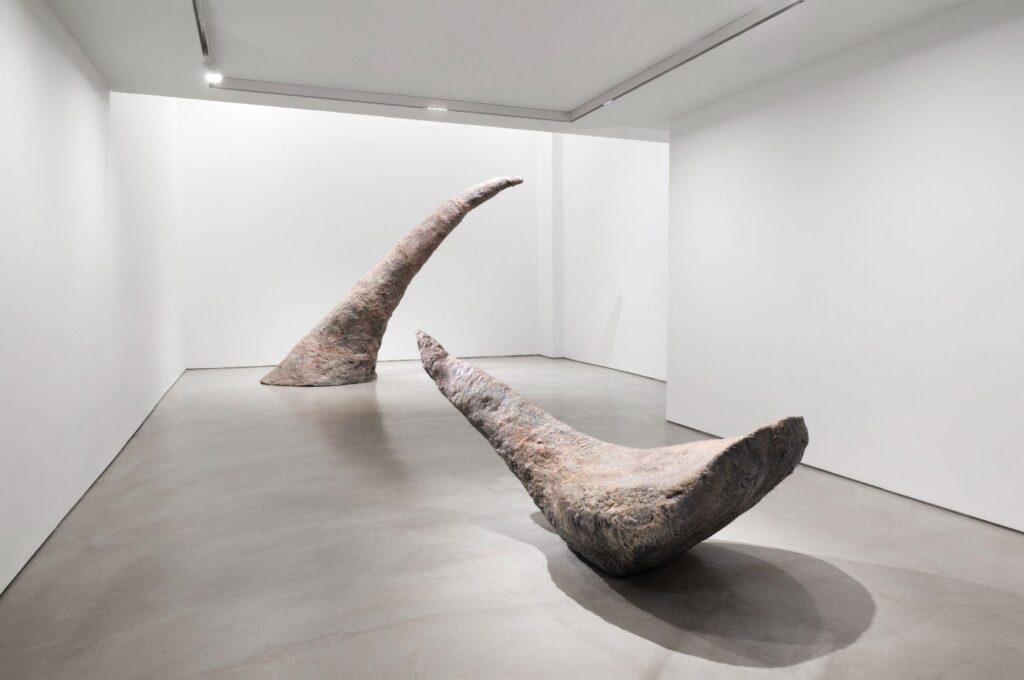
The elongated forms recall male genitalia, but the association feels less symbolic than physical. What strikes first is force: the tension of bodies pressing outward, the sense of pressure held just short of release. Made of concrete coated in encaustic, the surfaces are mottled and skin-like, stained with yellow and pink tones. Wax has been smeared, scraped, and worked by hand. Nothing is polished. The sculptures feel exposed, even bruised.
It is only after lingering with them that their history settles in. These works were first shown in 1982 at the Leo Castelli Gallery’s 25th Anniversary Exhibition, alongside Jasper Johns, Andy Warhol, Robert Rauschenberg, and Bruce Nauman. A photograph from the event shows Westerlund Roosen as the only woman in the room. At a moment when sculpture was dominated by rigid geometry, industrial finishes, and emotional restraint, her sensuous, materially expressive forms stood apart. In a recent interview, Westerlund Roosen told me her work is often sidelined in the male-dominated industry.
That tension between presence and neglect threads through Then and Now at Nunu Fine Art in New York, Westerlund Roosen’s current exhibition. The show brings together works from the 1970s to the present without hierarchy, allowing different moments in her practice to speak laterally rather than chronologically. The effect is not retrospective but continuous. The work does not announce a comeback; it asserts that it never left.
Near the doorway, Sac (2019) shifts the emotional register. Smaller in scale, wrapped in pale flannel and resin, its slumped form resembles a condom — soft, folded, faintly comic. Yet the humor is uneasy. The fabric suggests protection and containment, while the concrete core implies weight and permanence. While Heat (1981) and Conical (1981) extend outward with force, Sac (2019) collapses inward. It sags, depleted, vulnerable. Seen together, the works complicate Westerlund Roosen’s long engagement with masculinity, turning from assertion toward fragility and exposure.
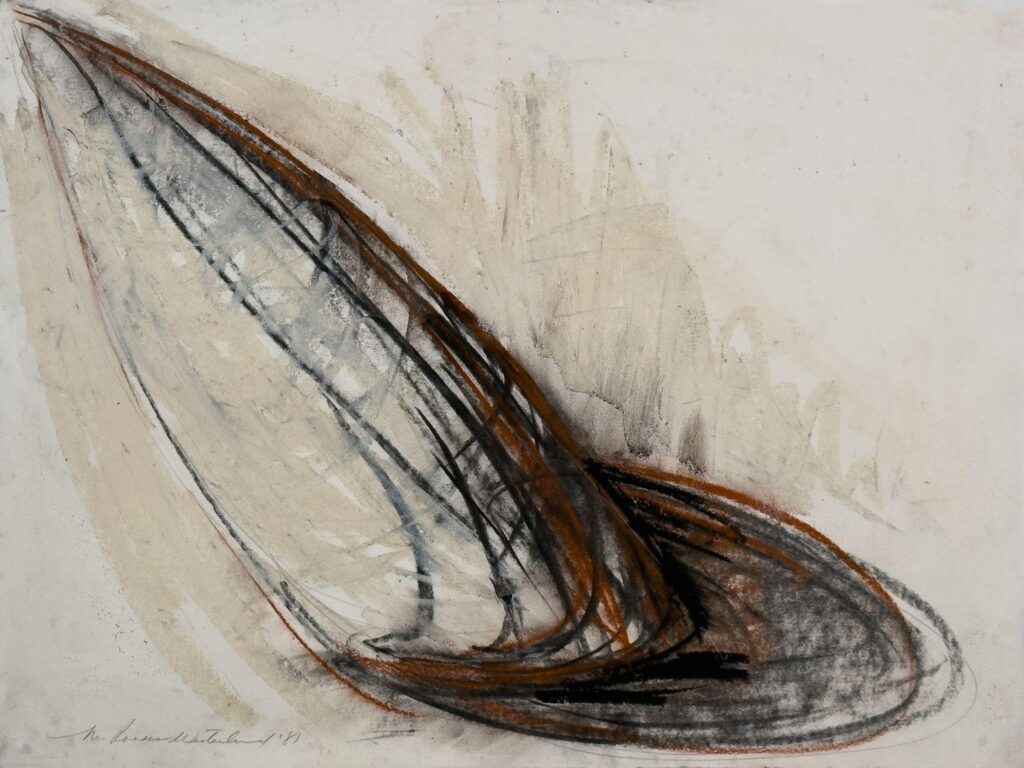
On the walls, drawings such as Heat 1 (1981) and Heat 3 (1981) extend this bodily logic into another register. Made after the sculptures were completed, they function not as preparatory studies but as afterimages — records of remembered movement rather than plans for form. Lines loop, overlap, and darken as if tracing repeated gestures through space.
Westerlund Roosen’s approach was shaped in part by the influence of Process Art and artists like Lynda Benglis, whose poured, viscous works embraced gravity, accident, and material excess as a direct challenge to Minimalist austerity. Like Benglis, Westerlund Roosen rejected the idea that seriousness in sculpture required emotional distance or mechanical finish.
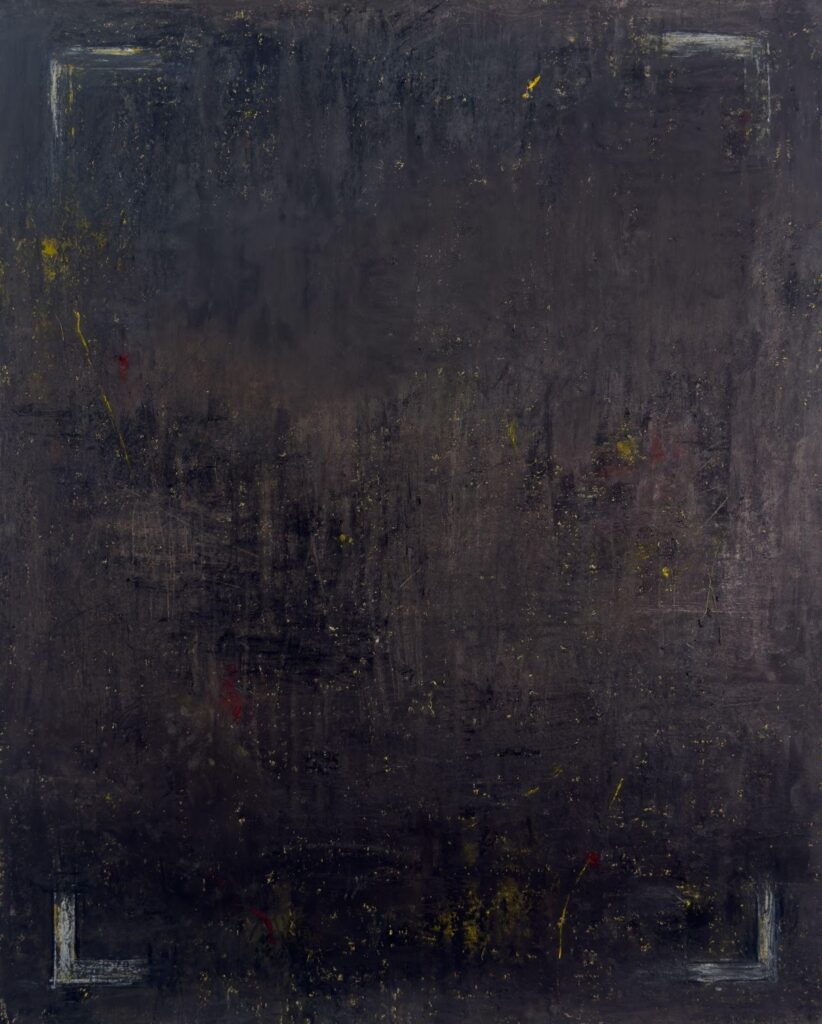
In Asphalt (1978), for example, Westerlund Roosen investigates the material in depth. The drawing presents a dense, dark field worked with charcoal, pastel, and oil stick until it feels compressed and resistant. Flecks of color break through the surface, while faint abrasions suggest pressure and friction. Paper becomes a testing ground where weight, density, and texture are translated into touch, refusing to take disembodied form.
Now in her eighties, Westerlund Roosen continues to work with physical intensity, and her work feels more urgent than ever. In her 2022 solo exhibition at Betty Cuningham Gallery titled Aftermath, she created a sequence of skin-toned resin boxes that recall coffins, suggesting death, containment, and bodily vulnerability in response to the atmosphere of war, political violence, and normalized loss that defined the Trump era. In an art world tuned to immediacy and constant attention, Westerlund Roosen’s work insists on something slower, grounding abstraction in duration, touch, and care.
Then and Now at Nunu Fine Art, 381 Broome St, New York, NY 10013, Tuesday – Saturday, 11:00 am to 6:00 pm. On view January 9 – February 21, 2026. @nunufineart
About the writer: Xintian Tina Wang is a NYC-based arts and culture journalist whose work has appeared in ARTNews, Brooklyn Rail, Observer, TIME, HuffPost, NBC News, VICE, ELLE, and Business Insider, among others. Her reporting and documentaries have earned recognition from the Gracie Awards, the United Nations Correspondents Association, and the Boston Short Film Festival. She also serves as the President of the Asian American Journalists Association. She can be found on Instagram @tina_wangxt