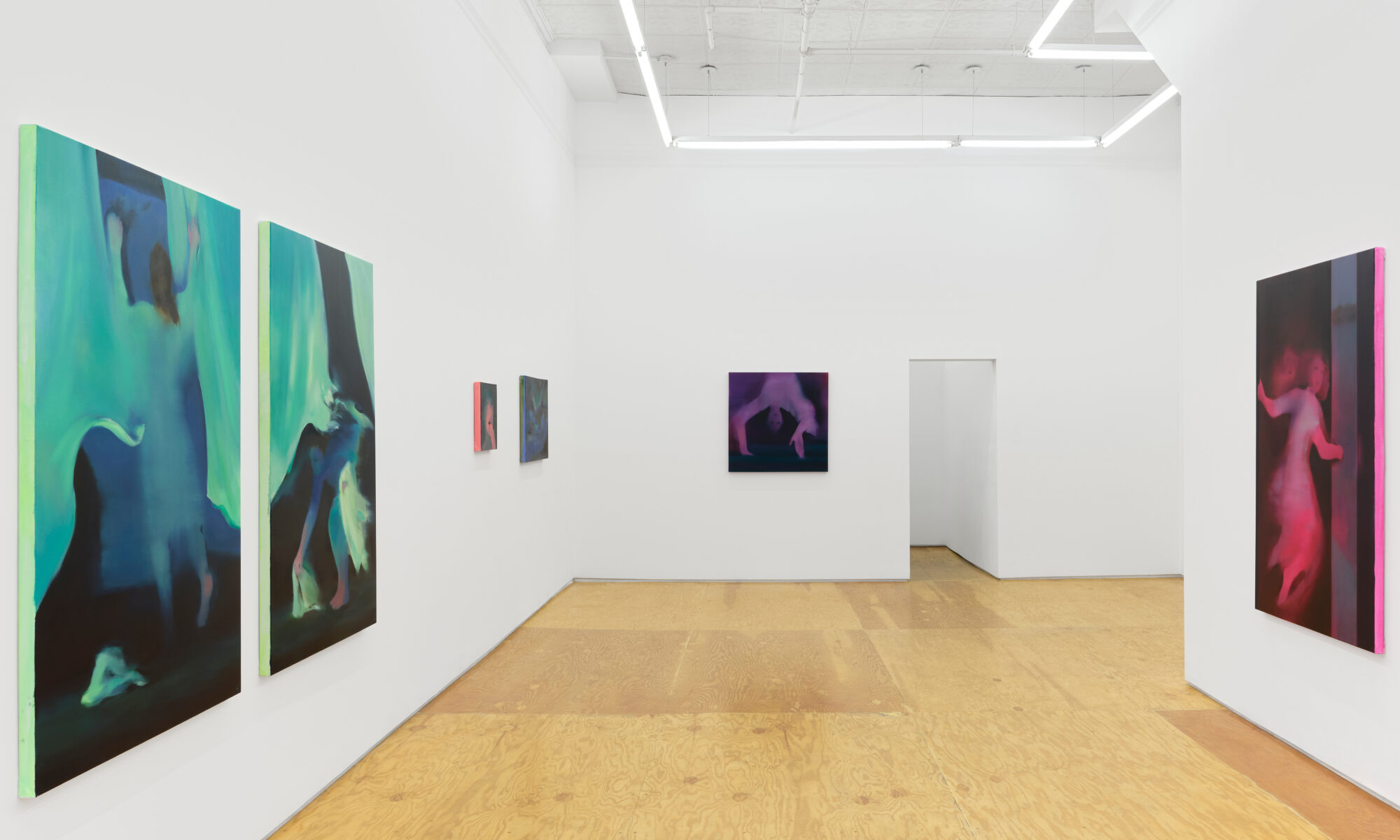
It had just rained in New York City when the smell of wet grass and pine in Central Park transported me somewhere else entirely: back in my hometown, a place I hadn’t lived in for a decade. I could’ve sworn I heard the same birds I woke up to every morning. The reminiscence was completely involuntary, but for a few seconds, I found myself caught inside an instant that felt like a different lifetime. This is the feeling that Episodes, Cathleen Clarke’s new exhibitionat Margot Samel, creates. There is no nostalgia or comfort, but instead, the disorienting realization that the past has intruded on the present uninvited.
Courtesy of Margot Samel
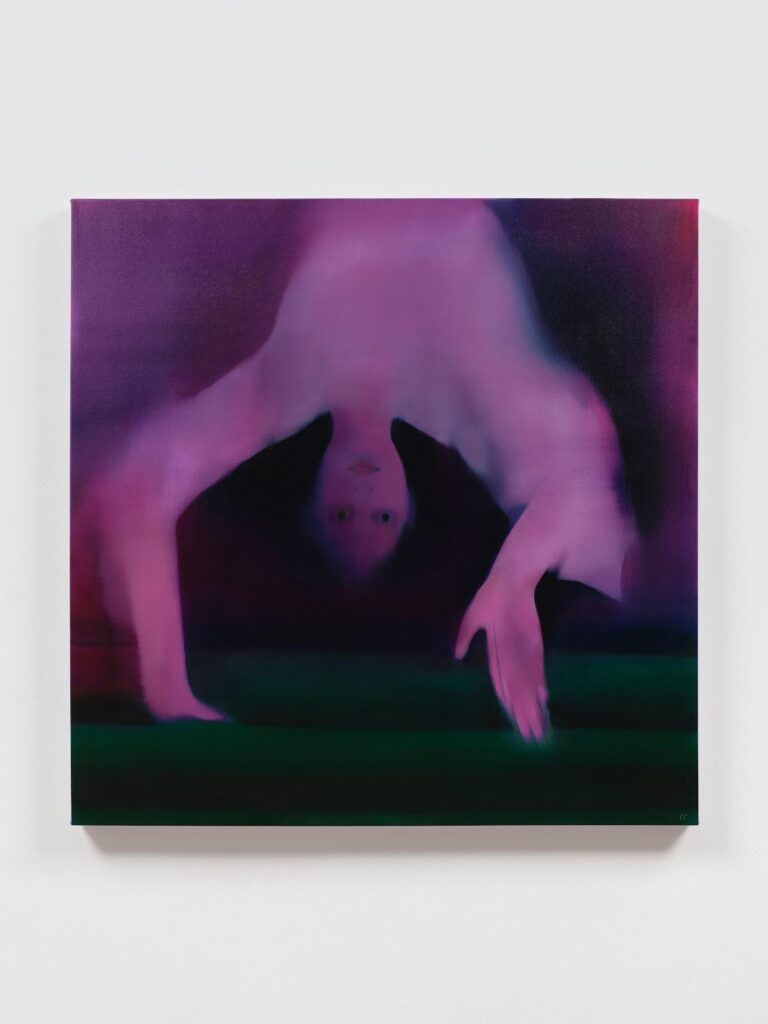
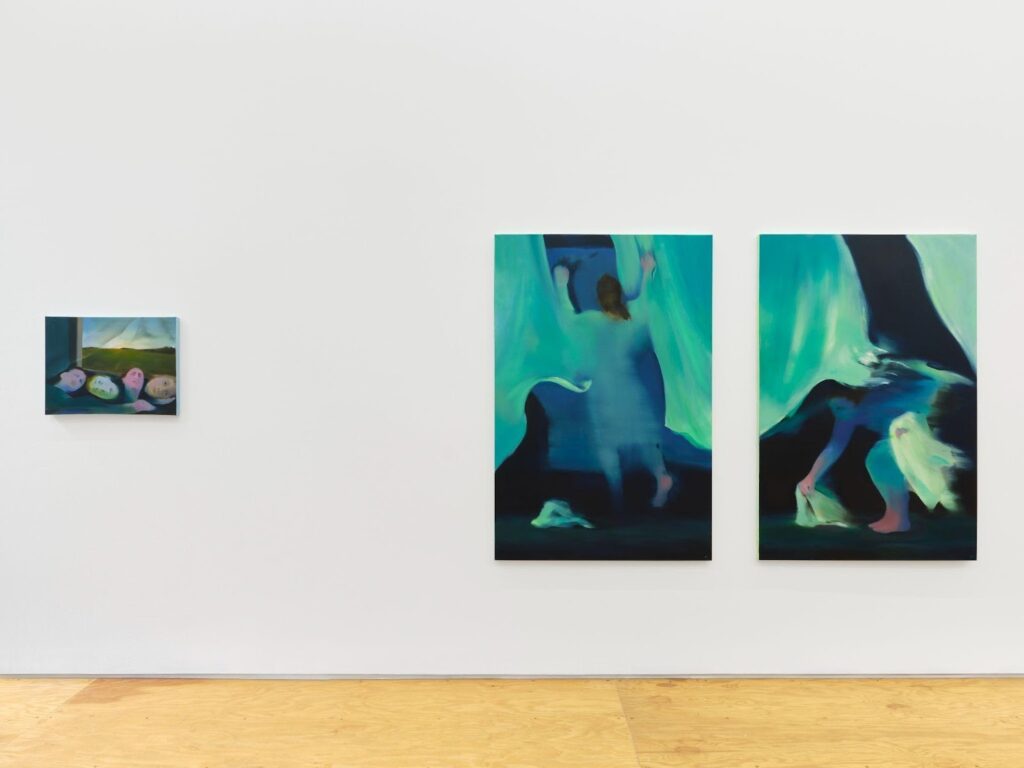
Clarke works from childhood recollections, old family photographs, and domestic scenes to create moments that hover between clarity and dissolution. Her scenes feel fluid, the colors bleed into one another, and the figures are locked mid-gesture as if caught between states. Walking into the gallery, my attention was immediately drawn to Deva Ju (2025), depicting a strange figure arching backward and staring outward. The boundary between the character and its surroundings feels unstable, yet the eyes cut through the softness with striking precision, breaking through the veil that holds it in place.
Courtesy of Margot Samel
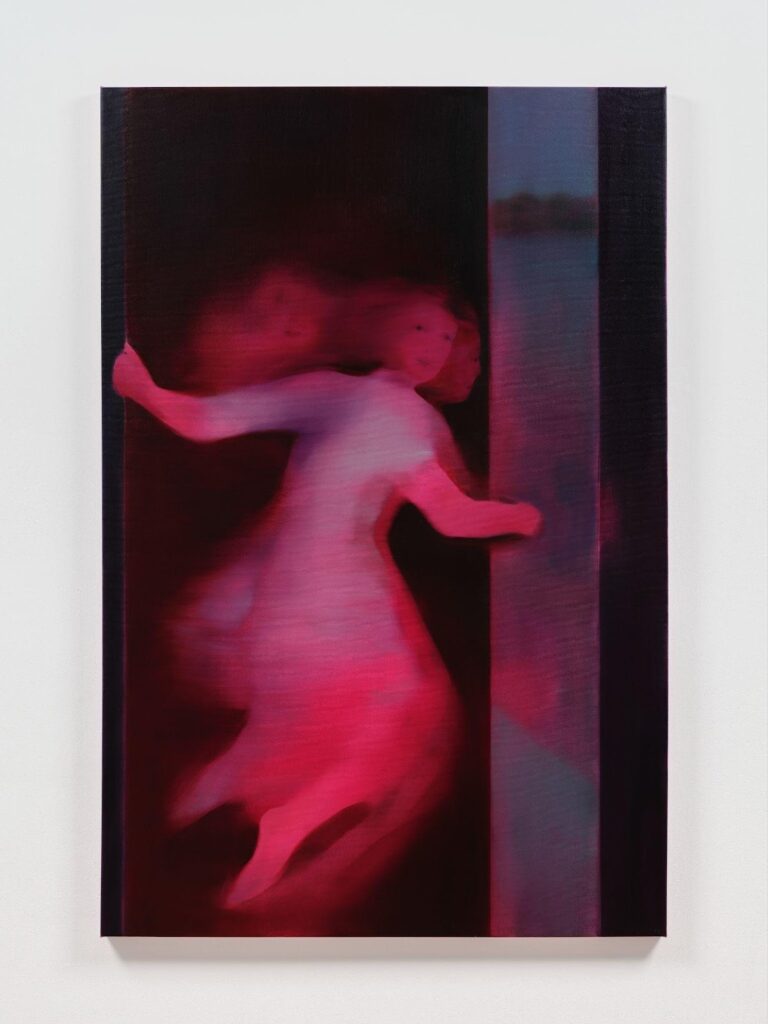
A similar tension develops in The Exit (2025), where the character’s head appears multiple times within a progression of movement. The body is destabilized and almost suspended in the air, but the eyes are rendered with a sharpness that the haziness around intensifies. Her figures do not fade into the atmosphere; they push back.
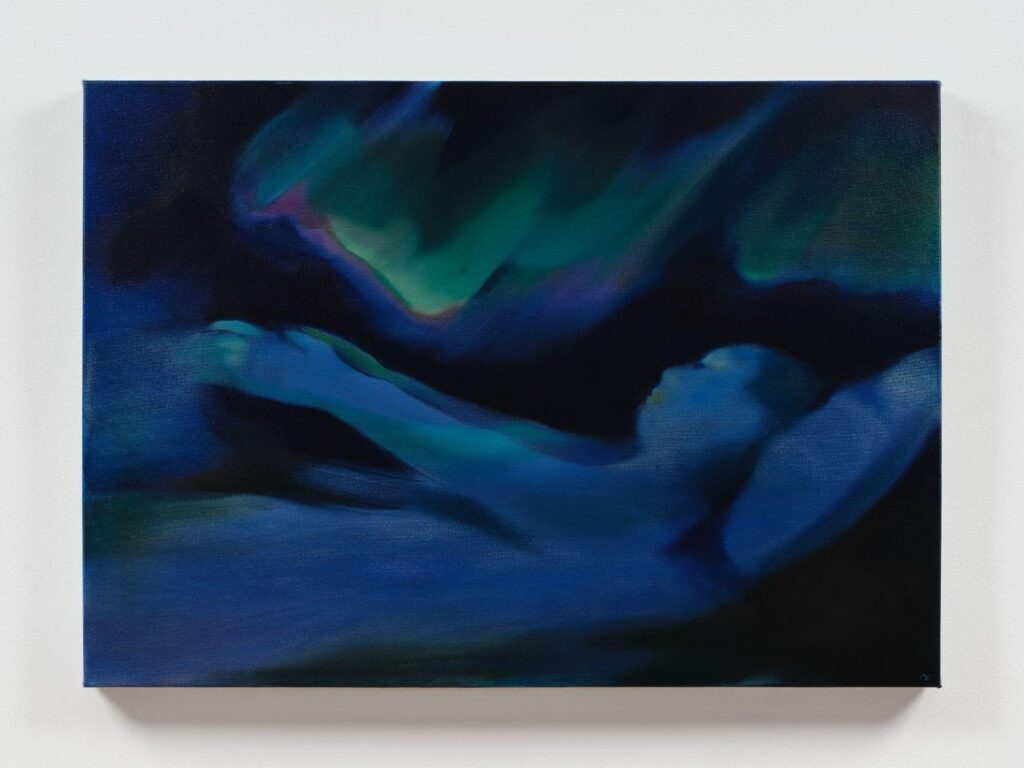
The formal qualities that characterize Clarke’s paintings are more than stylistic choices—they recreate a memory as a physical sensation rather than an image. The scenes refuse to settle as the dissolving edges, and figures caught mid-motion create friction between emergence and erasure. Memory isn’t presented with the warmth and longing that we might expect; instead, it unsettlingly presses against the present. We see this as well in Devotion (2025), where a reclining figure diffuses into its surroundings without fully surrendering. Clarke creates a state of simultaneity that is intimate and destabilizing at the same time, maintaining this tension rather than releasing it.
Courtesy of Margot Samel
Overall, the experience is never purely comforting. Although Clarke draws from intimate and personal material, the works do not offer that intimacy. Throughout the exhibition, we see elements such as curtains flowing in the wind or hands mid-gesture that make these figures feel stuck in an in-between, passing through rather than inhabiting the scenes. The familiar and the strange are held together in suspension, and neither is allowed to resolve the other.
Clarke’s refusal of nostalgia feels pointed in a cultural moment obsessed with it. In recent years, we’ve seen a resurgence that seems to only intensify—there is a collective hunger for the escapism the past provides. This longing has grown so prevalent that 2026 itself has become subject to it by being compared to 2016, a year many online describe as the last moment of cultural happiness. Clarke pushes against this notion entirely. Here, the past isn’t something to be recovered; instead, it arrives on its own terms, pulling you under before you’ve had a chance to resist.
Courtesy of Margot Samel
Episodes isn’t really about remembering—rather, it asks how we deal with memories when they return unbidden. Clarke recreates this moment of interruption with enough accuracy to make the viewer part of the experience rather than just an observer. Walking out of Margot Samel, I wasn’t sure if what I was carrying was hers or mine.
About the writer: Mer Mora is a New York City-based writer and communications professional with experience working across arts and cultural institutions in Barcelona, New York, and Tokyo. She holds a BA in Art History from the Autonomous University of Barcelona and an MA in Visual Arts Administration from New York University.