HIGHLIGHTS
As the vague New Year comes barreling in, trailing behind is a hazy fog that distorts perceptions of time and space, folding into one another like delicate parchment paper. It reads as hopeful uncertainty, especially as artists create in response to their surroundings. It is in those folds that art and dreams converge to inspire fantastical work that propels us into a new reality.
The Philadelphia Art Museum presents a survey of Surrealist artists who develop their own visual language to steep the mysticism of the natural world into everyday life in Dreamworld: Surrealism at 100. Calder Gardens welcomes you into a serene underworld, inviting exploration and quiet rumination on a selection of Calder’s works. In Holding Pattern at Blah Blah Gallery, curators organize a group of artists that pull the ornate and sentimental out of repetition while showcasing new ways to experience art. As I navigate these curated collections, I recall the work of Jeanne Blissett Robertson and Julia Policastro at Studio 105, and the transformative nature of their collection. Consider this piece an itinerary for those who seek the surreal and welcome a new environment abstracted from its original form.
Dreamworld at the Philadelphia Museum of Art
On view through February 16, 2026
Curated by Matthew Affron, Muriel and Philip Berman Curator of Modern Art, with Danielle Cooke, Exhibition Assistant @visitpham
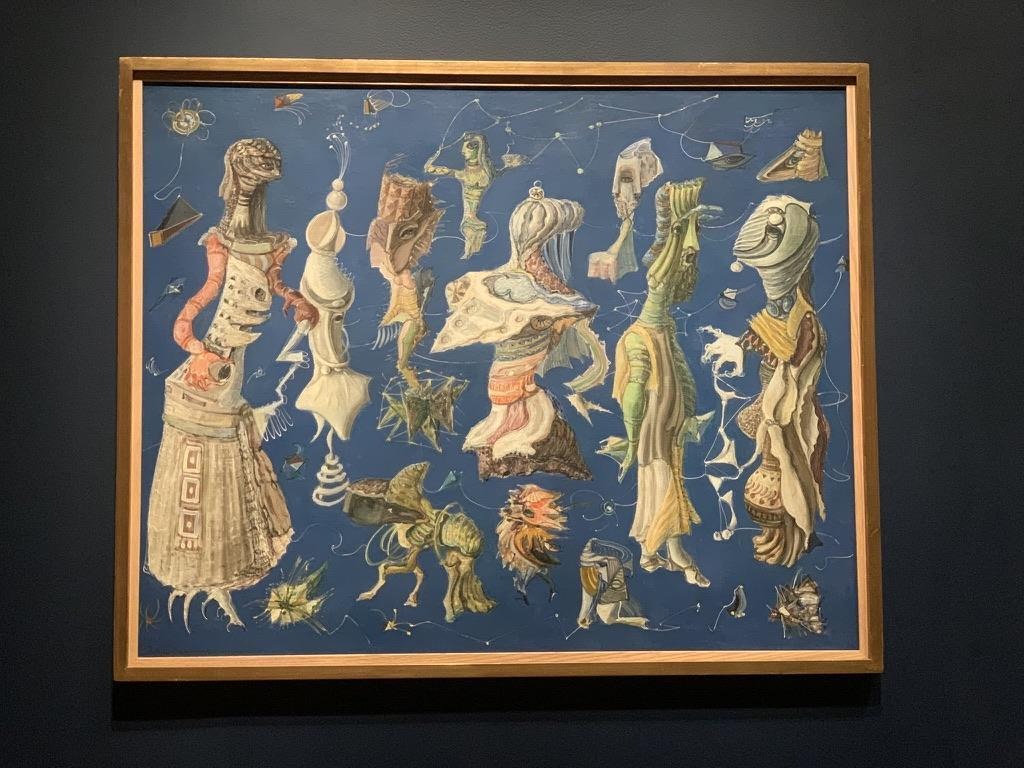
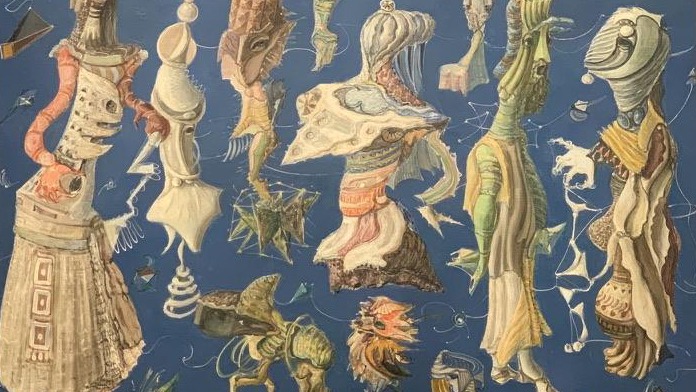
The exhibition’s entrance feels dark and foreboding, as if walking through a cave and leaving conventionality behind. Suddenly, as if it were a careless slip, you fall into a new world of cultivated color and unrecognizable bodies. The physical and material fade into poetic paintstrokes, compelling viewers to stop and read the work, like in André Breton’s The Prey. Brick reds, sage greens, and lavenders swarm around a formation with the suggestion of a foot, a hand, and an eye, basking in the sun’s rays. This piece turns feelings of uncertainty into solace, transporting you on emotional journeys as you encounter unfamiliar works by familiar names. Wandering through the exhibition felt like encountering one surprise after another: underwater creatures, a clock made of feathers and eyes, an umbrella of sponges, and a lobster phone, each work more absurd and intriguing.
As a lifelong fan of Magritte, I would always visit the single painting in the PMA’s permanent collection, The Six Elements, and was ecstatic to hear others would be on display in Dreamworld. As I went for a closer look at the corner of Magrittes, I came to an involuntary halt in front of a large painting patterned with four deceased birds positioned over a rock formation. Overly grotesque, their nearly severed heads lay limp as their exposed ribcages stared back. The deep maroon of their blood shines bright among the carefully painted cliffside, presumably a death from jagged rocks or steep heights. I had never seen the work before, but the collapsed plane, the jarring subject, and the hazy skyscape marked it as a Magritte. The Murderous Sky (1927) reminded me of how Surrealism began.
Young poets, writers, and painters were outraged over the cruel violence that came from World War I, and how oppressive regimes still managed to loom over Europe. This inspired them to take their disciplines into uncharted territories, filled with imagination while also critiquing the systems in power. While the Philadelphia Museum of Art introduces the collection as a response to “new expressive forms designed to stir up the human capacity for wonder and amazement”, it is very easy to see that the artists on display are doing more than conjuring mystical beings. They are holding mirrors up to the monstrosities that are already waking among them, while also tearing down the walls of conventionality. The sections focusing on biomorphism, the erotic, monsters, and magic unveil a variety of otherworldly wonders while silently alluding to anti-war sentimentalities.
Along with discovering additional works by my favorite artists, I was overjoyed to come across many women Surrealists adding their perspectives to the exhibition. Just from the few pieces I saw, I am excited to research the work of Suzanne Van Damme, Valentine Hugo, and Grace Pailthorpe.
Art on View at Calder Gardens
Currently on view, featuring Alexander Calder. @caldergardens
All year, the city had been buzzing over the newest addition to the Parkway: Calder Gardens. I purposely waited a few months to visit after the opening to avoid the crowds and get a sense of how the campus would look during the winter season (all the marketing mockups showed the gardens overgrown and beautiful, and I wanted to face reality). Coincidentally, a day before my planned visit, Philadelphia received its first major snowfall, blanketing the Parkway with a cushion of snow, adding an unexpected bit of magic to our adventure.
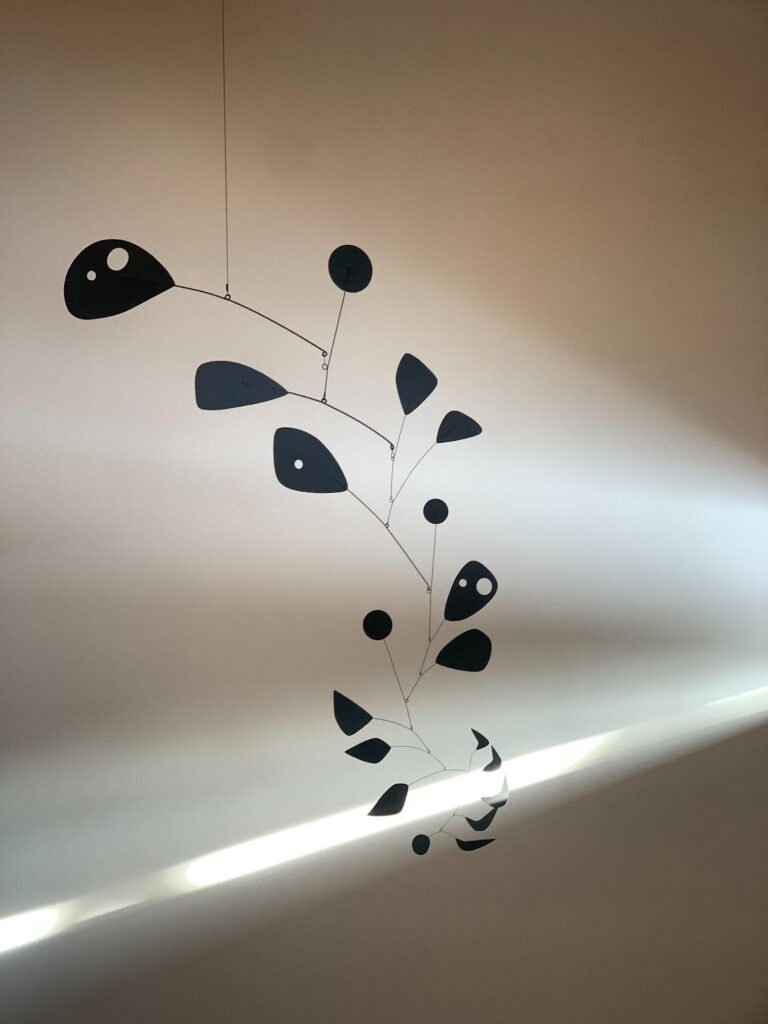
As someone who never paid too much attention to Calder’s work, I was not sure what to expect. Of course, the building itself was exquisite. An entrance of paneled wood, reflective panels, and a curated landscape, just the outside alone was a thing to behold. Following the usual awkward exchange of getting a ticket, I felt untethered as the attendant gestured towards where to begin. I nervously crept down the stairwell, afraid my boots would make too much noise, until I met the gaze of Calder’s Black Widow bathing in the afternoon sun. I felt my gaze drawing figure eights as I sized up the work, looking for a pattern or the suggestion of a body. As it was floating in the center of the room, I was still able to perceive its size, bigger than myself, but hovering gracefully over the other visitors.
Across the room, I watched another work, 21 Feuilles Blanches, 1953, carefully spin, as if in the midst of a solitary waltz. I did not expect to observe the pendant as much as I did, but it engaged my curiosity. How could something so large and presumably heavy move so quietly? Was the HVAC system a part of the swaying? Would it make a full rotation if I sat long enough? I was almost frantic to try to get closer to the piece. Soon came possibly my favorite stairwell of my lifetime: a dark, noiseless cavern with walls of black, textured stone. It reminded me of volcanic rock formations, solid yet porous, oozing with vigor in a way that made me feel safe. It was as if I had stepped through a portal where the outside world disappeared, and a new dream was constructing itself. Spotlit at the bottom, beckoning me forward, was a tendril-like piece, its appendages curving over and around one another. It was hauntingly beautiful in its presentation, solitary but elegant, and I was more than happy to give it company.
This interaction was satisfying but not unique, as each time I turned the corner, I was amazed by another mobile suspended in the air. I was delighted to discover the various ways I could co-exist with the work, whether it was walking beneath the arches of Jerusalem Stabile II, watching snow gently fall on the outside sculptures, or craning my neck to follow the patterns on the ceiling-hung pendants.
Calder Gardens made me rethink my museum-visiting habits. I have never seen so much thought put into the viewing experience, and I was delighted to be introduced to the different lounge areas that were a part of the building itself. I look forward to returning again.
Holding Pattern at Blah Blah Gallery
On view through February 28, 2026.
Curated by Megan Galardi, Shannon Maldonado, and Libby Rosa. @blahblahgallery
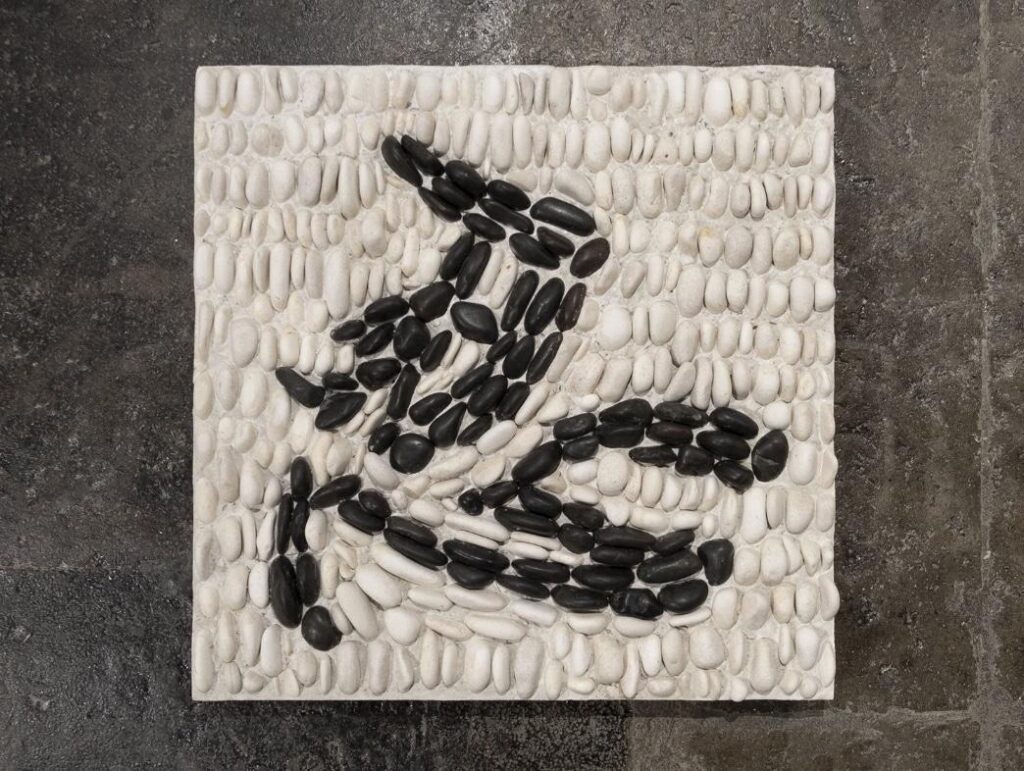
Taking a break from the ethereal and the imagined, this juried exhibition focuses on the grounded and tactile. The gallery challenges your ability to be open and engaged the moment you walk through the door and hear the quiet beckoning of Rachel Hsu’s work, Love, If We Can Stand It. A single concrete tile, a little over two feet by two feet, is stationed on the floor, embedded with salt white and volcanic black river stones of varying size. Their contrast was arranged in an unfamiliar pattern, which I later learned was Chinese characters: “刃 (the edge of a knife or blade), 心 (heart), and 忍 (endure). A simple, formal sign stood at its right: “Please remove your shoes before treading.” No permission was requested, but the artist already knew I was tempted by the textured path before me. I felt vulnerable and unprepared in my mismatched socks, yet excited to see how the sculpture would feel against my feet. As I let my weight drop to my toes, I took inventory of how I was feeling. Dignified as if I were wearing high heels, but tense as if I were going to fall. Parts of me felt nestled while others felt pierced, and no matter how I shifted my balance, I could not predict whether it would be relaxing or hurtful. The metaphor lasted even after stepping off the platform, as the balls of my feet still remembered the shapes of the rock.
As I did my first lap of the gallery, I began to notice the theme of opposing processes coming together in most of the work: painting with woodworking, crochet and enamel, cross-stitch and wax, chrome and plastic. It was satisfying to observe so many opposing materials together in harmony, clearly the result of meticulous craftsmanship. It is inspiring to repeat the same artistic choice, over and over: to weave the smallest thread, to stitch another row, or to add another layer of wax. According to the exhibition statement, “Systems emerge through repetition rather than explanation, allowing process and decision-making to stay present on the surface.” It is as if the artists are aiming to work against the passage of time by focusing on innocent objects, such as a dollhouse or a ceramic figurine, to elevate them into something new.
PAST EXHIBITION SPOTLIGHT
Visions of an Inbetween at Studio 105
November 21–December 21, 2025
Featuring work by Jeanne Blissett Robertson and Julia Policastro. @jeanneblissrob @juliapolicastro
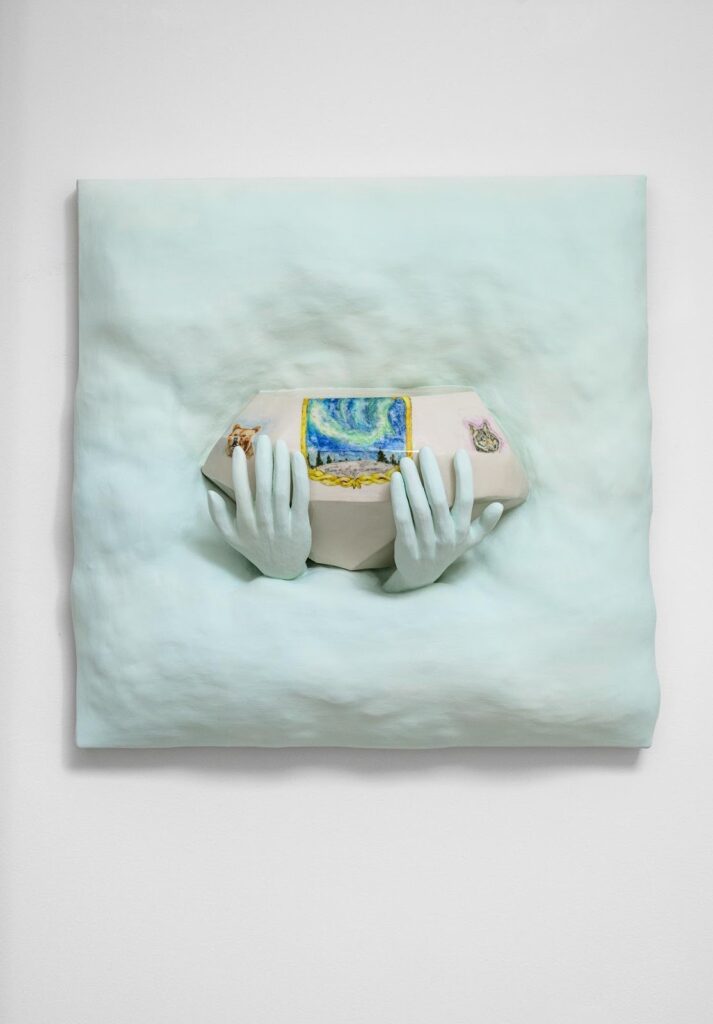
Cloud planes and ceramic gemstones whisper to one another in this standout collaborative exhibition. The muted colors allow for the smallest details in form to come alive, like the subtle folds of a pillow or the precariousness of a ceramic shard. The visual play between the soft matte textures of Policastro’s cloud sculptures and Blissett Robertson’s glossy, angular structures allowed for a dynamic viewing experience that was both still and guided. Policastro’s work hung on the wall at eye level, as if it were a door to another realm. She created panels of opaque clouds with hands reaching out, gently offering flowers, a martini glass, or a cut ribbon. These gifts read as innocent and disciplined, adding to the elegance of Blissett Robertson’s free-standing sculptures. Positioned on pedestals around the gallery, the sculptures demanded to be appreciated in the round. I craned my neck to see the impressions of painted animals and landscapes on every face of the precious stone. Along with filigree decoration, the wolf, owl, and horse portraits feel holy, adding another layer of spirituality to the exhibition. The relationship between the two collections is as tangible as the materials used, which is another element that adds to the ethereal feeling of passing through a transitory state.
About the writer: Jessica Aguilar is a writer and arts professional from Prince George’s County, MD. She holds a Bachelor’s in Art History from Tyler School of Art and Architecture, where she fell in love with the murals, mosaics, and wheatpastes of Philadelphia. She was a 2023-2024 participant of the Arts Writing Incubator at The Black Embodiments Studio in Seattle, WA, with a published essay in A Year in Black Art. She is a regular contributor to Art Spiel and has been published in several art publications across the U.S. Guiding both her writing and creative processes are interests in nostalgia, identity, and gender expression through Latine perspectives. She aims to make the art world accessible to all communities while working at Paradigm Gallery. Her studio and casual exhibition reviews can be found on her Substack. @jesswiththe_mess