Stepping into Elza Kayal Gallery, a plethora of expressions and an eclectic gathering of objects greeted me. Noting the title, Props, I had assumed most of the work I’d see would be props or remnants of performances only; however, taking the term props at face value was not the best approach to this interesting exhibition. This exhibition makes the concept of props into something that is multilayered, deeply detailed, and full of meaning. According to the Oxford English Dictionary, a prop can be “anything that serves to support something or keep it in place.” In András Böröcz’s work, things are rarely in one singular place, as he continuously and strategically misplaces the function of objects. He alters their relations to create a disturbance to the “natural” order of things, and he upends our expectations of both the material and the objects themselves. This upheaval drew my focus to each piece, staring closely at the details so that I could understand what context Böröcz had placed the prop within, as well as understand the full narrative that he is building with these props and characters that walk within his pieces.
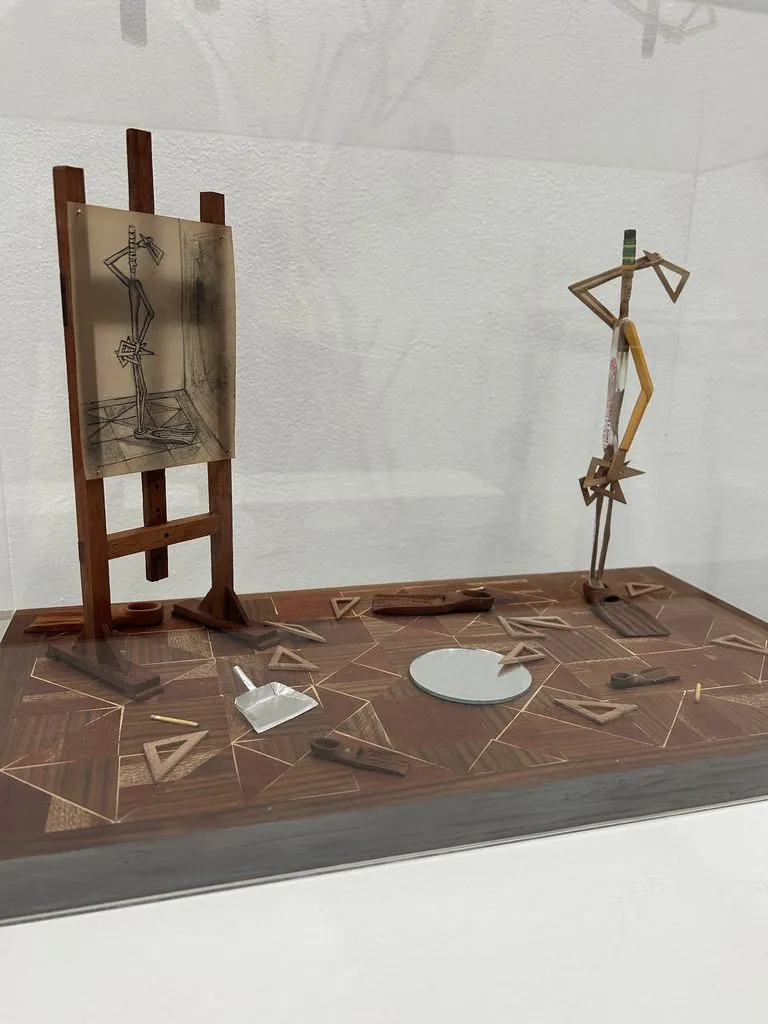
Böröcz’s objects move among different tasks and ways of being—they are artwork, toys, fetishes, musical instruments, and even visual narratives. The carved pencil works are encased, suspended within a scene. The pencil forms are carved into comic, vulnerable human figures; many of the pencil works resemble an artist paused mid-action. Böröcz made these into boxes that function as both rooms and theatre stages, and his elegant carved pencil figures become the actors, characters facing the solitude of themselves. Ironically, the artist transforms a piece of art equipment to instead create his own unique works of art. I was awed by the craftsmanship of the carving and assembly of these curving, fragile forms. Seeing part of the process in a video inside the gallery, I realized Böröcz brings these pieces to life by whittling away the excess and removing the expected. The pencil lead is showing in places, and I wonder how he is able to work with such a small form without breaking it, making it unusable in this new function. The miniature faces on the figures evoke emotion and a sense of focus as you piece together a story from the scenes presented before you. Such as the one titled Drafting Triangles, Open Sundays, where the figure is peering at a canvas that has a pencil drawing of themselves hanging upon it, as the figure poses in the same position as the self-portrait. This subversion of subject and viewer, artist and the art, pulls me into the fray as I am now left to question what it means to be both the spectator and the spectated. I am left wondering where the self-portrait stands, and where the art and artist begin and end.
Böröcz carves, draws, paints, assembles, and constructs his work from unusual raw materials as well as from found and readymade objects. He often uses the finished works as performance props as he dons costumes of unexpected household objects, changing his persona into another character that could easily join the ones inside his little theater boxes. He makes, uses, and misuses objects within his studio, upon his apartment rooftop, in his garden, or in front of an audience, to imitate and upstage various practices of art and everyday life. His clever, often melancholic and humorous work also has political dimensions, as Böröcz’s props propose a freedom from the prescribed functions of the objects and the expectations of the audience. By upending prescribed conventions and assumptions on what an object, a figure, or a specific piece of work should be, Böröcz undermines established cultural expectations and refuses to remain within the boundaries of painting, theatre, performance, or sculpture.
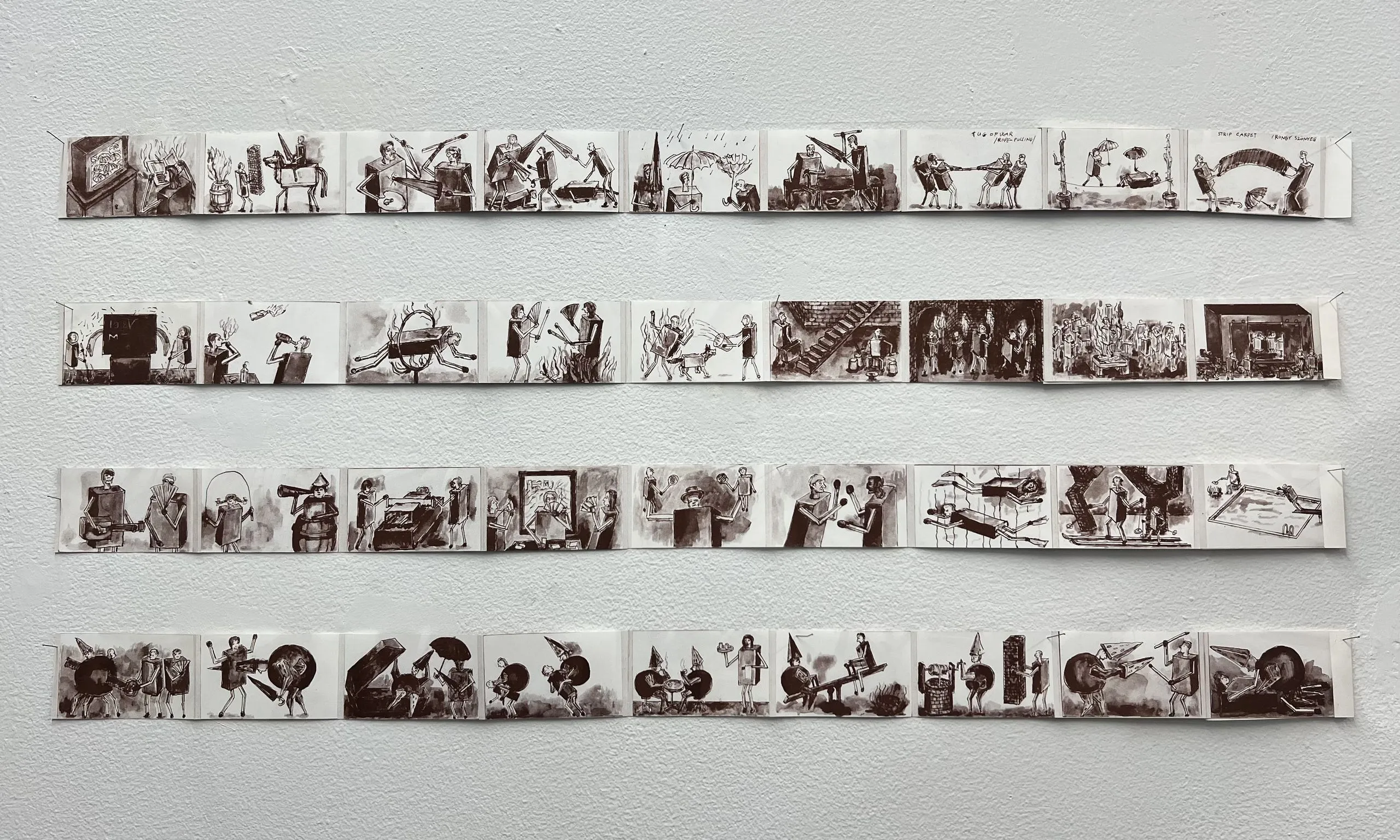
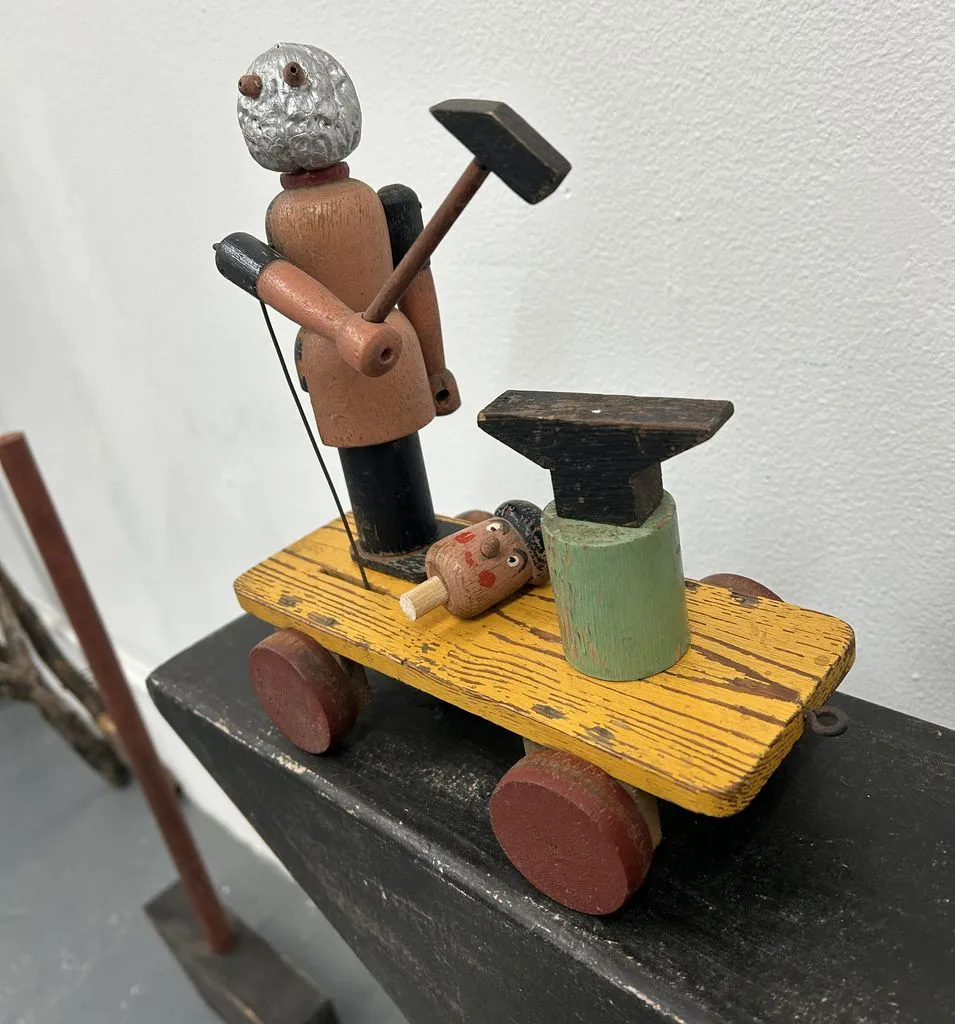
The three-dimensional works dispersed throughout the gallery form a theater of objects created through playful deconstruction and disassembly, along with a wide sense of imagination and creativity. Besides the pencil figures, Böröcz offers a matchbox-sized flipbook that shows us a set of illustrations of his woodworks, such as the piece titled Pendulum, which is accompanied by props from his performances sitting next to it- some of those props consist of a walnut that is hollowed out to be worn as a hat or figurehead, a toy car that is resting over an anvil, its rider paused as if waiting for its final destination. The head of the rider has fallen; a walnut replaces it- this miniature version of a character that Böröcz often portrays truly connects all of the veins into one source. All the while, we get to see pieces of his process or performances on a television in the gallery as well- these videos offer us glimpses into his endless sense of curiosity, creativity, and a constant sense of both making and unmaking; just to make something entirely new and unexpected from the items he is given.
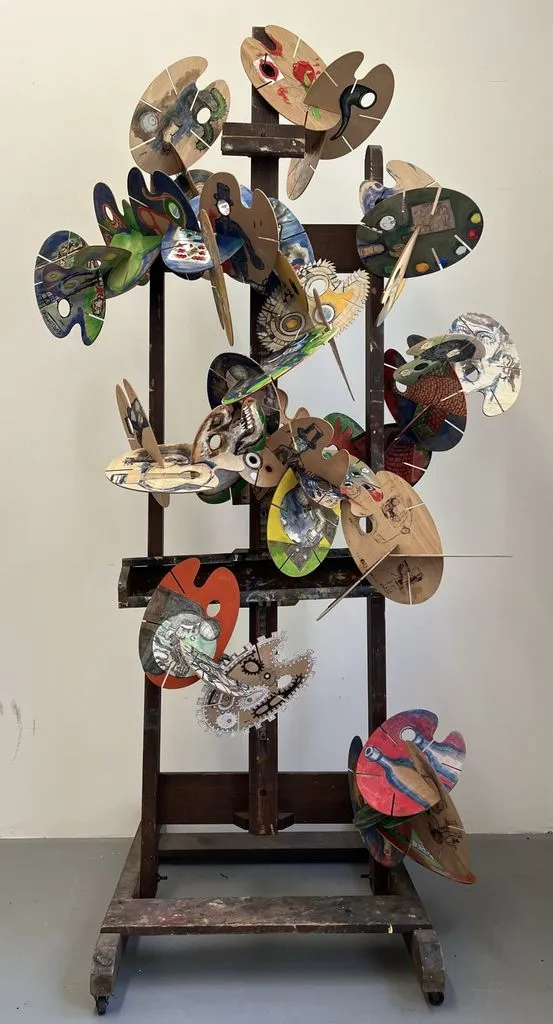
After seeing all of this work assembled in one place, Böröcz reminds me of a Renaissance man. Knowing Dada’s focus on assemblage and readymades, Böröcz uses those to bring new life into his creations and pushes them further as multifaceted works of art. Found objects such as paint pallets found in the piece titled Color Palette look to be growing off of a tree. As Böröcz adhered or hung them from large tree branches that form the foundation of the piece, the painted palettes meld into the branch clusters very easily; the art is hovering amongst more art. Here he brings sculpture and painting into one conversation; he synthesizes two-dimensional and three-dimensional works together to give us a piece we can walk around and look into. We can also explore the miniature paintings left upon the palettes, each facing in various directions off of the branches, offering us many different ways to look at an artwork.
Another interesting discovery and layer to Böröcz’s work within this exhibition is the performance pieces and the history behind them. The air of a performance and its symbolism extend throughout the gallery, making the exhibition a kind of archive or a backstage. Learning about his performances while exploring the details of the exhibition sheds light on how parts of his practice are tightly intertwined with each other. He began his multimedia performance work in 1977, with painter László László Révész, where the work tackled numerous themes such as gender and the body, identity, conventions and authority, as well as the boundaries of art and just how far he could push them. Since 1986, Böröcz has been living in New York, where he continues making and performing. Böröcz’s practice is rooted in Dada performance and assemblage work. He is deeply involved with Duchampian conceptualism, and Eastern European literary and theatrical traditions of the absurd, yet he creates objects and images with a precise hand and the gift of a master craftsman in multiple mediums. The fine details in the work carry a tenderness to them, a care to the story, and how they are assembled and grow. While some of his performances give me a sense of a slower motion and progression, a contemplation even.
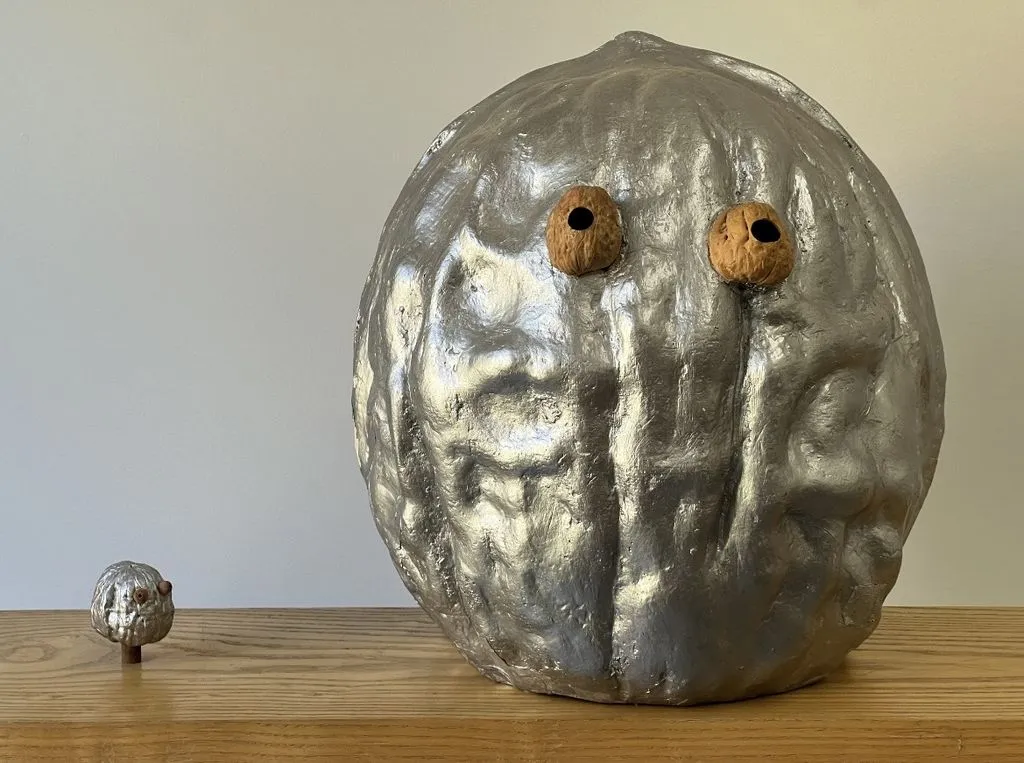
This exhibition is deep, humorous, and detailed. It is a wonderful cabinet of curiosities; one that opens up history, art, and societal critique all in one fell swoop. Multiple layers within the works and varied mediums offer viewers a deep dive into András Böröcz’s multifaceted practice. It introduces us to Dada, to the utility of the readymade, and how wonderfully active it can be. András Böröcz uses his creations and performances to make us question, to notice details and symbols, and have us try to understand the meanings behind them- such as the walnut, where the artist shows the beginning and plays through to the end where he dons the costume. Or where some of his pencil figures brave danger and step close to matches that were placed in the glass case alongside them. This suspension of action, or even danger, and the endless amount of possibilities make us wonder how the performance will end, what the character will do next, or perhaps what the art will make us discover next. András Böröcz expertly toes the line between humor and seriousness. He knows the materials he’s working with; he knows how he’s expected to use them, and he instead uses them in an entirely new way- illustrating that anything can be a possibility as long as you keep a good amount of curiosity while working to assemble it.
András Böröcz, Props, at Elza Kayal Gallery, 368 Broadway, Suite 409, New York. On view through October 16 – November 20, 2026.
Make your tax-deductible donation today and help Art Spiel continue to thrive. DONATE
About the Writer: Taylor Bielecki lives in Gowanus, where her studio is, and works at Pratt Institute, where she earned her MFA. She also studied at Penn State, where she earned a BA in English and a BFA in Fine Arts. She finished as a finalist in the Kennedy Center’s VSA National Emerging Young Artist program for 2017, where she earned an award of Excellence. She has shown prints internationally in a print exchange in Australia and exhibitions in Dubai, India, and the Glasgow School of Art. She has also shown paintings internationally in Gallery 24N, PhilaMOCA’s juried exhibitions in Philadelphia, Pa., Perry Lawson Fine Art in Nyack, NY, BWAC in Red Hook, and IW Gallery in Brooklyn. Taylor works for Two Coats of Paint, TUSSLE Magazine, and has joined Art Spiel as a contributing writer. @Taylor.Bielecki