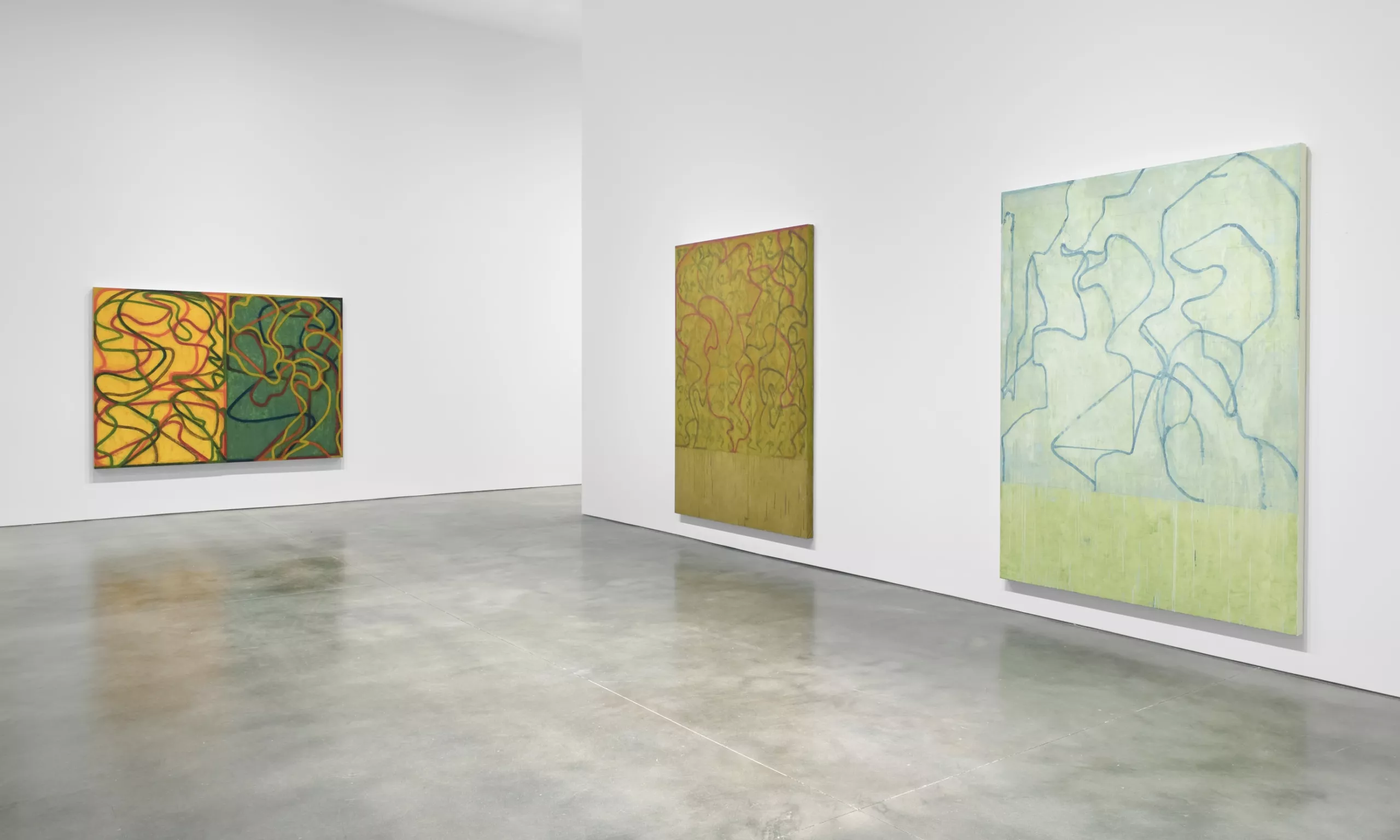
Knowing Brice Marden’s work for a while, and studying his process alongside other artists such as Ellsworth Kelly, Mark Rothko, and Barnett Newman, who were also tackling the intricacies of color, surface, and a painting’s visual experience, this show was a wonderful adventure. Brice Marden: I am a Plane Image is a museum-quality retrospective at Gagosian that pulls you in and allows you to flow through Marden’s entire career. Seeing a survey of works in order allows us to explore his discipline, weave through his explorations, and discover the evolution within his works. After seeing it several times, not always following chronological order, offered new and different ways of seeing how the surfaces speak to one another. The exhibition’s title stems from Marden’s career-long conviction that the progression of modern art relies on tightening the relationship between an image and the flat surface of the canvas. He famously noted that twentieth-century art history “seems to be where you work up to the ultimate plane image.” In this show, the “plane image” appears to be the anchoring focus in his more modernist works. What drew me in was the opportunity to see these works up close and see the connections to the many influences that Marden had.
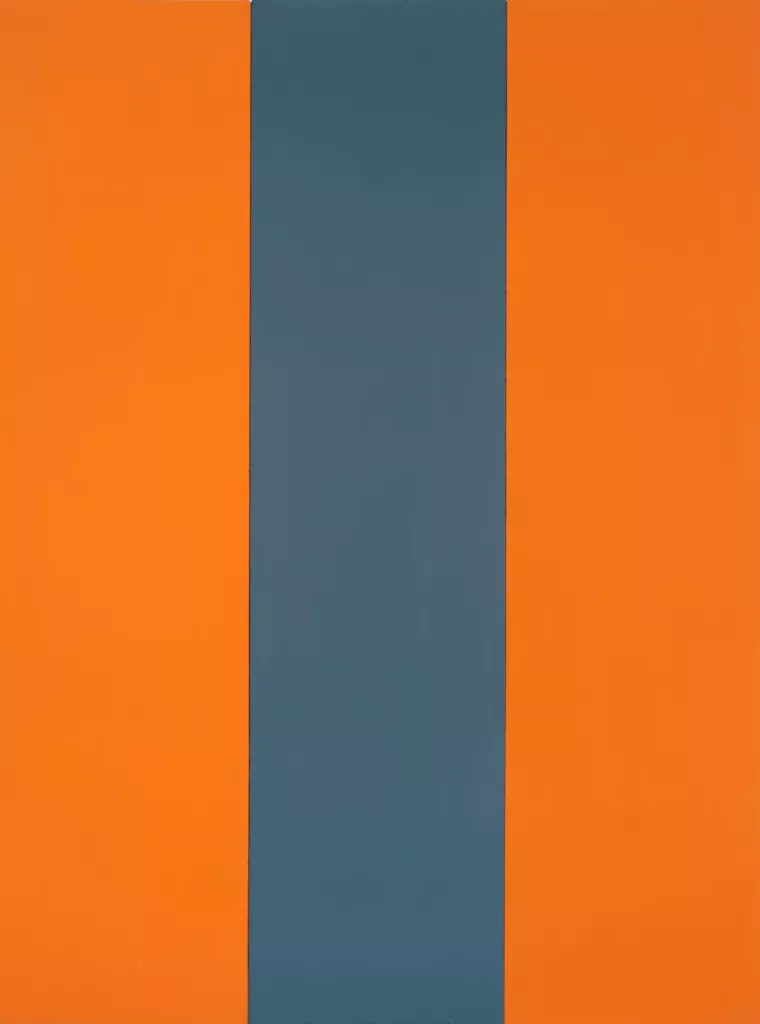
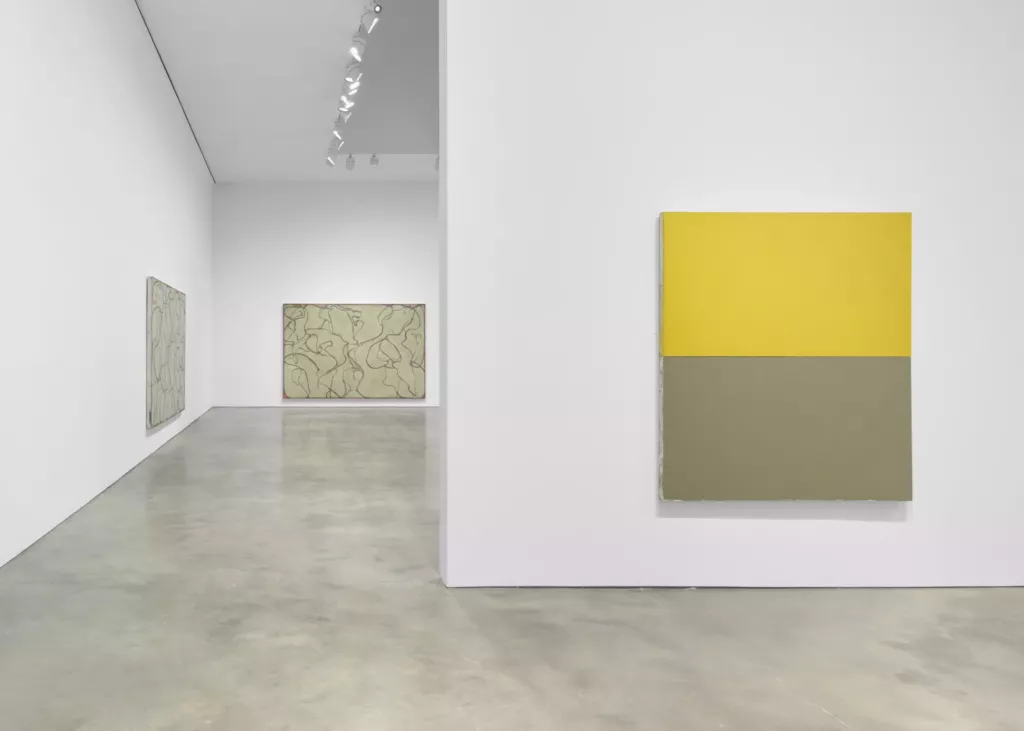
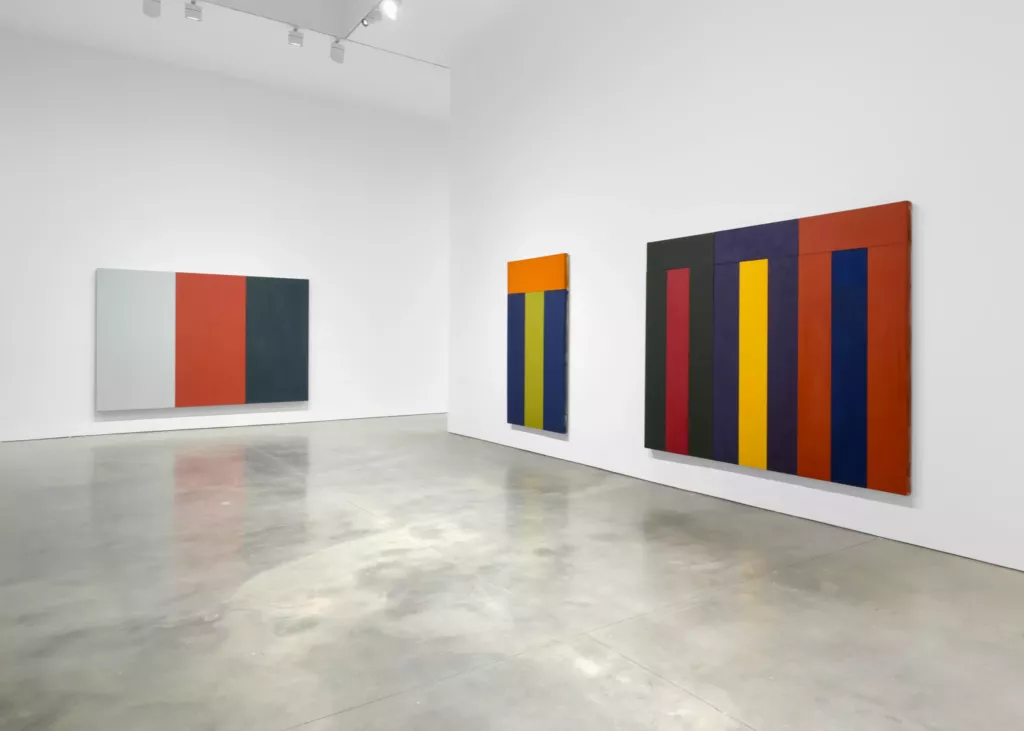
The intricacies of the surface matter. The color, its interaction with other colors, and the effects of slight changes activate these canvases. Marden’s surfaces involve single color planes, such as the piece titled Pumpkin Plumb, showing his exploration of the canvas as a physical surface and space. Getting up close to these vibrant color planes, I notice how he chooses to render these surfaces, allowing each canvas in the room to optically bounce off one another—and later, move within the canvas itself when he added other color quadrants to multi-panel rectangular canvases such as the pieces titled Number One or Plane Image. Here, the surface becomes an experience both optically and physically. One of the biggest joys I found within this exhibition was the ability to step up close, step back, and approach pieces from different angles.
Marden’s surfaces are explorations in both excavations of light and color, as well as an accumulation of a luminous surface. The canvas becomes an active space. Colors emanate from underneath other strokes of color, ever so slightly, a technique Marden used to activate his canvas, especially in his color plane series. The early works look like plaster or stone, while the late works like Nemesis feel fluid, almost transparent, and layered like veils. Through this accumulation and push-and-pull motion that are both above and below layers of wax, Marden shows how he could activate a space and push the limits on what energy a canvas can emit. His surfaces carry with them a verticality like Newman and glowing luminosity like Rothko.
To achieve this dynamic surface, he mixed oil paint with melted beeswax, applying it with spatulas and brushes to create a rich, tactile, and luminescent surface. As you weave through the gallery, these large works draw you in, envelop you, and allow you to become an active participant in the work, making you step closer, jump farther back, and look deeper than just surface level. By ironing and troweling this mixture into an entirely flat, matte surface, he eliminated any illusion of deep space. Yet, because beeswax is slightly translucent, light travels just beneath the surface before bouncing back. These surfaces become even more complex as Marden places canvases together, creating a new rhythm within the work. A rhythm where quadrants of color and optical mixing push against the edges of the canvas and vibrate against each other. Such as in the piece titled Number One, where purple and yellow contrast each other while a combination of black and red offers a stark edge to the left, and the red and deep ultramarine section draws us in, building a sense of a deeper space. This space was almost galaxy-like or the dark depths of an underwater pool. Through these multicolored pieces, Marden constructed space by means of color and allowed the activity within the quadrants to pull spatial qualities out of a usually flat surface.
Barnett Newman, who is part of this conversation on abstraction, space, and verticality, used his famous vertical “zips” to evoke the spiritual and sublime—a lightning bolt of human consciousness reaching toward the cosmos. Marden took that verticality but grounded it. This sense of grounding brings a certain weight to the work. Instead of using a thin painted line to divide a canvas, Marden joined entirely separate physical panels together. The “seam” where Marden’s heavy, beeswax-infused canvases met became Marden’s version of Newman’s “zip” composition. By building the space of the painting, he translated Newman’s abstract, metaphysical tension into a tangible, heavy, and human-scaled architecture of color and edge, bouncing off of and melding into each other.
Similarly, Ellsworth Kelly was another artist who activated the rectangle and pushed the boundaries of its space. In his own modular paintings, however, Kelly’s color operates in a conceptual, architectural space where the surface is fused with support and observed from the physical world. Rather than painting internal borders or lines, Kelly joined separate monochrome rectangular canvases edge-to-edge, making the physical seam between panels the only line in the work. Marden’s use of color, which is deeply poetic, ambiguous, and packed with a kind of simmering light, contrasts with Kelly, whose compositions were based on physical space and observation. Both Kelly’s and Marden’s rectangles are prominent; however, Marden gives me an ethereal sense where the surface is built on motion, luminosity, and expanding space.
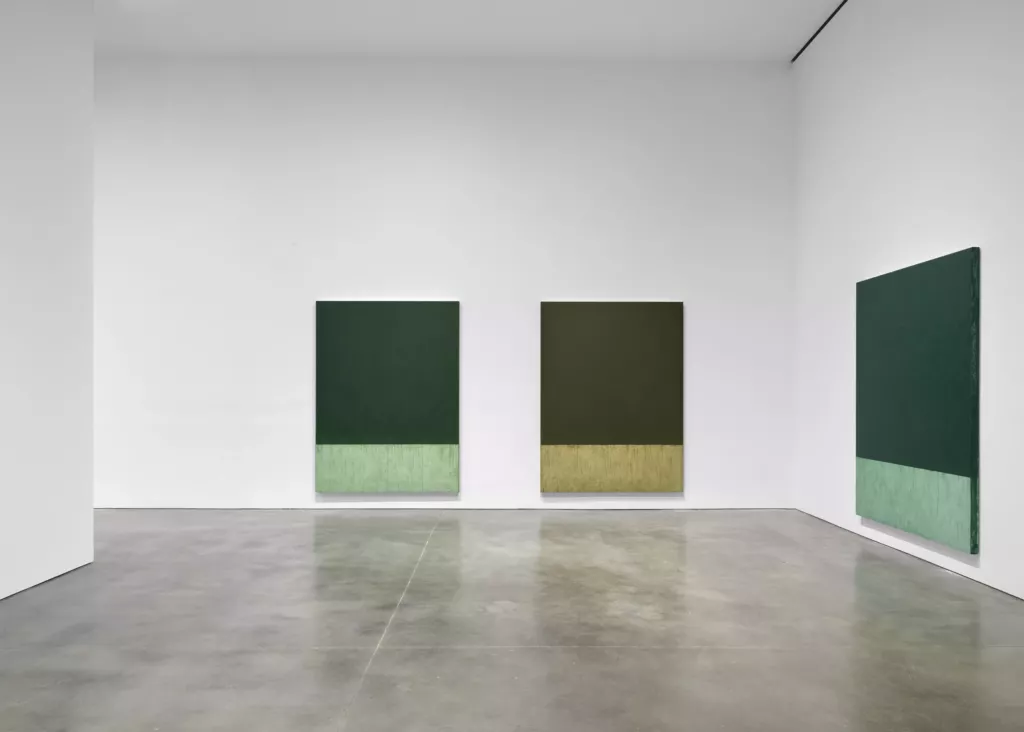
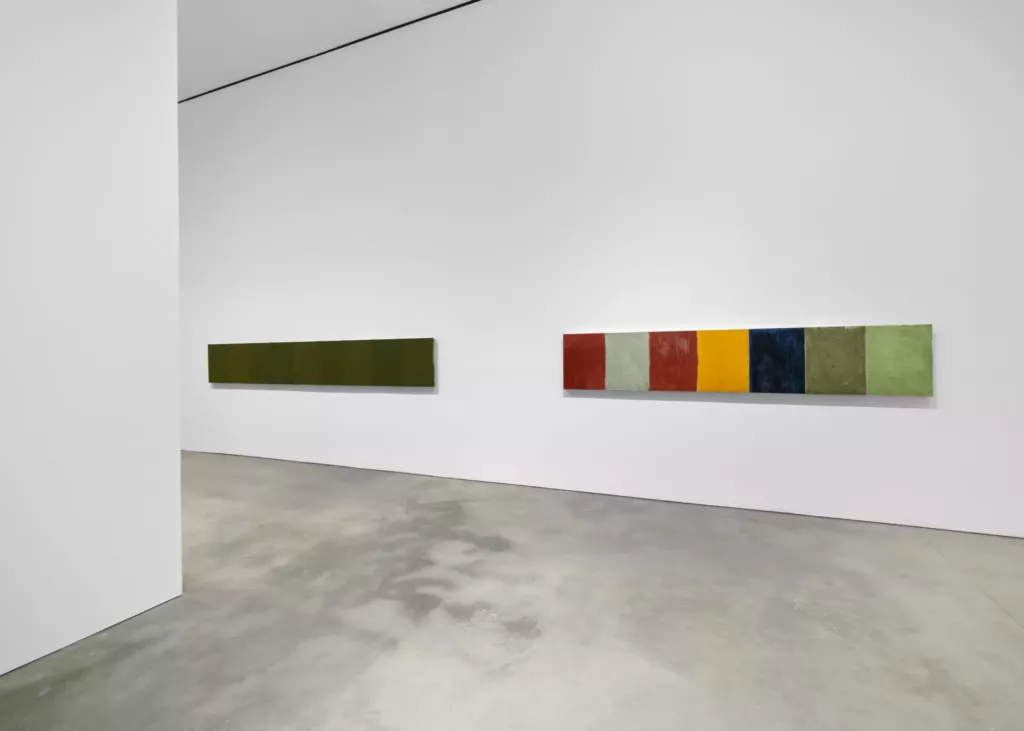
While working through all of the works in the exhibition—from the color planes into the works with more calligraphic brushstrokes, and back into the monochromatic surfaces—Mark Rothko’s rectangular compositions kept coming to mind. Rothko’s works are atmospheric even on a flattened plane and are constantly glowing. His reds, oranges, and blues seem to vibrate with energy. Marden’s early mastery involved binding distinct single-color panels together, letting the waxy textures do the emotional work that Rothko achieved with feathered edges. After getting to see pieces in the Terre Verte Series, I realized Marden’s return to a monochromatic surface once again brought some of that atmosphere and emotion with this experiment. This series of ten large-scale (8 by 6 foot) canvases is dedicated entirely to a single pigment: terre verte, an iron silicate clay pigment historically mined near Verona and used since antiquity. Each painting was made with a different brand of oil paint, including Williamsburg, Holbein, Sennelier, and Winsor & Newton. Because each manufacturer sources and mixes their raw pigment differently, every canvas results in a radically distinct hue—ranging from soft, mossy gold to dark, near-black- and Marden pulls these nuances into each piece. Marden makes these intricate details become welcome discoveries, and if one is willing to jump into the depths of the work, you will be rewarded.
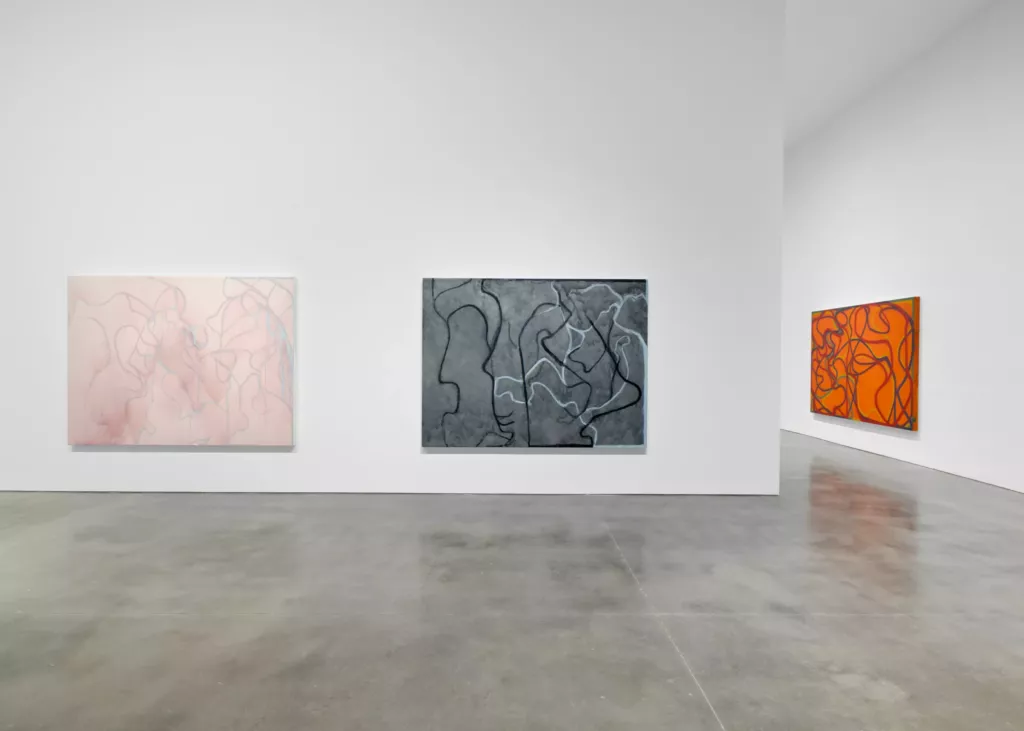
The later works, where lines and marks are added, make the pieces even more spatial, and the pieces where Marden leaves a band of space at the bottom that is often called an action strip seem to suspend emptiness. In the more linear-based works, the flowing line over the plane creates optical tension as Marden pulls strokes over his deep surfaces. These works combine vibrant, contrasting monochrome panels with meandering, multi-colored linear networks that seem to expand and contract optically. The hand of the artist becomes exceedingly evident. The lines themselves are not uniform; some vary in weight, some flow, some drag, some wind, and some intertwine with others as they also push depth into the work. The lines become another porous layer, where the iconic luminous backgrounds stand behind them. Marden is great at leaving space and letting it work, especially in the works where the action strip is left with process drips and the results of the work. The band is not an end; it is simply a pause, a space where he lets the paint drip, flow down to the floor, and, in turn, pull the composition into a bit of a suspension. This use of the action strip in works like the Dylan Painting and Nebraska illuminates his admiration for Jasper Johns’ focus on the reality of the canvas and use of the strip as a testing ground. This shows us the process and physicality of the painting.
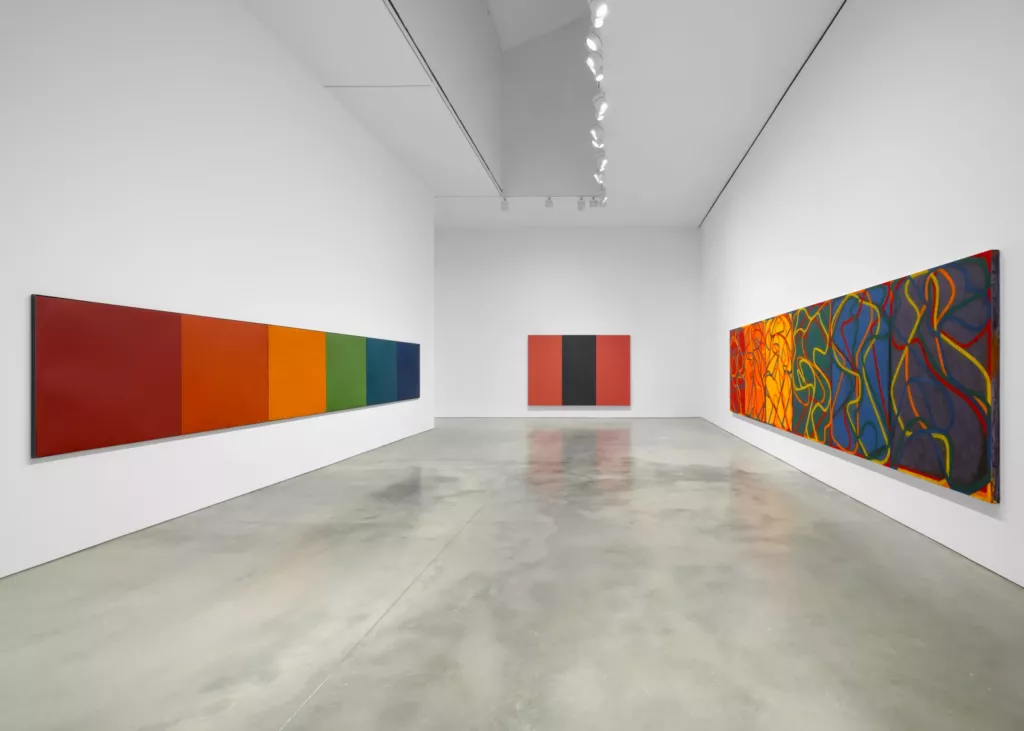
The inclusion of his final works, made while his physical mobility was limited, adds a poignant, human layer to an artist otherwise known for intense, athletic precision, and a relentless pursuit of movement, rhythm, and flow. To me, while I loved all of the other eras of his work, I adored these the most. These show resilience, a connection to Marden’s shift back into intuition, and a drive to continue working with the surface despite the change in circumstances. They are inspiring, and after visiting the show multiple times, I often enjoyed ending with these. Because of his physical limitations, Marden had the canvases arranged around his studio and worked on all six paintings simultaneously over the course of about a year. Compared to his tightly controlled earlier works, these paintings have a remarkably raw, spontaneous, and sketch-like appearance because he couldn’t physically reach the canvas the same way. With these, it looks like he leaned heavily on sheer intuition and the flow of the mark. The loose, looping, web-like linear networks that float over background fields of varying densities and colors are full of potential. Some panels are dark and raw, while others are light and lyrical. He allows lines to fade and thin paint to pool naturally, as opposed to controlling the layers, building the space, or allowing his hand alone to decide the results.
This exhibition is deep and dynamic. Each era of Marden’s work offers new insights into how he worked, evolved, and continued expanding space. By entering the conversation alongside the likes of Johns, Rothko, Kelly, and Newman, Marden’s own introduction of the “seam” line, the action strip, and the energy and motion that those components add to the surface shows how the spaces within his canvases are constantly active. This show implores me to keep looking at the paintings and experience not only the space within, but the space around, and the space that was taken away. Marden’s painting becomes an experience – one where abstraction becomes suspended within an ever-growing space full of emotion, the experience of the artist, and the continuous experience of viewers all around the works.
Brice Marden: I am a Plane Image, Gagosian, West 21st Street, New York, NY 10011, September 15 – December 12, 2026
Gagosian, in collaboration with the estate of Brice Marden
Make your tax-deductible donation today and help Art Spiel continue to thrive. DONATE
About the Writer: Taylor Bielecki lives in Gowanus, where her studio is, and works at Pratt Institute, where she earned her MFA. She also studied at Penn State, where she earned a BA in English and a BFA in Fine Arts. She finished as a finalist in the Kennedy Center’s VSA National Emerging Young Artist program for 2017, where she earned an award of Excellence. She has shown prints internationally in a print exchange in Australia and exhibitions in Dubai, India, and the Glasgow School of Art. She has also shown paintings internationally in Gallery 24N, PhilaMOCA’s juried exhibitions in Philadelphia, Pa., Perry Lawson Fine Art in Nyack, NY, BWAC in Red Hook, and IW Gallery in Brooklyn. Taylor works for Two Coats of Paint, TUSSLE Magazine, and has joined Art Spiel as a contributing writer. @Taylor.Bielecki