Notice: Function WP_Object_Cache::add was called incorrectly. Cache key must not be an empty string. Please see Debugging in WordPress for more information. (This message was added in version 6.1.0.) in /www/artspiel_344/public/wp-includes/functions.php on line 6131
Tessa Grundon, Invasive Species, 2018-2021/2022, Asiatic Bittersweet root systems and border fencing, dimensions variable.
The group show Fragile Rainbow: Traversing Habitats at the Williamsburg Art and Historical Center in Brooklyn includes paintings, sculptures, videos, and installations addressing environmental issues by more than fifty artists from the New York City region who are members of ecoartspace. The title is based on Claire McConaughy’s oil painting, Fragile Rainbow, referencing both hope and loss. The show runs from May 7th through June 4th, 2022. Curator Sue Spaid elaborates on this large-scale group show.
Installation view of The Agreement: Chromatic Presences, curated by William Corwin at Zürcher Gallery. Photo: Adam Reich. Courtesy of Zürcher Gallery NY/Paris.
I’ll start with a question: does a critic have an obligation to propose a solution to an enigmatic puzzle an exhibition might pose? What has led to this, is reading William Corwin’s catalog essay for The Agreement: Chromatic Presences, in which he ignores recounting the history of sculpture and color—deemed for a very long time to be irreconcilable like fish and cheese. It is now common knowledge, sculpture till the time of the renaissance was largely polychromed, but a neo-classical notion of purity and essentialism came to be imposed upon it to differentiate it qualitatively from painting. As a result, sculpture came to be limited to the colors of its materials—marble, bronze and wood. In the West, this formalism was institutionalized by the Enlightenment’s and was the excepted norm until the mid-20th century, when art’s traditional forms began to morph. Consequently, we must ask if there is a more contemporary issue concerning color and form at the heart of Corwin’s The Agreement: Chromatic Presences, and if so, what might it be?
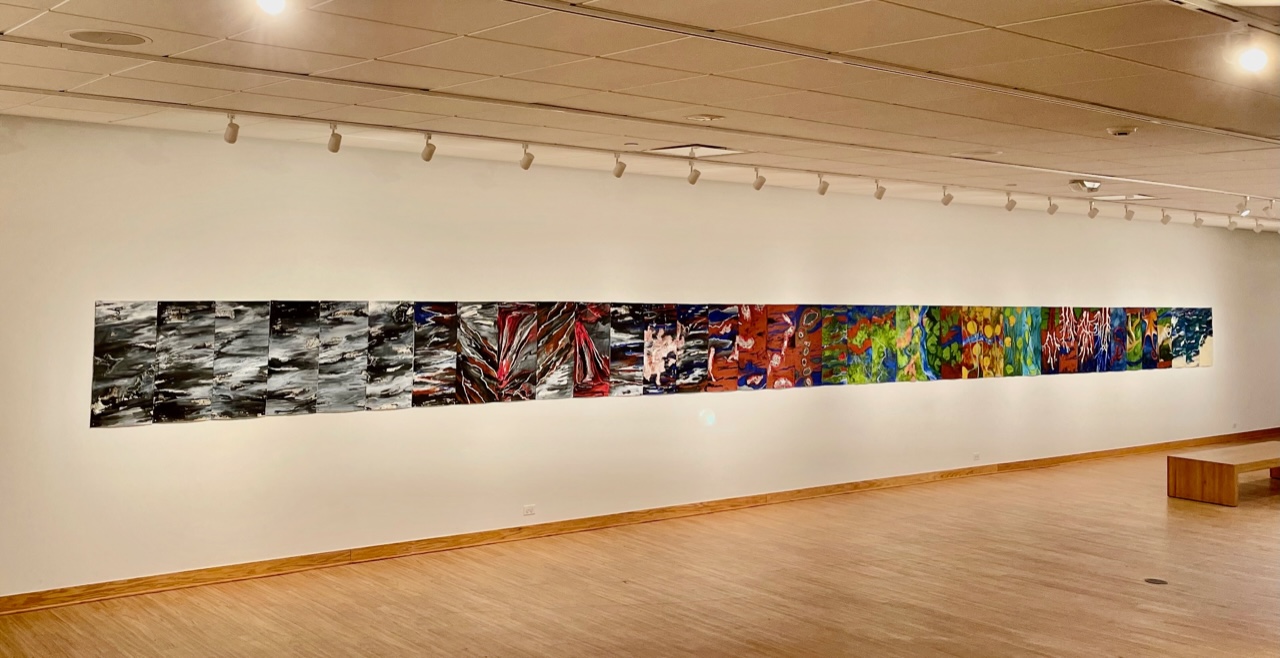
Susan Hoffman Fishman, In the Beginning There Was Only Water, 30 in. x 50 ft., acrylic, oil pigment stick and mixed media on paper, 2021, Installation view at Janice Charach Gallery, West Bloomfield, Michigan
During the height of the COVID-19 pandemic, from 2020 through 2021, eight women artists from the Midwest and the East Coast of the United States came together via Zoom to read and discuss All We Can Save: Truth, Courage and Solutions for the Climate Crisis, edited by Ayana Elizabeth Johnson, Ph.D. and Katharine K. Wilkinson, Ph.D. The book contains essays and poetry by a cadre of diverse women policy wonks, scientists, writers, journalists, lawyers, activists, and others who address the most critical existential issue of our time with the intention of offering different ways to effect change and mend the significant damage that we have caused to the Earth. The artists’ responses to the essays form the exhibition Climate Conversations: All We Can Save. The exhibition runs through June 30th, 2022.
The curatorial team held a fascination with exploring and activating the ceiling, corners, and floors of Equity Gallery via the works that comprise Making Sense Without Consensus. Here are 2 examples of this; on the left, Linda King Ferguson’s work stretching downward to the floor; and on the right, Diogo Pimentão’s work installed to live and extend around the corner of a gallery wall.
Now on view at Equity Gallery in the Lower East Side is a notable group exhibition, cogently titled Making Sense Without Consensus, with works by 14 remarkable artists and 3 astute curators at the helm. The exhibition statement says that these artists explore reality through fragmented connections and geometric materiality, “investigating whether the linearity of time is real or if past and future overlap.” In further absorbing what this exhibition might represent, I also want to offer an illuminating quote from The Radicant (2009), an essay by celebrated curator and critic Nicolas Bourriaud. This thought piece provides context for the development of Making Sense Without Consensus:
“In ordinary language, ‘modernizing’ has come to mean reducing cultural and social reality to Western formats. And today, modernism amounts to a form of complicity with colonialism and Eurocentrism. Let us bet on a modernity which, far from absurdly duplicating that of the last century, would be specific to our epoch and would echo its own problematics: an alter modernity …”
To Have and To Hold exhibition with works by from left to right: Jean Carla Rodea; Maria De Los Angeles; Micaela Martello; Julia Justo, Maria De Los Angeles; and Jeff Kasper
Featured Project: with curators Anna Shukeylo and Yasmeen Abdallah
The group show To Have and to Hold at the Abrazo Interno Gallery at the Clemente brings together work by Maria de Los Angeles, Julia Justo, Jeff Kasper, Michela Martello, Patricia Miranda and Jean Carla Rodea, who explore in their work notions of beauty and soulful trajectories through the potency of heirloom-like objects. Co-curators Yasmeen Abdallah and Anna Shukeylo share their thoughts on their collaborative curatorial experience.
Entanglement (Paintings by Cecile Chong, Sculpture by Jack Henry, courtesy BravinLee Programs
Entanglement is a new exhibition of works by Jac Lahav, Cecile Chong, Jack Henry, and Erik Olson. The work ranges from the psychological to the sentimental with many references to the natural world. Much of the work is dissimilar, like a portrait of Ruth Bader Ginsburg wearing leopard print and a leafy necklace which stands in contrast to atmospheric encaustic paintings referencing Chinese landscape. Together these pieces take us deep into a post-pandemic psyche. The binding theme is plants, using nature as a metaphor for an internal growth many of us have experienced during the past two years. Entanglement opened on Thursday March 3rd and is up at BravinLee Programs in Chelsea New York until April 9th. We sat down with gallerist Karin Bravin and two of the artists to talk about the show.
Featured Project with Curator and artist Jenn Cacciola, and Artist/Owner of Ice Cream Social Matthew Shively
Installation view, photo courtesy of Ice Cream Social.
The inaugural group exhibition, Terrarium, at Ice Cream Social features painting, photography, sculpture, fiber and site-specific installations by 26 artists. Terrarium examines growth of different forms, inside and outside of containment, managed and wild, protected and exposed, as well as growth that sometimes requires destruction or thorny discoveries. The show runs from March 5th through May 6th, 2022.
Alignments at Flinn Gallery in CT is a three-person exhibition featuring abstract work by Meghan Brady, Ben Godward, and Erika Ranee, curated by Tracy McKenna. The work triangulates around shapes and strata. It runs through January 26th, 2022.
Featured Project: with curator Maria De Los Angeles
Ryan Bonilla. Hope, 2004. Encapsulated Digital C Print, 20 in x 30 in.
The group show, A message from the Underground at Mana Contemporary Jersey City, curated by artist and curator Maria De Los Angeles, featuring 18 artists from Mana Contemporary whose work explores current political climate, love, and sense of place. The exhibition runs through 1/15/2022, 3rd floor, Mana Contemporary in Jersey City
From line drawings and cutouts to wall reliefs and sculptures, lines shift forms throughout the group exhibition Drawing a Line at Five Myles. Curator Klaudia Ofwona Draber says she was inspired by the gallery founder Hanne Tierney’s vision to organize a drawing exhibition. Ofwona Draber’s interest in social justice and post-colonialism guided her choice of artists as well as the theme of the exhibition – drawing a line as an action of drawing boundaries, whether to protect personal boundaries in the quietude of one’s own home, or at the heart of a political conflict. “By drawing a line, we protect ourselves, our families and our communities from the violence and inequalities that are happening around us,” says Ofwona Draber.