Notice: Function WP_Object_Cache::add was called incorrectly. Cache key must not be an empty string. Please see Debugging in WordPress for more information. (This message was added in version 6.1.0.) in /www/artspiel_344/public/wp-includes/functions.php on line 6131
Born in 1913, Canadian American painter Philip Guston began his career in the 50’s in New York during the Abstract Expressionist movement. The Ab-Ex-ers were sweeping the country as the next great thing and developing a bit of a swagger. Painters everywhere were ditching representational painting for the new experimental style of pure abstraction, and Guston was no exception. Well-esteemed and well-reviewed, he was a part of the in-crowd. Everyone loved the guy.
Jonathan Torres is a Puerto Rican artist born and raised in San Juan, Puerto Rico. He is based in Brooklyn, NY since 2010 and was recently a resident at the Sharpe Walentas Studio Program in DUMBO. In his paintings and sculptures a sense of otherworldliness and living in the diaspora recur. For over 15 years, Torres’ practice has grown from exploring different emotional and mental stages that have affected the way people interact with each other throughout various stages of life—crisis and anxiety with a bent of dark humor that have been crucial to the development of Torres’ imagery.
Sam Francis, Untitled, 1968-9, acrylic on canvas, 96 x 156.25 inches
Painter Elisabeth Condon’s reflections on a painting by Sam Francis were initially presented in the third episode of Elisabeth Condon Describes a Painting, a new series artist Amy Talluto has launched in her podcast Pep Talks for Artists. In each episode in this series, Elisabeth Condon shares her way of looking at one painting, here, at Sam Francis’, Untitled, 1968 -1969, acrylic on canvas, 96 x 156.25 inches, hails from the series known as Edge, Sail, or Open Paintings. Untitled is currently on view at the Los Angeles County Museum of Art through July 16 in the exhibition Sam Francis and Japan: Emptiness Overflowing.
Ellsworth Kelly (1923-2015) is one of those artists whose status I’ve never understood. While he is held in high esteem by many, I’ve always questioned his significance. Don’t get me wrong, I like his work, but liking it doesn’t necessarily make it significant. His work is elegant, refined, and smart, and yet even in the 1950s-70s, it seemed conservative against the backdrop of Abstract Expressionism, Pop, and Minimalism. What made Kelly different from his peers was that when he was living and studying in Paris after World War2 on the GI Bill, while many of his fellow artists from the States were exploring lyric abstraction and L’informale, Kelly was looking at Art Concrete and had begun to make multi-canvas paintings.
As an artist, have you ever looked around and felt ancient, withered, and uncool? Well, this pep talk is for you, because we’re about to find out how later in life, big bangs can be the bravest and most creative big bangs of all.
Gallery view, East End Arts, Riverhead, NY. Courtesy East End Arts and the artist.
In Double Take, Rainer Gross’ solo show at East End Arts through November 5, 2022 in Riverhead, NY, the artist invites the viewer to take a step closer to his abstract, intensely colorful paintings. Gross offers the viewer the satisfying experience of engaging intellectually with the underlying organizing principle of his compositions while savoring a sumptuously layered array of the results. His paintings are comprised of two (sometimes four) identically sized, stretched rectangular canvases shown side-by-side. He applies pools, bands, bars and patches of saturated hues of oil paint on one canvas and water-based pigment on the other. While the colors are still wet, the paired canvases are then placed together, face to face. When pulled apart, the forms on one canvas imprint on the other creating a shared Rorschach-like result. The artist refers to his paintings as “twins.” The side-by-side canvases are nearly identical, yet their differences become an intriguing puzzle to recognize, trace and sort. This easy-to-grasp concept offers a frisson of delight for the viewer as they experience the variety of its execution.
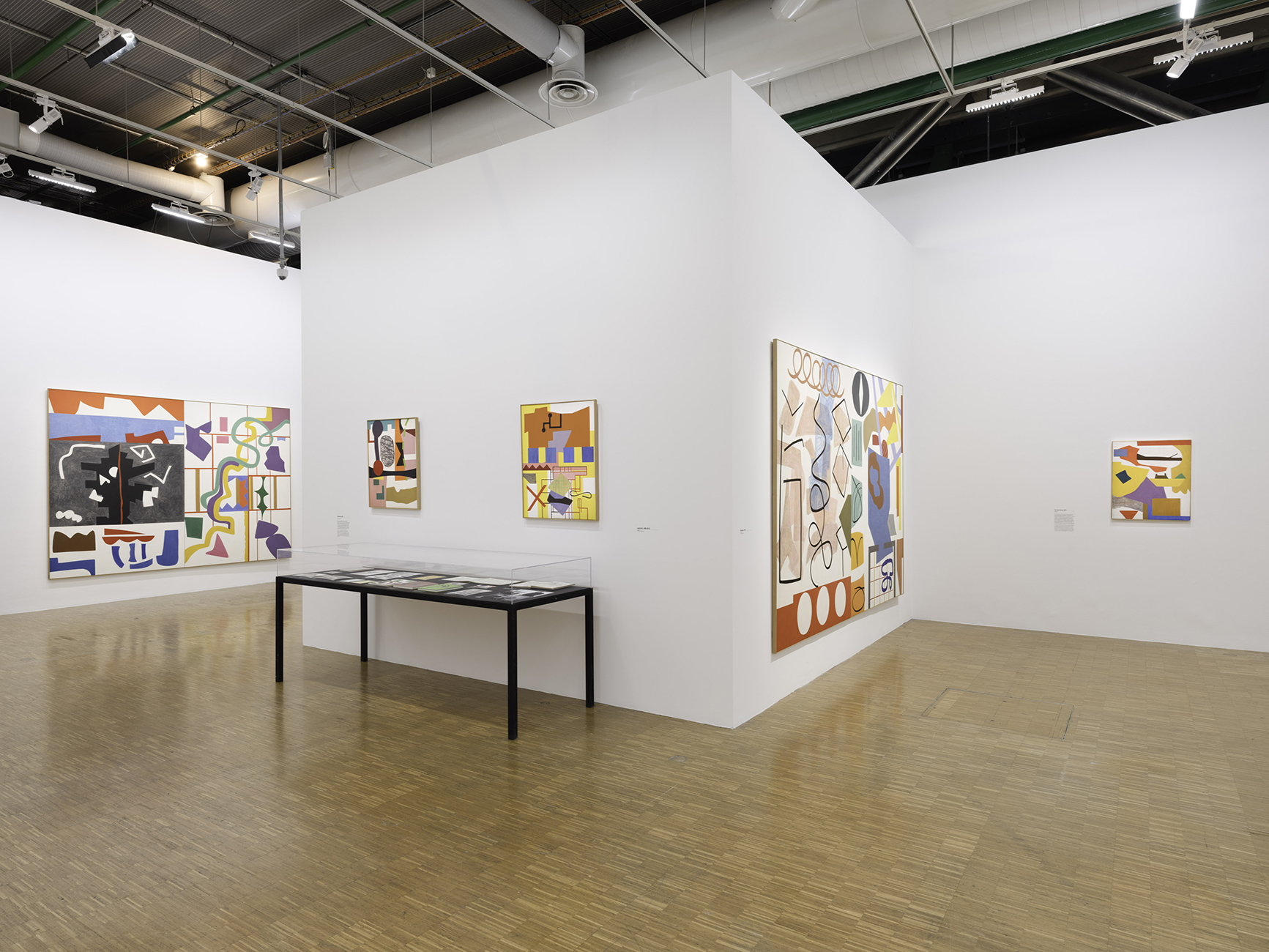
Shirley Jaffe, installation view, Pompidou Center, photo courtesy of Helene Mauri
It might be said for the most part, given the dominant ideology of Modernism, Shirley Jaffe has been overlooked for the standard reasons—her work was out of step with the times, it was derivative of Henri Matisse and Stuart Davis, it was too French, or too American—all according to who you speak with. Yet the gorilla in the room is she was an American woman of the post-war generation who had stayed on after almost everyone had gone home, who sought to get a foothold in the male dominated Parisian art world. Despite this, she persisted and gained respect and support among multi-generations of artists. As such she developed a reputation as an artists’ artist, yet despite her boosters and the fact that she is now being acknowledged with a retrospective exhibition at the Pompidou, Jaffe remains one of the best kept secrets of post-War abstract painting in France and remains unacknowledged in the States.
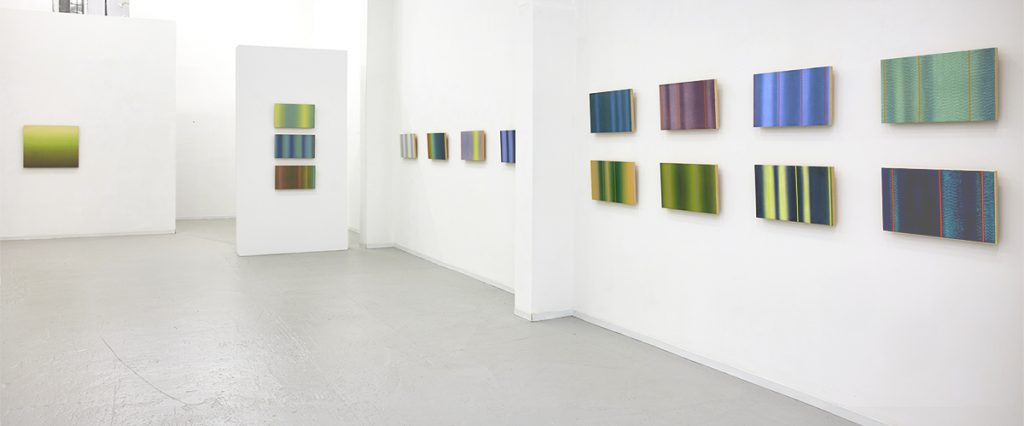
Gallery View. Photo courtesy of David Richard Gallery
Vigil, Ellen Kozak’s first solo painting exhibition with David Richard Gallery, featured two fully realized series of abstract oil paintings on panel. The painter, with studios in New York City and beside the Hudson River in Greene County, explores the relationship between the fluidity of paint and river surfaces affected by the intersection of natural and manmade phenomena. Altogether the paintings activated the gallery space into a cohesive site-responsive installation.
Becky Yazdan’s paintings are based on things she encounters in her daily life as well as her memory of events, feelings, and colors. For her the painting process is an active dialogue with the nature of things around her. “The paintings are like dreams—the events of the day reorganized and combined with other events and memories until a new, often surprising reality has taken shape,” she says.
At a certain point in one’s life, they stop making new marks or registering new memories. All that remains is a fluid, ever-changing assemblage of the fragments from the past. I would call it no stagnation: it is rather a moderate manner of growing at a different pace.