Gail Winbury: The Girl who Drew Memories at the Wilson Museum

Gail Winbury: The Girl who Drew Memories at the Wilson Museum

Featured Artist

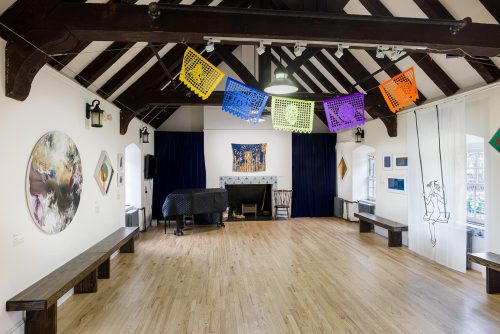
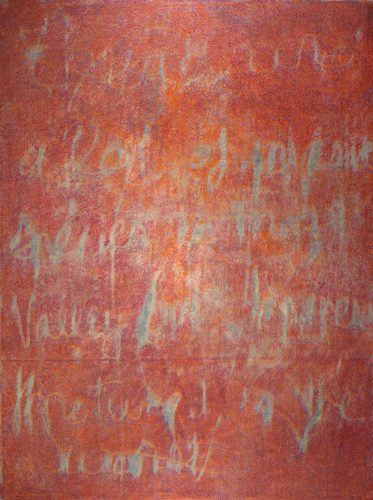
Gail Winbury’s multidisciplinary art exhibition The Girl Who Drew Memories at the Elizabeth de C. Wilson Museum on the campus of the Southern Vermont Art Center in Manchester, Vermont, addresses the intersection of art and psychology, specifically “vulnerability and creativity”. Winbury proposed to include poetry as a component of the exhibition and curator Alison Crites brought together Winbury’s paintings and collages, with poetry by living poets. The exhibition altogether raises the question “how do we tell the stories of our early childhood when at times there may be no words, or we dare not utter the words aloud?”

Map Description automatically generated

Crazy River Umwelt Series Part I

Featured Project

A central theme in my Crazy River project has been highlighting the emotional toll of the climate crisis by putting under a microscope, so to speak, my own feelings about not only the impacts of the crisis but the knowledge that humans’ actions are the cause. This series of three on-line essays, thought experiments if you like, expands that project to change the POV to non-human actors that are inextricably bound with the habitat in the Western Catskills: the black-legged or deer tick (Ixodes scapularis), the white-tail deer (Odocoileus virginianus), and Japanese knotweed (Reynoutria japonica). All three have seen their habitat change dramatically through climate change and human interventions. Using my imagination and research, I try to enter the umwelt of all three species, an impossible task, as Thomas Nagel pointed out in “What Is It LIke to Be a Bat,” for which artistic license may give us the best chance to accomplish. My intentions in doing so fall along three axes: theoretical, aesthetic, and spiritual, dimensions all essential to my own art practice. What follows is a look at the umwelt of black-legged ticks from the perspective of theory.

Jody MacDonald: Under the Veneer of Whimsy

Jody MacDonald: Under the Veneer of Whimsy

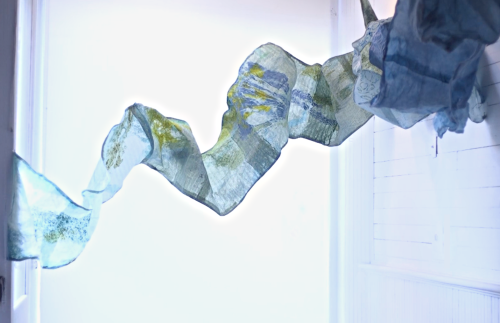
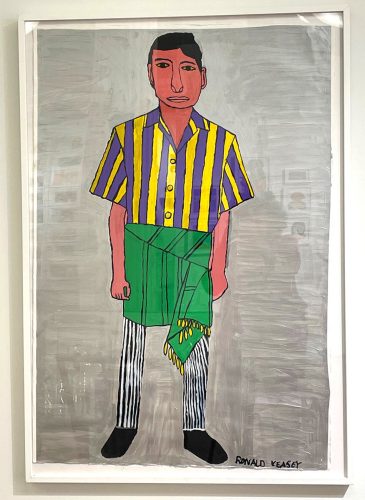
Jody MacDonald dissects in detail the concept of “identity” through a cast of small-scale 2-D and textile-based 3-D surrogates. She uses repurposed materials to create figures and detailed, miniature accessories (wigs, clothing, shoes furniture) set inside elaborate, mixed media environments with clues which shed light on the complex, often conflicting narratives.

Smashworks Dance – CITY STORIES at Center for Performance Research

Smashworks Dance – CITY STORIES at Center for Performance Research

DANCE

Though I saw Smashworks Dance’s CITY STORIES over a month ago, it still lingers in the back of my mind. As a New Yorker, how could it not? The images from the show are the images of my daily life. Flashes of scenes and movements weave their way through my commute and my coffee run, popping up like absurdist smash-cuts in early-2000s sitcoms. That’s where Artistic Director Ashley McQueen’s magic lies: the source material is everyday, the execution is something else entirely.

Exhibition-View-Andre-Pierre-Arnal-2022-©Adam-Reich-courtesy-Ceysson_Bénétière(1)

André-Pierre Arnal at Ceysson & Bénétière New York

Opinion

With the advent of Modernism in the late 19th – early 20th century, differing movements, schools, and networks sprang up internationally—some were generative and sustainable, others dead-ended, though unbeknownst to most of us, traces of these persist or return. This cross-fertilization drove Modernism’s evolution until the post-World War II era the new art made in the U.S. came to dominate the narrative. The triumph of the NY School (AbEx) corresponded to the new political and economic order. In this scenario the vanguards that emerged from the rubble and detritus of the War such as C.O.B.R.A., Nouveau Realisme, Lettrist, Zero, Arte Povera, etc. were trivialized, marginalized, or came to be appropriated. To this day, the European artists whose works come to be acknowledged in the States tend to be those whose works are used to typify the whole of a critical discourse, or style. This has reduced post-War European art to a short list that includes Pierre Soulages, Antonio Tapies, Lucio Fontana, Yves Klein, Francis Bacon, Joseph Beuys, Gerhardt Richter, Anselm Keifer, etc. In this manner, the illusionary status of the U.S. as the cultural leader of the free world is sustained, while European art is made to appear to be broken, fragmented, or at best sporadically relevant, rather than constituting a network of competing histories, practices, and critical discourses.

Text Description automatically generated

Table of Contents at Time and Space Limited in Hudson

In October 2021, at the periphery of the parking lot outside of the Time and Space Limited Center in Hudson, artwork by Linda Mussman appeared—about 20 large dictionaries and encyclopedias opened out on a crude wooden table. For several months, round the clock, these dictionaries were exposed to rain, sunlight, and snow, and rifled through by winds. Peach-colored streetlight bathed the texts some nights, and bright sunlight bleached the pages some days. The grass around the table receded and then returned with – mirabile dictu – a green shoot briefly fighting its way between 2 volumes. 

An Interview with Chicago Artist Vito Desalvo

By opening night the installation of Vito Desalvo’s rare public showing of his drawings was completed and the exhibition opened without a hitch. It will be showing, through December 31 at Greenkill Gallery in Kingston, NY. With the help of Mariah Karson, we were able to present his work in a manner that he found acceptable. My main task other than that was convincing him to attend the opening. After a great deal of bargaining, Vito not only showed up but was also surprisingly charitable in his conversations with guests. No one hurt, no foul. In the weeks following the opening, I was asked to interview Vito about his state of mind and thoughts about his work. Last Monday night after considerable liquid consumption, he responded to my inquiries. Our housemate Leo took the dogs—Tina, Louise, and Jack— out for an extended walk so we wouldn’t be distracted. Here are some excerpts of our chat, flaws and all.

A picture containing text, scene, gallery, room Description automatically generated

Saba Farhoudnia: Reflection at Jamaica Center for Arts & Learning

In conversation with Adèle Eisenstein and Saba Farhoudnia

Reflection, the solo show of Saba Farhoudnia in Jamaica Center for Art & Learning, highlights the cruel and tragic practice of so-called “honor” killing, by way of individual stories which give the victims their voice back, and shed a light on this reality for far too many women, girls and LGBTQ+ (taking at least 5000 lives annually per the United Nations Population Fund). The ensemble of individual panels and stories welcomes the visitor into a colorful and intriguing landscapes. Adèle Eisenstein, the curator of the show, says that the layers of paint reveal a reflective surface, which delivers a direct message to the observer—this might have been you. While dishonor killing is the most extreme end of the spectrum, the subject addressed also touches upon and exposes stratified layers of gender-based violence.