Dee Shapiro – From Fibonacci to Bathers

A person smiling in front of a curtain

Description automatically generated with low confidence

The artist at the Islip Museum. “Cornered”, watercolor on graph paper, 40 x 40 inches, 1975-76

Dee Shapiro’s paintings have evolved over decades of a rigorous thematic and formal search—how colors and shapes can express the intricate relationship between pattern, geometry, and nature through a two- dimensional form? With what appears to be a strong impetus to constantly re-invent her painterly vocabulary, Dee Shapiro’s work keeps us on our toes with each of her series of work, which she sees overall as evoking an alternate reality with absurd connection. From her early Fibonacci progression color coded on graph paper, to her later representational Bathers series–Shapiro’s paintings assert themselves with a life of their own, without a need for any explanation.

Continue reading “Dee Shapiro – From Fibonacci to Bathers”
Todd Bartel: an Omni-coupler

A person standing in front of a blackboard

Description automatically generated with medium confidence

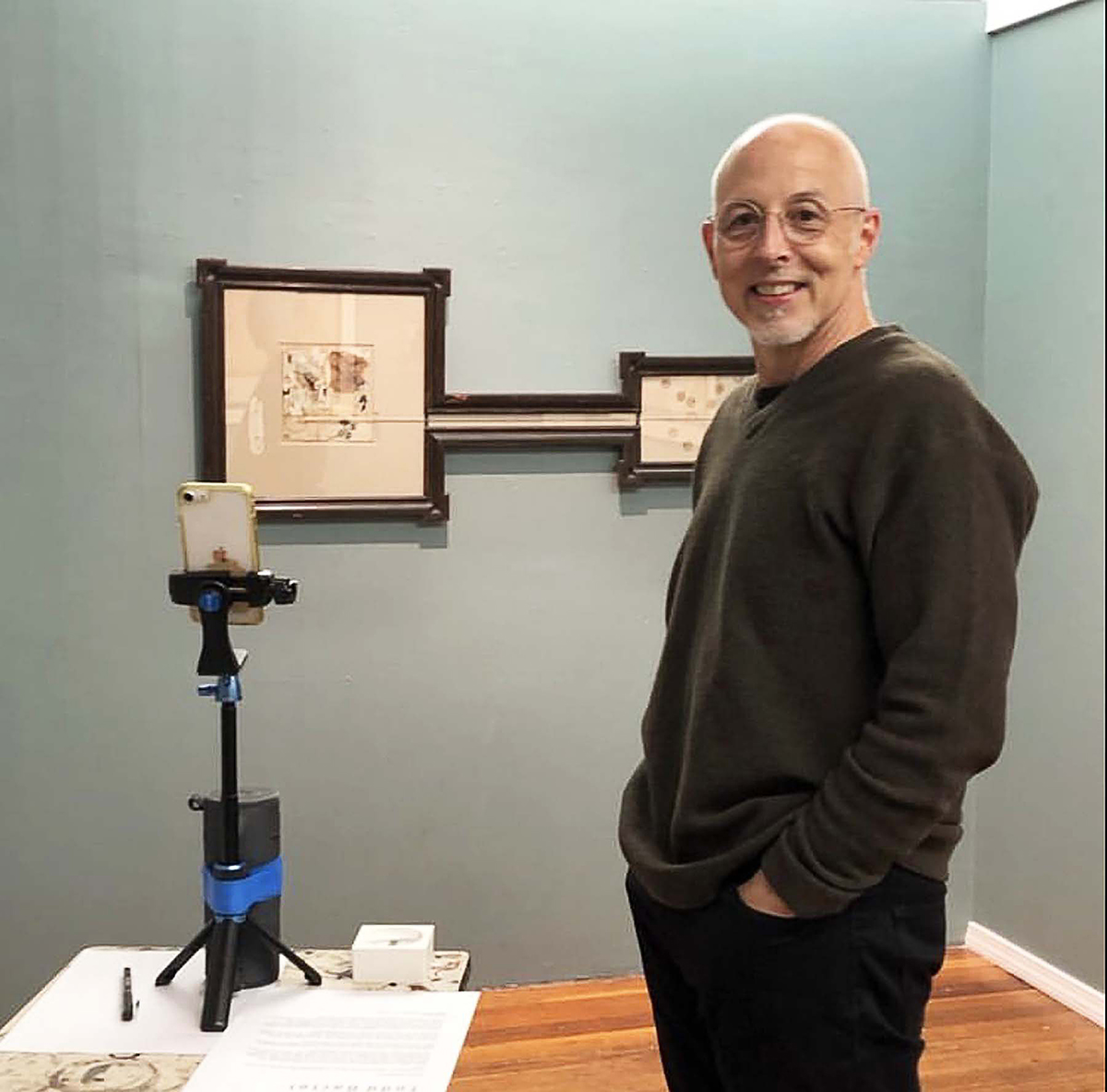
Todd Bartel in front of Pollination of Devonia, (Synterial series), 2002, gallery talk, L(and) exhibition, Room 83, Watertown, MA, photo courtesy of Ellen Wineberg

Todd Bartel came to serious collage because of an assignment he received on the first day of his first class as a freshman at RISD. He recalls the desks were strewn with magazines, and as soon as the course started, Professor Hardu Keck gave the students a prompt, “Create five collages that work with the following sentence: Surrealism is the chance happening of finding an umbrella and a sewing machine on a dissecting table.” Keck did not mention he was quoting Andre Breton, who was quoting Comte de Lautréamont (Isidore Lucien Ducasse). He expected his students to work with the strangeness of visual combination and found imagery. That was Todd Bartel’s introduction to Surrealism and chance coupling. He fell in love with collage immediately, coming up with forty-five collages by the first week. One of the key elements that draws him to collage is that it can involve a vast array of analog and digital technologies. “I consider myself an Omni-coupler,” he says.

Continue reading “Todd Bartel: an Omni-coupler”

Instituting The Re Institute in Millerton

In Dialogue with Henry Klimowicz, founder and director


The Re Institute empty, 2021, photo courtesy of Henry Klimowicz

The Re Institute is an extension of Henry Klimowicz’s studio, a very large 1960s dairy barn outside of Millerton, New York. About 11 years ago sculptor Henry Klimowicz started the gallery as a response to living in the “center of nowhere”, as he puts it. The artist says that the gallery allows him to have extended working relationships with other artists and their work. “I try not to know what a show will be about before it opens and I get to spend the length of the exhibition becoming aware of all of each show’s nuances,” he says about his curatorial process. A normal season at Re Institute includes 4 to 5 shows, which mostly feature 2 to 3 artists showing in the large space upstairs and another person downstairs. “I try to get each artist to have a specific reason for showing in the gallery outside of the possibility of selling work,” he says. This fits his vision of Re Institute as a non-profit institution. It’s important for him that the featured artists will find reasons to use the space uniquely. “There has to be something in the process of showing an artist that brings depth to the artist’s understanding of their own work or the process of exhibiting their work,” he says. These different ways of interacting with each artist have become the most important aspect of the space for him.

Continue reading “Instituting The Re Institute in Millerton”

Polly Shindler: Place on Material


The artist in her studio at The Wassaic Project, 2020, photo by Luis Mejicanos

In her paintings CT based painter Polly Shindler takes a close look at lived-in spaces – interiors with furniture of different periods, textiles with colorful patterns, flooring with different textures. Here spaces are typically void of people and at the same time breath with a sense of human occupancy.

Continue reading “Polly Shindler: Place on Material”

Common Frequencies / Frecuencias Comunes at BioBat Art Space

In Dialogue with Elisa Gutiérrez Eriksen


Elisa Gutiérrez in conversation with Miguel Gleason, Director of the Mexican Cultural Institute in NY, at the opening of Common Frequencies. Background video shows Marcela Armas’ video piece “Tsinamekuta”. Image: @onwhitewall

Common Frequencies brings together a group of Mexican artists whose work explore the intersection of art and science through sound, urban ecology, language, and collective imageries through performance, installation, photography, sound, and drawing. The exhibition will be accompanied by a series of free bilingual educational programs that encourage the participation of families. The exhibition runs through October 16th. 2021.

Continue reading “Common Frequencies / Frecuencias Comunes at BioBat Art Space”

Armita Raafat: Reflective Tactility


Site specific installation, 2016, The Horse & Pony Fine Arts, Berlin

Armita Raafat is a New York based artist, born in Chicago and raised in Iran. Her sculptures, installations, and wall reliefs draw upon traditional Iranian architecture, specifically the Muqarnas Domes, the vaulting element in Islamic architecture. She is exploring their form and symbolism through her personal lens by using contemporary materials, transplanting them into new cultural, historical, and geographical contexts to assume a new meaning.

Continue reading “Armita Raafat: Reflective Tactility”

Naomi Kawanishi Reis: Snippets of Beauty

The artist with her work

In her drawings, murals and paintings, Japanese born, and Brooklyn based artist Naomi Kawanishi Reis, utilizes paper and fabric to make idealized spaces, ranging from utopian architecture of modernism, gardens, and more recently, still life in domestic spaces. In this recent body of work, Reis starts with photographs taken by her mother of her ikebana arrangements displayed outside the family home in Kyoto. Reis downloads the images from the family online chat, the link that has connected her diasporic family across oceans.

Continue reading “Naomi Kawanishi Reis: Snippets of Beauty”

Tina Struthers: Life in Fiber


Tina Marais Struthers, studio in Montreal, 2020, Photo courtesy of Josiane Farand

Tina Marais Struthers’ work develops from a rigorous, personal, and highly technical consideration of fiber as an evocative medium deftly addressing subjective experience, memories of place, and processes of change and growth. Struthers says she is fascinated by how fabric reflects and absorbs light, how it can entice us to touch, and feel comfort, or discomfort, by visual directing textures—”In this world during the pandemic, this need to touch, to feel textural comfort I think has really been amplified. I often challenge the notion of textile as being soft, in manipulating it to appear as metal sculptural forms.”

Continue reading “Tina Struthers: Life in Fiber”