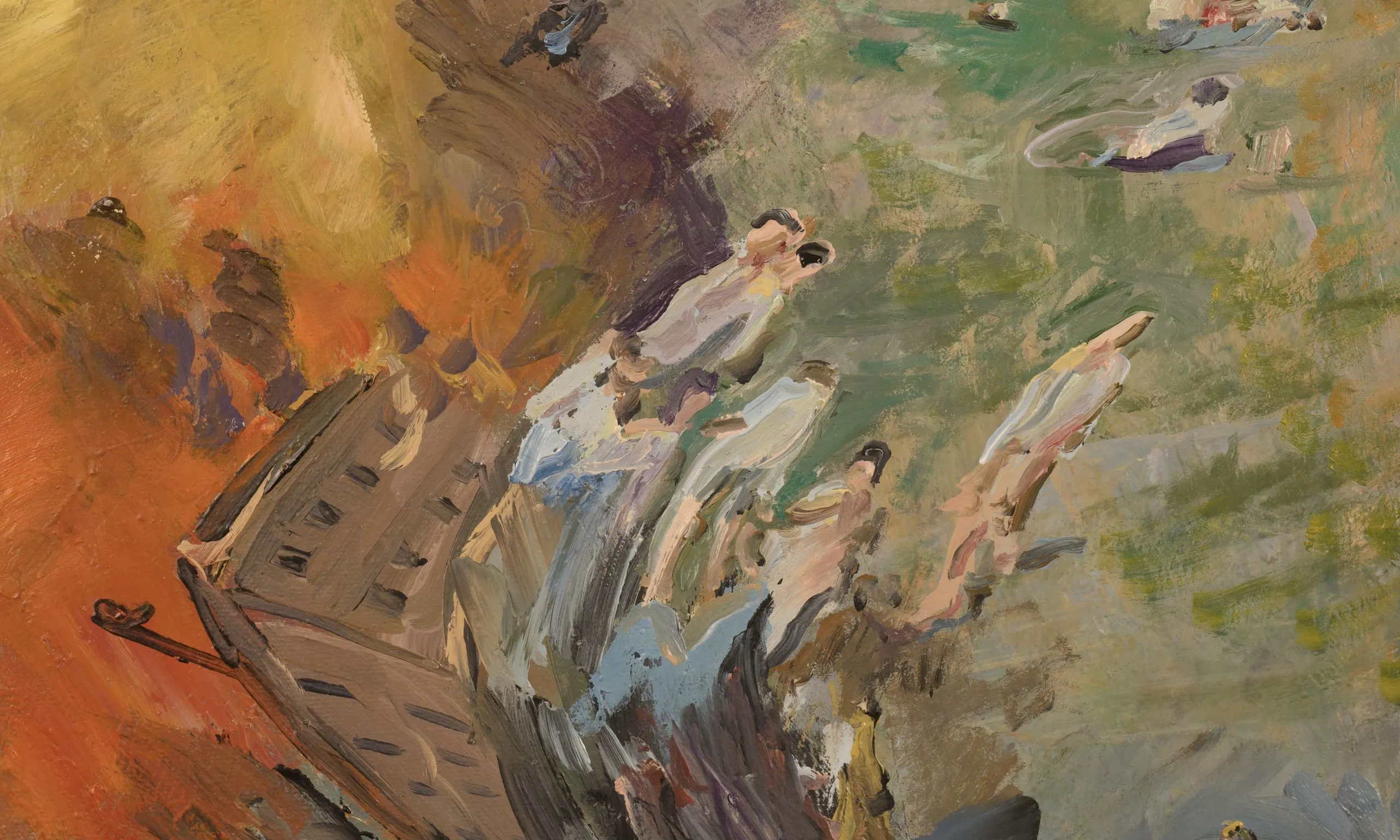
In early 2026, Elizabeth Johnson responded to an open call from Collective Z on NYFA, and it turned out to be an excellent opportunity. Gallerist Alex Z. Wang selected a small painting, Grievous Smoke, in which fire, smoke, a building, and figures are compressed into an arc erupting from a hillside. That first opportunity set things in motion, leading to her current solo show at Collective Z.
What does it mean to have your first New York solo show?
It’s thrilling and unnerving to have a first solo show. I figure I will worry less next time. Friends, acquaintances, and strangers seeing your work all at once is a strange situation. The paintings look much better under professional lighting than they did in the studio. Since I focus on each painting one at a time, I haven’t really thought about their cumulative effect up until now.
The show sits in the gap between dreaming and waking. In 2024, you described dreams as construction sites being hammered together; now the emphasis seems to be on dissolving. What shifted?
The work is still “hammered together” in the sense that dream building at night while I sleep parallels being led by imagination while painting. And it works both ways since dreams sometimes draw from the experience of painting and planning composition. I am an occasional or spotty “lucid” dreamer. If I look at the edges of dreams by chance, I’ll notice that there is nothing there, and immediately start building a stage for the action, so to speak. People and things and landscape flip up like stage sets. Once I pulled apart a porch roof in a dream and marveled over the fact that it didn’t crush me. I am always moving in dreams, and have some compelling, unnamed goal. I travel much more while asleep than in real life. I wake up remembering parts of the journey: setting, details, and familiar people or invented ones. It’s refreshing to linger in between an invented world and our real one. I titled the recent series “Dream Gap” since it suggests the danger of falling into gaps or voids and the allure of being between mental states.
You scrape and wipe away more than you keep, a practice you call “losing to gain.” How do you decide what survives, and why partly erase failed ideas rather than paint them out?
It used to bother me that I destroy so much rendering and beautiful color combinations that communicate but unfortunately feel too stiff or common. I still wrestle with intentions that create failure. Losing to gain means I am giving into a sense of dissolve as process as much embedding it in the painted surface. I have always painted clouds and fog, but they carry more lately: they hide, reveal, float and disperse softly or aggressively. I am learning that whatever feels familiar and safe must be painted out, the sooner the better, and that there can be different degrees of doing so. Wiping and scraping away sacrifices what you thought would work to discover something more subtle or surprising. Allowing degrees of erasure carries, pushes, and unifies my trembling, resistant, resigned, and hopeful self forward. It invites the manifestation of what could happen in a particular place, here and now. Physical labor focused on a limited zone of activity is the glue that holds a painting of many parts together. I usually work on one or two sections a day, daydreaming and tinkering inside 3-D zones suggested by 2-D messes. Both the zones and their contents are mutable. I like not knowing where a painting is going except that it will have multiple, unrelated parts, textures and points of view. All that happening seems to push aside the need for narrative.
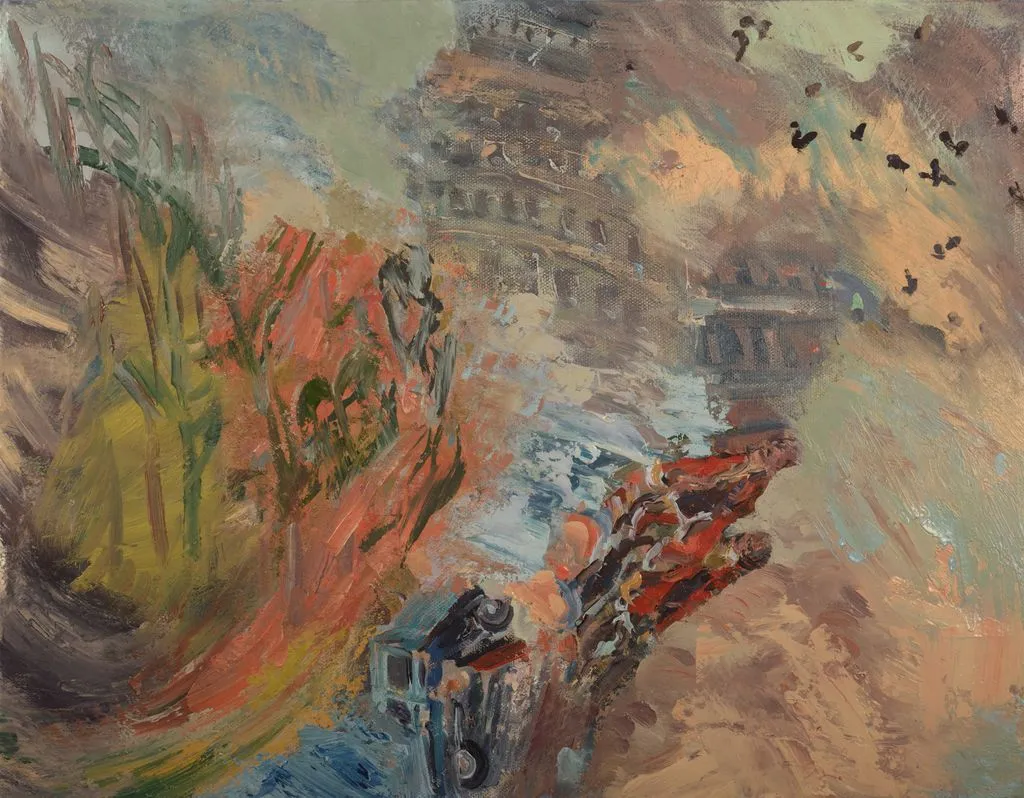
The newest paintings are shaped by caring for your mother, who had dementia for twelve years. How did something so personal enter work that has long resisted storytelling, especially in Pretty Much Gone, Thief and Dream Gap?
The overwhelming effect of Anita’s outgoing personality sliding into dementia has made a huge impact on me. Emphasis on dissolve or things falling apart relates to her death in 2025: my husband and I witnessed her suffering and did the best we could to support her for what seems like a really long mental decline. She lived with us until she went into the nursing home. A giant, hovering sadness naturally entered my process of joining interchangeable subject parts and abstraction. And her personal effect is not apparent in specific places within the pieces you mention. I recognize it as a consistent mood felt through different markers such as water, boats, figures, nature, and a painted muffling effect within the pieces you mention.
Even further back than mom’s dementia, storytelling was and still is a fundamental aspect of family life. Let’s just say the women in my family are extremely verbose. It’s in our DNA, and we compete to get “a word in edgewise,” be witty, shock and entertain. The complete picture would be women sitting around a table eating sweets, drinking coffee, talking over each other and sometimes painting together. I would call the hedonistic atmosphere that my Aunt Diana and mom created a rural, 70s-styled idyll that includes too many animals, weeding left for another day and the thrill of eluding their husbands. And of course, they fought with each other. During this period, I learned to be a good listener. When my husband and I returned to Pennsylvania after 25 years in California in 2011 to help mom, The “Anti-Story” series of paintings was my response to reentering beloved, aggravating, tedious and constant yakking. Working in a quiet studio sure helped even if the work had no effect whatsoever on stemming the flood of family discourse; yet, composing paintings that mixed unrelated story fragments gave me space to myself, a private visual and mental space not dominated by external voices.
Mortality is a deep well that we all skirt until we can’t anymore. And at the very end of Antia’s life, sketching with markers with her kept our bond intact, and she knew who I was until the very end. She was a talented artist, despite being more invested in nurturing and working after her divorce as a nurse’s aide. She could draw well and loved working in watercolor. I absorbed her gesture and expression from youth: she was my first art teacher along with my aunt and cousins. In her generation, since women were rewarded for being housewives, art was not considered more than a hobby; nevertheless, she painted on occasion and liked to say, her pieces “look like I painted them with my feet.”
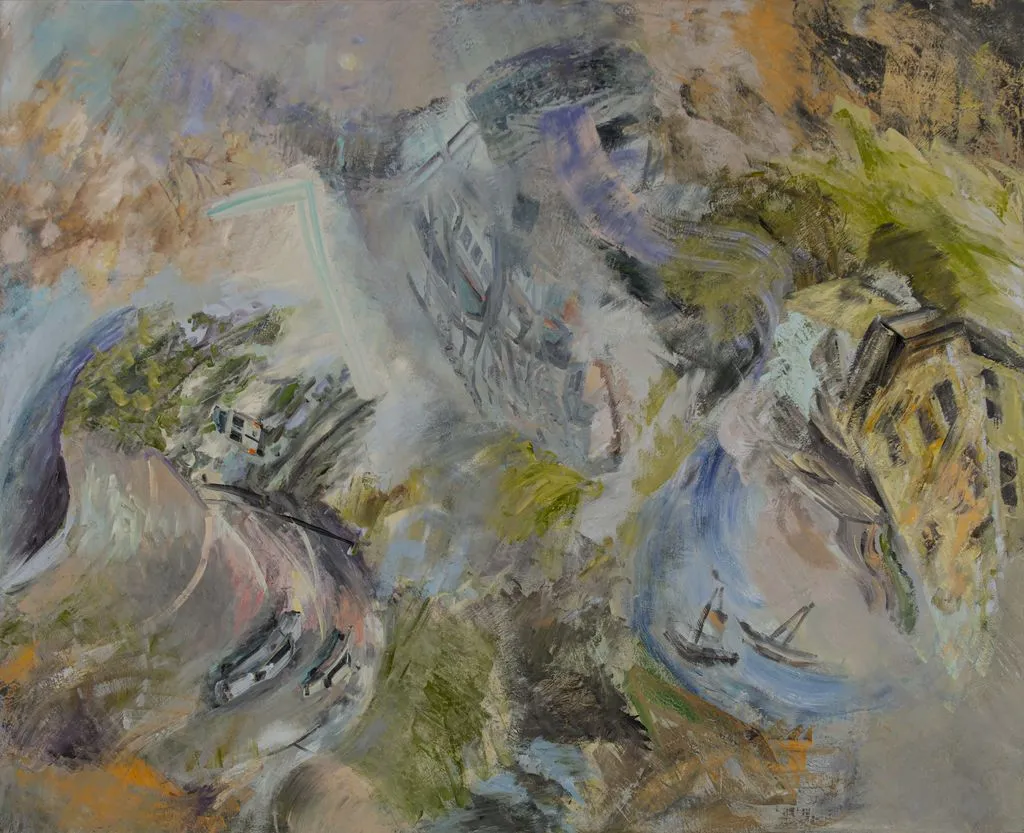
The show spans 2020 to 2026, from the large Attamaroov to small canvases like Pearl Shoes. How did the Dream Gap series grow out of the earlier work, and where does a title like The Grass Is Far From the Goat come from?
Besides being united through storytelling, all the recent work has a strong water influence. I painted and drew the ocean when we lived in San Francisco; it was a great passion for me to set up outside and try to capture the movement and pattern of the waves. I relate to brief, specific details erased by the massive scale of breaking waves, that constantly create and destroy themselves. Dream Gap presents water as standing outside the influence of gravity, almost as if it is a psychic medium that connects people and the flotsam and jetsam of life. I like that the figures are smaller at the bottom of this piece and larger at the top, making it top-heavy and full of potential energy. Attamaroov succeeds through sloughing off a curving surface that holds distorted cars and a van.
I guess it is a visual pun on freeway pavement being like an applied surface. We installed wallpaper for a living when we lived in San Francisco, so working with rolls of paper, cutting and pasting (in the actual physical way), and critical attention to surface was part of the job. Wallpaper hanging also involved planning how a repeated pattern would deploy across several walls in a room. Storytelling, being overwhelmed by other people, water studies, figure drawing, and wallpaper hanging have all been influential. The title The Grass Is Far From the Goat was lifted from Dante’s Inferno. It means something like our saying “the grass is always greener on the other side of the fence.”
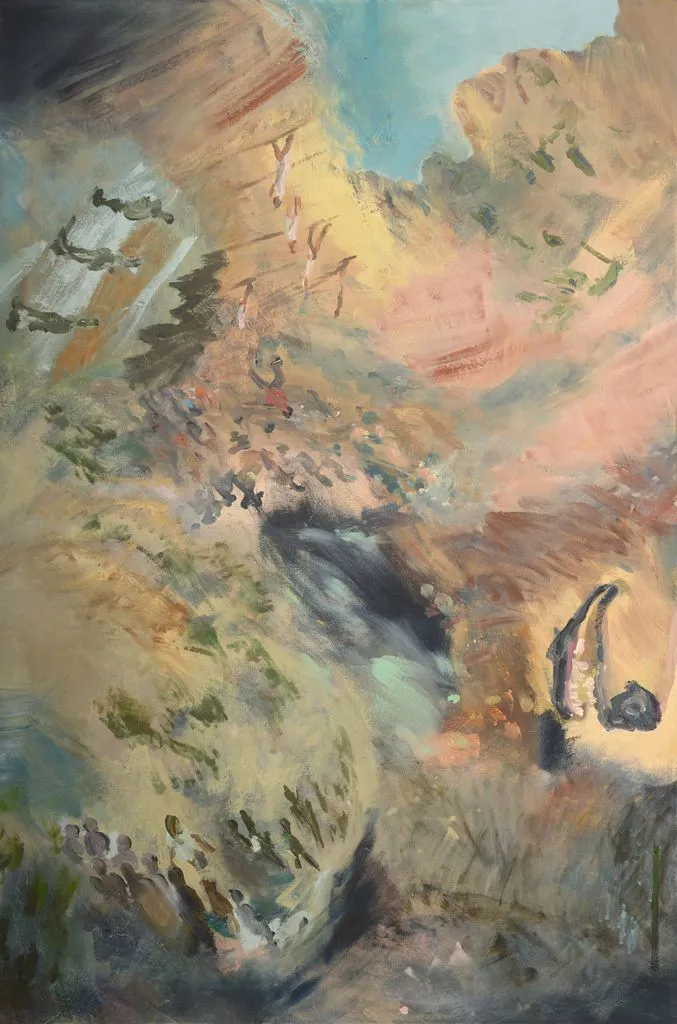
Elizabeth Johnson’s Dream Gap will be on view at Collective Z Gallery, 325 Broome St in Manhattan through December 5th, 2026. More information can be found at collectivez.com, and on Instagram @collective.z.gallery
Make your tax-deductible donation today and help Art Spiel continue to thrive. DONATE
About the Artist: Elizabeth Johnson participated in 7 group shows during 2025 and 2026: “In the Heat of Becoming,” at Collective Z Gallery in New York, NY; “Bending the Arc,” at Perry Lawson Fine Art in Nyack, NY; “Seen and Unseen” at The Painting Center in New York, NY; “75 A-One,” Silvermine Art Center’s Annual Juried Exhibition, in New Canaan, CT; “Equinox” at Millersville University in Millersville, PA; “Drawn from Life 2025: Identify,” with Upstream Gallery in Hastings-on-Hudson, NY; and “Flotsam and Jetsam,” at 490 Atlantic in Brooklyn, NY. She’ll have a solo show with Z Collective Gallery this fall. Johnson writes art reviews for “The Brooklyn Rail,” “Two Coats of Paint,” “Art Spiel,” “The Philly Occasional,” and “Roborant Review,” and interviews artists for commercial and academic galleries. She’s currently proposing American Dream Complex, a group exhibit that integrates American landscape, consumerism and pollution at the Hunterdon Art Museum in Clinton, New Jersey. elizabethjohnsonart.com elizjohnson2018
About the writer: Etty Yaniv is a Brooklyn-based artist, writer, curator, and founder of Art Spiel. She works in installation, painting, and mixed media, and has shown her art in exhibitions across the United States and abroad. Since 2018 she has published interviews and reviews through Art Spiel, often focusing on underrecognized voices and smaller venues. More about her art can be found at ettyyanivstudio.com and on Instagram @etty.yaniv