In low-light conditions, what is known as adaptation in visual physiology refers to the ability of the retina to adjust to various levels of light. For the adaptation to yield any successful results, humans must undergo a dark adaptation period of up to two hours. Retinal sensitivity and the regeneration of photopigments determine the duration of the period. Nowhere does physiology mention the discomfort of the body, thrust into otherwise unnatural conditions; here, the body is no more an extension of the eye but must entrust the latter with its movements; the body is at the mercy of the eye that is not yet attuned to the new lighting conditions. At any first array of light, the adaptation works within seconds. Equally disregarded is the precondition of the light source, whether it is of natural or artificial cause.
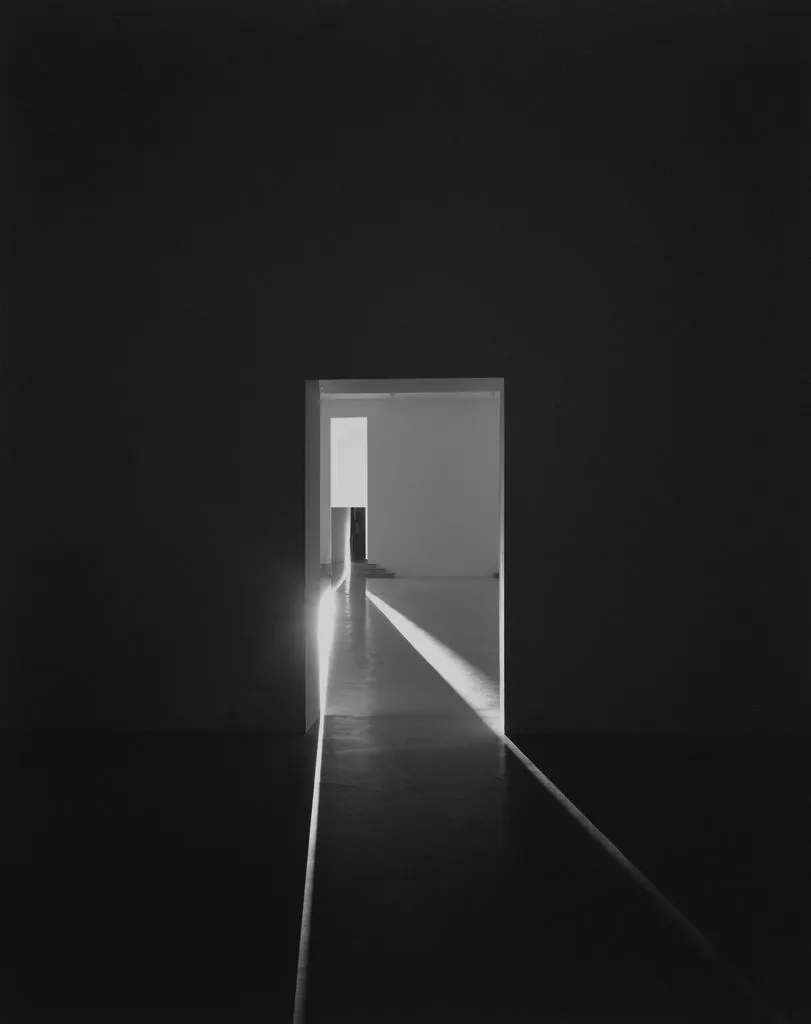
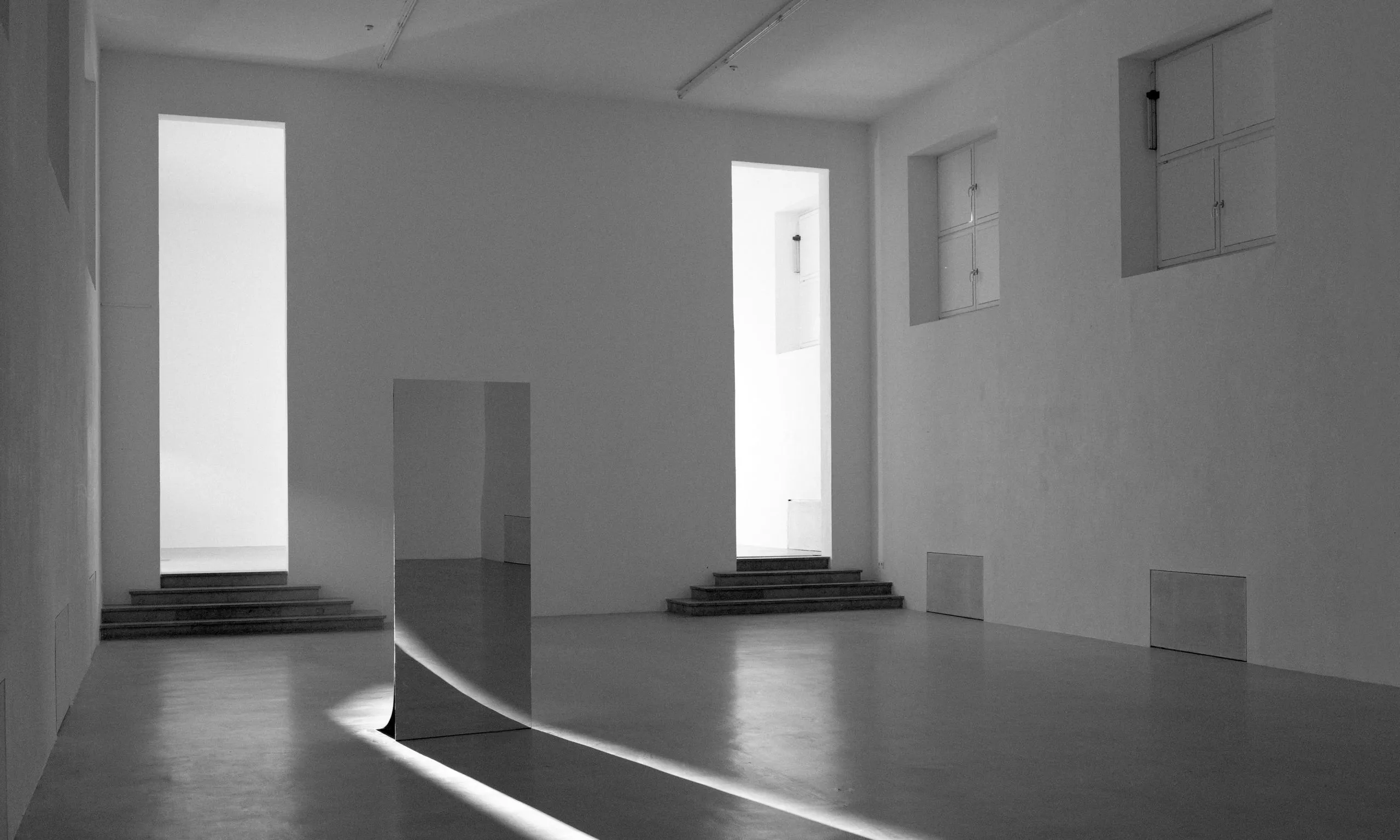
In the upper hall of the Kunstverein München’s exhibition area, visitors of the current Kitty Kraus exhibition enter a domain of incertitude, much like the now-blind trying to accustom themselves to the visual dislocation. Here, the dislocation comprises the bifurcation of a shadow by an upright mirror. The hall itself is filled with ambiguities: the shadow itself takes its incipit at an artificial source of light of almost blinding intensity, situated in the back quadrant of the exhibition space – which one is discouraged from entering as to not disturb the fragile ecosystem of the particular angle the light has to sit at – and actively drafts a delineation of the entrance to the main hall, finally stopping at the furthest wall and forming a further shadow veil.
Merely based on this rather assemblage description, one will notice that describing the edges of the works may not be as evident as it seems. What instead becomes apparent is the duality of the tangible and the phenomenological, the retinally perceivable and the “expression”, Husserl’s “ultimate dimension”, of said objectal manifestation. Here, what is expressed is perfectly in line with Gilles Deleuze’s extrapolation of “sense” as both that which does not exist outside the proposition as well as that which neither merges with said proposition, thus acquiring a distinct objectivity. Here, the monolithic mirror as the object does not end at what it presents but extends that which is expressed into the room, so much so as to also dictate external conditions such as equilibrium, darkness and reflection.
In fact, where a mirror in much of modern art is used in order to duplicate a third party, here the effect of the mirror as that which “makes appear” is expertly delegated to non-physical states of affairs in which that which is eventually expressed “has no resemblance whatsoever to the expression”. This very dichotomy – the mirror as the supreme duplicator and the shadow a sensation of reflection – attunes the mirror to its own objecthood while extrapolating the use-value from it; neither monolithic nor the panopticon of the spectacle, the mirror, through the artificial light, becomes both site of the event as well as being liquified by its shadow as an effect.
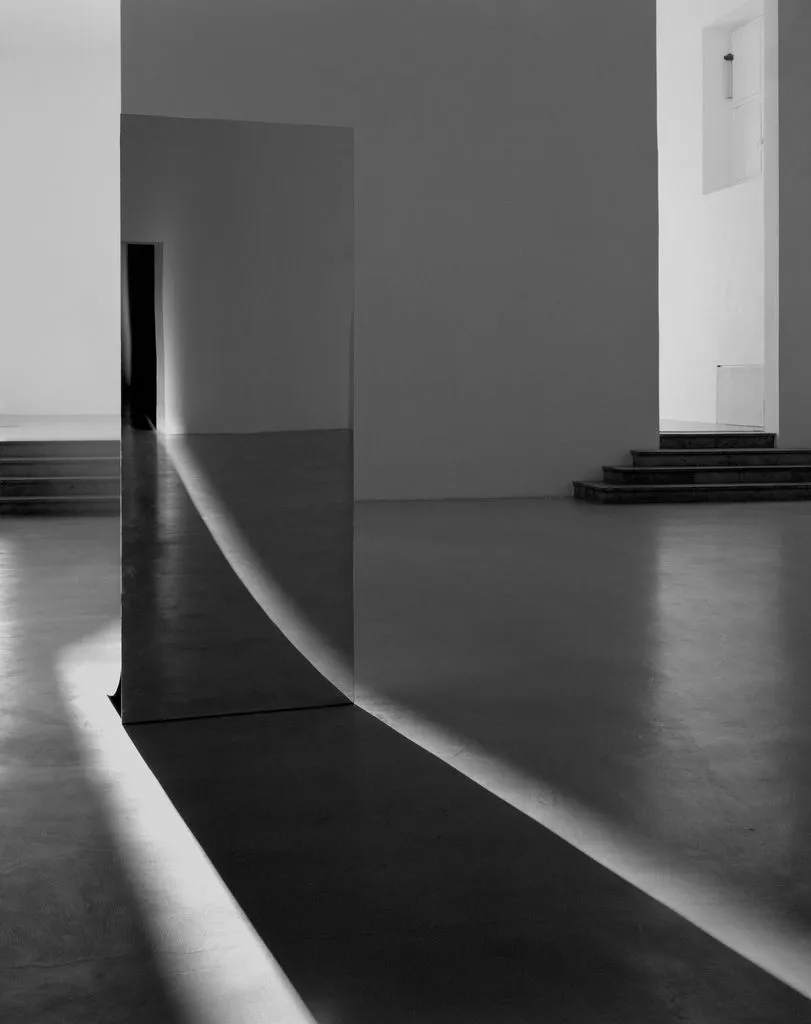
Yet, it is important to inquire about where this event truly takes place: is it in the apparent stasis of the settled shadow comprised of a myriad of invisible light particles? In the edges of the mirror? On the ground as the carrier for a particular event? In the light source’s trajectory? Or in the retinal perception of the visitor? Here, the “a priori” and “a posteriori” of the event becomes apparent, for it is able to nestle itself comfortably in between the two unfoldings only in order to not resolve itself. “…the phantasms of the surface have replaced the hallucination of depth” (Gilles Deleuze, Logic Of Sense, P.24).
Yet the expression, the denotation of the event, is decidedly present, even if ad negativum: there is no doubt in the mind and eye of the visitor that the intensity of the shadow is tangible, perhaps even more than the duplicative aspect of the mirror (given the low-light conditions in the exhibition space). This, naturally, presupposes the antecedent supposition of the sense itself, of both the shadow as possible event as well as the event being a relational phenomenon to the instantiation of the particularity of the light source, the position of the mirror, the darkness in the room and various other minutely precise factors. Kraus never hides this assumption; the exhibition is not about optical illusions, tricks of the Mad Hatter oculist or spectacularizations of sense but about a precise moment of conjunction between space and vision in which the event is present.
A mere defiant but benign peek into the back quadrant of the installation in fact reveals no Alice and no Wonderland but merely the inner workings of a particularly precarious apparatus that has to remain homeostatic in order for the event to actually take place. The technical equipment thus demystifies the presumed fantastical nature of the event in order to reveal the latter’s adherence to the logic of inverse relations: even if one knows how the event is achieved, the event still persists, neither in spite of nor because of but through it.
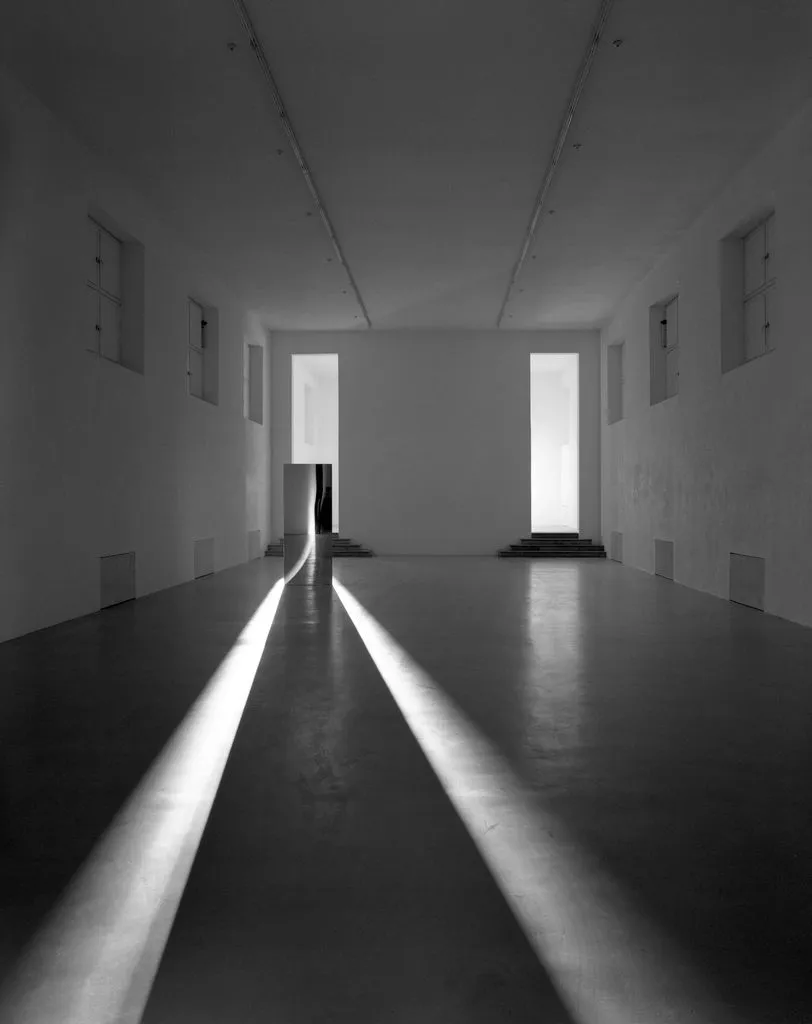
Certainly, the knowledge of the technical intricacies of the event delineates it outside of the concerns of the eerie, which is constituted by either a failure of absence or by a failure of presence. Yet, the event maintains a kind of undeniable intensity. The sense of the event does not originate in one specific part of the installation but seems to become an epiphenomenon of the equipollence of all its interlocked parts.
This kind of specifically nebulous quality of the instantiation of the event goes on to further the unstable relationship between subject and object but also between vision and movement. Here, the exhibition space does not offer any clear demarcation of where the installation stops and begins; the sense might depart from this intertwining of elements, but the absence of natural light in the hall itself already constitutes the condition for the event’s integration. Kraus manages to overcome the priority of the purely retinal without falling into the Mad Hatter’s trap of the “experiential”; in fact, one could argue the artist reaches further into a kind of staging of sense within which what is made apparent is the “eternal within the finite, the spiritual within matter, the limitless given form” (Andrey Tarkovsky, “Sculpting In Time, ” p. 37).
Here, we must return to the mirror as both an object of replicancy and reassurance. Yet, most of all, the mirror is a kind of Lynchian marker of thresholds; in “Snow White”, the mirror is said to be a symbolizer for vanity and the inescapable truth of aging, still it could be arguable that this misses the entire point of the mirror’s representative qualities. At Kunstverein München, the mirror becomes precisely that which does not lead anywhere, that which neither corroborates nor denies but instead interlocks the present – being the focal point of the light source – and, simultaneously, elongates its own sense.
It is not about the event marked by the mirror but that which passes through it in order to be. In this way, the mirror can be equated with the red curtains of “Twin Peaks” as a point of transition of matter and state, conscious and non. Perhaps, in fact, the latter, the unconscious, through not actually being a subject, lends itself much more to the voyage between the thresholds that Kraus imagines in the show.
References:
Deleuze, Gilles: “The Logic of Sense”. Bloomsbury: London (UK), 2015
Fisher, Mark: “The Weird And The Eerie”. Repeater Books: London, 2016
Tarkovsky, Andrey: “Sculpting In Time. Reflections on the Cinema”. University of Texas Press: Austin, 1986. Translated from the Russian by Kitty Hunter-Blair
W.G. Clifford, Colin/ A. Webster, Michael/ B. Stanely, Garrett/ A. Stocker, Alan/ O. Sharpee, Tatyanna/ Schwartz, Odelia: “Visual adaptation: Neural, psychological and computational aspects”. Elsevier (ScienceDirect), online at: https://www.sciencedirect.com/science/article/pii/S0042698907003756
Kitty Kraus’s exhibition at Kunstverein München, Galeriestraße 4, 80539 München-Altstadt-Lehel, Germany. On view through Novebmer 29, 2026.
Instagram: @kunstvereinmuenchen
Make your tax-deductible donation today and help Art Spiel continue to thrive. DONATE
About the writer: Daniel Gianfranceschi is a multidisciplinary artist and writer working within the realms of sound, text and painting. Gianfranceschi is currently studying at the Academy of Fine Arts under Prof. Florian Pumhösl & Prof. Florian Hecker. His work has been shown at Museum Brandhorst, Kunstbau (am Lenbachhaus), AkademieGalerie München, Kunstpavillon München, Goethe-Institut Athens, Künstlerhaus Stuttgart, Kunstverein München, among others. Writing contributions include the books “Sonic Nihilism” (Adventurous Music) and “Soft Leather Contradictions (The Creative Writing Department) as well as features in Hyperspekulation, Blue Labyrinth, Glamcult, Whitehot Magazine, Les Nouveaux Riches, Positionen Magazin and more. His sonic output has been performed at various institutions including BLITZ Club, NoDepressionRoom and Galerie arToxin. His discography includes solo work as well as features in compilations by the likes of Sound & Experiment, Industrial Coast, Les Horribles Travailleurs.
Instagram: @danielgianfranceschi / @subjectchange.pdf