The Art Center of the Capital Region in Troy, NY is host to one of the most consequential exhibitions this season, Scapegoat and the Bear, Paintings by Jeff Wigman, curated by renowned conceptual artist Mark Dion, on view through November 20. The colors are lush, the surfaces smooth like a muted satin finish, hazy landscapes in the distance that could be paintings on their own, and tiny creatures, rendered with economically deft brushstrokes that clearly depict the tasks at hand. These descriptions partially detail more than 50 works of art created by artist, Jeff Wigman, that make up The Scapegoat and the Bear. What is even better, there are no labels. Wigman trusts the audience to look and come to their own conclusions.
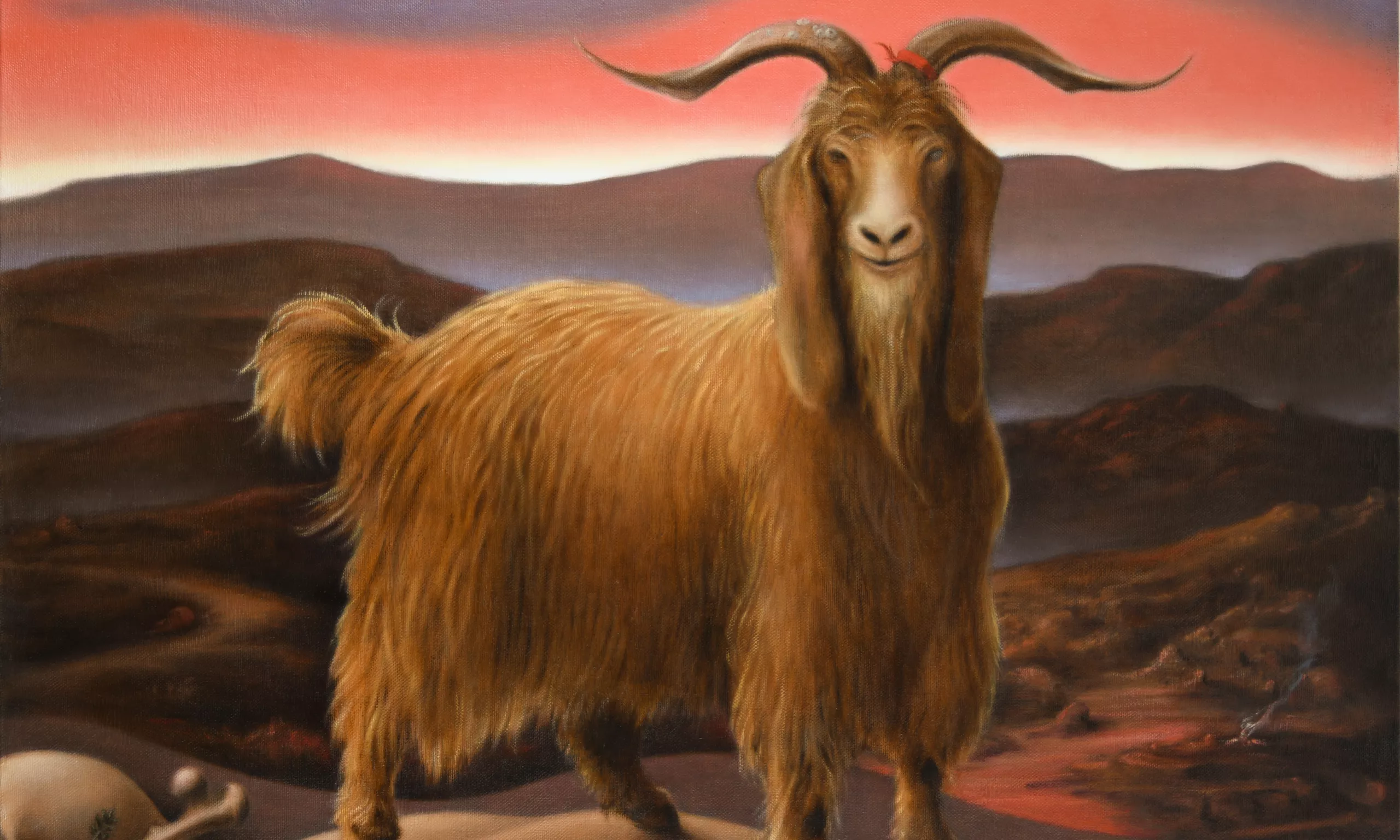
Upon entering the gallery, you are immediately confronted by one of the larger works in the show, The Scapegoat’s Return. Inspired by the biblical tale found in Leviticus 16 of the sacrificial rite of two identical male goats, one sacrificed for the sins of the community and the other, the scapegoat, who becomes the innocent bearer of all sins transferred by a high priest. The scapegoat is then released into the wilderness and carries away all ungodliness with him. In some later rabbinical versions he is pushed off a cliff.
But, Wigman’s scapegoat is no sacrificial lamb. This is a majestical warrior, hooves firmly planted on a ledge at sunset, a long coat of golden tendrils cascading down, with eyes staring straight ahead. This creature emanates the heart of revenge more than a docile martyr. In the tale, the goat has a red cloth tied to its horns that turns white when God bestows forgiveness . In Wigman’s portrait there is no white cloth, but a severed red remnant on one horn. Inscribed at the bottom of the painting is ECCE REDEO, Latin for, Behold! I have returned!
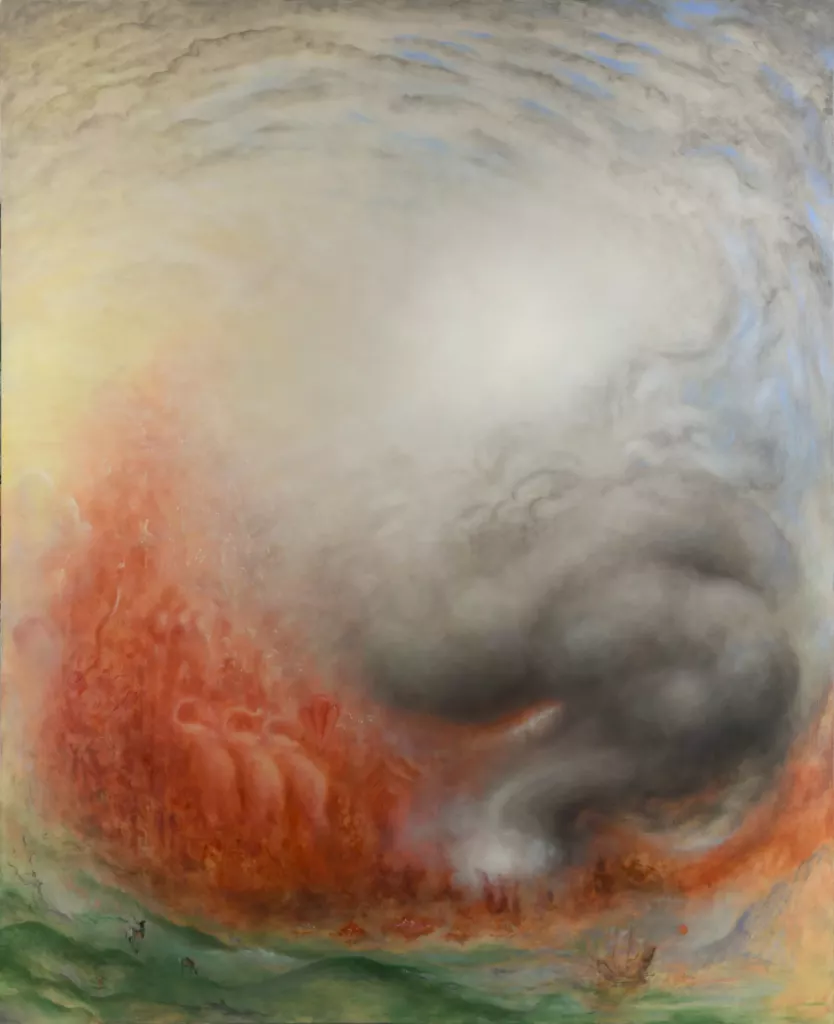
At a time when many art spaces display large dogmatic statements explaining in a rigid narrative exactly what is intended in the visuals exhibited, Wigman is focused on trusting painting that can convey a sense, an emotion by a line, a color and varying texture. Having become enamored with Flemish Painting from the 14th to the 17th century he has spent decades decoding and studying how the likes of Bruegel, Bosch and van Eyck created and developed the techniques that produced so many masterpieces. When a tool such as a palette knife was not available commercially he created one for himself with a borrowed anvil. This does not mean that Wigman is stuck in antiquity; on the contrary, he swings with the grace of an acrobat between abstraction and figuration, a figuration that often challenges the Western canon. First impression is a truly beautiful abstraction that conveys a sense of utopia, a peaceable kingdom. Bright white light moves out of the center of the canvas as though it is animated. It appears to block out dark grey swirls. As you look closer, elephants move through a reddish glaze and ships and other fauna frolic in ripples of deep shades of green.
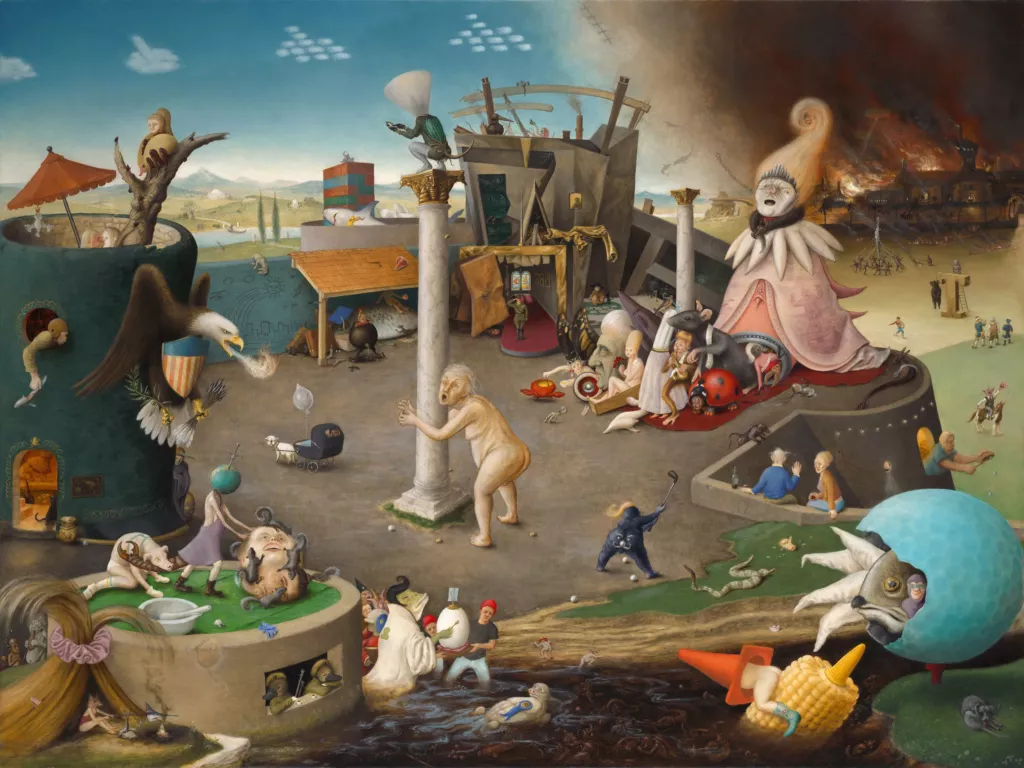
In the back of the gallery, a velvet curtain cordons off a rectangular space that could be described as a hybrid medical examination room and a confessional. In another space it could be an exhibition unto itself. Enter and you find yourself in a cathedral-like atmosphere where artworks reminiscent of Hieronymus Bosch’s Garden of Earthly Delights line the walls as altarpieces and Stations Of The Cross. Each panel depicts not an ancient disaster, but the world we survive in today. Horrific scenes with several bizarre figures exquisitely rendered. Necrotic babies and skeletons romp around. Much like a hip hop master, Wigwam samples small discrete visuals from Bosch, but then imbues them with contemporary atrocities, weapons, bombs, you name it. Upon parting the curtains you leave feeling Wigman has exposed a satanic cult via political intrigue.
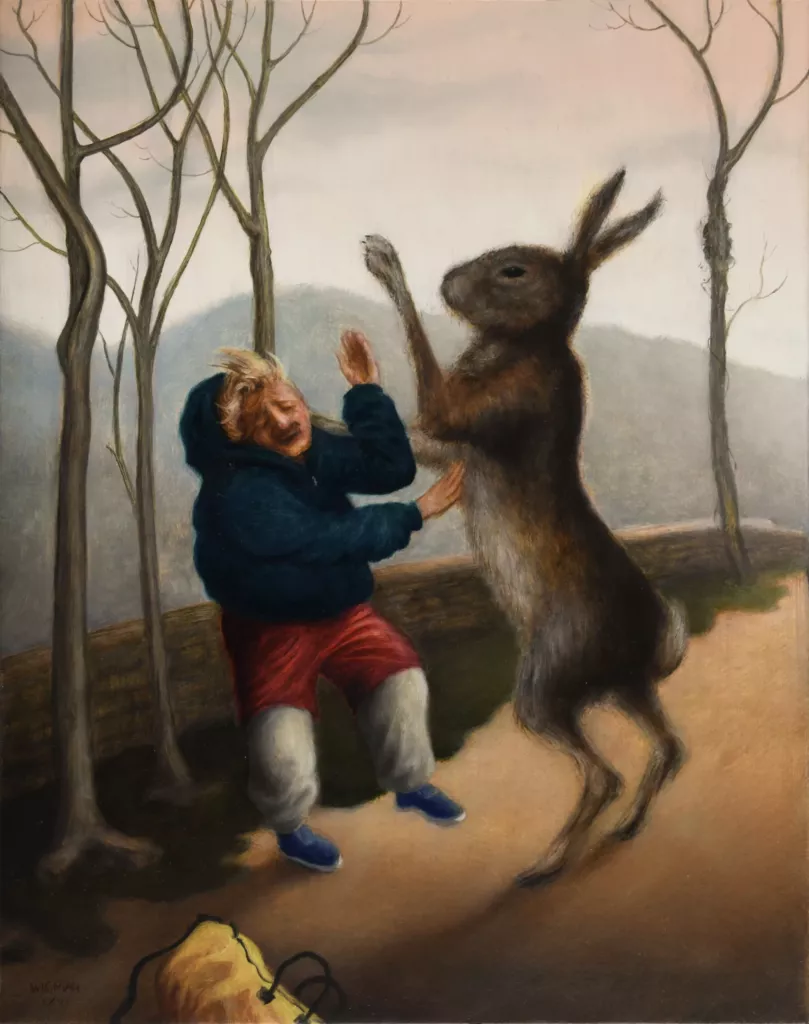
It would be a mistake not to mention the noble status animals hold in this exhibition, unlike their human counterparts. During the 14th -17th century, while the Flemish painters were honing their techniques and signature styling, explorers from Europe traveled to Asia, Africa and America generating a tsunami of colonialism that fractured cultures in the world. Europeans promoted a hierarchy of humans, particularly white males and violently superimposed this belief for centuries. To many indigenous peoples this was the antipathy of their cultures that was based on the sanctity of all living entities. Wigman has a wild sense of humor and it is on full display in a small delicately painted work where a rabbit appears to beat the hell out of a man. The rabbit is much larger than his opponent and is obviously the victor.
If you have an opportunity to see Jeff Wigman’s work do not pass it up and allow time to truly enjoy his skill, intelligence and humanity.
All photos courtesy of the artist
Make your tax-deductible donation today and help Art Spiel continue to thrive. DONATE
Jeff Wigman, The Scapegoat and the Bear runs through November 20th, 2026 at the Arts Center, 265 River Str, Troy, NY 12180 @capregionartscenter @jeffwigman
About the writer: Sara Farrell Okamura is an artist, educator, and writer with over 40 years of experience. She has received grants from the Illinois Arts Council, MASS MoCA, Assets For Artists, Project, A.R.T. Fund, Martha Boschen Porter fund, and Mass Cultural Council. She will have a solo exhibition at LABspace in Hillsdale, NY, in May 2026. In addition to Art Spiel, she has written reviews for Brooklyn Rail, Boston Art Review, and Hyperallergic. @sfokamura