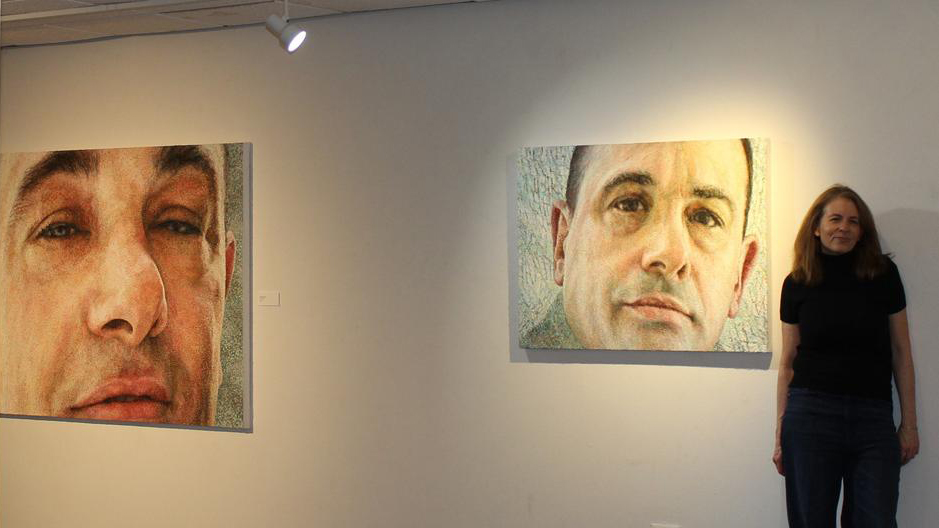
Joyce Polance has spent three years painting the same therapist nineteen times, in oil with fingers, and always from photographs taken at the close of a session. Polance inverts a familiar asymmetry: in therapy, Polance is the one exposed and observed, and here the therapist is the subject of long study, a figure whose features have grown more familiar to Polance yet, in many ways, remain a stranger. That paradox drives this body of work and gives the exhibition its title, The Patient Looks Back. It opened this September at Vassar College’s James W. Palmer III Gallery. What began as a single painting became something more persistent: a reflection on how difficult it is to truly know another person, even under the closest attention.
How did this series begin? Was there a moment you knew your therapist would become your subject — and how did the two of you arrive at working from photographs of your sessions?
I’d been working with my therapist for less than a year over Zoom, yet we’d been doing very deep work together. My work carries narratives that reflect my own life and state of mind, so for me, it was natural to ask to paint the person who was rewiring my brain in a profound way. I felt afraid to ask him, but he said it seemed an inevitable part of our process and agreed to sit for photos. By then, we’d begun meeting for monthly in-person sessions, so I took some pictures on my cell phone at the end of a session. Aside from my not having regular access to him, I always work from photographs, as my paintings can take months to complete. I’d only planned to paint him once, but it had been an unexpectedly joyful experience for me—as opposed to the anxiety that normally rippled through my work—and I wanted to continue. He’s remained supportive of my artistic process and still sits for photos.
In therapy, you’re the one being observed while the therapist stays composed and hard to read. Here you reverse that. What made you want to look back, and what was it like to study the person whose work is to study you?
I’d attached to him in a way I hadn’t with previous therapists. I became curious about him—probably as a way to hold onto him because I was so vulnerable in our work. I think it gave me some illusion of control. I grew up with a lot of chaos and learned early on to read people for safety. And because I’m so visual, I would study his face in the frame of the small screen, noticing subtle shifts in his appearance—his shirt, how his hair was combed, the lines in his forehead. I would often comment on the changes. I had stories in my head about him which he wouldn’t validate, and I wanted to tell those stories through paint. When we first met in person, everything was a surprise: I’d imagined him larger than life, and he was a regular guy. Some version of that surprise happens every time—he seems different again on Zoom and different in the photos. It’s made me look even more closely, almost like a treasure hunt. Painting him over the last three years, I’ve come to know his features more intimately than my own, yet in many ways he’s a stranger. That paradox remains fascinating to me. And of course, he’s still studying me as I’m studying him. I hope the paintings teach him more about me.
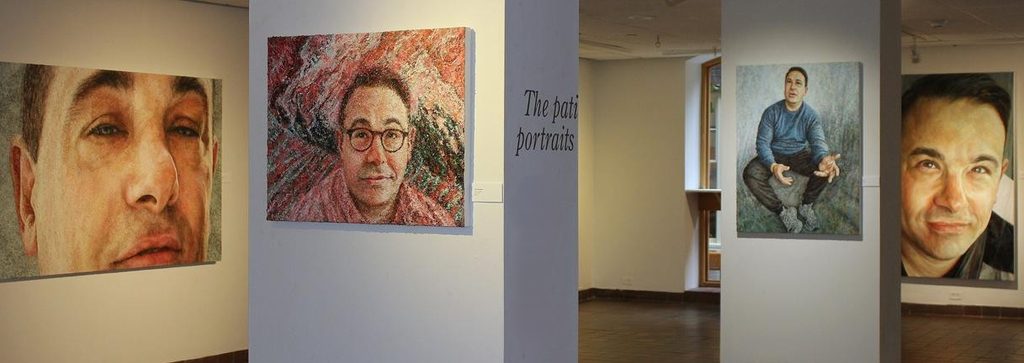
Walk me through how a painting actually gets built. You’ve described pressing, layering, and lifting paint while it’s still wet, mixing color right on the surface — where does a piece start, and how do you work it from there?
With this particular series, I’ve approached every painting differently. The early pieces look like they could have been done with a paintbrush, but in the last half-dozen or so, I’ve developed a painting language which is new for me. I don’t try to pose my therapist; I try to get him talking so he’s moving and not always sitting with his hands folded. Once I choose a photo, which is a labored process as I’m seeking a picture to which I respond emotionally, I draw in a rough image. Over that, I apply an underpainting. (I work only in oils. I wear gloves.) Working in sections while the underpainting is still wet, I mix up multiple flesh tints and apply them simultaneously with my fingers, pressing and mixing them into the underpainting, then removing some of the top layers with my fingernails to reveal what lies beneath. Because I have an interest in movement, I’ve begun paying closer attention to the direction of the marks, how they pull the viewer’s eye around the face and body. I’ll add more layers to refine the details and shading, and to create depth. I’ve learned which fingers are best for which gestures and how much pressure to use. The language is becoming instinctive.
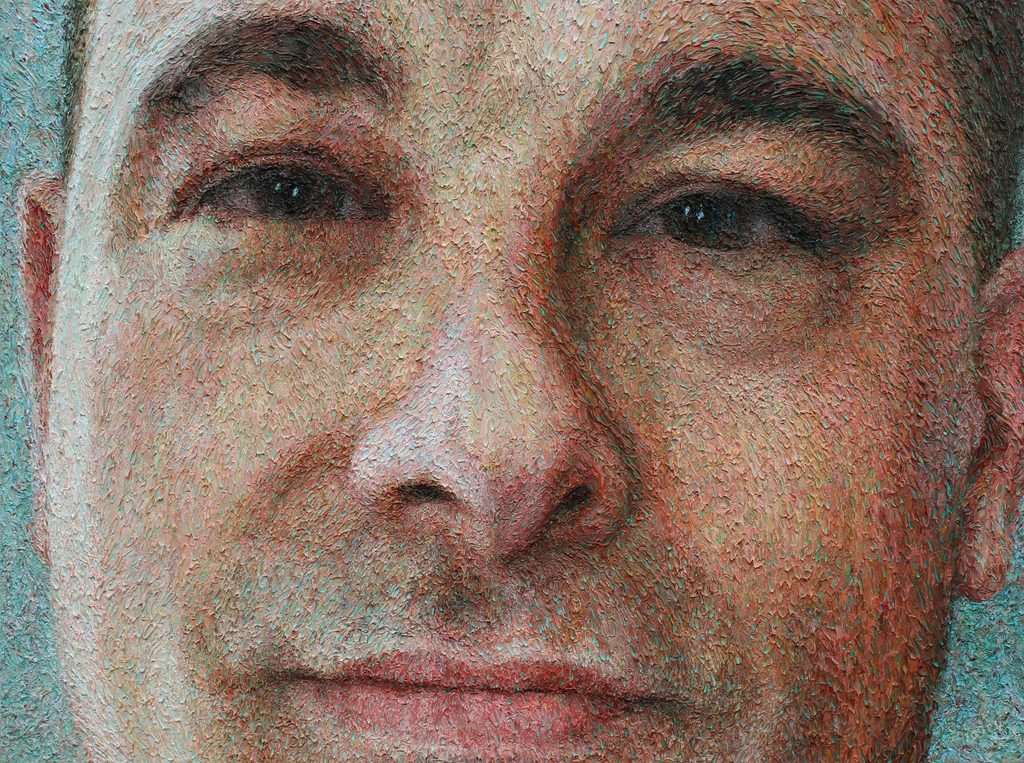
You paint entirely with your fingers, at a scale set by your own hands, so the contact stays visible and can’t be fully controlled. Why does that loss of control matter for these portraits?
Therapy is a constraint: a vulnerable alliance with strong boundaries and borders. My therapist often says he’s mirroring me. For me, the paintings are another form of mirror. Like therapy, they can only work if I’m willing to be uncontrolled within the constraints of the canvas and the marks I can make. And what’s interesting about the textural language is that it defies definition: the closer you get to the piece, the more it dissolves into abstraction. There’s also something primitive about working with my hands; it removes the distance between artist and subject. I feel like I’m touching his face, which I don’t touch in real life. I can’t think of a better way to channel all my unconscious emotions into my art. Ultimately, I’m painting an image from a photo, but I have no idea what he was feeling when I took the picture. Perhaps it was just a reflection of something in me.
Nineteen paintings, the same figure, three years. Is there one that felt like a turning point, or one where the likeness caught you off guard? What shifted between the earliest and the most recent?
When I began the series, I’d been painting expressionistic figures and landscapes for the past few years, so I assumed I’d depict him as distorted, with a lot of movement. That style had become my identity as a painter. I remember telling my therapist the first piece probably wouldn’t look much like him, and I actually changed my reference photo three times in frustration while I kept trying to force expressionism. I had it in my head there was something intellectually superior about that form of painting. But the paintings refused to cooperate. I struggled with each piece until I surrendered to something that both looked and felt authentically like him. In early 2025, when I did Gray, the aforementioned technique emerged, and I knew I was onto something. One of the reasons I’ve kept going with the series is an interest in pushing that method within the same constraint to see where it leads me.
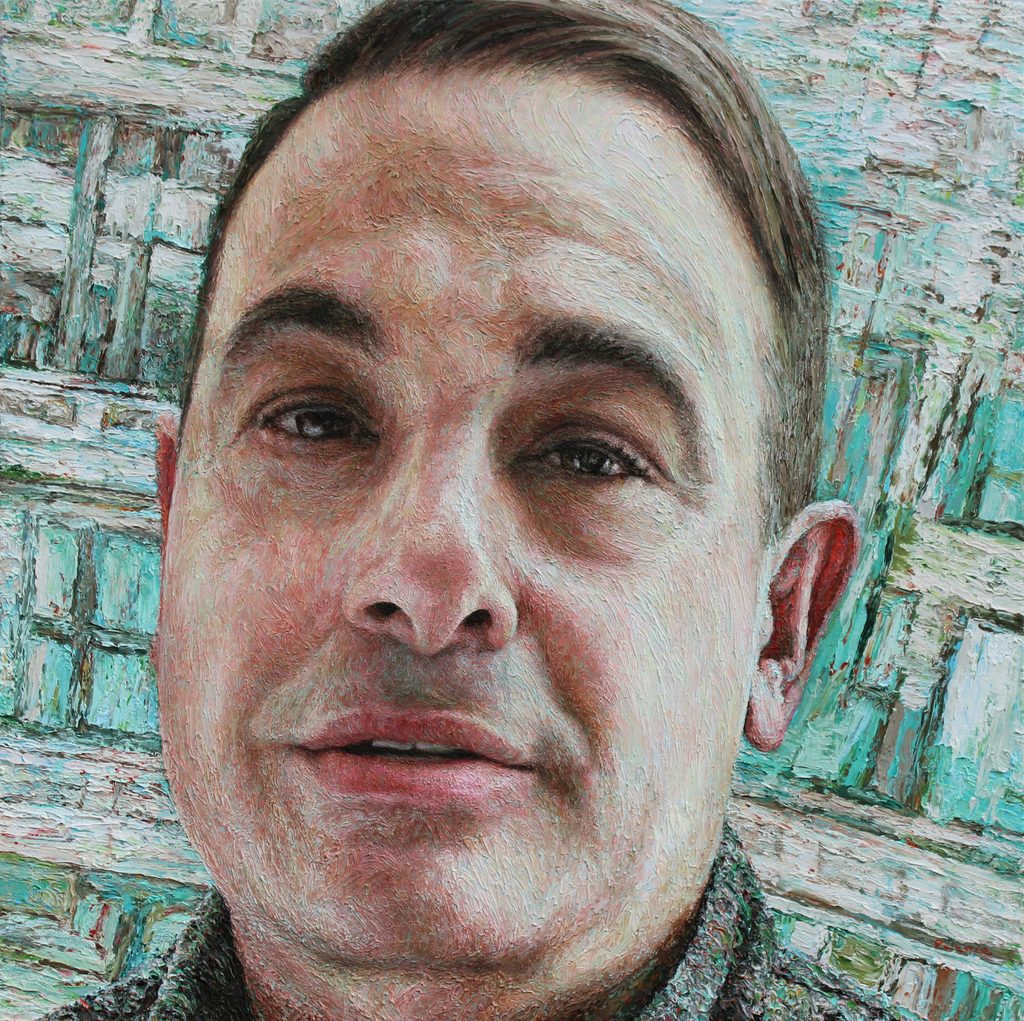
You’ve said likeness doesn’t resolve the image but adds pressure to it — the figure stays present yet never fully knowable. How do you know when a painting is finished, if recognition never quite settles?
It’s a physical process for me. Early on in a painting, I’m building the surface. I get lost in the texture and details. As the piece progresses, I’m constantly walking back and forth, backing up further to survey the work as I make increasingly smaller changes. It’s always about looking and where my eyes stop—that’s where I need to make a mark. Eventually, if I’ve captured the expression I want, the alterations become so small that I recognize I’m not changing much and become willing to let go. At that point, the image holds him authentically for me, even if it doesn’t resolve him. I can always see where I could do more work. I’m sure I could continue for weeks.
A viewer meets this face nineteen times without knowing the relationship behind it. What do you hope they take from looking so long at someone they’ll never know — and where does this series sit in the larger arc of your work?
I don’t entirely think of these paintings as a series of portraits. The series itself is the portrait. People are complex; I couldn’t capture my therapist in even fifty paintings. I hope people will reflect upon that concept: how difficult it is to truly know someone else, even when you think you’re getting a window into them, and how intimate relationships are about both knowing and not knowing—but you can discover a lot by looking closely. People I’ve shown the work to have often had a visceral response to the series and a feeling of connection with my subject, so I hope that will resonate more widely with the Vassar show. I’d like my therapist to see that show, but he hasn’t said if he will. For me, the difference between a JPEG (which I share with him when I finish a piece) and an in-person painting is immeasurable. Aside from the portrait aspect, there is so much texture to get lost in, to really stay with and look deeper.
In terms of my work, this series brings together my interests in figuration, emotional expression, surface texture, and movement. I’d stopped painting large nudes because they felt too controlled, then spent a year painting over everything I did until I found a new voice. And here I am painting likeness again, but in a way that’s uncontrolled. It feels like a culmination, yet it’s simultaneously moving me to new places I’m still developing. I won’t paint him forever, and I don’t know when I’ll stop.
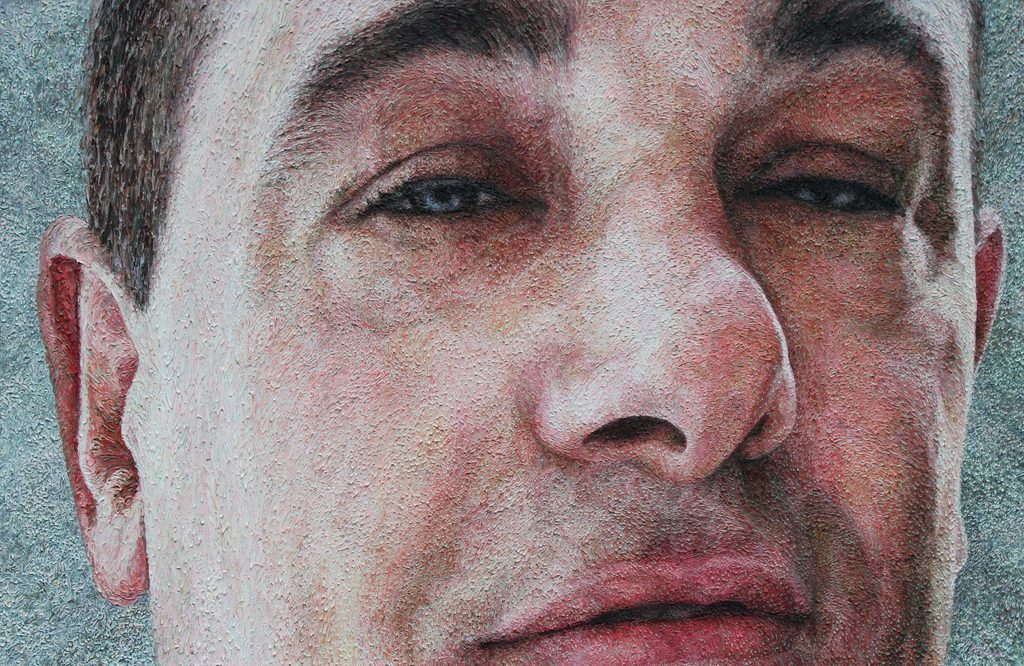
Joyce Polance’s The Patient Looks Back: Portraits of My Therapist, exhibiting at James W. Palmer III Gallery, College Center, Vassar College, 124 Raymond Avenue, Poughkeepsie, New York. On view September 17–October 10, 2026.
Opening reception: Thursday, September 24, 5–7 p.m.
Artist talk: Saturday, October 3, 4–5 p.m.
Instagram: @joycepolance | @vassarcollege
Make your tax-deductible donation today and help Art Spiel continue to thrive. DONATE
About the artist: Joyce Polance is a painter based in Catskill, New York. Her work spans portraiture, the figure, and landscape, with a focus on psychological presence, emotional intensity, and the instability of human connection. She has presented solo museum exhibitions at the Wausau Museum of Contemporary Art in Wisconsin and the Dubuque Museum of Art in Iowa, and has exhibited widely throughout the United States. Her work has been supported by six Chicago CAAP grants, a George Sugarman Foundation Grant, two Judith Dawn Memorial Grants, and a fellowship at Spertus Institute in Chicago. Polance received her BFA from the Fashion Institute of Technology and attended Wesleyan University. Her paintings are held in private and corporate collections nationally and internationally. She lives and works in Catskill, where she is developing The Patient Looks Back, a three-year body of finger-painted portraits of her therapist. Follow her on Instagram at @joycepolance and visit joycepolance.com.