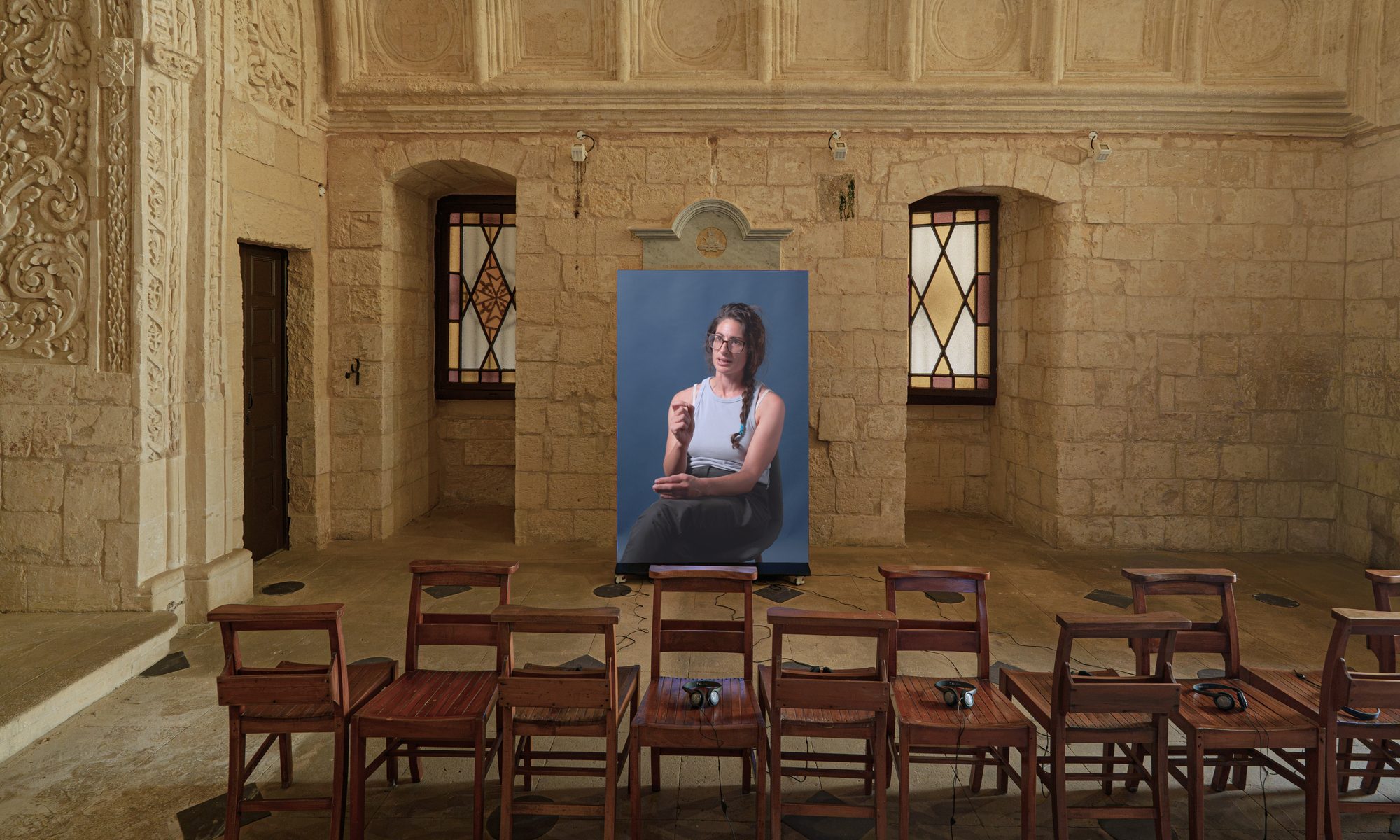
The opening of AMEN : NEMMEN, Vince Briffa’s installation on faith and belief, fell on the first rain of the year, closing out a hundred-and-twenty-day drought and the first completely dry Maltese summer in six years. I had not yet met the island’s infamous heat, and on September 14th, as if the island had been holding its breath, the grip finally let go. The narrow stone bridge into Fort St Elmo and the Chapel of St Anne, the exhibition’s site, act as a conduit through time, folding centuries and space into a single, intimate passage of entry. Fort St Elmo’s honey-hued limestone stood monumental, solemn, and unbothered in the late-summer light, the kind of backdrop that makes an installation about faith feel almost inevitable.
When Briffa debuted his installation at the Johanniterkirche (Church of Saint John) in Feldkirch, Austria, in 2002, critics read it in the language of confession. That reading was inevitable: intimate testimonies, recorded in the visual language of television, appeared just as private experience was becoming public spectacle. What once needed a booth now needed only a screen.
That framing still holds, though it has aged oddly. Confession itself has stopped being the interesting part. We disclose ourselves constantly now, without ceremony, and social media has made exposure the default setting where transgression used to live. The rare thing today is the willingness to sit with a stranger’s account of the sacred without rushing to verify or dismiss it.
Briffa’s testimonies offer no proof. AMEN : NEMMEN does not test belief; it retrains listening instead.
Twelve of the original twenty-four testimonies survive in this iteration: video recordings of friends and acquaintances of the artist recounting their experiences of faith in English and Maltese, on large twin screens mounted along the chapel’s left and right walls. Headphones and chairs are provided, an invitation to stay rather than pass through. Listening has become an act of will, made harder by our entropic times; attention is increasingly trained by an endless feed of reels to reward the swipe over the stay. Briffa’s testimonies run long and unedited, with no skip button available. To remain through even a single act of witness now asks something closer to the old discipline of prayer.
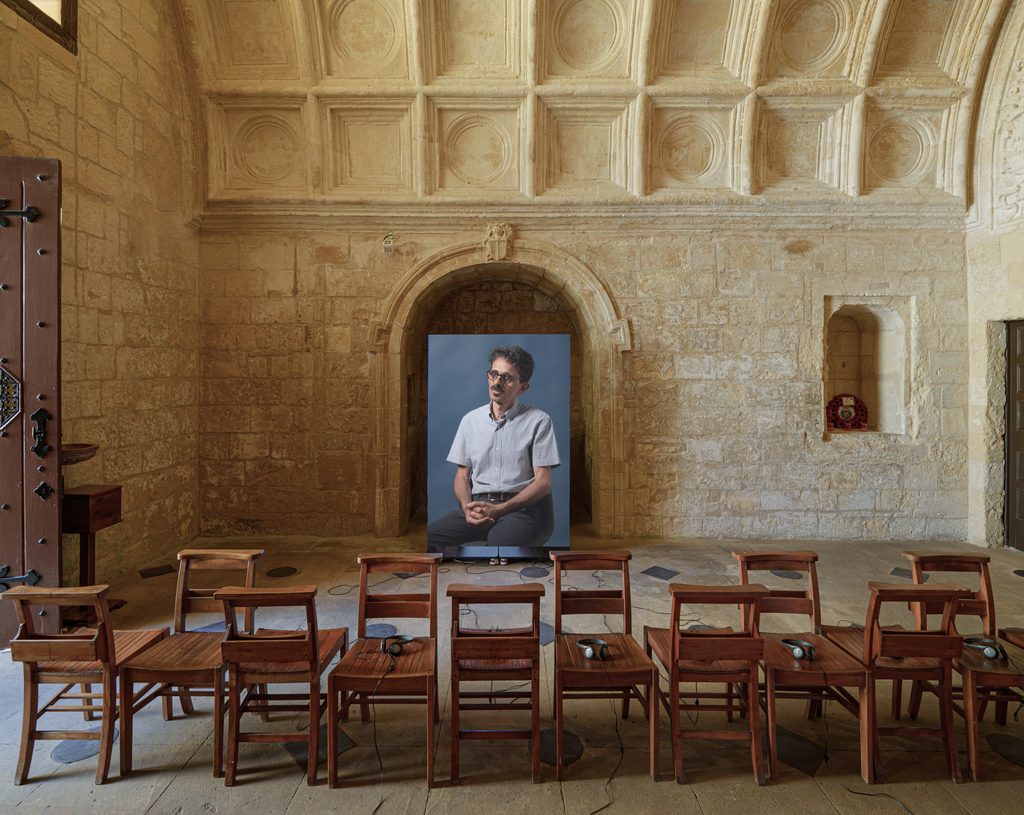
Returned now to the Chapel of St Anne, on Briffa’s native Malta, the work acquires a second, sharper edge. The chapel was the site where St Elmo’s defenders made their last stand against Ottoman forces during the Great Siege of Malta in 1565, holding the fort for nearly a month at the cost of almost the entire garrison, and buying time for the rest of the island to prepare. Whatever prayers, invocations, or confessions were uttered in that space during their final hours went unrecorded, absorbed into the walls and lost to history entirely. AMEN : NEMMEN’s voices survive by the opposite design: recorded, transcribed, and looped without end. Placed here, they seem to recall that older, buried testimony to the surface. The same walls now hold two kinds of testimony: one we can listen to, and one we can only listen for.
This activation of sorts is where the work’s meditative quality resides. Prayer and confession are often imagined as speech addressed to God, yet contemplative traditions have long understood both as forms of sustained attention. Speech need not persuade, explain, or convert. In the installation, the testimonies enact this exchange: people speak, and strangers undertake the discipline of listening.
Even the title keeps its nerve. Amen affirms. Nemmen, Maltese for “I believe,” extends understanding without demanding proof of it. Doubting Thomas needed to question his way into faith; Augustine got there through relentless self-examination. Eden goes further: seeking forbidden knowledge cost humanity its safe haven and gave it the world in its place. The title holds conviction and doubt together without resolving either.
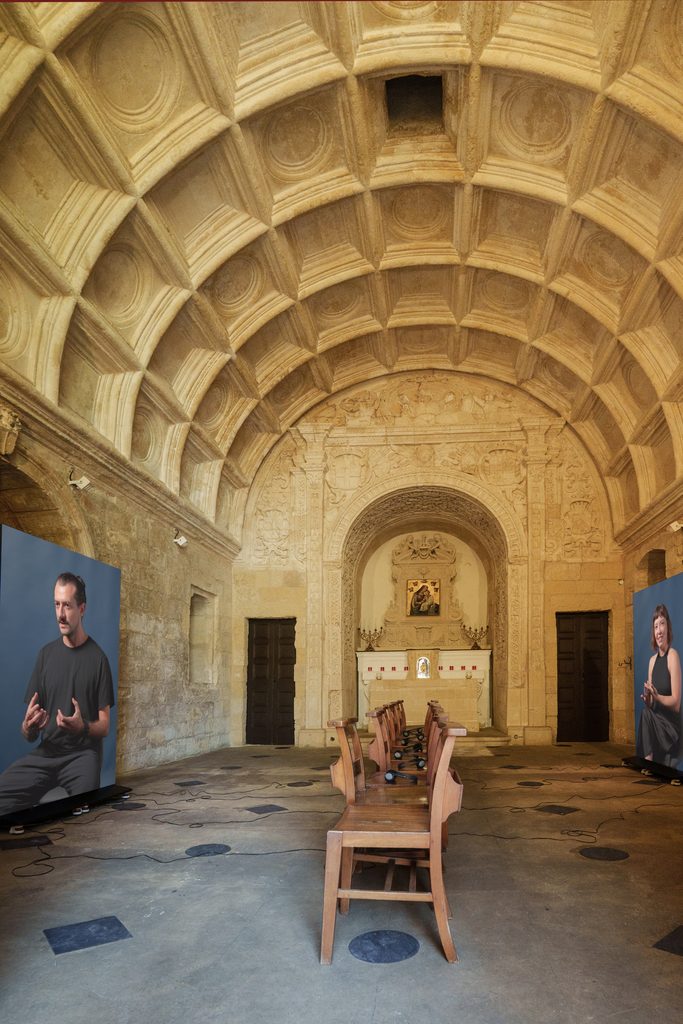
Briffa leaves that friction exactly where he found it. Certainty belongs to those testifying, inquiry to those listening. Between the two, a thin, provisional community forms, held together by the willingness to stay in the room with someone else’s truth rather than by any agreement about what that truth is.
The voices fade eventually, and the chapel empties the way it always does. What continues to resonate is not whether we believed what we heard, but whether we still know how to listen.
AMEN : NEMMEN 15 September – 8 October 2026
Chapel of St Anne, Fort St Elmo, Valletta, Malta
Curated by Andrew Borg Wirth and Sera Galea
Supported by @heritagemalta, @aps.bank, @visitmalta and the @archdioceseofmalta‘s Digital Presence office.
Images courtesy of Nina Musumeci.
About the writer: Eva Zanardi is an Italian art writer, independent curator, and art advisor based between New York and Malta. Her writing has appeared in Flash Art, Whitehot Magazine, Widewalls, Art & Object Magazine, and American Vogue, among other international print and online publications. Since 1998, she has curated exhibitions for museums, galleries, and other cultural institutions across the United States and Europe.