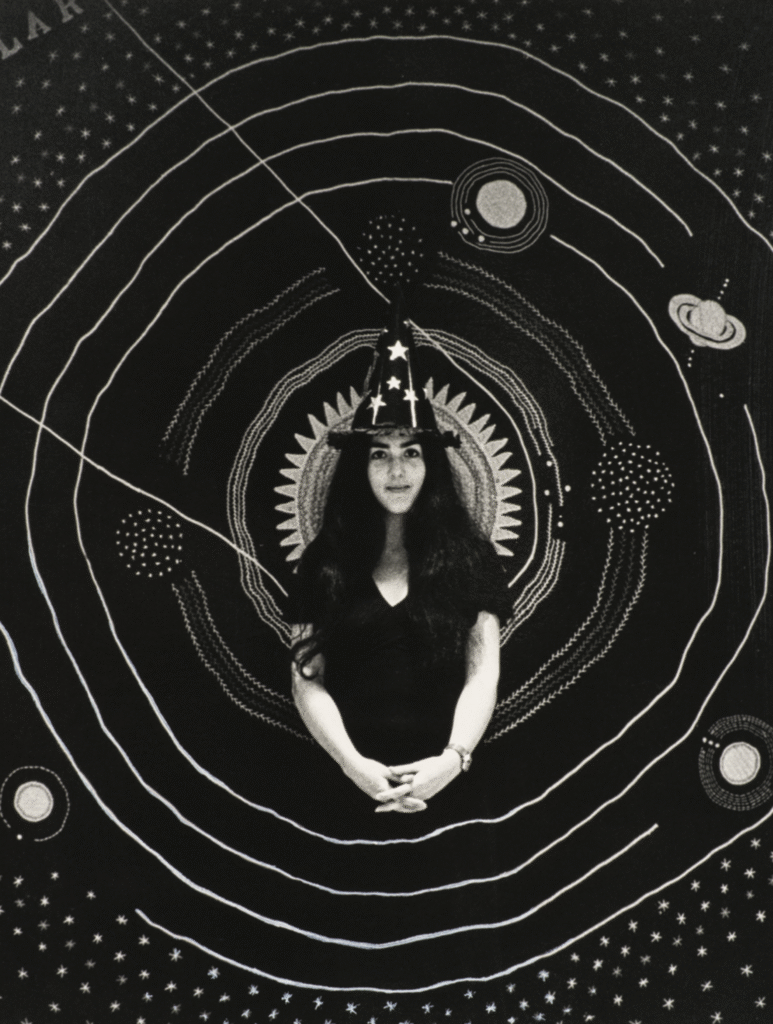
I’ve never been to a séance; however, walking into Maureen McCabe’s exhibition Fate and Magic at the William Benton Museum of Art invokes strong séance vibes. Artworks on black slate whisper, engravings of shooting stars, goddesses, brew potions, and long-forgotten stage magicians appear at the Benton like reliquaries of the past. For over six decades, Maureen McCabe has been an overlooked alchemist of memory, transmuting her personal experiences and arcane cultural references into this intimate magical retrospective.
Born in 1947 in Quincy, Massachusetts, McCabe grew up in an Irish Catholic home where myth and superstition battled dogmatic ritual. Her mother, a kindergarten teacher and practicing Catholic, encouraged her daughter’s early artmaking. A blend of faith and skepticism shaped the young artist’s world. As McCabe puts it, “early on, I was drawn to mythic sculptures and medieval relics; it all made sense to me.”
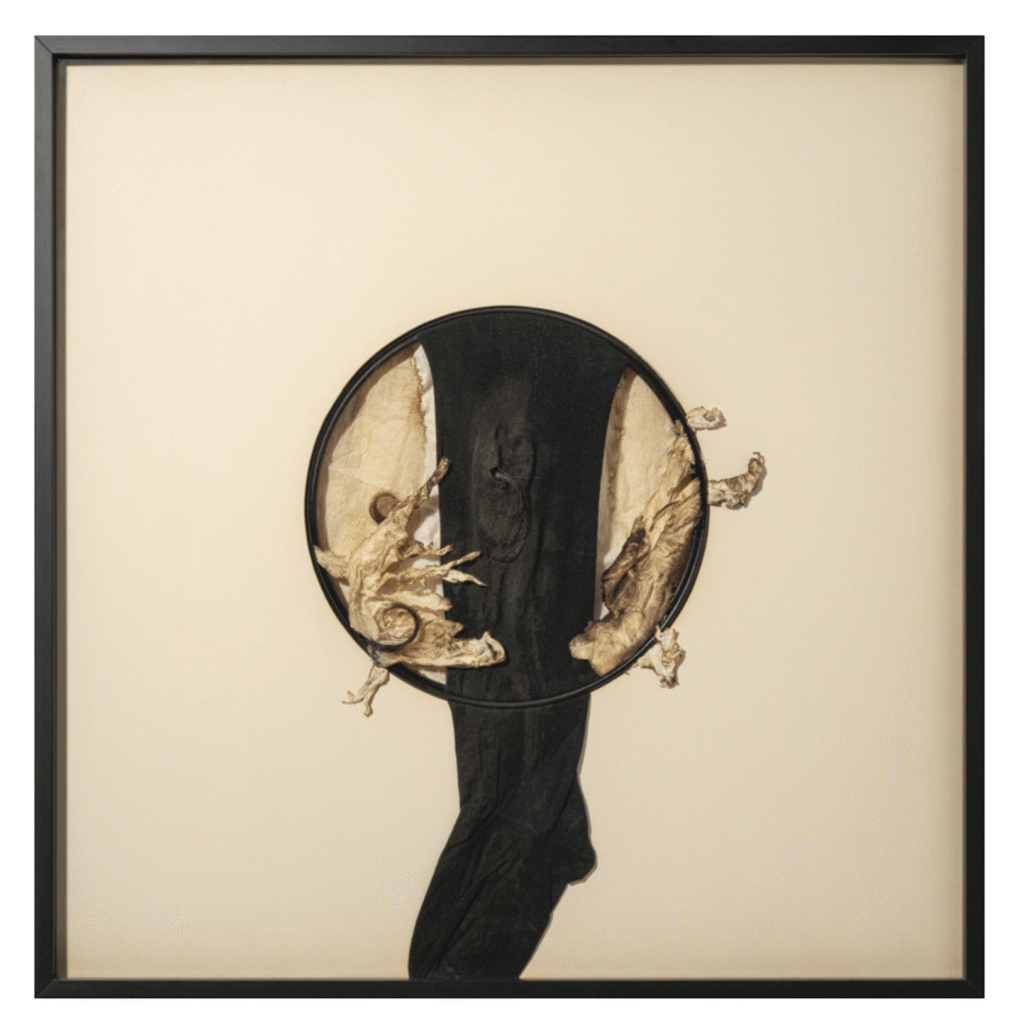
Her early sense of wonder became the foundation for a lifelong exploration of the mystical, the surreal, and the feminine. Curator Amanda Douberley traces McCabe’s artistic journey from the 1970s to the present. Perhaps the most viscerally powerful work is an early reliquary-like assemblage, Blood Stocking (1970), made after a near-fatal car crash during McCabe’s graduate school studies. The piece contains her own bloodied stocking and strands of hair from fellow passengers, sealed and presented like a holy relic. “I really thought I was going to die,” the artist recalls, “so maybe that piece was a kind of talisman against fate.”
McCabe’s career unfolded against the backdrop of 1960s experimentalism. The artist remembers this as a time when “well-done representational art was not respected.” Similarly, the handmade and mystical were dismissed by her male contemporaries, marking the artist as an outcast who aligned with hidden matrilineage and feminist makers. One example is the naturalist educator Edna Lawrence, whom McCabe studied under at RISD. McCabe recalls male students looking down on their lessons, like drawing seashells. While today we can read these early practices in natural observation as an echo of contemporary “witch” culture, embracing and emphasizing naturalist femininity.
Throughout the retrospective, the artist displays virtuosic drawing and precise collage, which often plays second fiddle to the magical content. “I’ve always been attracted to the 19th century,” McCabe says. “The occult, the Pre-Raphaelites, the symbolists, it all overlaps.” That sensibility infuses her slate works, begun in the 1970s, in which she engraves on found chalkboard slate like a tombstone of imagination.
Slate, a material with familial and pedagogical resonance, McCabe’s Irish ancestors were stonemasons and her mother a teacher, becomes both canvas and mirror. “I like the formal qualities of black,” she explains. I will, dear reader, that McCabe was referred to as an OG in the 1970s RISD – the Original Goth. Her signature black wardrobe, fascination with tarot, and reverence for relics place McCabe firmly within a lineage of artists who blur the boundaries between art, ritual, and survival.
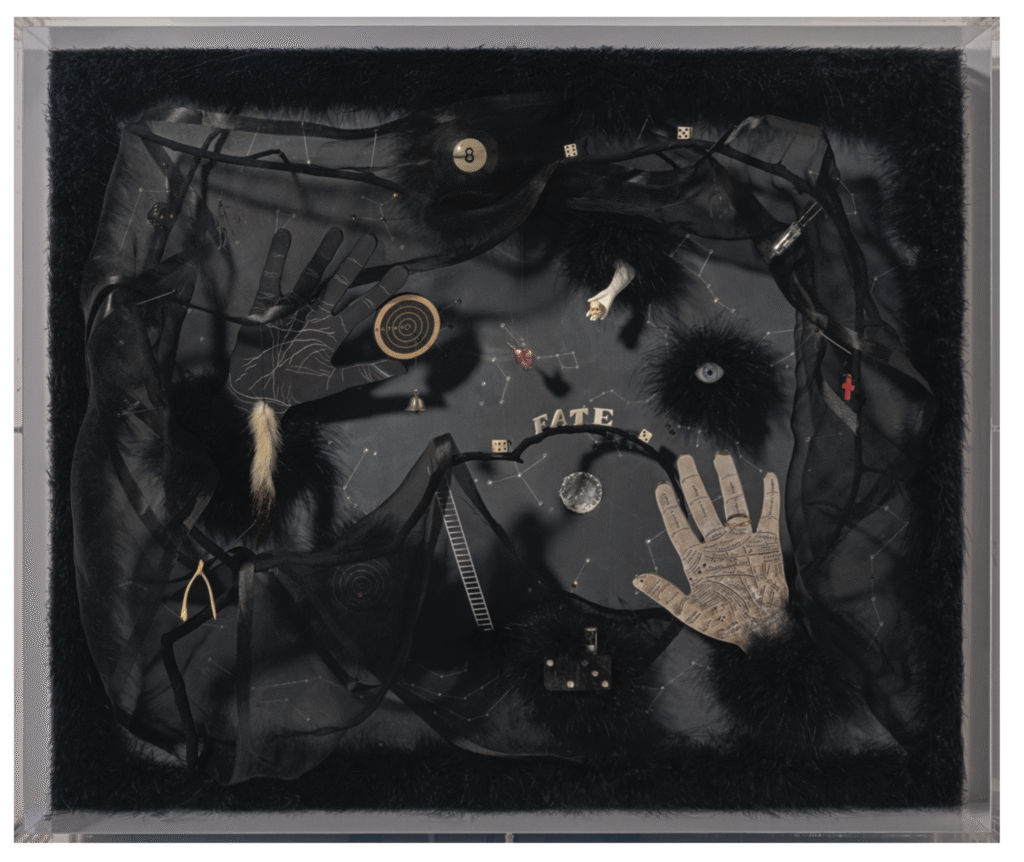
One key to understanding this recent exhibition is the female magician Ionia, a Belgian illusionist, Clementine de Vere, who keeps popping up in the artwork. “She only performed for five years but lived many lives,” McCabe says, admiringly. “She spoke eight languages, survived revolutions. That’s the kind of woman I like.”
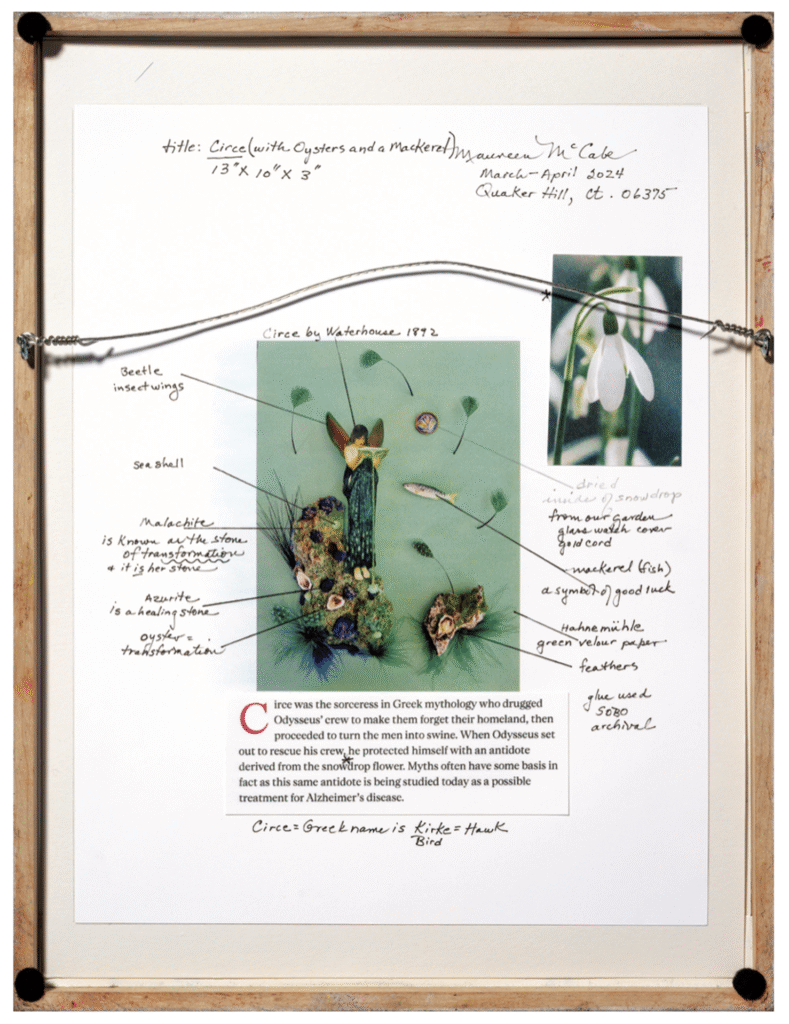
A recent assemblage from the show Circe (with Oysters and a Mackerel) (2024) revisits myth with an eye towards surrealist greats like Carrington, Dorothea Tanning, and Florence Stettheimer, using fantasy and humor to critique gendered realities. In this work, the witch Circe, lifted from John Waterhouse’s 1892 painting, poisons a rival with grace and defiance; McCabe adds beetle wings, malachite, and oyster shells, transforming Circe into a protector rather than a villain. Here art is interchangeable with witchyness. “It’s about transformation,” McCabe notes, “about turning danger into power.”
For all its darkness, McCabe’s work isn’t about morbidity; it’s about control. Like the Blood Stocking, its about reforging our personal narratives and archetypes after chaos and trauma. At 78, the artist is still making new works, assemblages acting as visual spells, offering viewers a way to summon change in a troubling world.
Join us Dec 19 for the Art Spiel 2025 Brooklyn fundraiser featuring 200+ artists’ works RSVP here
Fate and Magic: The Art of Maureen McCabe
August 26th – December 14th, 2025
The William Benton Museum of Art | UConn | Storrs, CT
245 Glenbrook Rd, Storrs, CT 06269
About the writer: Jac Lahav is an artist and arts writer based in Connecticut whose practice spans portraiture, art history, and installation. With 9 solo museum exhibitions, their work has appeared at institutions including the Jewish Museum New York NY and Longview MFA TX and supported by National Endowments of the Arts and the Rauschenberg Foundation. @jaclahav | jaclahav.com
Related articles:
https://artspiel.org/the-art-of-being-watched-julia-weist-and-surveillance-culture/
https://artspiel.org/cj-hendry-and-the-rise-of-photo-op-art/
https://artspiel.org/sara-jimenez-the-rain-from-dreams-or-from-breaths-at-rachel-uffner/
https://artspiel.org/jodi-hays-the-find-at-night-gallery-in-la/