Photo: Kate in studio M01, 20 Jay St. with the wall drawing “Falls The Shadow” in progress. Photo courtesy of David Henderson
On April 26th and 27th, from 1 to 6 pm, artists in DUMBO will open their doors to the public as part of DUMBO Open Studios, offering a rare look inside the art studios along the Brooklyn waterfront. Since the 1970s, DUMBO has been shaped by its vibrant art community. This interview series highlights a handful of participating artists in 2025. Each response offers a glimpse of what’s waiting behind the studio door. Kate Teale has been in DUMBO since January 2019. Her studio is at 20 Jay Street #M01.
Woomin Kim sitting next to a work table and in front of textiles Leslie’s Room and Live Work
On April 26th and 27th, from 1 to 6 pm, artists in DUMBO will open their doors to the public as part of DUMBO Open Studios, offering a rare look inside the art studios along the Brooklyn waterfront. Since the 1970s, DUMBO has been shaped by its vibrant art community. This interview series highlights a handful of participating artists in 2025. Each response offers a glimpse of what’s waiting behind the studio door. Woomin Kim has been in DUMBO since September 2024. Woomin Kim’s studio is at Smack Mellon, 92 Plymouth. Street.
The artist and her work, photo courtesy of Camille Thomas
Canboulay, Simonette Quamina’s solo exhibition at Smack Mellon, features a series of immersive wall-sized visual horizons which borrow the methodological framework of a caesura, a break in a poem. The notion of “break” exists within each work through cuts and rips as well as overall, separating elements of her continuous visual story into vignettes of individual works. Through her use of sophisticated variety of collage and printmaking techniques, Quamina integrates narratives referencing histories such as socioeconomic ramifications of sugarcane and familial subjugation, into complex, dark surfaces.
The artist at Smack Mellon, photo courtesy of Rachel Vera Steinberg
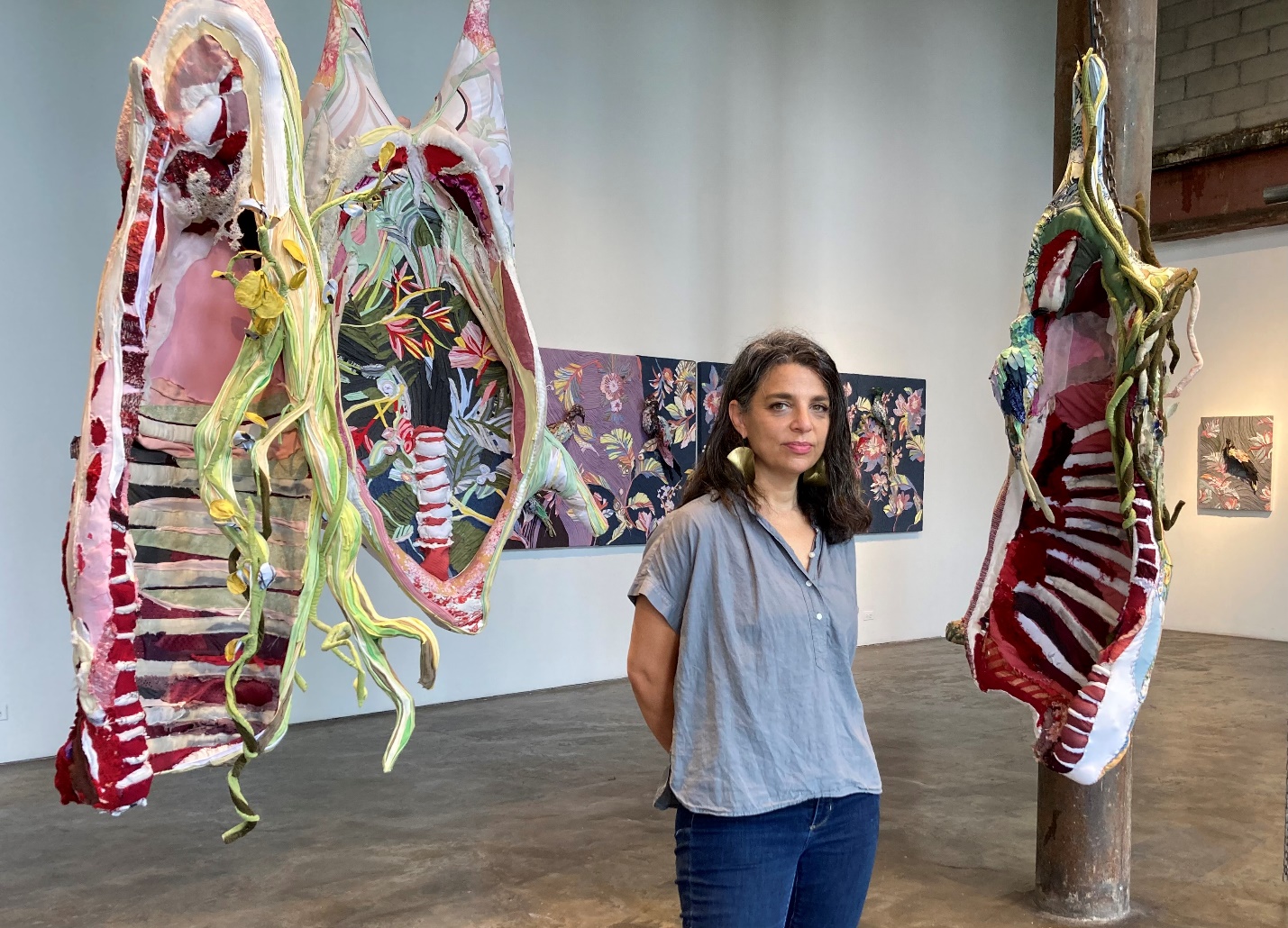
Between Wounds and Folds, Tamara Kostianovsky’s solo exhibition at Smack Mellon, features sculptures which link issues of gender-based violence, personal memory, and ecological destruction through consumption into a complex and speculative ecosystem. Her dimensional forms, both soft and brutal, combine discarded fabric with industrial materials, often drawing their shape from mutilated fauna and flora in various states of decay, including tree stumps, cow carcasses, and birds of prey.
Katya Grokhovsky ‘s site-specific installation FANTASYLAND at Smack Mellon explores the rise and fall of a fantastical empire and its uncertain future. Giant plush toys, inflatable beach balls, deconstructed and re-assembled mannequins, an unfinished carousel structure, recycled parachute canopies, wallpaper, a glowing neon sign, and performance videos, altogether underscore American society’s surplus of objects, and unbridled desire for material possessions, ironically, the capitalist symbol of freedom. The artist scrutinizes the American Dream through an immigrant lens, exposing a desirable yet unattainable mirage. Katya Grokhovsky’s work is currently on view in the solo exhibition FANTASYLAND at Smack Mellon, through May 2nd, 2021.
The Immigrant Artist Biennial (TIAB) is a volunteer, female-led, artist-run project. TIAB 2020 launched in March in New York City at Brooklyn Museum, and continued in September through December at EFA Project Space, Greenwood Cemetery, and virtually, presenting 60+ artists. This interview series features 10 participating artists.
Priyanka Dasgupta and Chad Marshall’s practice draws from sociological conventions, archival texts, and postcolonial studies to examine power and disenfranchisement in the US and their relationship to appearance. Recent exhibitions of their work include ‘Uptown Triennial’ (2020), ‘The Immigrant Biennial’ (2020), ‘Pigeonhole,’ Knockdown Center, NY (2019), Dodd Galleries, UGA, Athens (2019), Sunroom Project: Paradise, WaveHill, NY (2018), In Practice: Another Echo, SculptureCenter, NY (2018). Residencies include Artist Studio Program, Smack Mellon (2018-19) and AIRspace, Abrons Arts Center (2018). Dasgupta and Marshall’s work has been reviewed in various publications. They are recipients of the Smithsonian Artist Research Fellowship, 2019-20.
Georgia Lale, “3”, 2020, performance, photo by Petros Lales
The Immigrant Artist Biennial (TIAB) is a volunteer, female-led, artist-run project. TIAB 2020 launched in March in New York City at Brooklyn Museum, and continued in September through December at EFA Project Space, Greenwood Cemetery, and virtually, presenting 60+ artists. This interview series features 10 participating artists.
Georgia Lale is Greek visual artist with Anatolian heritage, based in New York City. She received her MFA from the School of Visual Arts, NYC, and her BFA from the Athens School of Fine Arts, Greece. She is the recipient of several awards and fellowships. Her work has been shown internationally in Berlin, Venice, Brussels, Izmir, and Athens, among others. She has presented her work in major performance festivals, such as the Venice International Performance Art Week and Nuit Blanche Festival in Brussels. Lale’s work has been exhibited in the New York City area, including Smack Mellon, Shiva Gallery, and The Hole. She has been invited to talk about her work by Yale University, the Dedalus Foundation, and MoMA. Her public performance #OrangeVest was presented at the Greek Pavilion at the 15th Venice Architecture Biennale.
During the Coronavirus pandemic, Art Spiel is reaching out to artists to learn how they are coping.
At EFA Studios. Photo: Gaby Deimeke
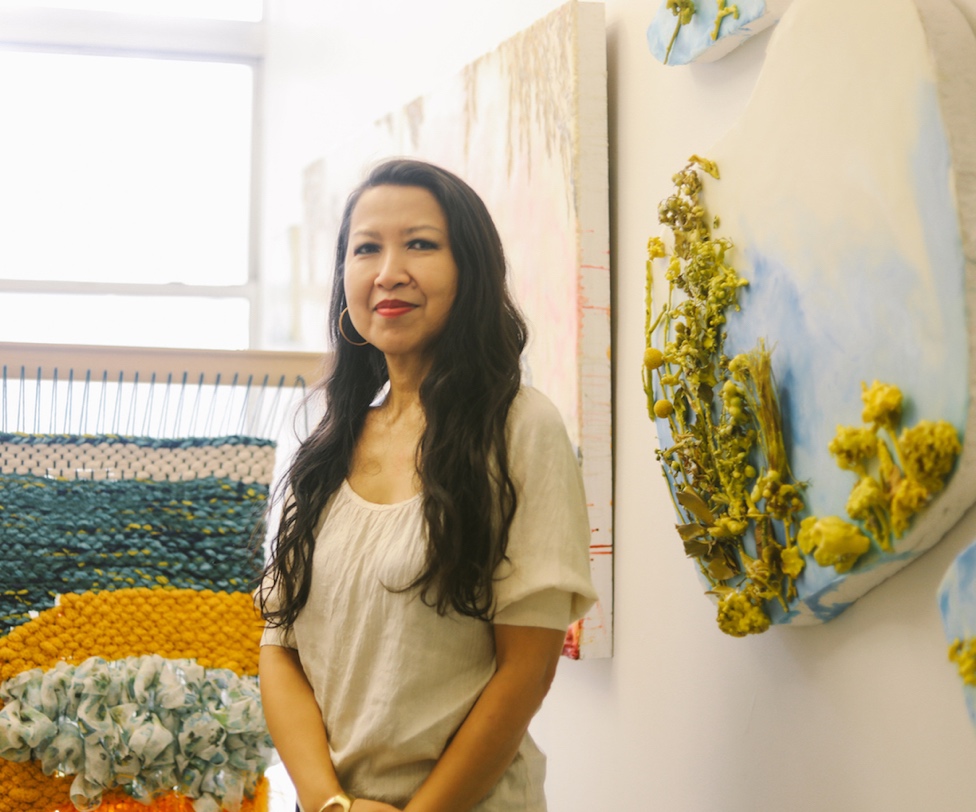
Cecile Chong is an Ecuadorian-born, New York-based multimedia artist working in painting, sculpture and installation in which she layers material, identities, histories and languages. Her work addresses ideas of culture interaction and interpretation, as well as the commonalities humans share both in our relationship to nature and to each other. Inspired by materials as signifiers, Chong is interested in how we acquire and share culture, and how world cultures now overlap and interact in ways previously inconceivable. With uncertainty looming in everything from our economies to our weather patterns, she’s concerned with the fragility of our civilization despite the universality of its cultural underpinnings.