Krista Svalbonas has been capturing images since her first darkroom photography course in high school. The camera in some form — as an integral part of the work or as a reference — keeps playing a central role in her artwork, which takes shape in diverse forms such as painting, ceramics, and sculpture. Her first solo exhibition at Klompching Gallery in Dumbo, Brooklyn, features work spanning a six-year period.
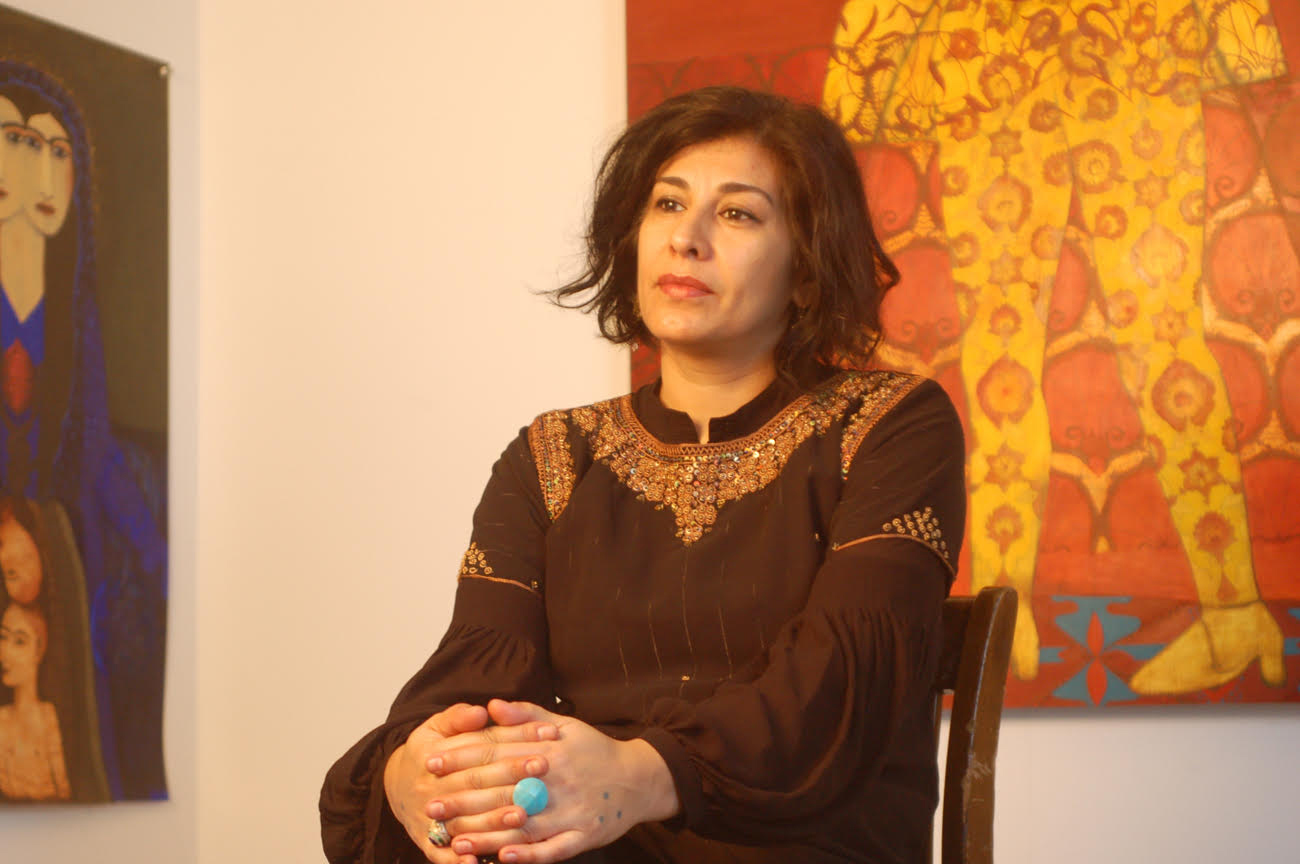
Samira Abbassy’s paintings and drawings portray mysterious iconic figures, primarily female, who inhabit an ambiguous space. While her pictorial world resonates with archetypal imagery from eastern and western cultures, it equally pulsates with an urgent psychological core, creating an invigorating tension which prompts the viewer to search and discover rich layers for meaning.
Margaret Roleke, Margaret Roleke: Made Visible, 2020, window installation of cyanotype banners and mylar, Creative Arts Workshop, New Haven, CT., photo courtesy of Rashmi Talpade
When Margaret Roleke finished her MFA, she was a sculptor and installation artist. From early on she created installations dealing with issues of water, sound and light and after becoming a mother to four children, notions of motherhood and domesticity became central in her work. As her children grew, current political events became increasingly part of her visual expression. For instance, around 2002 she started including toy soldiers in her sculptures, referencing the Iraq war, and also around this time for a public art project in Brewster, NY, she made seating for the day-laborers who were regularly gathering on that site. She continued to make work that spoke to issues that were important to her, mainly gun control, domestic abuse, and immigrant rights. She says she had no intention to be an activist artist, but became one in the course of making art and exploring her true voice — “The Trump presidency led me to march on the streets and register voters, but I feel I can be a better activist when I create work which starts a dialogue on these important subjects, as this seems to be what comes naturally to me,” she says.
For Cathouse Proper’s second ensemble exhibition, More Time Less, curator and gallery director David Dixon brought together five artists — Zac Hacmon, Elana Herzog, Aga Ousseinov, Tim Simonds, and Nari Ward — whose installations, wall-based work, and sculptures reflect our changing perception of ‘normative time.’ David Dixon describes his curatorial process, gives us a closer tour of this ensemble exhibition, and shares some background on his diverse art practices.
Marco Palli, 2020 at his studio in Kent CT, with “The Origins of Sculpture” Photo by Sandra Cafarelli
The online sculpture exhibition “FLUX : Vita Mutata” curated by Natsuki Takauji and hosted by the veteran non-for-profit artists’ cooperative Sculptors Alliance, features seventeen artists who display works made before the pandemic, throughout the closure, and beyond. The Sculptors Alliance president, Marco Palli. shares with Art Spiel how the show evolved, and how his organization transformed throughout the pandemic, while offering us a generous peek behind the scenes.
To celebrate the 100th anniversary of the passage of the Nineteenth Amendment guaranteeing women’s voting rights, Women to the Fore, the current group exhibition at the Hudson River Museum features more than forty female-identifying artists, spanning one hundred and fifty years. The two curators, Laura Vookles and Victoria Ratjen, selected diverse artworks across media —paintings, drawings, prints, photographs, collage and sculpture— from the Museum’s permanent collection, regional artists, galleries, and collectors. The exhibition includes works by renowned artists like Marisol, Judy Chicago, Louise Nevelson, and Mary Cassatt among many others, and less recognizable contemporary and 20th century artists. For instance, one of the highlights in this show is Anna Walinska’s self-portrait which not only marks her first return to the walls of the Hudson River Museum in over 60 years, but also brings to light her significant role in the art world of her time, including her dedication to promoting the work of other artists, like Arshile Gorky, who got his first New York City solo show in the mid-30s at the Guild Art Gallery, an art venue she founded and ran.
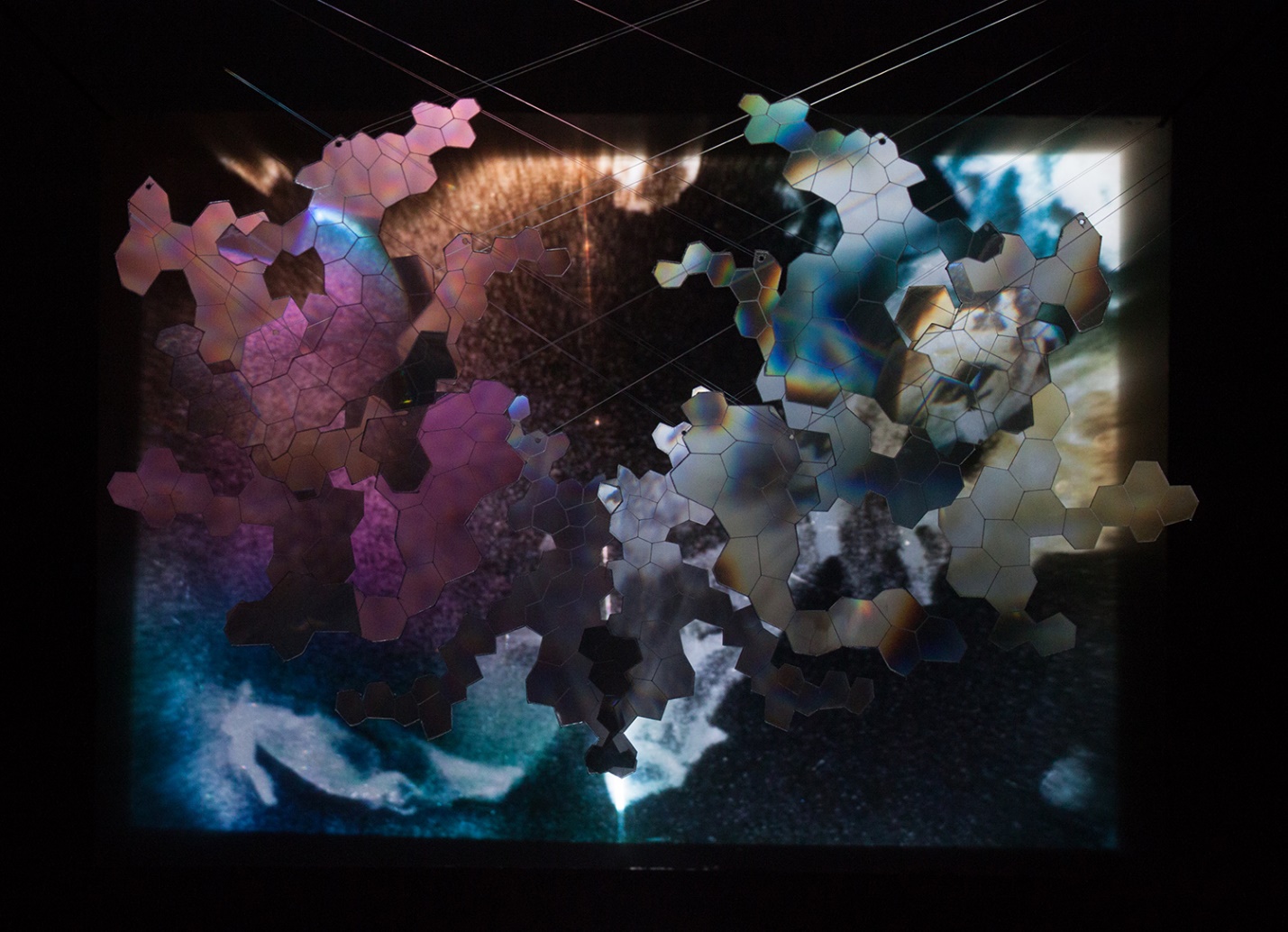
Jess Holz, Borderlands, 2020. Installation with laser cut Fresnel lenses and video of the artist’s skin being examined under the scanning electron microscope at the HoloCenter exhibition EDGE OF LIGHT
The Edge of Light began with the intent to create a group exhibition of artists who work in light. Jonathan Sims, a light artist himself and the curator of this group show at Plaxall, says that although there are a very large number of artists currently working with light as a medium and a material, but their chances to exhibit, particularly in a group setting, are limited.
Sari Nordman, Assembling on Ancient Towers, 2020, video, video still courtesy the artist
The Immigrant Artist Biennial (TIAB) is a volunteer, female-led, artist-run project. TIAB 2020 launched in March in New York City at Brooklyn Museum, and continued in September through December at EFA Project Space, Greenwood Cemetery, and virtually, presenting 60+ artists. This interview series features 10 participating artists.
Sari Nordman, a native of Finland, is a NYC-based interdisciplinary artist working with dance, video and installation. She loves to travel to the isolated parts of the world to reflect on nature, history and female experience, the recurring themes in her works. She continues developing Torni-Tower, an installation work which has received support from the Catwalk Institute and NYU, The Immigrant Artist Biennial, The Amsterdam Collective and Tohmajärvi Residency, for Jamaica Flux: Workspaces and Windows 2021 exhibition and Performance Mix Festival. She worked as a performer with choreographer Dean Moss in 2009-2018, and holds a M.F.A. from NYU/Tisch School of The Arts.
Bianca Abdi-Boragi, Barbary Fig, still, short film, 17 min
The Immigrant Artist Biennial (TIAB) is a volunteer, female-led, artist-run project. TIAB 2020 launched in March in New York City at Brooklyn Museum, and continued in September through December at EFA Project Space, Greenwood Cemetery, and virtually, presenting 60+ artists. This interview series features 10 participating artists.
Bianca Abdi-Boragi is a French-Algerian/American interdisciplinary artist who received her MFA from Yale School of Art, Sculpture, in 2017 and obtained her BFA from ENSAPC. Her solo shows include “The Heel of the Loaf” at Border Project Space and a presentation at CADAF Art Fair, she has exhibited with the Immigrant Artist Biennial, NARS Foundation, Border Project Space, VCU Arts, NURTUREart Gallery, Chashama Gallery, Field Project Gallery, Galerie Protégé, and The Clemente Soto Velez Center NY, among others.
Michele Brody, working in home studio in The Bronx on handmade paper body sculpture for Annual Earth Celebrations Eco Pageant, paper made from recycled linen table cloths and caning, 2020. Photo by Olivier Marcaud
A fourth generation NY builder, artist Michele Brody loves working with materials. She recalls how her father groomed her early on to become an architect so that she could continue the family tradition of builders and land developers. Although she excelled in the study of Architecture, she was not attracted to pursue it as career. ” I prefer building with my own hands,” she says. So in 1994, instead of getting a degree in Architecture, she graduated with an MFA from the School of the Art Institute of Chicago from the Fiber and Material Studies Department.