Marya Kazoun: Trans-mutational Materiality#


Steady Breath, 2003, installation/ performance, bamboo, wool, fabric, thread, 320 cm x 300 cm x 228 cm , photo credit: Margerida Correia

Each of Marya Kazoun’s sculptures, performances, and installations evolves into its own open-ended narrative, deriving from the artist’s personal journey—childhood memories and cultural background. Throughout her versatile body of work, Marya Kazoun plays with the concepts of time and space by blurring their boundaries, excavating a wide array of imagery from the realms of the collective and the subconscious to form rich and poetic installations evoking parallel universes. The eclectic materials she is using in her work—fabric, bamboo, Murano glass, plastic, paper, and whatever inspires her—assume new life and new meaning within her idiosyncratic, imaginative, and elaborate visual vocabulary.

Continue reading “Marya Kazoun: Trans-mutational Materiality#”

Earthscapes: Emerging to a Brighter World: Pamela Casper at Wisner House

Art Spiel Photo Story


Installation view

In her solo art exhibition at Reeves-Reed Arboretum, Pamela Casper invites the garden-loving public to reconcile a personal relationship of guardianship that goes beyond admiring nature’s beauty. The artist says that the trajectory of the work in this show follows her own path of transformation—from observing beauty and imagining nature “above ground” to exploring the endless networks hidden below. The show is curated by Executive Director Jackie Kondel and runs through October 31tst, 2021.

Continue reading “Earthscapes: Emerging to a Brighter World: Pamela Casper at Wisner House”

Instituting The Re Institute in Millerton

In Dialogue with Henry Klimowicz, founder and director


The Re Institute empty, 2021, photo courtesy of Henry Klimowicz

The Re Institute is an extension of Henry Klimowicz’s studio, a very large 1960s dairy barn outside of Millerton, New York. About 11 years ago sculptor Henry Klimowicz started the gallery as a response to living in the “center of nowhere”, as he puts it. The artist says that the gallery allows him to have extended working relationships with other artists and their work. “I try not to know what a show will be about before it opens and I get to spend the length of the exhibition becoming aware of all of each show’s nuances,” he says about his curatorial process. A normal season at Re Institute includes 4 to 5 shows, which mostly feature 2 to 3 artists showing in the large space upstairs and another person downstairs. “I try to get each artist to have a specific reason for showing in the gallery outside of the possibility of selling work,” he says. This fits his vision of Re Institute as a non-profit institution. It’s important for him that the featured artists will find reasons to use the space uniquely. “There has to be something in the process of showing an artist that brings depth to the artist’s understanding of their own work or the process of exhibiting their work,” he says. These different ways of interacting with each artist have become the most important aspect of the space for him.

Continue reading “Instituting The Re Institute in Millerton”

Armita Raafat: Reflective Tactility


Site specific installation, 2016, The Horse & Pony Fine Arts, Berlin

Armita Raafat is a New York based artist, born in Chicago and raised in Iran. Her sculptures, installations, and wall reliefs draw upon traditional Iranian architecture, specifically the Muqarnas Domes, the vaulting element in Islamic architecture. She is exploring their form and symbolism through her personal lens by using contemporary materials, transplanting them into new cultural, historical, and geographical contexts to assume a new meaning.

Continue reading “Armita Raafat: Reflective Tactility”

I Wish I had a River, The Underground Lobby Garden: Keren Anavy at ZAZ10TS

Art Spiel Photo Story

A picture containing outdoor, road, ground, person

Description automatically generated

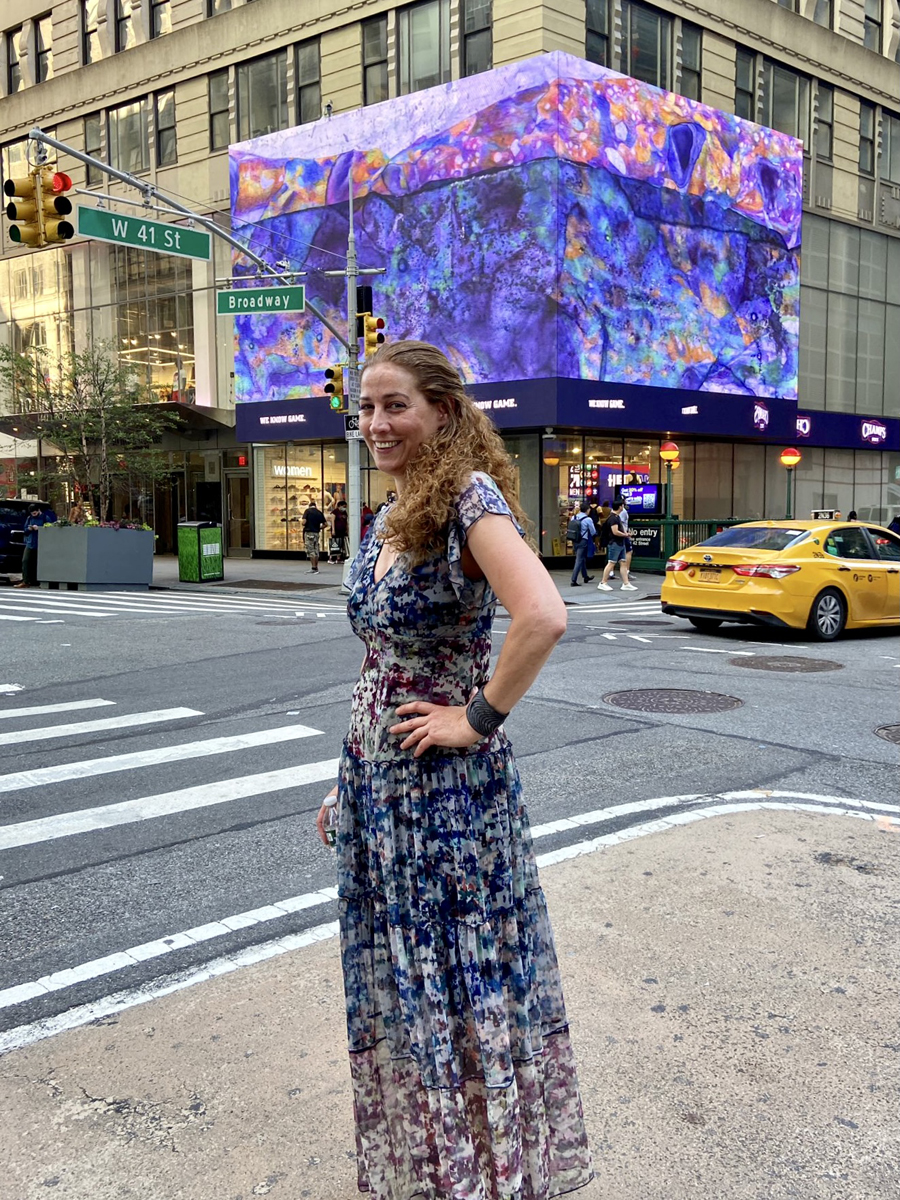
The artist in front of the billboards featuring her work, I Wish I Had a River, The Underground Lobby Garden.Photo credit:ZAZ10TS

Keren Anavy’s site-specific multi-media installation I Wish I Had a River creates a sense of a painted garden made of paintings, drawings, laser cutouts, sculptures, and video within the confines of the lobby of 10 Times Square. The artist draws on the history, architecture, and ecology associated with her installation site–the center of the bustling garment district; and Art Deco architecture of the building. Moreover, merely 40 years before its completion, New York’s biggest reservoir and supplier of all of Manhattan’s drinking water in the 19th century was decommissioned and torn down one avenue to the East. This relationship between nature, particularly water, functioning as a cultural agent and an important element of consumerism is of particular importance for Anavy, who grew up in a desert region of conflict, where the water resource was scarce. The show is curated by Lauren Powell and runs at ZAZ10TS through August 31, 2021.

Continue reading “I Wish I had a River, The Underground Lobby Garden: Keren Anavy at ZAZ10TS”

Meridian at Haggerty Gallery: Sara Cardona and Elisa Lendvay

Thomas Motley in conversation with Elisa Lendvay and Sara Cardona


Installation view, Meridian, Haggerty Gallery, photo courtesy John Watson

The unique design and location of the Beatrice M. Haggerty Gallery at The University of Dallas proved a most fitting space for the exuberant content of Sara Cardona and Elisa Lendvay’s exhibit, titled Meridian. Picture a giant treehouse, spanning the edge of a steep ravine, extended over a leafy canopy of thick post oak trees. From the gallery’s atrium entry, visitors enjoy a dramatic bird’s-eye view of a sylvan campus below. Under gallery director John Watson’s sculptor’s eye, Cardona’s and Lendvay’s lively celebration of nature, a Gaia shout-out, projected joyous meridian energy-lines from gallery to surrounding woods. Meridian expressed the artists’ shared interests in earth’s natural shapes and cycles, regeneration of discarded or out-of-fashion cultural designs and hardware, and celebration of movement, of dance.

Continue reading “Meridian at Haggerty Gallery: Sara Cardona and Elisa Lendvay”

Overflowing Skies: Stephanie Eche at High Line Nine

Art Spiel Photo Story

../Downloads/drive-download-20210718T211005Z-001/120%20dpi/Agua-Cielo_Stephanie%20Eche%20.jpg

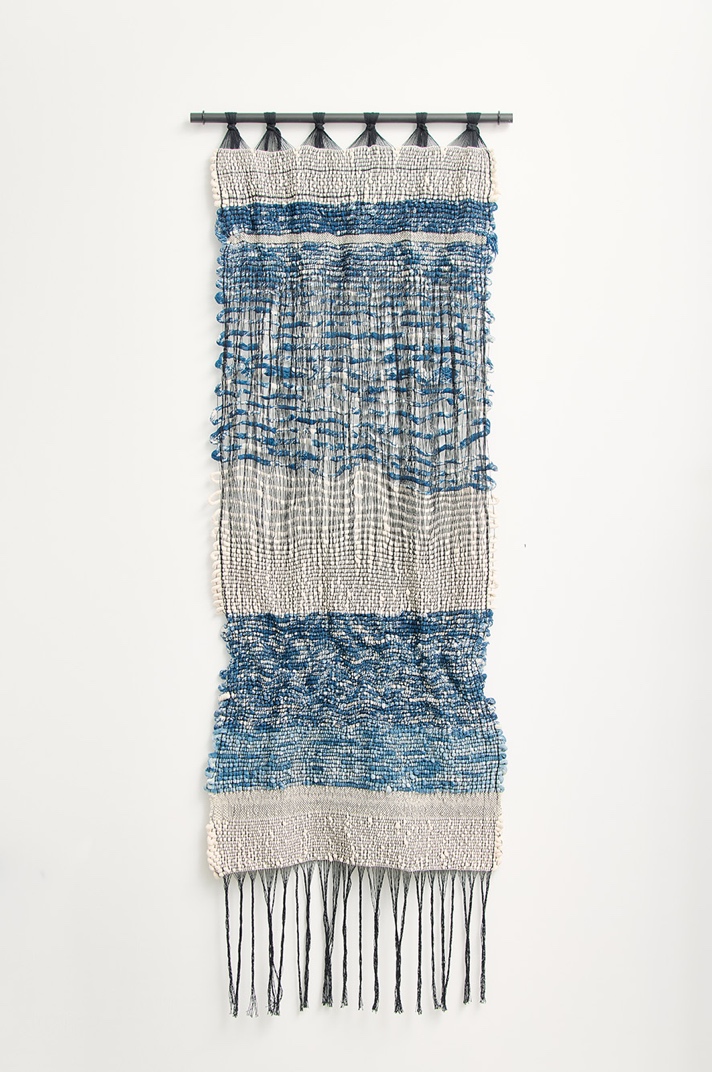
Agua/Cielo, 2021 Cotton, wool, indigo, wire and steel. Photo by Brian Schutza courtesy of the artist.

“…I try to follow the threads where they lead in order to track them and find their tangles and patterns crucial for staying with the trouble in real and particular places in time.”

– Donna J. Haraway, Staying with the Trouble: Making Kin in the Chthulucene.

The undulating asymmetry of Stephanie Eche’s weavings in her solo exhibition Handmade Landscapes: Ocean Meets Sky that ran through July 26th, 2021 at High Line Nine, leaves space for you to interpret. The first work that your eyes encounter, Agua/Cielo, mirrors staring out at an ocean horizon that becomes the air above, a direct embodiment of the show’s title. The loosely woven piece speaks to the cyclical nature of water; its evaporation and transformation into rain that returns it to earth. 

Continue reading “Overflowing Skies: Stephanie Eche at High Line Nine”

Imagining Icebergs


Arctic Magnetism, photograph of Russell Glacier, Greenland. Printed on backlit film. Drawing by removal with scratch nibs, steel wool with water-based crayons, 106” x 44,” 2019.

Multi-media artist and educator Itty Neuhaus has spent a great deal of time observing and interpreting environmental changes in Newfoundland and Labrador, Canada, and in Iceland and Greenland. Since 2000, when she took her first trip to Iceland, her drawings, photographs, sculptures, and videos have addressed the degradation of glaciers and the nature of icebergs. 

Continue reading “Imagining Icebergs”

Tina Struthers: Life in Fiber


Tina Marais Struthers, studio in Montreal, 2020, Photo courtesy of Josiane Farand

Tina Marais Struthers’ work develops from a rigorous, personal, and highly technical consideration of fiber as an evocative medium deftly addressing subjective experience, memories of place, and processes of change and growth. Struthers says she is fascinated by how fabric reflects and absorbs light, how it can entice us to touch, and feel comfort, or discomfort, by visual directing textures—”In this world during the pandemic, this need to touch, to feel textural comfort I think has really been amplified. I often challenge the notion of textile as being soft, in manipulating it to appear as metal sculptural forms.”

Continue reading “Tina Struthers: Life in Fiber”