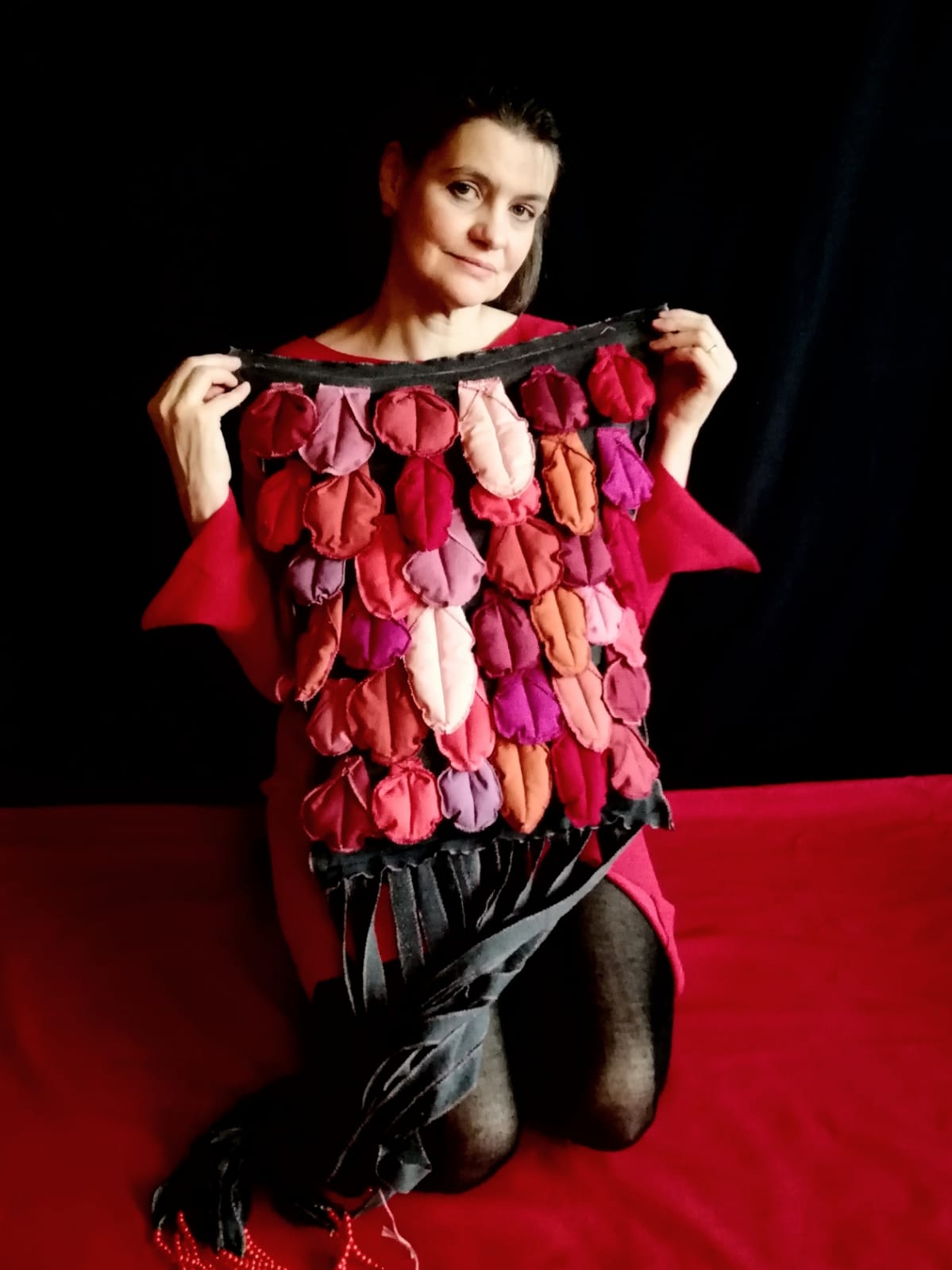
Franziska Warzog, Creature covered by tongues, textile sculpture, 2008, 134 x 27 x 12 cm, (52.8 x 10.6 x 4.7 in), photo taken by the artist’s husband
The Hanover based artist Franziska Warzog makes textile sculptures characterized by bold shapes and vivid colors reminiscent of patterns in nature. As a daughter of two visual artists, she was introduced to design principles since early on.
Installation view, Garrison Art Center Gillette Gallery
Punto in Aria, Patricia Miranda’s solo exhibition at Garrison Art Center, features monumental textile- based sculpture and installations in the gallery space, as well as a site-specific lace installation on the venerable tree outside. In addition to Miranda’s artworks, the show includes items from the artist’s collection, such as panels and glass gilded with vintage and inherited gold leaf depicting lace patterns. Miranda’s work involves a rigorous research into historic material practices in context of women’s labor, ritual, and the environment. The show runs through November 7th, 2021.
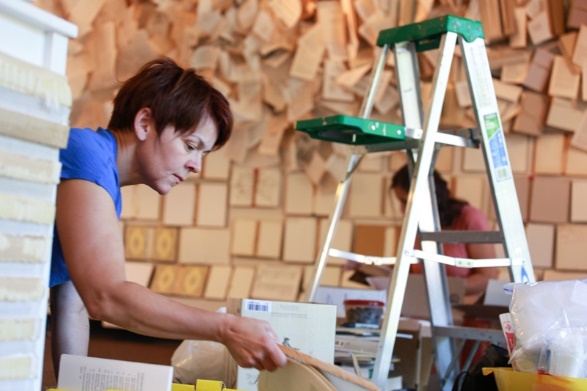
Rita Grendze installing “Susurrations” , 2013, Krasl Art Center, St. Joseph, MI
Chicago based artist Rita Grendze draws, sculpts and makes large scale installations that bring the two and three dimensional forms together in imaginative ways. She creates visceral environments utilizing mostly found materials, ranging from music sheets to textiles.
Featured Project: Nicholas Stavri and Eric Thorp – Answering collectively as THORP STAVRI
The Factory Project – Warehouse Internal – Thorp Stavri
Whilst The Factory Project runs through the most commercially driven week of the London art calendar, Frieze week, it is championed as a non-profit museum scale multi-disciplinary exhibition that has been produced by the duo Thorp Stavri with the aim of amplifying underrepresented voices of emerging to mid-career artists and curators, offering them the opportunity to exhibit new work without the constraints of commercial bias. It is set to open from October 9th to the 22nd, showcasing 10 exhibitions by 10 curators and over 110 artists within the former Tate & Lyle 67,640 sq ft warehouse and yard complex at Thameside Industrial Estate by City Airport. ” We’ve been thinking of the project as a sort of music festival, where you can travel from stage to stage (exhibition to exhibition), catching your favorite acts while discovering loads of new ones,” The Factory Project producers say.
Manufacturers Village Artist Studios, located in an 1880’s historic industrial complex at 356 Glenwood Avenue in East Orange, NJ, will feature the work of over 60 different artists at its annual open studios weekend, Friday 10/15 (VIP Preview) and Saturday thru Sunday from 11-5, 10/16 and 10/17.
Manufacturers Village Artist Studios, located in an 1880’s historic industrial complex at 356 Glenwood Avenue in East Orange, NJ, will feature the work of over 60 different artists at its annual open studios weekend, Friday 10/15 (VIP Preview) and Saturday thru Sunday from 11-5, 10/16 and 10/17.
Adjusting “Sky Cache” on the Jersey City waterfront
Manufacturers Village Artist Studios, located in an 1880’s historic industrial complex at 356 Glenwood Avenue in East Orange, NJ, will feature the work of over 60 different artists at its annual open studios weekend, Friday 10/15 (VIP Preview) and Saturday thru Sunday from 11-5, 10/16 and 10/17.
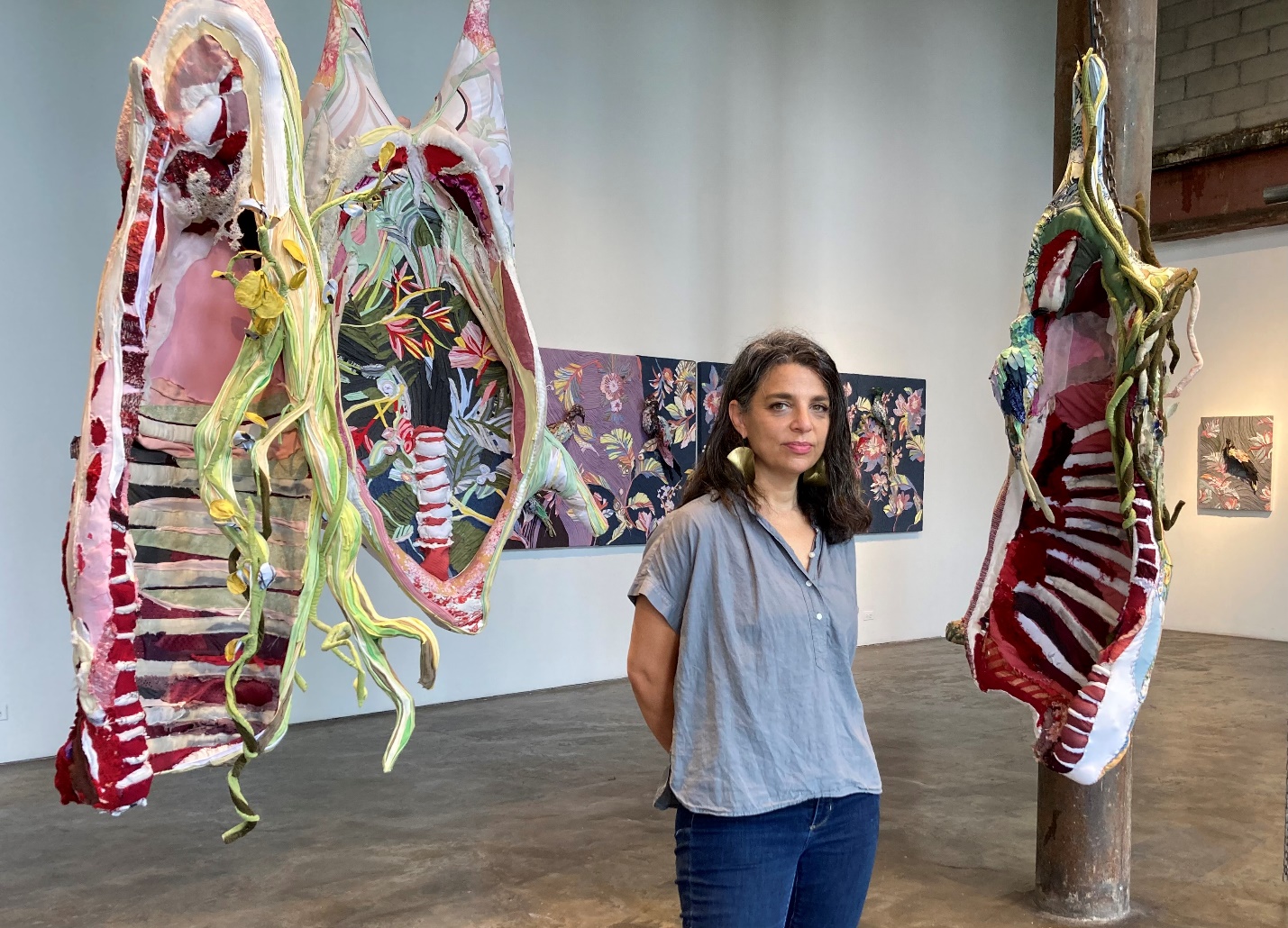
The artist at Smack Mellon, photo courtesy of Rachel Vera Steinberg
Between Wounds and Folds, Tamara Kostianovsky’s solo exhibition at Smack Mellon, features sculptures which link issues of gender-based violence, personal memory, and ecological destruction through consumption into a complex and speculative ecosystem. Her dimensional forms, both soft and brutal, combine discarded fabric with industrial materials, often drawing their shape from mutilated fauna and flora in various states of decay, including tree stumps, cow carcasses, and birds of prey.
Sarah Canfield, photograph courtesy of James Horton
Manufacturers Village Artist Studios, located in an 1880’s historic industrial complex at 356 Glenwood Avenue in East Orange, NJ, will feature the work of over 60 different artists at its annual open studios weekend, Friday 10/15 (VIP Preview) and Saturday thru Sunday from 11-5, 10/16 and 10/17.
Luisa Caldwell installing Curtain Call at the University of Iowa 2019, photo: Justin Torner
Brooklyn based artist Luisa Caldwell began to exhibit her candy wrapper work in 2002. She collects candy wrappers, from her daily walk on the city sidewalks or gets them from friends who send them to her from all over the world. Caldwell says she likes cleaning up the earth one wrapper at a time. Her current show at FIveMyles runs from September 18th through October 17th.