Some Great Books

Book Review
Some Great Books by Paul D'Agostino

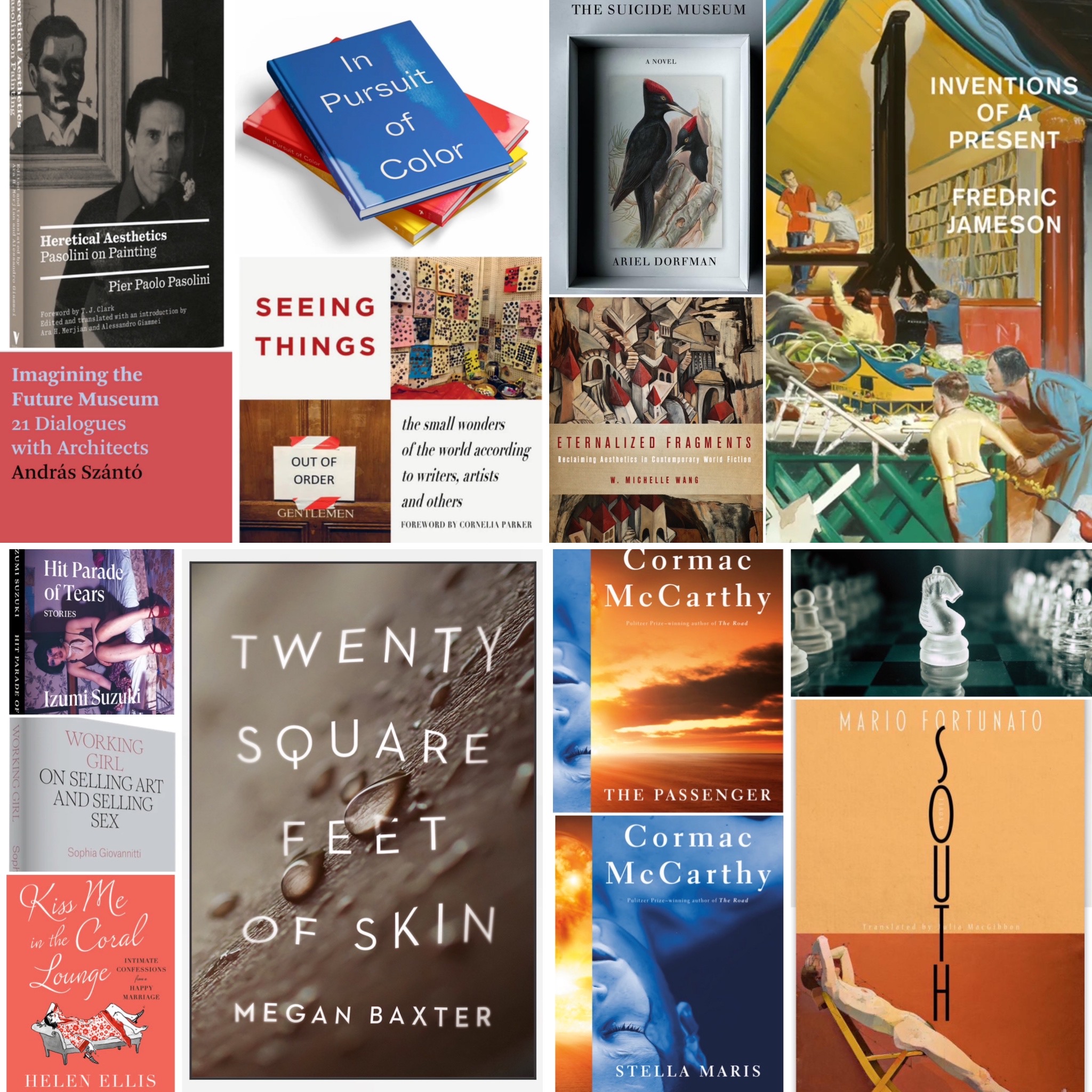
I didn’t have a mandate to compile anything along the lines of a ‘Best Books of the Year’ list, so I didn’t. There are plenty of those out there already anyway. Some even feature hundreds of titles. Hundreds! The restraint is impressive.

Nevertheless, I’d be remiss if I didn’t spread the word a bit about some books I really did relish reading this year, so what follows is a short list of standout titles and a few words about each. Limiting my picks to 12 – plus a couple brief extras I couldn’t resist folding into the mix – seemed logical enough, and they appear here in no particular order. My selections run a gamut and include fiction, nonfiction, essays, critical theory, humor, architecture, art, material history, and a charmingly assembled byproduct of social media. Additionally, several of the titles are books in translation, and ‘excellent syllabus material’ for various types of courses, especially interdisciplinary ones, would be a viable subcategory for nearly everything included here.

Continue reading “Some Great Books”

At the Limits: Elena Dahn at Revolver

Dahn Performance

Thin, translucent layers of shaped and stretched natural latex are mounted onto walls or wooden boards to extend the limits of painting—these are Elena Dahn’s New Bodies, on view at the Buenos Aires-based artist’s first New York exhibition. Hosted by Revolver, a contemporary art venue launched in 2008 by Giancarlo Scaglia in Lima and subsequently in Buenos Aires and on the Lower East Side, the exhibition is an invitation to rethink the relationship between body and painting, performance and mark-making, space and surface.

Continue reading “At the Limits: Elena Dahn at Revolver”

The Immigrant Artist Biennial, In Dialogue

Thread and Fiber: Jovencio de la Paz, Juna Skënderi, and Lilian Shtereva

Lilian Shtereva. Samovila, 2023. Yarn, thread, batting, cochineal, and indigo dye on canvas. 24 x 18 inches. Courtesy of the artist and The Immigrant Artist Biennial.

As noted by Julia Halperin in a September T Magazine article, “[l]ong caught in the liminal space between craft and something more prestigious, works of thread and fabric are reaching newfound institutional recognition.” With the advent of AI spurring a complicated mix of overwhelm, anxiety, and curiosity, an increasing interest in fiber art seems to stem from its tactility and materiality, generating a contrasting tension with what’s available in the virtual world. Fiber art is also welcomed by the art-loving public as a medium supporting marginalized communities and their traditions. As participating artists of The Immigrant Artist Biennial 2023, Jovencio de la Paz, Juna Skënderi, and Lilian Shtereva discuss how their fiber-based practice relates to heritage, empowerment, technology, and dimensionality.

Continue reading “The Immigrant Artist Biennial, In Dialogue”

Rachel Frank: Ritual and Rehabilitation

Hot Air
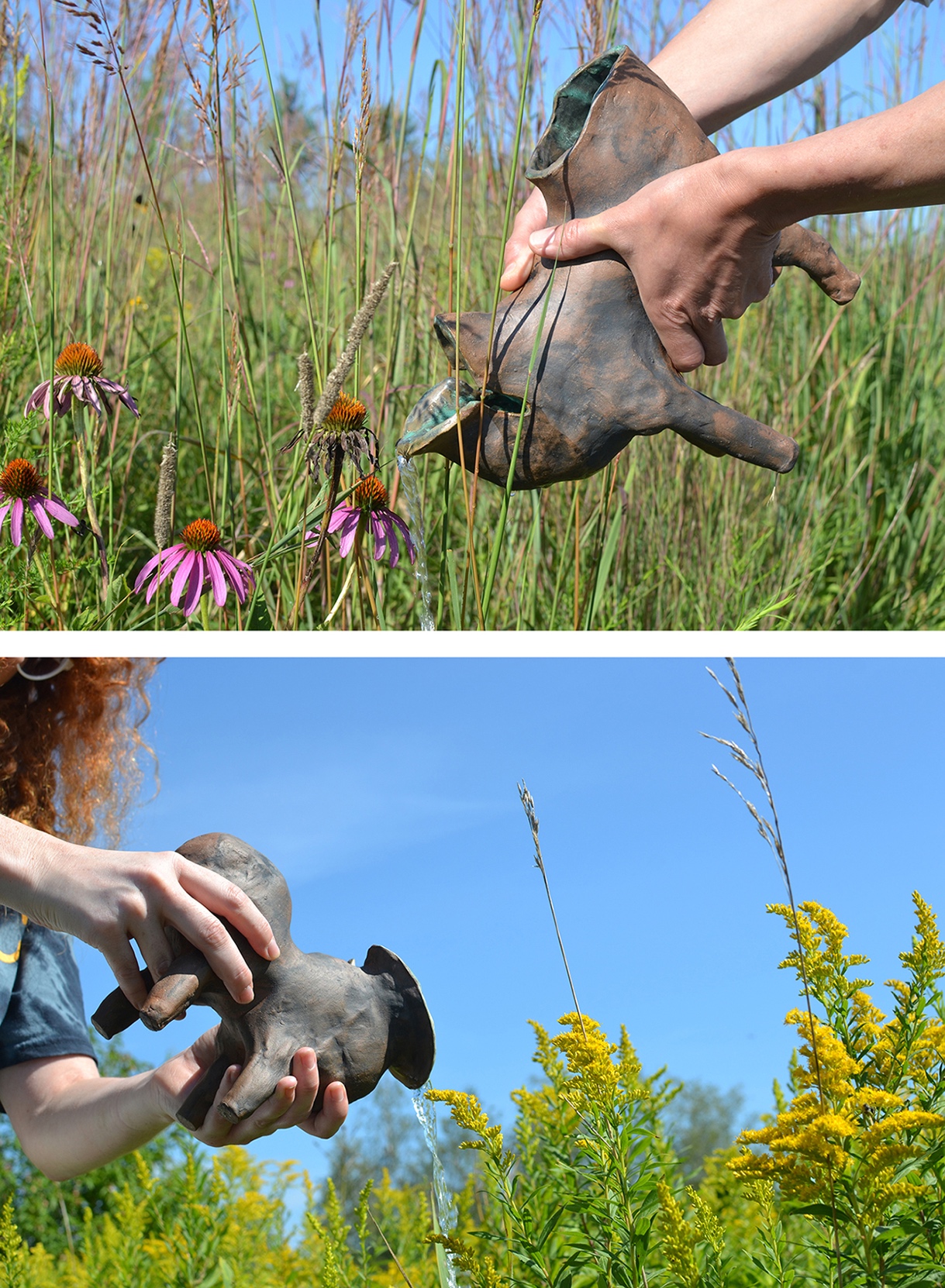
A collage of hands holding a clay dog

Description automatically generated
Rewilding Franconia Sculpture Park, Participatory Performance as part of 4Ground: Midwest Land Art Biennial, Franconia Sculpture Park, 2022. Photographer: Rachel Frank

Rachel Frank is a Brooklyn-based artist whose practice includes sculpture, video, and performance. Her art explores our shifting perspectives towards natural history, climate change, and relationships with non-human species. She grew up near Big Bone Lick, Kentucky, the birthplace of American paleontology, where large mammoth and other megafauna fossils were found, altering Western views on extinction and evolution. She works as a staff wildlife care manager at The Wild Bird Fund, a wildlife rehabilitation center in Manhattan.

Continue reading “Rachel Frank: Ritual and Rehabilitation”

Linda Sok: Biomythorgraphies

In Dialogue
My grandmother with a bird, 2021, silk, cotton, salt, ink, wood, 80 x 70 inches, image courtesy the artist.

Linda Sok uses in her fiber-based sculptures elaborate dyeing techniques practiced throughout Asia and imagery of her family she receives through social media to convey narratives of migration and cross-cultural pollination. Linda Sok is a second-generation descendant of survivors of the Khmer Rouge Regime, a genocidal period in Cambodia’s history that forced her family to flee Cambodia. By accessing fragments of Cambodia’s traumatic past, she attempts to recontextualize lost traditions and culture to allow living descendants to process the history through a contemporary lens.

Continue reading “Linda Sok: Biomythorgraphies”

Shay Arick: Demons and Fields

Featured Exhibition
A white room with a white floor and a white rectangular object

Description automatically generated with medium confidence

In Demons and Fields, Shay Arick’s solo show in Tel Aviv Artists’ Studios Gallery, most sculptures are made of dried Ficus leaves he collected near his home. The vertical constructions are like linear drawings of delicate figures—they sway gently with the air or rotate in place through an automated mechanism. Each has its rhythm and character, evoking wonder and awareness of life’s fragility. Arranged along an extended white platform reminiscent of a road, these characters appear as if caught in a paused procession—some still move but remain anchored as part of a collective entity, an undefined network, or an intricate matrix. It is a nuanced and powerful metaphor for life’s transience in a complex reality. It is the second exhibition by Shay Arick since his return from New York City to Israel a year and a half prior. The show, curated by Eitan Bognim, opened on October 6th but was closed the next day on October 7th, due to the devastating Hamas attack on southern Israel and the subsequent ongoing war. The conversation with Shay Arick focuses on his art and his process.

Continue reading “Shay Arick: Demons and Fields”

The Immigrant Artist Biennial – In Dialogue

In Dialogue with Linnéa Gad, Magdalena Dukiewicz, and Anna Ting Möller

Linnéa Gad. Detail from Shoal II. Photographed by David Schulze. Courtesy of The Immigrant Artist Biennial.

Instead of transcribing a previously established set of ideologies through scholastic mediums, Linnéa Gad, Magdalena Dukiewicz, and Anna Ting Möller engage with materials that “breathe”—materials whose lives and afterlives warrant separate biographies.

Presented within the context of The Immigrant Artist Biennial 2023: Contact Zone, Swedish artist Gad creates sculptures with limestone, oysters, lapis lazuli, and other materials profoundly connected to the Earth’s carbon cycle. On Governors Island, her sculptures, Shoals I-II, evoke humanity’s resonance with and reliance upon nature. Polish-born artist Dukiewicz juxtaposes industrial components with provocative, organic materials such as hair and blood. In the group show, Enmeshed, Dreams of Water, at NARS Foundation, Dukiewicz’s Object #6 (2023) contains decay, regeneration, and fluidity elements into beautifully translucent and sculptural artwork. Chinese-born Swedish artist Möller, whose work will be presented in Parasites and Vessels at Accent Sisters, unpacks the convoluted social history of kinship via kombucha cultures. The oysters, hair, and kombucha are not subjected to manipulating the artists’ hands; instead, the materials are collaborators in these projects, bringing their subjectivities, histories, and sociological implications into the creative process.

Together with TIAB’s co-curator, Anna Mikaela Ekstrand, the artists speak about their work about technology, materiality, and ecosystems.

Continue reading “The Immigrant Artist Biennial – In Dialogue”

Donna Zarbin-Byrne: Like Water from a Rock at Arts Fort Worth

Hot Air

Donna Zarbin-Byrne, Like Water from a Rock. Here Once Was Ocean, still image from augmented reality animation. Photo courtesy, Donna Zarbin-Byrne

In her installation-based exhibition, Like Water from a Rock, at Arts Fort Worth, Fort Worth, TX, Donna Zarbin-Byrne responds to the landscapes of the Chihuahuan desert of West Texas and the West Maui mountains, connecting material sites with an internal process. Western art traditions often portray the landscape as an idealized place to conquer and expand. Zarbin-Byrne frames the landscape as a place to experience the sensate.

Continue reading “Donna Zarbin-Byrne: Like Water from a Rock at Arts Fort Worth”

The Sublimity of Simplicity in Dai Ban’s Sculptures

On view at Carrie Haddad Gallery through November 26

Artist Profile
A person in a striped shirt

Description automatically generated
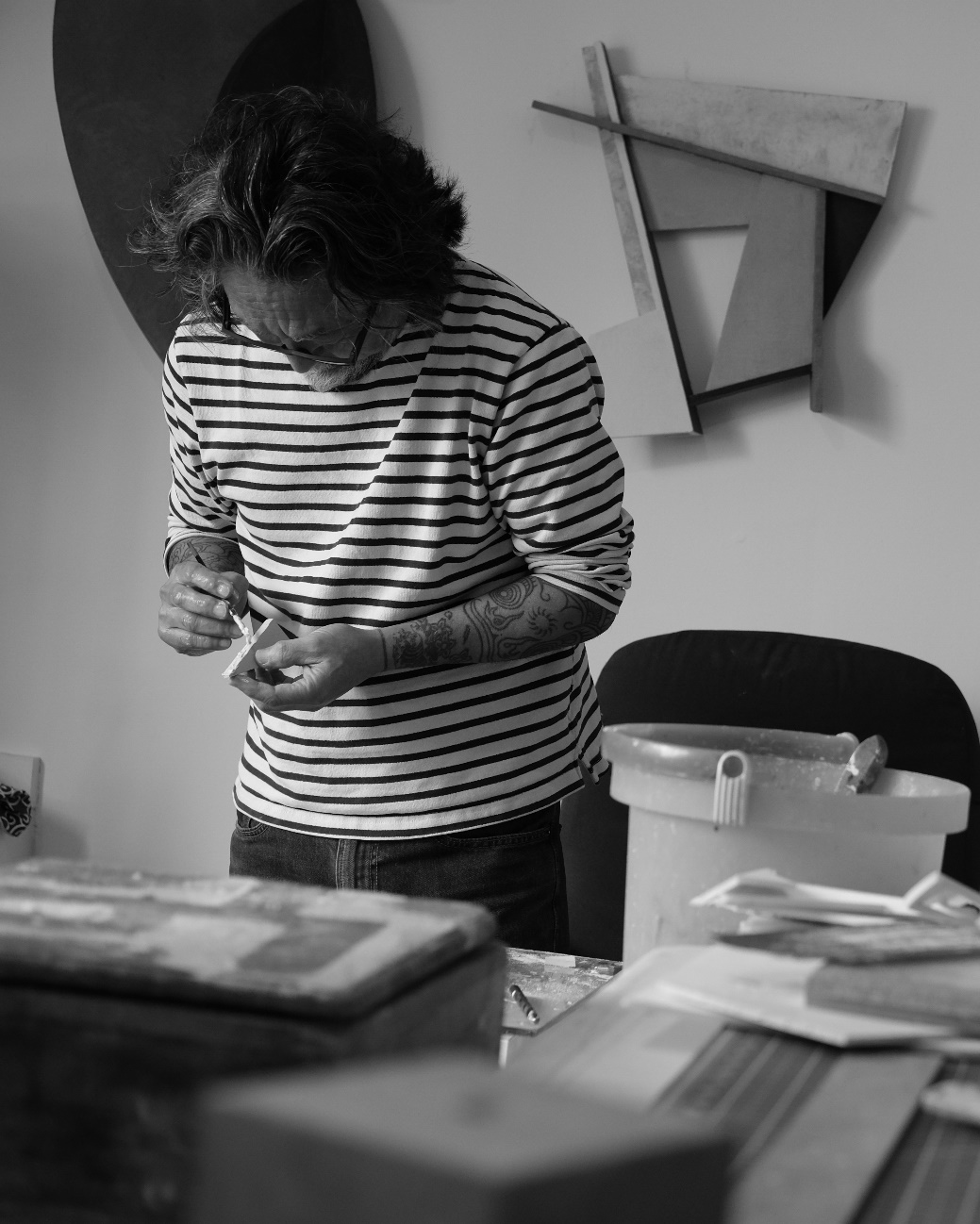
The Artist in his Studio, Great Barrington, MA. Image Credit: Matt Moment

When Dai Ban first traveled from his native Japan to the United States, he was struck by the nonchalant vibrance of American street art. The year was 1985, and although the golden age of graffiti had come and gone, its ethos had indelibly permeated the fine art world. Imagery that had been considered lowbrow just ten years prior became astronomically salable, so long as it decorated a canvas and not a subway car. Ban was bemused by the transformative power of gallery spaces. “Anything you show at the gallery looks like some kind of art,” he observed.

Continue reading “The Sublimity of Simplicity in Dai Ban’s Sculptures”

The Immigrant Artist Biennial – In Dialogue

Reproducing as an Im/migrant: Young Joo Lee, Maria Kulikovska, and Coralina Rodriguez Meyer

Young Joo Lee. Disgraceful Blue, 2016. Digital Animation. 10:24 min. Courtesy of the artist and The Immigrant Artist Biennial.

During a talk at NYU, feminist post-Marxist scholar and author Silvia Federici said: “The image of the worker is not the image of the person at the assembly line; it’s the immigrant.” With this statement, she is referring to vulnerable migrants whose movements are fueled by the climate crisis, corporate control of natural resources, and economics. With her social practice project Mama Spa Botanica, Coralina Rodriguez Meyer attempts to recreate the bond between nature and the female body to enhance healthcare for black and brown pregnant women, empowering them to advocate for themselves and their communities within an inadequate maternal healthcare system. In her book, Beyond the Periphery of the Skin: Rethinking, Remaking, and Reclaiming the Body in Contemporary Capitalism, to explain the link between migrants and reproduction, Federici cites “the war on human reproduction” which encapsulates the separation of people from land, soil, sea, and independent means of reproduction acted out by corporate interests. This is a separation that Rodriguez Meyer both highlights and resists in her work.

Continue reading “The Immigrant Artist Biennial – In Dialogue”