Maurizio Cattelan’s Hypocrisies

Opinion
View of Maurizio Cattelan’s 2024 exhibition “Sunday” at Gagosian, New York. Photo Maris Hutchinson

The conjunction of art and politics is a confusing and often compromised enterprise. The commentator Ben Davis argues that as our society regresses under the politics of neoliberalism, such art serves a “compensatory role.” Much explicitly political art is either pedantic or satirical. There’s a long history dating back to the Incoherents and Decadents, the late 19th-century artists who embraced absurdity, irrationality, and the grotesque to protest against emerging bourgeois values and the academic practice of art. They used parody, satire, the carnivalesque, as well as didactic and pedantic jokes to expose cultural ideocracies and societal flaws. This was followed by the Dadaists in the early 20th century, who expressly mixed real-world politics and provocative, anti-art gestures with the intention of undermining social and artistic conventions and setting the groundwork for a social and cultural revolution. Since then, and as an avant-garde compliment to social realism, there has grown up a tradition of the trickster artist—pranksters using absurdity, parody, and gestures to scandalize and provoke their audiences.

Continue reading “Maurizio Cattelan’s Hypocrisies”

Man Bites Dog Bites Man

John O’Connor at L’Space presented in conjunction with Pierogi Gallery

Noahbot-colored pencil and graphite on paper. 83 x 69.5. 2013. Photo courtesy of John Berens

There is an astonishing amount of information in John O’Connor’s drawings. The work, currently on show in Chelsea at L’Space Gallery, explodes off the paper with words and numbers, names, logos, and dates. It’s information overload, and that is part of the genius of the show.

Continue reading “Man Bites Dog Bites Man”

The Immigrant Artist Biennial – In Dialogue

Images and Art: In and Out of Politics with Carlos Franco and Keren Anavy

Keren Anavy. Archipelago, 2023. Ink and colored pencils on mylar, plexiglass, shells, concrete bricks, and plywood. Dimensions variable. Courtesy of the artist and The Immigrant Artist Biennial.

As part of The Immigrant Artist Biennial 2023, artists Carlos Franco (b. Puerto Rico) and Keren Anavy (b. Israel) both showed their work in the group exhibition Enmeshed: Dreams of Water at NARS Foundation. Franco’s work often deploys appropriated images and linguistic symbols. He seems to be exploring the contextual complexities behind how signification takes shape and how signification continues to evolve as a context-dependent subject. Anavy’s site-specific work has been connected to the multifaceted paradigm of “ecological order,” according to the book Transnational Belonging and Female Agency in the Arts. Her fabricated environments consider the “liminal geographic spaces between political art and escapism.”

Continue reading “The Immigrant Artist Biennial – In Dialogue”

Stéphane Mandelbaum at The Drawing Center

A drawing of a person

Description automatically generated
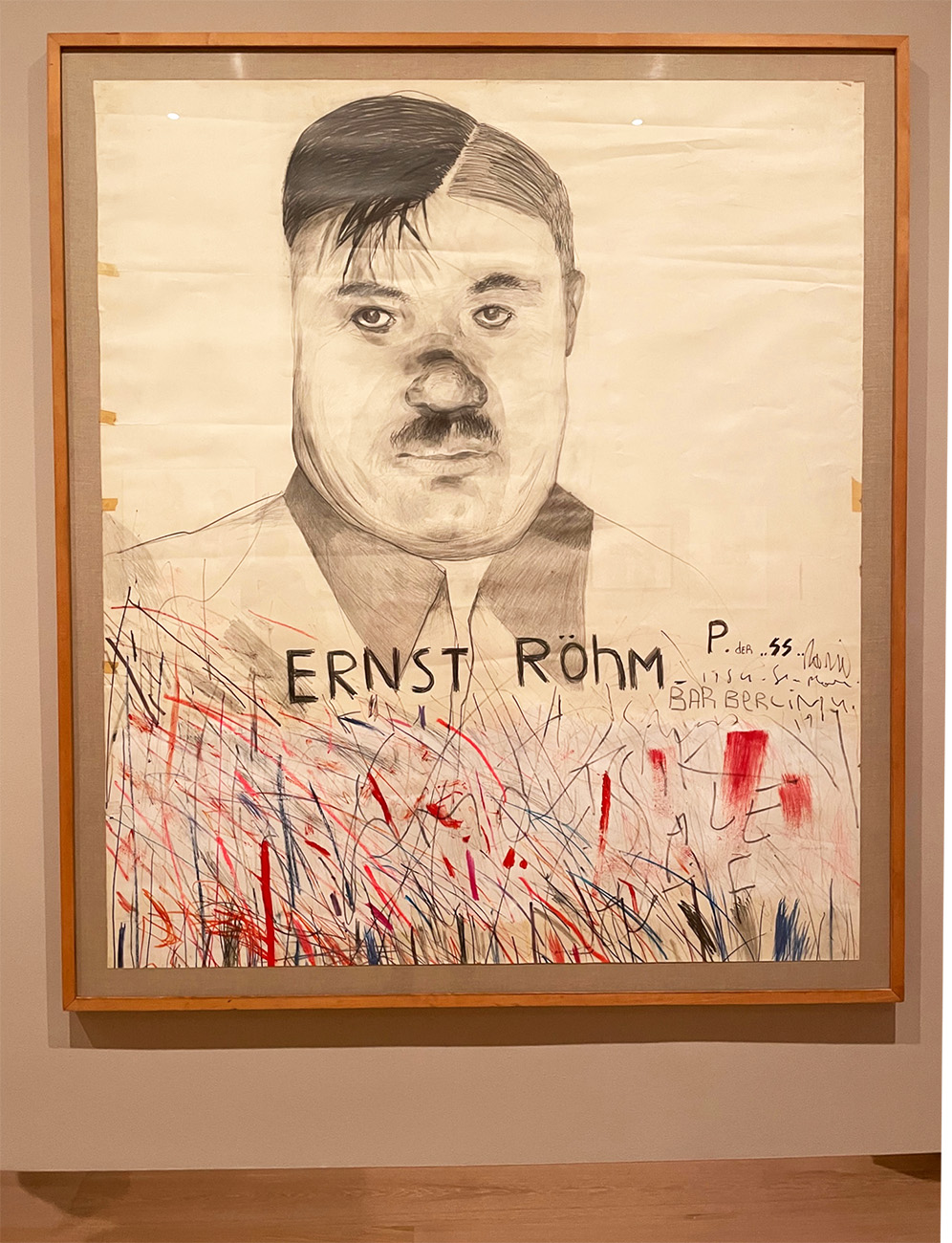
Ernst Röhm, 1981, Graphite, gouache, marker, and color pencil on paper. 54 3/4 x 47 1/4 inches

Who was Stephane Mandelbaum? A closeted gay man? The child of Holocaust survivors? A liar? A thief? A brilliant artist you’ve never heard of? All of the above and perhaps more.

The Drawing Center is presenting the first-ever show of Mandelbaum’s work in the US, and it is a show that left me gob-smacked. The combination of Mandelbaum’s brilliant drawing, deeply personal vision, and the complexity of his backstory is a tale made for cinema. Born in 1961 to a family of paternal Polish Holocaust survivors and maternal Belgian Armenians, Mandelbaum grew up in the town of Namur, about an hour and a half from Brussels. His Father, Ari, was a well-known painter, and his mother, Pili, was an illustrator. There is no record of siblings. A gifted draftsman from a young age but dyslexic and eccentric, Mandelbaum moved from Namur to Brussels, where he seemed to devote his time to making drawings and engaging in what is termed “petty crime.” He married a woman from Zaire (now called The Democratic Republic of Congo) and lived between the worlds of Belgian Africans, the Belgian crime underworld, and his own artistic imagination.

Continue reading “Stéphane Mandelbaum at The Drawing Center”

The Immigrant Artist Biennial- In Dialogue

Art as Political Vehicle? Pritika Chowdhry, Marcelo Brodsky, and Rafael Yaluff

Marcelo Brodsky. 1968, Fire of Ideas. Kingston, 1968. 60 x 90 in. Overwritten photograph. Courtesy of the artist and Henrique Faria Fine Art.

Exhibiting in Conflictual Distance at EFA Project Space within the framework of The Immigrant Artist Biennial: 2023 Contact Zone Pritika Chowdhry, Marcelo Brodsky, and Rafael Yaluff explores, in Oraib Toukan’s formulation, ‘cruel images.’ Images that contain evidence of political and bodily violence but are confronted at an extreme political or geographic distance from their events’ site of occurrence. Together with the artists, co-curator Anna Mikaela Ekstrand discusses the politics of art and how the artists approach personal histories and historical and political events before the exhibit.

Continue reading “The Immigrant Artist Biennial- In Dialogue”

“KIDNAPPED”

In Dialogue
A street sign on a pole in a city

Description automatically generated
New York City

Shortly after the outbreak of the war between Israel and Hamas, flyers suddenly sprouted on New York streets. These flyers were attached to streetlamp posts, tree trunks, and subway stairwells, showcasing photos of infants, children, teens, and grandparents. beneath bold red banners that read “KIDNAPPED.” These photos capture moments from everyday life of people prior to the Hamas attack on October 7th—babies being fed, grandmas smiling, and teens taking selfies. This public art campaign was the brainchild of Israeli street artists Dede Bandaid and Nitzan Mintz. The couple, partners in life and art, have a history of engaging with public spaces globally in places like Tel Aviv, Berlin, Warsaw, and New York. They have recently arrived in New York to pursue their art. However, the events of October 7th shifted their focus. While trying to grasp the enormity and brutality of the terror attack on Israel, they felt compelled to respond by using the street art techniques they were proficient in. Art Spiel had the opportunity to speak with graffiti artist Dede Bandaid over the phone about the inception of this guerrilla street art campaign, which went viral and all over the globe.

Continue reading ““KIDNAPPED””

Collage and Then Some: Vitamin C+

Book Review
Vitamin C+ Collage in Contemporary Art. Introductory essay by Yuval Etgar. Phaidon (back cover)

Recently released by Phaidon, Vitamin C+ is another noteworthy addition to the publisher’s boundlessly malleable series of anthological volumes gathering scores of artist profiles into luxuriantly illustrated, conceptually cohesive tomes. Medium, era, genre, or movement tend to be the organizational binders for these books, as might be expected, and they’re generally wonderful and inspiring as such. But they’re sometimes wonderful and inspiring in less obvious ways as well, furnishing readers with much more to delve into, reflect on, and revisit time and again.

Continue reading “Collage and Then Some: Vitamin C+”

Bob Seng: Cutting Corners at John Molloy Gallery

Featured Artist
Macintosh HD:Users:robertseng:Desktop:Art Spiel:Molloy overview3.jpg
John Molloy Gallery: installation view “Cutting Corners”

Bob Seng’s collages at John Molloy remake and reimagine the iconic EXIT sign. The artist says that he has chosen these ubiquitous signs for their attitude, a “go out” directive to an alternate space and time, and for their combative red and black elements. Initially he approached these signs as if they were archaeological excavations, selectively removing layers of the red and black paint to reveal what he imagined as “lost” civilizations buried underneath, “possibly a harbinger of our own in future time.”

Continue reading “Bob Seng: Cutting Corners at John Molloy Gallery”

The Center for Cuban Studies and Art in DUMBO Open Studios

Featured Project
A group of people posing for a photo

Description automatically generated
Courtesy of the Center for Cuban Studies / Cuban Art Space

Each spring over 100 artists and art organizations in DUMBO And Vinegar Hill open their studio doors to the public for a weekend. This year the event takes place on April 22 and 23 from 1 to 6 PM. Art Spiel created a Mixed Media Guide for this event in addition to other curated guides on the Art In Dumbo website here. In conjunction with the event Art Spiel conducted a few interviews with individual participating artists. This one is with Sandra Levinson, the executive Director of the Center for Cuban Studies / Cuban Art Space.

Continue reading “The Center for Cuban Studies and Art in DUMBO Open Studios”

A Conversation with Curators of Pro-Ukrainian Exhibit Sovereignty Reimagined

Sovereignty Reimagined. Installation view, Maenad Collective, NY, US © photo by Alex Faoro. From left to right: Jaroslav Pobezhan, Marina Naprushkina, Dana Kavelina, Serhiy Popov, Daria Maiier x Äsc3ea.

Pro-Ukrainian video art from antiwarcoalition.art (https://antiwarcoalition.art/) curated by Alex Faoro, Maxim Tyminko and Aleksander Komarov both members of The International Coalition of Cultural Workers In Solidarity with Ukraine were on view in the group exhibition Sovereignty Reimagined March 18-24, 2023 at Maenad Collective in Brooklyn.

With artists: Oksana Chepelyk (UA), Helena Deda & Alex Faoro (US), Daniil Galkin (UA), Uladzimir Hramovich And Lesia Pcholka (BY), Zhanna Kadyrova (UA), Anton Karyuk (UA), Dana Kavelina (UA), Daria Maiier x Äsc3ea (UA), Elturan Mammadov (AZ), Metasitu (GR), Vladimir Miladinovic (RS), Marina Naprushkina (DE), Valentyna Petrova (UA), Iaroslav Pobezhan (UA), Serhiy Popov (UA), Mykola Ridnyi (UA), and Igor Sevcuk (NL).

Continue reading “A Conversation with Curators of Pro-Ukrainian Exhibit Sovereignty Reimagined”