Stéphane Mandelbaum at The Drawing Center

A drawing of a person

Description automatically generated
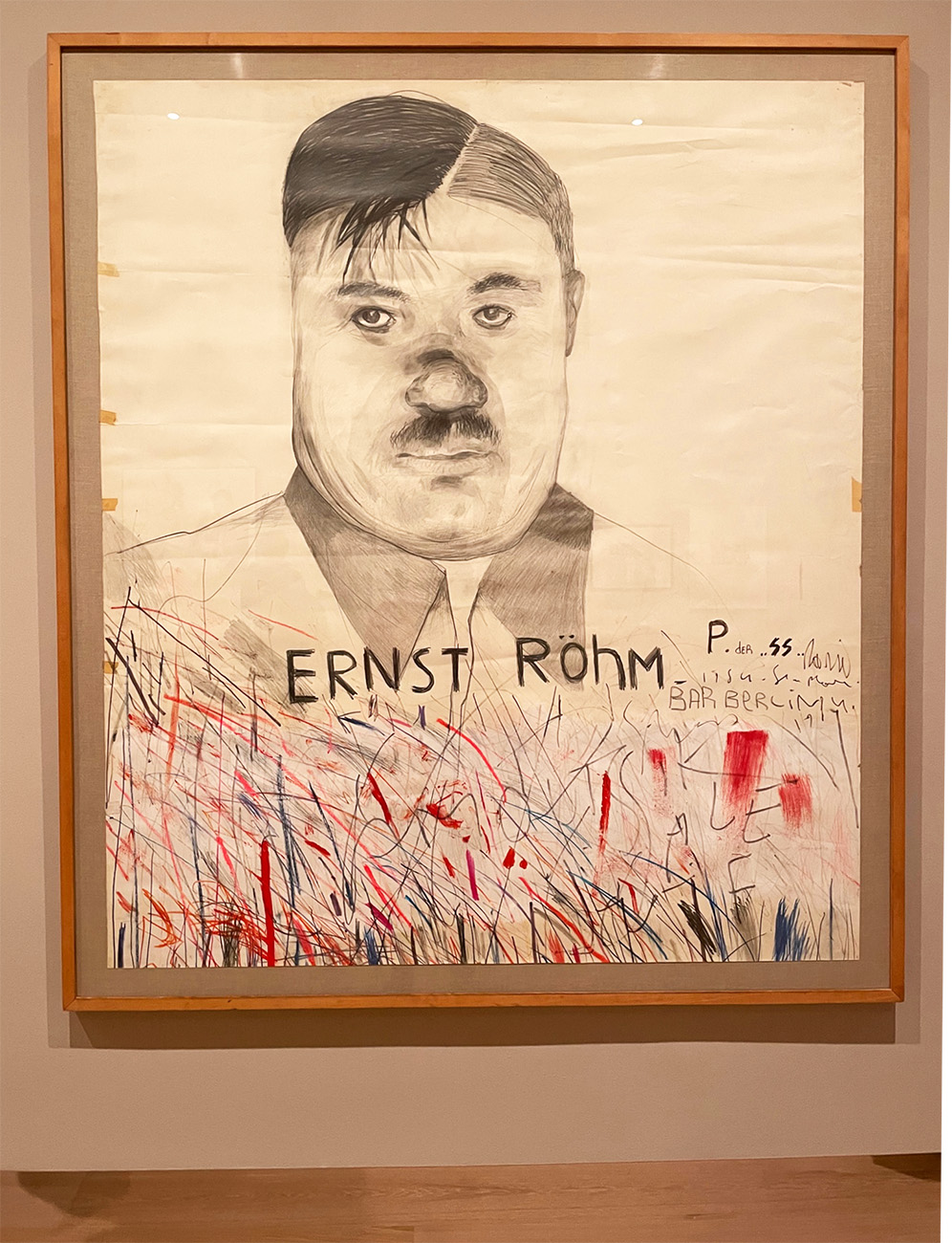
Ernst Röhm, 1981, Graphite, gouache, marker, and color pencil on paper. 54 3/4 x 47 1/4 inches

Who was Stephane Mandelbaum? A closeted gay man? The child of Holocaust survivors? A liar? A thief? A brilliant artist you’ve never heard of? All of the above and perhaps more.

The Drawing Center is presenting the first-ever show of Mandelbaum’s work in the US, and it is a show that left me gob-smacked. The combination of Mandelbaum’s brilliant drawing, deeply personal vision, and the complexity of his backstory is a tale made for cinema. Born in 1961 to a family of paternal Polish Holocaust survivors and maternal Belgian Armenians, Mandelbaum grew up in the town of Namur, about an hour and a half from Brussels. His Father, Ari, was a well-known painter, and his mother, Pili, was an illustrator. There is no record of siblings. A gifted draftsman from a young age but dyslexic and eccentric, Mandelbaum moved from Namur to Brussels, where he seemed to devote his time to making drawings and engaging in what is termed “petty crime.” He married a woman from Zaire (now called The Democratic Republic of Congo) and lived between the worlds of Belgian Africans, the Belgian crime underworld, and his own artistic imagination.

Continue reading “Stéphane Mandelbaum at The Drawing Center”
Linda Sok: Biomythorgraphies

In Dialogue
My grandmother with a bird, 2021, silk, cotton, salt, ink, wood, 80 x 70 inches, image courtesy the artist.

Linda Sok uses in her fiber-based sculptures elaborate dyeing techniques practiced throughout Asia and imagery of her family she receives through social media to convey narratives of migration and cross-cultural pollination. Linda Sok is a second-generation descendant of survivors of the Khmer Rouge Regime, a genocidal period in Cambodia’s history that forced her family to flee Cambodia. By accessing fragments of Cambodia’s traumatic past, she attempts to recontextualize lost traditions and culture to allow living descendants to process the history through a contemporary lens.

Continue reading “Linda Sok: Biomythorgraphies”

Patricia Satterlee at Gold Montclair

In Dialogue
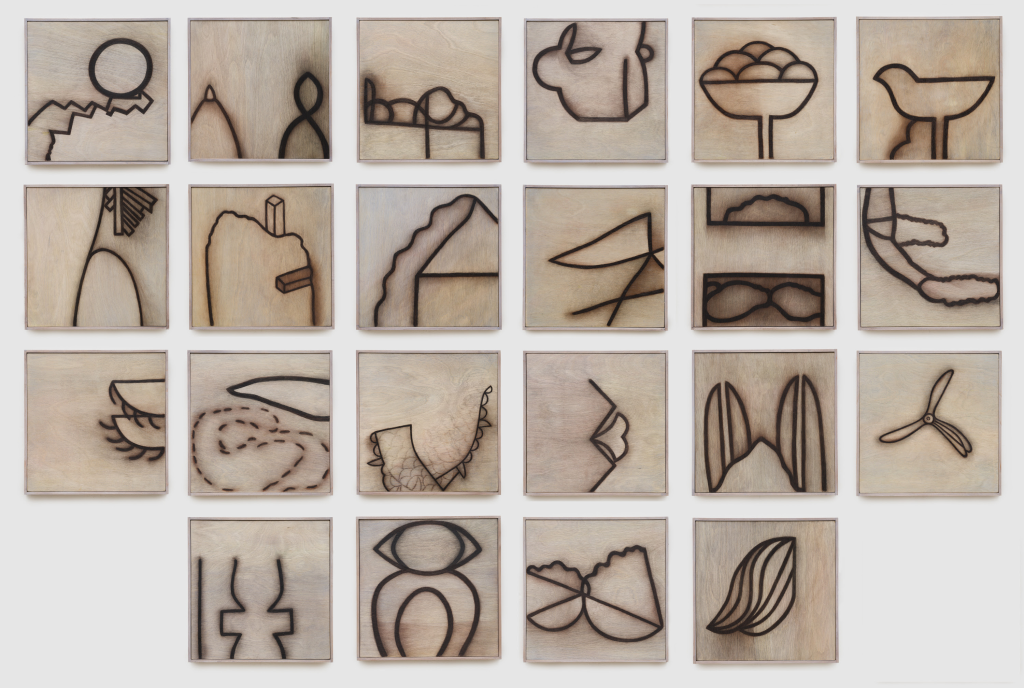
SPACELAND. Each Flashe paint and graphite on panel. 12 x 12 in. / 30.5 x 30.5 cm
SPACELAND. Each Flashe paint and graphite on panel. 12 x 12 in. / 30.5 x 30.5 cm

Patricia Satterlee wrote this concise statement to contextualize the work she exhibits in her third solo show at Gold Montclair:

This work resists the feeling that everything is falling apart. Holding on to a real or imagined moment without the noise. A particular way of being a boat on a stream passes in time. A figuration of forms floating and morphing, rediscovered as they’re painted.

An interview with curator and gallery founder Jennifer Wroblewski gives us more insight into her curatorial vision and the featured artworks.

Continue reading “Patricia Satterlee at Gold Montclair”

Shay Arick: Demons and Fields

Featured Exhibition
A white room with a white floor and a white rectangular object

Description automatically generated with medium confidence

In Demons and Fields, Shay Arick’s solo show in Tel Aviv Artists’ Studios Gallery, most sculptures are made of dried Ficus leaves he collected near his home. The vertical constructions are like linear drawings of delicate figures—they sway gently with the air or rotate in place through an automated mechanism. Each has its rhythm and character, evoking wonder and awareness of life’s fragility. Arranged along an extended white platform reminiscent of a road, these characters appear as if caught in a paused procession—some still move but remain anchored as part of a collective entity, an undefined network, or an intricate matrix. It is a nuanced and powerful metaphor for life’s transience in a complex reality. It is the second exhibition by Shay Arick since his return from New York City to Israel a year and a half prior. The show, curated by Eitan Bognim, opened on October 6th but was closed the next day on October 7th, due to the devastating Hamas attack on southern Israel and the subsequent ongoing war. The conversation with Shay Arick focuses on his art and his process.

Continue reading “Shay Arick: Demons and Fields”

Dalit Gurevich: A Memory Interwoven at Amos Eno Project Space

A painting of a pond with lily pads

Description automatically generated

Dalit Gurevich’s A Memory Interwoven, curated by Jenn Cacciola at the Project Space of the Amos Eno Gallery, is a vivid exploration of transformation and adaptation through depiction of mixed-media landscapes and cityscapes. The exhibit, now open to visitors, captures the shifts in Gurevich’s life from the confines of a Brooklyn apartment during the pandemic to the liberating nature of Vermont and back to the bustling city life. Her paintings tell a story of seeking space and peace in a time of global uncertainty.

Continue reading “Dalit Gurevich: A Memory Interwoven at Amos Eno Project Space”

The Immigrant Artist Biennial- In Dialogue

Art as Political Vehicle? Pritika Chowdhry, Marcelo Brodsky, and Rafael Yaluff

Marcelo Brodsky. 1968, Fire of Ideas. Kingston, 1968. 60 x 90 in. Overwritten photograph. Courtesy of the artist and Henrique Faria Fine Art.

Exhibiting in Conflictual Distance at EFA Project Space within the framework of The Immigrant Artist Biennial: 2023 Contact Zone Pritika Chowdhry, Marcelo Brodsky, and Rafael Yaluff explores, in Oraib Toukan’s formulation, ‘cruel images.’ Images that contain evidence of political and bodily violence but are confronted at an extreme political or geographic distance from their events’ site of occurrence. Together with the artists, co-curator Anna Mikaela Ekstrand discusses the politics of art and how the artists approach personal histories and historical and political events before the exhibit.

Continue reading “The Immigrant Artist Biennial- In Dialogue”

The Immigrant Artist Biennial – In Dialogue

In Dialogue with Linnéa Gad, Magdalena Dukiewicz, and Anna Ting Möller

Linnéa Gad. Detail from Shoal II. Photographed by David Schulze. Courtesy of The Immigrant Artist Biennial.

Instead of transcribing a previously established set of ideologies through scholastic mediums, Linnéa Gad, Magdalena Dukiewicz, and Anna Ting Möller engage with materials that “breathe”—materials whose lives and afterlives warrant separate biographies.

Presented within the context of The Immigrant Artist Biennial 2023: Contact Zone, Swedish artist Gad creates sculptures with limestone, oysters, lapis lazuli, and other materials profoundly connected to the Earth’s carbon cycle. On Governors Island, her sculptures, Shoals I-II, evoke humanity’s resonance with and reliance upon nature. Polish-born artist Dukiewicz juxtaposes industrial components with provocative, organic materials such as hair and blood. In the group show, Enmeshed, Dreams of Water, at NARS Foundation, Dukiewicz’s Object #6 (2023) contains decay, regeneration, and fluidity elements into beautifully translucent and sculptural artwork. Chinese-born Swedish artist Möller, whose work will be presented in Parasites and Vessels at Accent Sisters, unpacks the convoluted social history of kinship via kombucha cultures. The oysters, hair, and kombucha are not subjected to manipulating the artists’ hands; instead, the materials are collaborators in these projects, bringing their subjectivities, histories, and sociological implications into the creative process.

Together with TIAB’s co-curator, Anna Mikaela Ekstrand, the artists speak about their work about technology, materiality, and ecosystems.

Continue reading “The Immigrant Artist Biennial – In Dialogue”

Donna Zarbin-Byrne: Like Water from a Rock at Arts Fort Worth

Hot Air

Donna Zarbin-Byrne, Like Water from a Rock. Here Once Was Ocean, still image from augmented reality animation. Photo courtesy, Donna Zarbin-Byrne

In her installation-based exhibition, Like Water from a Rock, at Arts Fort Worth, Fort Worth, TX, Donna Zarbin-Byrne responds to the landscapes of the Chihuahuan desert of West Texas and the West Maui mountains, connecting material sites with an internal process. Western art traditions often portray the landscape as an idealized place to conquer and expand. Zarbin-Byrne frames the landscape as a place to experience the sensate.

Continue reading “Donna Zarbin-Byrne: Like Water from a Rock at Arts Fort Worth”

The Immigrant Artist Biennial – In Dialogue

Reproducing as an Im/migrant: Young Joo Lee, Maria Kulikovska, and Coralina Rodriguez Meyer

Young Joo Lee. Disgraceful Blue, 2016. Digital Animation. 10:24 min. Courtesy of the artist and The Immigrant Artist Biennial.

During a talk at NYU, feminist post-Marxist scholar and author Silvia Federici said: “The image of the worker is not the image of the person at the assembly line; it’s the immigrant.” With this statement, she is referring to vulnerable migrants whose movements are fueled by the climate crisis, corporate control of natural resources, and economics. With her social practice project Mama Spa Botanica, Coralina Rodriguez Meyer attempts to recreate the bond between nature and the female body to enhance healthcare for black and brown pregnant women, empowering them to advocate for themselves and their communities within an inadequate maternal healthcare system. In her book, Beyond the Periphery of the Skin: Rethinking, Remaking, and Reclaiming the Body in Contemporary Capitalism, to explain the link between migrants and reproduction, Federici cites “the war on human reproduction” which encapsulates the separation of people from land, soil, sea, and independent means of reproduction acted out by corporate interests. This is a separation that Rodriguez Meyer both highlights and resists in her work.

Continue reading “The Immigrant Artist Biennial – In Dialogue”

The Kite Runner from Kfar Aza

מצילומי הלילה של אביב קוץ
Night Photographs, Aviv Kutz

This article was initially published in Portfolio Magazine in Hebrew on October 17th, 2023. It was translated into English by Sharon Yam Sananes and Ariane Goldberg Davidson and edited by Art Spiel. This publication in Art Spiel is in collaboration with Portfolio Magazine.

The Kutz family had always found hope and solidarity in their ability to create. It was their way of managing and flourishing as a family and as individuals. Aviv, Livnat, Rotem, Yonatan, and Iftach Kutz were murdered in their home. Aviv’s sister, Talya Kutz Shamir—artist and art therapist—talks about the family on her Instagram account, using their art as a jumping-off point for conversation.

Continue reading “The Kite Runner from Kfar Aza”