Art Spiel Picks: Philly Exhibitions in October 2024

HIGHLIGHTS
Hanne Friis, ​​The Mountain, hand-stitched faux leather and steel, 37 13/16 x 54 5/16 x 37 13/16 inches, at Locks Gallery, photograph courtesy of the gallery

Sometimes, we are confronted with artwork that hums with possibilities so profound you can feel them taking root in your chest and making a new home. You stand in the gallery, soaking it in, and you want to share it with as many people as possible. That said, I hope you take a good chunk of time to sink into the transcendent earthy abstractions of Warren Rohrer at Locks Gallery. Afterward, head upstairs and marvel, open-mouthed, at the unexpected forms created by sculptors Hanne Friis and Lynda Benglis. Then, journey over to Fleisher/Ollman Gallery and get lost in Sarah Gamble’s glittering forest interiors and interdimensional abstractions, filled with mystery and magic.

Continue reading “Art Spiel Picks: Philly Exhibitions in October 2024”

The Philosophy of Physical Existence at Tutu Gallery

A room with a fireplace and a rug

Description automatically generated

Installation view of Gentle Mist group exhibition at the Tutu Gallery, Photo Credit: Yulin Gu and Yuhan Shen

The exhibition titled Gentle Mist at the Tutu Gallery in Brooklyn could be mistaken for primarily being idea-driven, in which case the ideas precede artwork production, along the lines of artists working with clarity of vision, such as the Conceptual artist Sol Lewitt and the Minimalist artists Tony Smith and Robert Morris. However, upon closer examination of the works by this group of New York and Baltimore artists, we realize that the makers of the art objects are more intuitively engaged with their art. There is a great deal of trial and error and improvisation in the creative process, and the ideation and production processes integrate up into a complex maneuver or dance.

Continue reading “The Philosophy of Physical Existence at Tutu Gallery”

Mapping the Invisible at the Flinn Gallery

In Dialogue
Patrick Vingo: Mapping the Invisible gallery view 1.jpeg
Flinn Gallery Installation Photo by Patrick Vingo

Mapping the Invisible, the final show of the ’23-’24 season at the Flinn Gallery in Greenwich, Connecticut, showcases the work of Laura Battle, Jaq Belcher, and Amy Myers, each of whom contemplate and explore the mysteries of our existence through the lenses of science, math, and geometry. Co-curated by Francene Langford and Caren Winnall, the show runs till June 19, 2024. Langford elaborates on the curatorial process and highlights the work in this show.

Continue reading “Mapping the Invisible at the Flinn Gallery”

Dreams of a Common Language: Elizabeth Duffy, Lu Heintz, and Anna McNeary In OVERLAP

Liz Maynard

Installation View: Left to Right Lu Heintz, Everything is Fiber: A New Lexicon, 2024 Graphite on paper Elizabeth Duffy Wearing / Ceremonial Costume for Gathering Rehill (1904-1972), 2023-2024, Unraveled worn braided rugs made into clothing, braided rug poncho with corn-on-the-cob holders, copper dandelion leaves, copper formed shoes, rug remnant; Anna McNeary, Common Set, 2024 Fabric, velcro, wooden rack Dimensions variable

The rhymes, homophones, and translations between the work of Elizabeth Duffy, Lu Heintz, and Anna McNeary are object manifestations of “Dreams of a Common Language.” The exhibition at Overlap Gallery in Newport, RI, offers up sweet and salty juxtapositions of textile, prints, sculptures, and installations of Providence-based artists. It takes its title from Adrienne Rich’s 1976 volume of poetry, which ruminates on the possibilities of life liberated from patriarchal constraints and the feminist community emerging from speech in common. Duffy, Heintz, and McNeary explore textile not just as a shared (and often gendered) medium but as a conceptual framework.

Continue reading “Dreams of a Common Language: Elizabeth Duffy, Lu Heintz, and Anna McNeary In OVERLAP”

Yi Hsuan Lai: Objects, Bodies, Things at Gallery 456

Yi Hsuan Lai. Something Happened, 2022. Archival pigment print mounted on dibond. 16.25 x 21.625 inches. Courtesy of Gallery 456 and the artist

I was scrolling through Instagram recently when I saw a post that read: “What’s your artspeak ick?” The word “anthropomorphism” immediately came to mind. It’s nothing personal. It’s just that a friend of mine had an art history professor who once (in)famously tweeted: “I will scream into a pillow if I see another student write the word ‘anthropomorphic’ in their paper.” Therefore, I paused before ascribing “anthropomorphic” qualities to the work of Taiwanese artist Yi Hsuan Lai.

Continue reading “Yi Hsuan Lai: Objects, Bodies, Things at Gallery 456”

Harriet Korman’s Brutal Realism

Opinion
a hallway with paintings on the wall
Photo credit: Fernando Sandoval/MW

In Harriet Korman’s exhibition titled Portraits of Squares, the squares in question are either nested within the framework of a grid or stand alone as discreet entities surrounded by blocks of color. Her palette, in the main, is made of secondary and tertiary colors, which for the most part, are applied in an opaque and unmodulated manner — her surfaces tend to be flat and dry. Korman uses color both as a formal element to reinforce her composition’s structure as well as spatially. As one moves around the gallery, there seems to be no logical progression or sense to the paintings’ variations. The canvases, all of the same dimensions, are rectangular and are hung on the horizontal at eye level; their sequencing refuses to surrender an associative, conceptual, or anecdotal narrative. What one is left with is the fact they all, in part, reference squares and that they are all relatively different in approach. Subsequently, it is hard to determine if the “portraits” represent systemic deviations on a singular theme or if each painting was individually intuited. Behind the reception desk hangs a painting from 1979 whose forms are organic, their edges blurred, and whose surface is mottled. This painting stands as a reminder that Korman works thematically, and the present paintings are an aspect of her broader investigation of abstract painting’s various idioms.

Continue reading “Harriet Korman’s Brutal Realism”

The Sublimity of Simplicity in Dai Ban’s Sculptures

On view at Carrie Haddad Gallery through November 26

Artist Profile
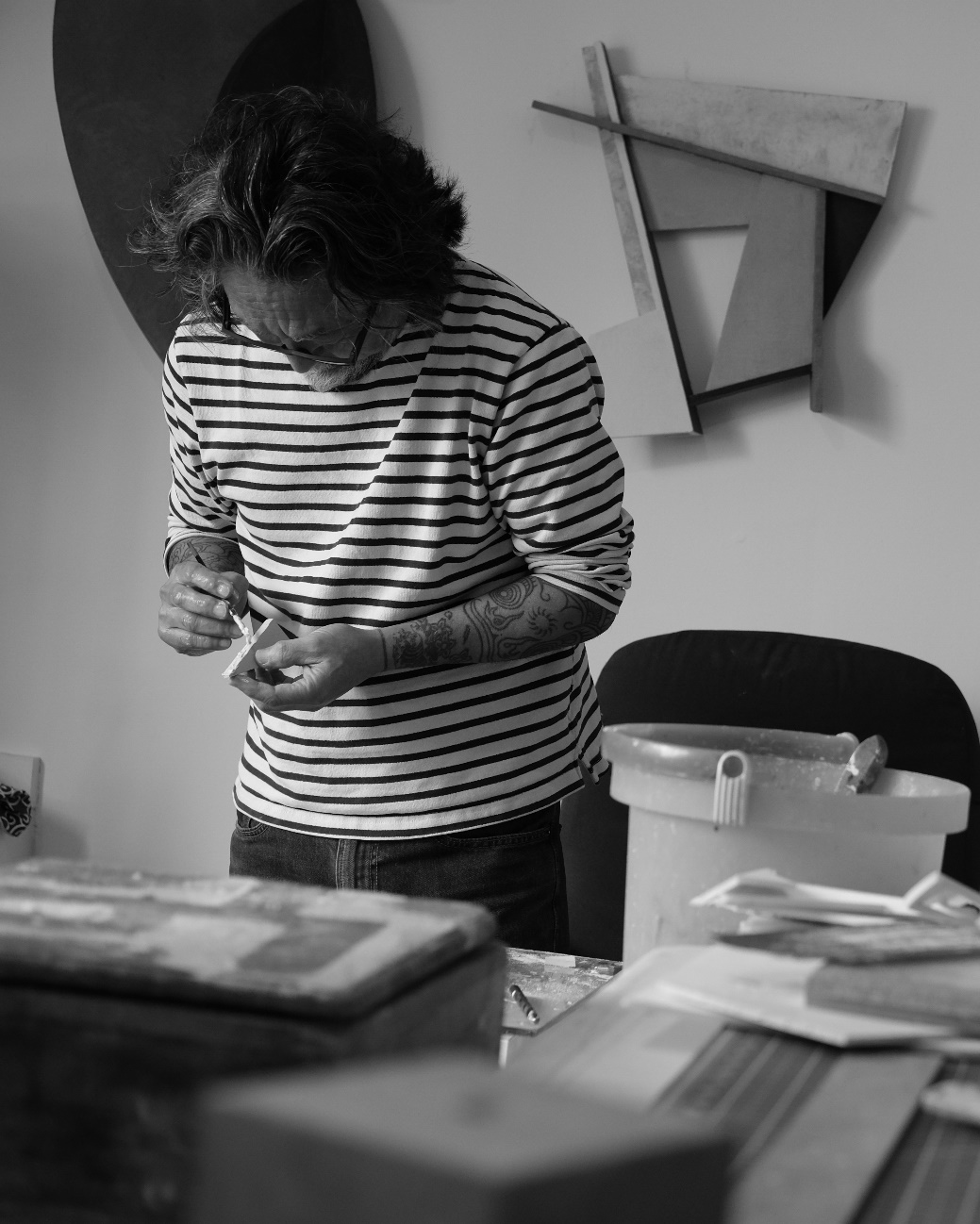
A person in a striped shirt

Description automatically generated
The Artist in his Studio, Great Barrington, MA. Image Credit: Matt Moment

When Dai Ban first traveled from his native Japan to the United States, he was struck by the nonchalant vibrance of American street art. The year was 1985, and although the golden age of graffiti had come and gone, its ethos had indelibly permeated the fine art world. Imagery that had been considered lowbrow just ten years prior became astronomically salable, so long as it decorated a canvas and not a subway car. Ban was bemused by the transformative power of gallery spaces. “Anything you show at the gallery looks like some kind of art,” he observed.

Continue reading “The Sublimity of Simplicity in Dai Ban’s Sculptures”

Whisperings from the Wormhole with @talluts

Unblocking Creative Block
A drawing of a person lying in pyramids

Description automatically generated
Louise Bourgeois Fear 1999 Drypoint from 11 Drypoints

Recently, I was making coffee, and I know it’s bad, but I love sweetening it with granulated sugar. I was trying to pour some out from a box, but only a few grains were coming out because the whole thing was full of clumps. And those clumpy lumps became for me an analogy for artist’s block, a condition I was suffering from at the time. As artists, we are like the sugar box with our sweet, sweet creativity trapped inside of us. Those heavenly granules are abundant and want to pour out to make coffee more delicious, but they can’t because their own selves are blocking it. And, as I was squeezing the box, trying to crush the bigger blobs, or choosing violence and stabbing a spoon handle in there, I started to wonder what other artists do in this predicament. So, I went up periscope, past the crystallized chunks, and spied about to find ideas for overcoming it.

Continue reading “Whisperings from the Wormhole with @talluts”

Re-evaluating Ellsworth Kelly at 100

opinion
Ellsworth Kelly, Spectrum IX, 2014, acrylic on canvas, twelve joined panels, © Ellsworth Kelly Foundation, Photo: Ron Amstutz, Courtesy: Matthew Marks Gallery

Ellsworth Kelly (1923-2015) is one of those artists whose status I’ve never understood. While he is held in high esteem by many, I’ve always questioned his significance. Don’t get me wrong, I like his work, but liking it doesn’t necessarily make it significant. His work is elegant, refined, and smart, and yet even in the 1950s-70s, it seemed conservative against the backdrop of Abstract Expressionism, Pop, and Minimalism. What made Kelly different from his peers was that when he was living and studying in Paris after World War2 on the GI Bill, while many of his fellow artists from the States were exploring lyric abstraction and L’informale, Kelly was looking at Art Concrete and had begun to make multi-canvas paintings.

Continue reading “Re-evaluating Ellsworth Kelly at 100”