Notice: Function WP_Object_Cache::add was called incorrectly. Cache key must not be an empty string. Please see Debugging in WordPress for more information. (This message was added in version 6.1.0.) in /www/artspiel_344/public/wp-includes/functions.php on line 6131
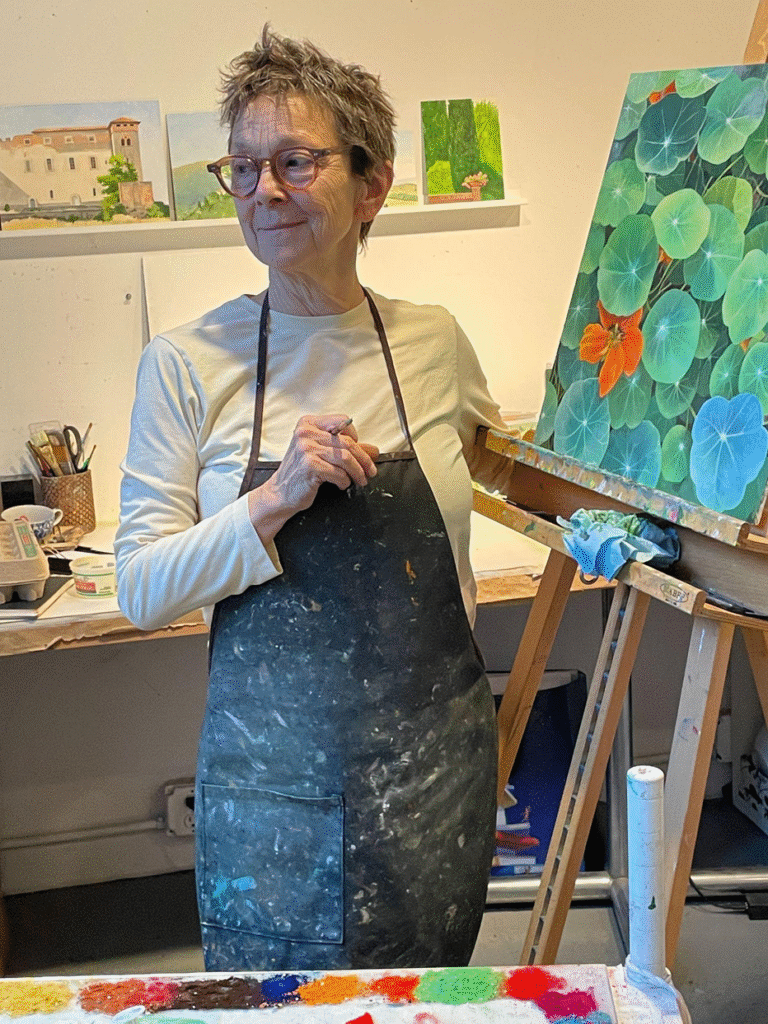
Work in progress, Constellation, Nasturtium, egg tempera on panel. Photo, courtesy of Cecilia Andre
Painter Susan Cohen began her artistic journey by depicting the interiors of the places she lived, drawn to the emotional resonance of light and shadow. While that early intensity has softened over time, her fascination with light remains the core of her practice — animating her still lifes, landscapes, cityscapes, and close-up studies of foliage.
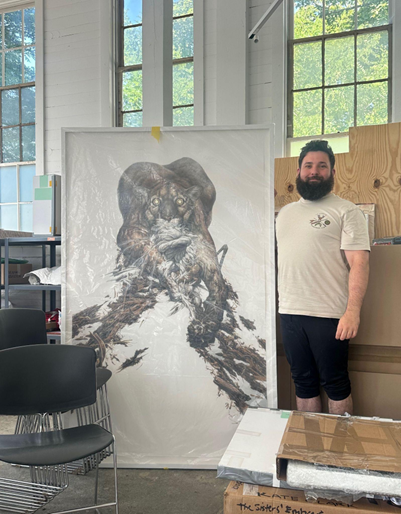
Curator Michael Morgan with George Boorujy’s Dredger (2017) in the Foundry, home to Cornell’s MFA studios. Photo courtesy of Michael Morgan
Curating an exhibition at Cornell doesn’t require waiting until after graduation or climbing a long academic ladder. The Art Department makes the process unusually accessible—for undergraduates, graduates, and faculty alike. Within the department, there are two dedicated galleries, and under the larger umbrella of the AAP College, a third gallery also accepts exhibition proposals. Each semester, a committee comes together to review applications for the following term. It was within this framework that two graduate students took on the challenge of organizing a large group exhibition. Michael Morgan, who co-curated the exhibition with Elina Ansary, tells us about the process behind the show.
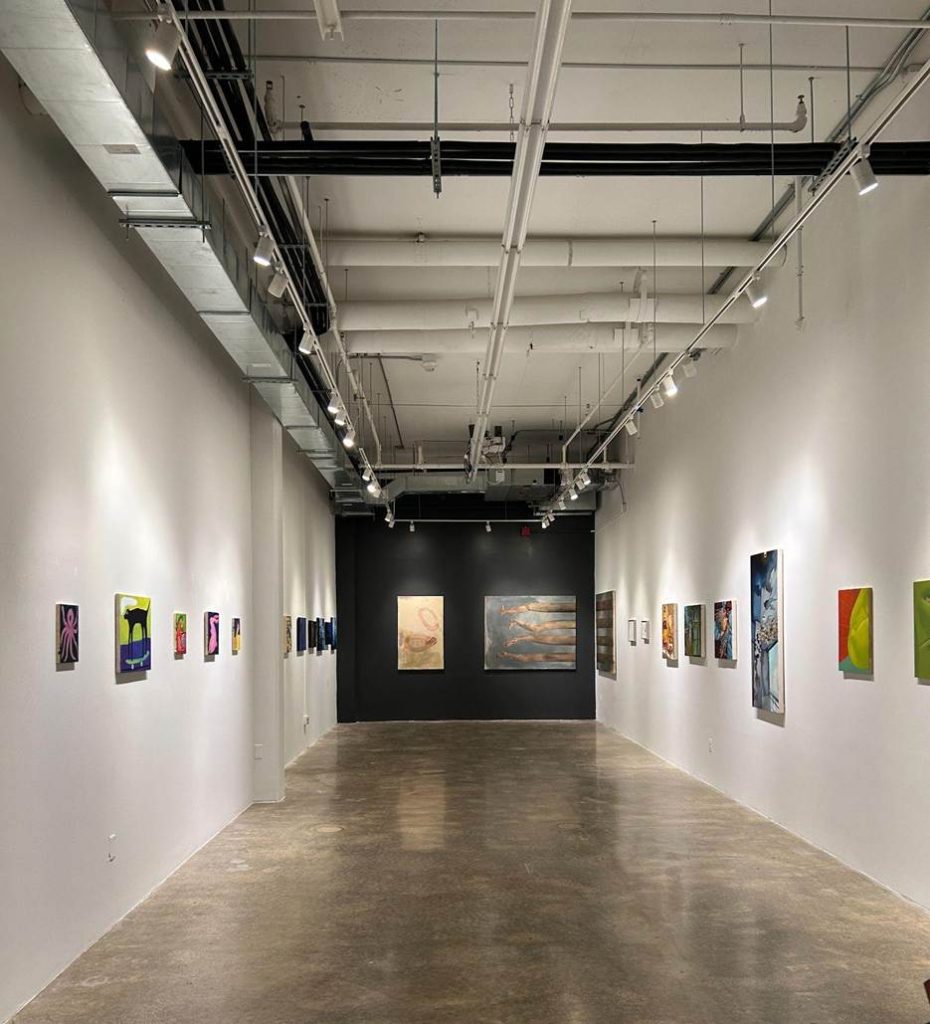
The Essence of a Moment, a group exhibition presenting a collection of artists’ contemplations on the makings of a moment. A moment is by its nature fleeting, and it’s by our nature as people that we seek to extend or preserve them; despite their intangibility. This group show engages with the questions – How can one define something as nebulous as a moment? Is it done retrospectively after it has passed? Is it a confluence of occurrences? Or perhaps it exists with the body’s perception of the present moment? These works offer a variety of insights and perspectives into understanding a moment.
Ellie Krakow with several pieces from her series Comfort Corners, Sharpe-Walentas Studio Program, photo by Kay Hickman, courtesy of the artist.
On April 26th and 27th, from 1 to 6 pm, artists in DUMBO will open their doors to the public as part of DUMBO Open Studios, offering a rare look inside the art studios along the Brooklyn waterfront. Since the 1970s, DUMBO has been shaped by its vibrant art community. This interview series highlights a handful of participating artists in 2025. Each response offers a glimpse of what’s waiting behind the studio door. Ellie Krakow has been in DUMBO since 2024. Her studio is at the Sharpe-Walentas Studio Program, 20 Jay Street, #720.
In the studio with Way Down, 2024, 50×50.25” photo credit Andrew Schwartz @artphotobiz
On April 26th and 27th, from 1 to 6 pm, artists in DUMBO will open their doors to the public as part of DUMBO Open Studios, offering a rare look inside the art studios along the Brooklyn waterfront. Since the 1970s, DUMBO has been shaped by its vibrant art community. This interview series highlights a handful of participating artists in 2025. Each response offers a glimpse of what’s waiting behind the studio door. Audrey has been in DUMBO since March, 2024. Her studio is at 45 Main Street, #1052.
Double Space at D.D.D.D., Installation shot. Photo taken by Rachel Kuzma
Anna Gregor often remarks, half in jest, that she wishes she were a poet. Poems, to her, come closest to immateriality; they exist in the mind and can be accessed anytime. In contrast, a painting is a unique object that must be seen in person, confined by paint, the artist’s technique, and the viewer’s presence. Gregor, a painter in New York City currently pursuing her MFA at Hunter, examines the divide between body and mind, material and immaterial, in her art. She sees a painting as having a dual nature: a physical object of paint sharing space with the viewer and an immaterial idea formed in the viewer’s mind. This mirrors the human condition, where body and mind coexist. Gregor says she often feels trapped by her physical form and its social labels—gender, age, race, and ability. Yet, she recognizes that her body is essential for her consciousness. For Gregor, making a painting is a confrontation with matter, a commitment to the material world while striving to go beyond its limits. Viewing a painting involves a similar struggle to find meaning in the artist’s creation. “ Without the physical painting, there is no idea. But without the idea, the painting is just inert matter,” she says. This intricate relationship is central to her solo show, Double Space, at D. D. D. D.
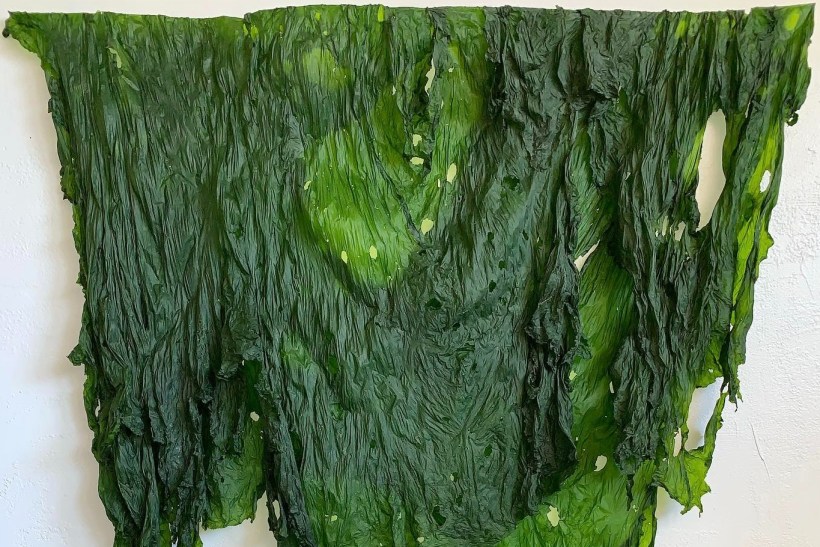
California-based artist, writer, and researcher Christina Conklin grew up spending summers along the coast of Oregon where she first developed a relationship with and understanding of the ocean as “an infinite vessel” of ever-changing and interconnected living systems. For the last 12 years, her artwork has explored the intersection of art, science, and spirituality as it relates to the sea.
Lesley Bodzy. I knew better, acrylic, 66” x 34” x 15”, 2022. All photographs are courtesy of the artist.
Wall sculptures by Lesley Bodzy will be on view during Armory Week 2022 at SPRING/BREAK in Leftover and Over curated by Giovanni Aloi and Erica Criss. Anna Mikaela Ekstrand interviewed the California-born Houston and New York City-based artist about her evolving practice.
Natalie Westbrook’s exhibition at ZYNKA Gallery in Pittsburgh features new paintings on canvas and drawings on paper. Westbrook depicts faces as thick lines immersed in saturated hot pinks, greens or monochrome gradations—altogether fluctuating between the monstrous and the angelic, the scary and the pathetic. Sometimes they are solitary and sometimes they indicate twins or perhaps a fragmented self. In her catalogue essay on Natalie Westbrook’s work, Larissa Pham observes that Faces “come for you, leering, grinning, mouths a garish lipsticked rictus of joy, embedded flat against the canvas, their features seeming to emerge from the psychological fabric of the painting itself.”
Jen Dwyer, Stay Hard & Soft, Ceramic sculpture, 2020
In the several years preceding the pandemic, Jen Dwyer completed her MFA in Ceramics at the University of Notre Dame, exhibited at Miami Context in 2019 as well as in back-to-back iterations of Spring/Break, and saw her work profiled by Forbes and Architectural Digest. Then, when the rapidly increasing toll of the coronavirus caused the collective art world to press pause on what promised to be yet another whirlwind year, she took the slower pace of life as an opportunity to embrace deeper introspection in her studio practice. This newfound creative intuition wove its way into the production of her most recent collection of sculptures and paintings, which the artist recently debuted at Wassaic Project in New York.