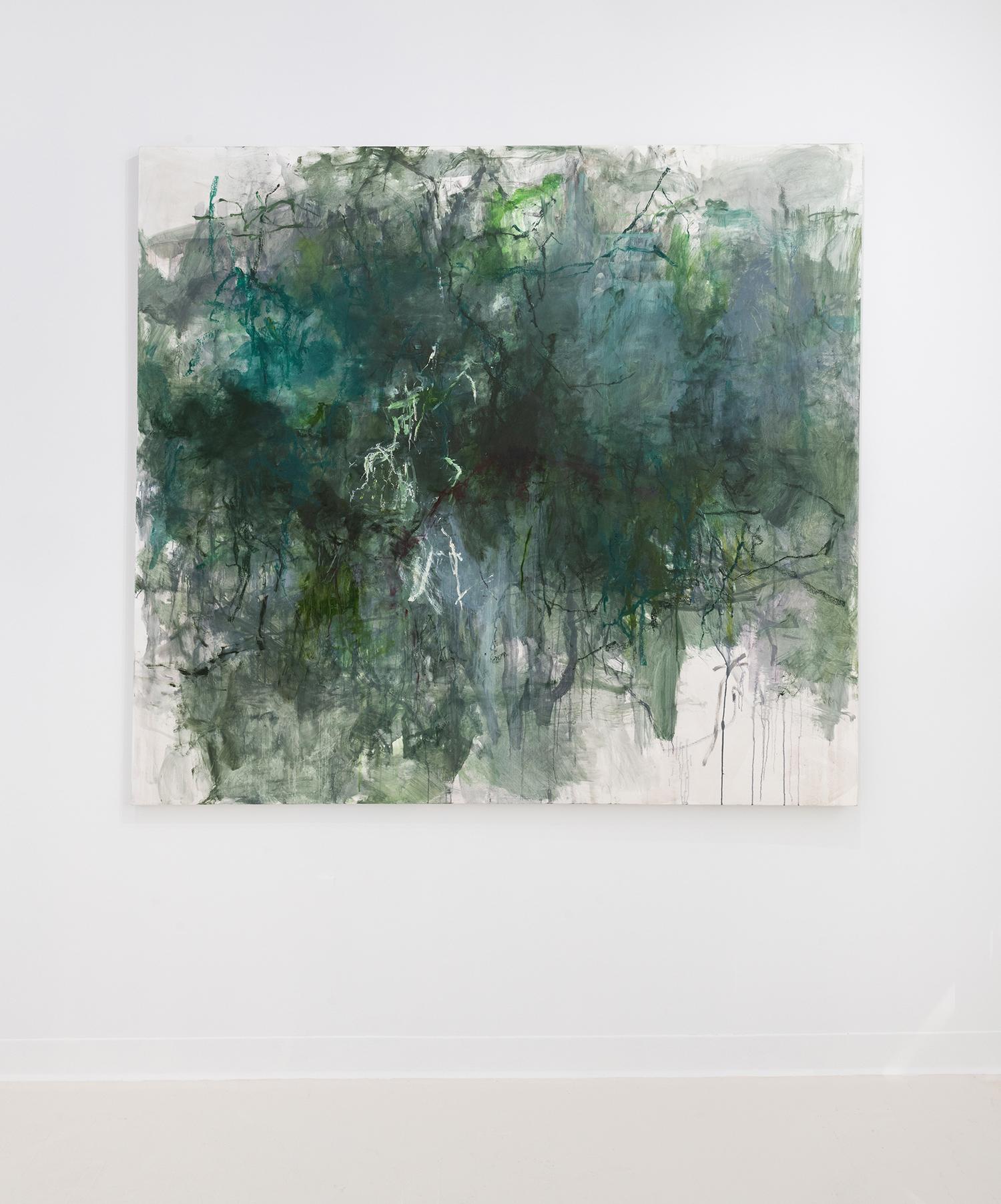
Matthias Franz (German, born 1984), infantile gestures, 2024, Oil on canvas, 170 x 160 cm. (66.9 x 63 in.) courtesy of GRIMM Gallery
From dark and moody to blithe and bright, gestural painting is having a resurgent moment at the Independent Art Fair this year. Representational, abstract, and everything in between, artists showcase a wide range of motions and gesticulations of the artists’ hand tell the stories.
The Space Between, curated by Tracy McKenna at Platform Project Space, combines works in paint and fiber by Lauren Luloff, Tessa Greene O’Brien, Mark Olshansky, and Amy Kim Keeler. They all share a sense of desire to capture the elusive space in between—where the artist’s perception and hand meet your gaze.
Ernesto Renda and Katie Hector in their studios. Images courtesy of the artists.
Ernesto Renda and I first met on the internet, as more and more artists do. A follow turned into likes, which developed into mutual curiosity and respect for each other’s practice. Renda, who lives in New York, and I in Los Angeles, kept in touch for months, viewing miniature backlit versions of the other’s work while each suspecting there was more than met the eye. As fate would have it, Renda’s solo exhibition, The Moment of Truth, opened at Moskowitz Bayse in Los Angeles; subsequently, my solo exhibition, EGO RIP, opened at Management in New York City two weeks later. Viewing the work in person was enlightening and generated conversations around material play, intuition, and the verisimilitude of our subjects. These brief yet poignant chats inspired us to pose the questions below from the perspective of one visual practitioner to another.
Right: Kosuke Kawahara, Forever Waiting, 2018-2023, Oil color, encaustic, spray paint, ink, pencil, gesso on wood panel, 773⁄4 x 621⁄2 x 3⁄4 inches / 197.49 x 158.75 x 1.9 cm. Left: Kosuke Kawahara, New Poison, 2023-2024, Oil color, acrylic, encaustic, spray paint, ink, gesso on synthetic fabric, 311⁄4 x 261⁄4 x 11⁄4 inches / 79.38 x 66.68 x 3.18 cm
Kosuke Kawahara’s solo show at RAINRAIN represents a multi-faceted approach to materials, exploring what are conventional ways of organizing knowledge? Or, perhaps, how cosmic, biological, and cultural systems intersect? Throughout the paintings, I recognize forms resembling distorted body parts and hinted symbols from astronomy, depicted with oil paint, acrylic, chalk, spray paint, fabric, and wood. When Kawahara’s surfaces manifest their materiality—a patch of exposed woodgrain or a peel of paint revealing found fabric—they suggest the existence of other dimensions and bring me to question the characteristics of processes like reproduction and decay.
installation view at Space 776 Gallery, photo courtesy of the artist
In her first solo show at Space 776, Dasha Bazanova’s oil paintings and ceramic sculptures engage with the theme of “alien” from various angles: the cultural alienation intrinsic to her Russian roots and her identity as an “alien” in the United States. She draws upon the 1970s, a period rich with alien conspiracy theories tying these themes to our present. The exhibition includes ceramic sculptures of Russian grandmothers, standing as symbols of endurance amid the aftermath of calamities and prompting contemplation on the legacy of alienation across generations. Bazanova elaborates here on the body of work in her show.
Installation view of Caroline Burton: Way Finding at the New Jersey State Museum (September 23, 2023 – March 31, 2024). Photo courtesy of Sarah Vogelman
The New Jersey State Museum, part of the NJ Department of State, has served the public for nearly 130 years, showcasing diverse collections in Archaeology & Ethnography, Cultural History, Fine Art, and Natural History. Assistant curator Sarah Vogelman dedicates herself to the Fine Art collection, focusing on its care, expansion, and exhibition. With over 12,000 works, the collection emphasizes American art and notably highlights New Jersey artists, positioning their contributions within the broader American art history context. Through the New Jersey Artist Series, featuring exhibitions like Caroline Burton: Way Finding, Vogelman aims to spotlight New Jersey’s vibrant contemporary art scene and foster local artist collaboration. By curating this series and organizing exhibitions that offer wider or even global art historical perspectives, she strives to convey that New Jersey’s art is a vital part of a broader cultural dialogue. “I want our visitors to see that art from New Jersey transcends our state’s borders,” says Vogelman.
Inside Out Oculus, 2022, acrylic on mylar, 36×45.5 in.
In her Interiors painting series, American Iranian-born painter Zahra Nazari draws on prominent features in classical Persian and Islamic architecture—decorative botanical motifs, arch, and particularly, iwan, the large, vaulted hall semi-enclosed and usually walled on three sides, with one end entirely open. Many scholars believe its origin can be traced back to the Parthian era. While looking at Nazari’s luminous surfaces, it may be interesting to keep in mind the dual role of the Persian arch—it serves both decorative and functional purposes—this richly decorated key aesthetic element in Persian architecture functions not only as an ornament but also as a structural support that provides stability. It is also designed to moderate the amount of sunlight that enters space, especially in iwans or other open spaces. Nazari’s frequent use of Mylar as a surface stirs a play on the notion of external and internal light, and simultaneously, her saturated color palette invokes a hot and arid climate with bright, sunlit days and crisp nights. Repetitive and rhythmical, these motifs coalesce into energetic, translucent, and luminous surfaces, evoking an interior space in flux. Zahra Nazari elaborates on her ideas and process in this interview with Art Spiel.
Elizabeth Gilfilen’s debut solo show at YI Gallery presents oil paintings that exhibit a meticulous yet bold exploration of color and texture. Her strokes span from boldly assertive to gently nuanced, each adding to her work’s visual depth and dynamic feel. Eschewing neat conclusions, her paintings are presented as evolving works, with each layer suggesting new narratives in an unfolding journey. The synergy of color and form in her paintings creates a dynamic tableau, inviting viewers to interact with the canvas, drawing them into the active narrative of the art’s continuous unfolding.
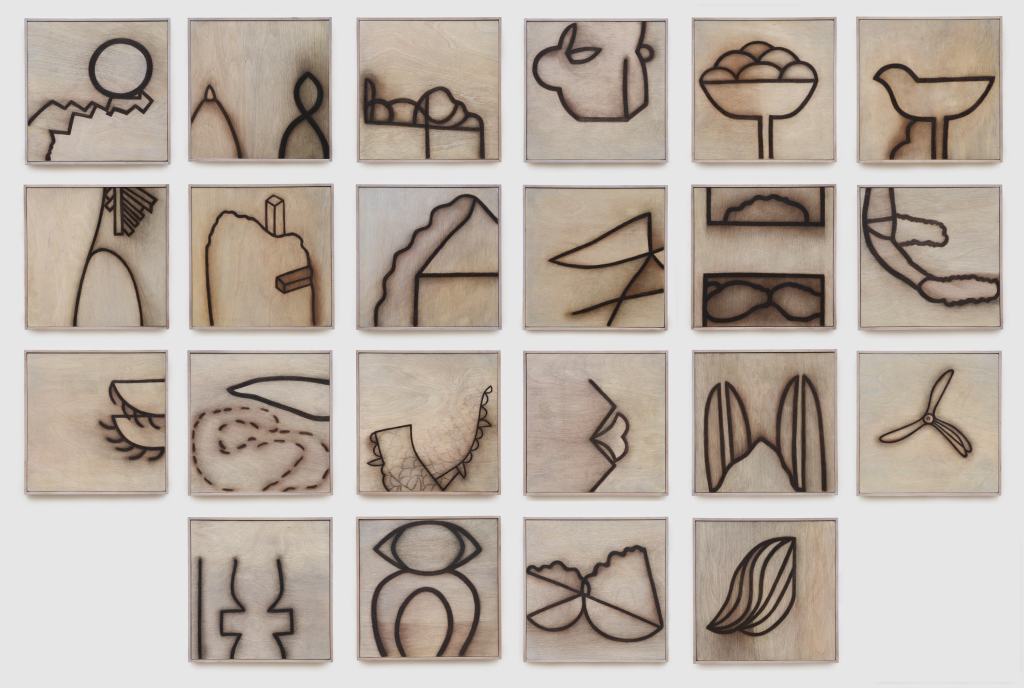
SPACELAND. Each Flashe paint and graphite on panel. 12 x 12 in. / 30.5 x 30.5 cm
Patricia Satterlee wrote this concise statement to contextualize the work she exhibits in her third solo show at Gold Montclair:
This work resists the feeling that everything is falling apart. Holding on to a real or imagined moment without the noise. A particular way of being a boat on a stream passes in time. A figuration of forms floating and morphing, rediscovered as they’re painted.
An interview with curator and gallery founder Jennifer Wroblewski gives us more insight into her curatorial vision and the featured artworks.
Noa Charuvi, Cairn, 2023, oil on canvas, 36×72 inches
45 Jacob took a stone and erected it as a pillar. 46 He instructed his kin, “Collect some stones.” They gathered stones, formed a heap, and shared a meal beside it. 47 Laban named it Jegar Sahadutha, while Jacob named it Galeed. 48 Laban declared, “This heap stands as a witness between us today.” Hence, it became known as Galeed.
Genesis, Chapter 31, Verse 45
A Gal’Ed symbolizes a location marked by significant events—deathly moments or sacrifices. As it appears in the Old Testament, it signifies a covenant. In Hebrew, ‘Gal’ is a heap of stones, and it is the same word for ‘wave.’ ‘Ed’ means a witness. This heap of stones becomes an emblem of the pact between Jacob and his father-in-law: their agreement not to harm each other’s possessions or families. Serving as a symbol of shared promises, Jacob sanctifies it, offering to God on this stone.