Notice: Function WP_Object_Cache::add was called incorrectly. Cache key must not be an empty string. Please see Debugging in WordPress for more information. (This message was added in version 6.1.0.) in /www/artspiel_344/public/wp-includes/functions.php on line 6131
Joanne Ungar is a singular talent. Her work is a luminous masterclass in the manipulation of color and wax. A gifted encaustic artist with a scientific approach to her art practice, she speaks directly through her chosen medium to address questions of beauty and pain. We spoke about living in analog and digital worlds, women’s beauty, and finding your own art world.
During the Coronavirus pandemic, Art Spiel is reaching out to artists to learn how they are coping.
Cibele Vieira in her studio
Cibele Vieira is a Brazilian-born artist whose work has been exhibited at Petzel Gallery, Gallery Geranmayeh, Valentine, Front Room Gallery, Christopher Henry Gallery, and Soho Photo in NYC; Ateliê 397 Gallery, the Bienal de Fotografia de São Paulo, and Casa de Cultura Mário Quintana, in Brazil. Her work is in the collections of the Ado Malagoli Museum and Rio Grande do Sul Contemporary Art Museum in Brazil, and the Kiyosato Museum in Japan, and has been published in The Village Voice, Brooklyn Rail, Hyperallergic, Visura Magazine, L Magazine, Culture Front, Washington City Paper, O Globo, Correio Braziliense, Zero Hora and Private Magazine. She was awarded First Place, Vision Awards 2000, by the Santa Fe Center for Visual Arts, and is currently an artist in residence at New York Presbyterian Hospital.
Joanne Ungar at Front Room, partial installation view
Pain produces sharp, bright sensations or sometimes ripping agony. It’s often intensely specific. The substances that bring us relief often do so by blurring the hard angles of our pain, allowing us to focus elsewhere. Some substances can leave us in a disconnected fog, far away from the source of discomfort. Others mute and muffle the pain, giving the relieved a sense of floating in a cushioned world. Calibrating effective pain relief can be a struggle for balance between an alert connection to the present and a silencing of uncomfortable sensation. Continue reading “Ethereal Anaesthetic”
In recent years Joanne Ungar has transformed found boxes into translucent paintings by embedding them in layers of wax. The forms are abstracted, but the narrative is evident. These beautiful objects carry the burden of their histories – boxes of pain killers, packages of cosmetics, or chocolate wraps. While their vibrant pigments may encapsulate broken dreams and their origin most likely resonates waste, their sheer alchemy uplifts. Joanne Ungar talks with Art Spiel about “Pain Relief,” her current solo show at Front Room Gallery, which just opened in March 1st, 2019. She also elaborates on her process and some of her forming experiences as an artist.
After November 2016 Patricia Fabricant‘s paintings shifted from dense and layered abstractions to self portraits depicting fluctuating expressions and altogether underscoring post election malaise. Fabricant developed an intriguing mechanism of observation and layering. Her gaze is meant to be neutral, just a stare into the mirror but throughout the weaving process, chance yields unintended emotions – knowing, anxious, sad. The artist describes in this interview for Art Spiel her process, ideas, and on going projects.
Patricia Fabricant, Emotions: Angry, Love, Confused, Sad, Shocked, Anxiety, 2016. Each gouache on paper, 16 x 12 inches, photo courtesy of the artist
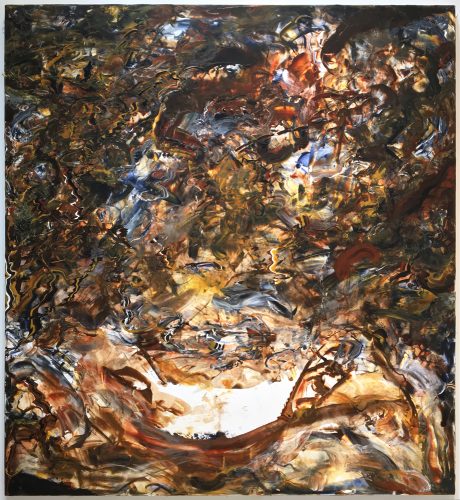
Peter Fox, Second self, 2018, courtesy of the artist
“Surface Tension”, Peter Fox’s third solo exhibition with Front Room gallery features a series of new paintings in which he manifests a controlled self-reflexive state – the layered painting application itself defines form and gesture. In this new series Fox has reduced his palette to earth tones, creating a rich counterpoint – burnt siennas, dark browns and yellow ochres play off cool blues in Payne’s grey. Continue reading “Peter Fox – Surface Tension at the Front Room Gallery”