Notice: Function WP_Object_Cache::add was called incorrectly. Cache key must not be an empty string. Please see Debugging in WordPress for more information. (This message was added in version 6.1.0.) in /www/artspiel_344/public/wp-includes/functions.php on line 6131
Kat Chamberlin: TRANSACTIONS for BEVERLY’S: Under Construction Sessions includes works in drawing, glass and aluminum created in response to a year in quarantine and loss of work. In exchange for the year’s shifted labor conditions and loss of independence, the artist uses her 5-year-old daughter’s ideas as payback. The show runs through April 20th, 2021.
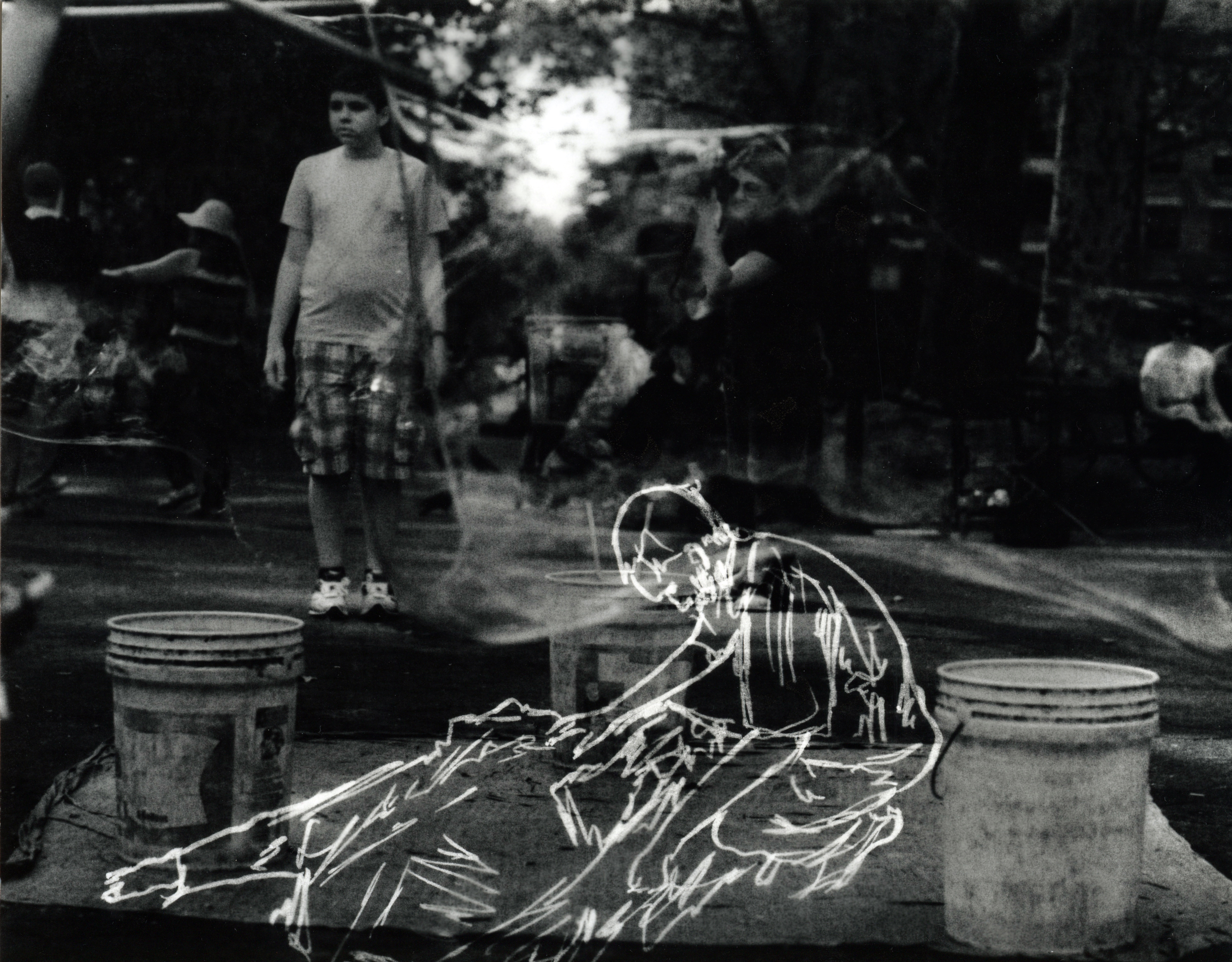
Farideh Sakhaeifar, You are in the war zone., 2016-17. Gelatine Silver Print, 8 x 10 inches
In her latest solo exhibition at New York’s Trotter&Sholer gallery, Iranian artist Farideh Sakhaeifar invites the viewer to reflect on the human experiences that connect us all. You are in the war zone confronts conflict, war, and social injustice head-on. Presented in partnership with the non-profit arts organization KODA, and curated by Klaudia Ofwona-Draber, the exhibition covers Sakhaeifar’s rich artistic practice, from her performance pieces to her sculptures to her hand and digitally manipulated photographs made over a seven year period. The works in the show underscore the artist’s strong critique of US foreign policy and Western portrayal of war in the Middle East and North Africa, as well as her impactful representations of shared experiences, the subjectivity of the media, and the inevitable distortion of memories and information over time.
Mira Dayal, installation view (wall text), “…In That Empire…” at Spencer Brownstone Gallery, 2021, photo courtesy of the artist.
In her inaugural solo exhibition with Spencer Brownstone Gallery, Brooklyn-based artist Mira Dayal has rubbed by hand the entire gallery floor in graphite, resulting in a map of the space’s topography – all lines and no borders. Drawing on Borges’s “On Exactitude in Science”, the show explores notions of scale, control, ethics, materiality, and simulation. The show runs through April 4th, 2021.
“Last Wash at Midnight” at The Border Project Space, installation view courtesy of The Border Project Space, New York
At a time when one would have to work 78 hours at minimum wage to afford a studio apartment in most of the US, the idea of a rusting laundromat provides a fitting theme for an exhibition to reflect the struggles faced by so many in the US. While the show curated by Jamie Martinez evokes layers of meaning, the sagging laundry machine of Chelsea Nader, provides an ethos for the current state of the world grappling with economic stress in a pandemic.
This Two, Sun You’s first solo show with Geary, takes place concurrently at Geary’s two locations: Bowery in the Lower East Side and Main street in Millerton, New York. Geary features You’s clay- based work which includes oven-baked polymer clay forms mounted on painted wood panels, sculpted clay forms in cardboard boxes, and a separate body of sculptures made of mixed media — metal wire, razor blades, beads, and artificial flowers “held by magnets and gravity”, as described by Michael McCanne in the press release. The show runs through March 5th, 2021.
Mary Ann Lomonaco began her artistic life as a papermaker after majoring in Fiber art at Parsons School of Design . Ultimately this led to exploring the kitchen mop as a cellulose fiber she could use when making pulp. One day she started noticing the mophead itself as a potential sculptural element on its own. This insight subsequently led her to explore other recycled materials. Mary Ann Lomonaco recently completed commissions for Delta Airlines for their Executive Lounges in San Francisco, London, JFK, Seattle and Atlanta as well as a large piece for their Atlanta Headquarters. Her installation at the Westchester County Airport is comprised of 55 multiple pieces. Her work is also in the collections of the Neuberger Museum, Neutrogena, AT&T, PepsiCo and the World Bank Library among others.
Fellow Travelers, PeepShow Space’s fifth and final exhibition, features the work of Joshua Rosenblatt, Jason Phillips and William Norton. The three artists reflect on travel, which at this moment is impossible in their lives as they shelter, wait and dream about places that no longer exist, except in memory.
Joyce Yamada, Portrait, 2019, photo courtesy of Nila Onda
Painter Joyce Yamada grew up on the west coast. She spent her childhood vacations in the beautiful national parks of the US and Canada where pristine forests and the Pacific coast were imprinted in her visual memory. She recalls that although as a teenager she realized that art is her task in life, struggling to survive by minimum wage work led her to medical school which she completed and then subsequently became a diagnostic radiologist. This science background has fed her mind and artwork ever since. Yamada says she is a painter because she conceptualizes in images rather than in words — “when puzzled, my mind juxtaposes or fuses unexpected images, often leading to new work,” she says. For instance, an early series, Body, Earth, came to her in art school — while looking at the hills across the bay from San Francisco she saw the low rounded hills as the reclining body of a woman. The juxtaposed imagery meant to her that we are intimately and indivisibly part of earth and of nature, that what we do to the earth we do to ourselves. She has subsequently seen this idea expressed in indigenous cultures, and it became central in her work.
The Immigrant Artist Biennial (TIAB) is a volunteer, female-led, artist-run project. TIAB 2020 launched in March in New York City at Brooklyn Museum, and continued in September through December at EFA Project Space, Greenwood Cemetery, and virtually, presenting 60+ artists. This interview series features 10 participating artists.
Priyanka Dasgupta and Chad Marshall’s practice draws from sociological conventions, archival texts, and postcolonial studies to examine power and disenfranchisement in the US and their relationship to appearance. Recent exhibitions of their work include ‘Uptown Triennial’ (2020), ‘The Immigrant Biennial’ (2020), ‘Pigeonhole,’ Knockdown Center, NY (2019), Dodd Galleries, UGA, Athens (2019), Sunroom Project: Paradise, WaveHill, NY (2018), In Practice: Another Echo, SculptureCenter, NY (2018). Residencies include Artist Studio Program, Smack Mellon (2018-19) and AIRspace, Abrons Arts Center (2018). Dasgupta and Marshall’s work has been reviewed in various publications. They are recipients of the Smithsonian Artist Research Fellowship, 2019-20.
In Dialogue with Eric Fallen, Founder and Executive Director
Duet, 2020 76.5”h x 84”w x 53”d Canvas, acrylic paint, wood, furniture parts, wheels, and hinges
Amy Butowicz solo show Boudoir Theatre at Peninsula Art Space features a collection of domestically scaled sculptures staged as a group of characters which are readily associated with notions of sensuality, ornamentation, and haute couture. Bulging cushion-like forms, meticulously hand-stitched over wooden structures, display intricate patterns and rich material suggestive of bedding, vanities, corsets and human anatomy. Bold and tender simultaneously, these anthropomorphic forms defy the disdain and fear that are frequently imposed upon feminine artforms, spaces, and bodies. Eric Fallen, founder and executive director of the Red Hook based Peninsula Art Space elaborates on Amy Butowicz’s exhibition and on his art venue.