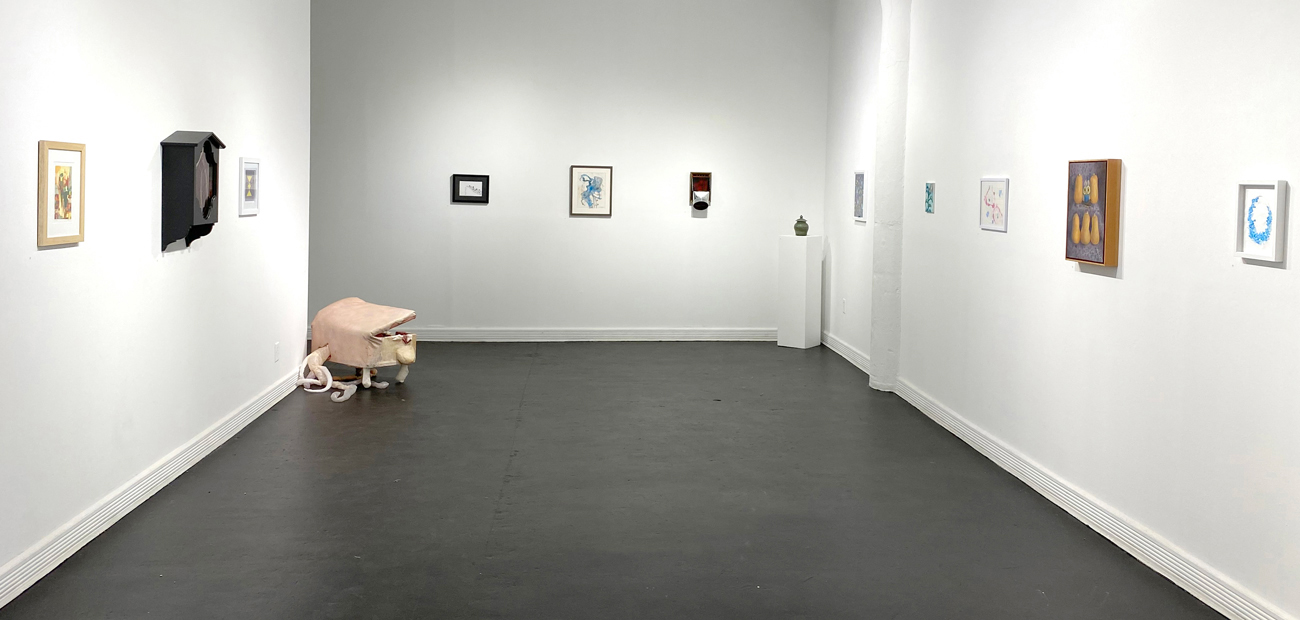
Through their group show at Re Institute, Julia Kunin, Barbara Zucker, Meg Lipke, Catherine Hall, and Joanne Howard reflect on how a supportive community and friendship nourish the often solitary act of creating art. Their lives have intersected over many years, and their approach to art cross-pollinates on multiple levels.
The mysterious elevator door facing the busy corner of Broadway and Canal takes you to the vast and brightly lit space of Ulterior Gallery, which is currently presenting Keren Benbenisty’s second solo show with the gallery titled Tristeza II. A continuation of a 2021 show by Benbenisty, named after the same lethal virus that infects citrus trees, comprises a series of new works in various media. At the center is a 14-minute video narrating the artist’s attempt at cultivating a blue orange, a project she has been occupied with for the past several years: The bluranj, as she named it, or Tapuchol, from the Hebrew word for orange, “Tapuz” and blue, “Kachol”. The video takes us through footage from her visits to an Israeli agricultural research institute, where she met with scientists who specialize in grafting new citrus species. They questioned her ambition – why a blue orange? Benbenisty does not offer a logical explanation but rather a poetic one. The works in the exhibition tell her personal story and provide a window into the larger narrative of the region.
Power. Power, not bravado, not ego, but the power of intelligence, skill, fortitude, and vision is what Mary Ann Unger possessed and that is what is on exhibition at Williams College Museum of Art (referred to as WCMA). Throughout her life she defied limitations frequently imposed overtly and subconsciously on women. Attending Mt Holyoke College in the mid-60s, she studied biochemistry when few women were found in science departments, then transferred to studio art taking up welding, casting and carving. This was not the typical route for women during the mid-to late 60s. She traveled on her own to North Africa and this journey greatly influenced her work. Returning to New York she completed an MFA at Columbia and launched her career as a post minimalist sculptor, finding herself in the minority amongst a sea of men.
Manju Shandler, Wonder Whale 1, 2018, mixed media, 23×19 inch
Luckily, or to many art-mavens’ chagrin, our 21st century art world—in line with the global techno-culture and socio-political processes—seems to have abandoned crusades of “right” or “wrong” related to artistic form (though sometimes that does not apply to content). We are experiencing a dizzying array of aesthetic expressions, where often fast-pace visual trends replace ideologies of form. Unlike some passing trends, visual narratives based on mythological iconography have been central in all art forms since archaic ages, except for the early-mid half of the 20th century when narrative impetus was largely downplayed in most of what was called the “Avant Garde” art of the time.
Study for “Mother/Son”, 1984, Ink on Artforum magazine cover. (March 1977), 10.5″ x 10.5″, photo courtesy of the artist
Enter Thompson Giroux Gallery in Chatham NY and come face to face with what we as artists, curators, critics, gallerists and historians consciously and subconsciously know; we are missing greats. Arthur González’s exhibition, Ego Diaries confronts the art world and those who control the keys to the kingdom and anoint who is recognized and who is not.
Jung Eun Park – In the Womb 13, 2003, pencil, thread, fabrics, watercolor on coffee-dyed Korean mulberry paper, 7” x 8”
Sensing Woman is a multisensory event taking place at C24 Gallery in Chelsea, New York City, for five days and four nights of Art by 50 contemporary visual artists, along with conversation, storytelling and music – altogether around the future of being female. All profits from this event will be donated to organizations working to protect autonomy over our bodies and improve maternal and sexual health, including the groundbreaking advocacy organization the Center for Reproductive Rights.
Vanessa German, Black on Black, 2021, Handmade folk art cloth Black woman pin cushion, glory, wood, love, astroturf, Black seed beads, confusion, Black rhinestone trim, Black bead trim, (they traded your grandmother for a handful of beads), vintage hand purse, rage, old doll parts, ptsd, the fallout from white supremacist delusion, cork, Black pigment, sorrow, vintage mirror, self loathing, cotton, a miracle, twine, tears, yarn, heartbreak, love. 26 x 18 x 9 1/2 in
Last weekend was the third annual Upstate Art Weekend, a wildly ambitious and fun three-day art fair that winds its way from Westchester to Catskill NY. Founded by impresario Helen Toomer in 2020, Upstate Art Weekend celebrates and promotes visual arts throughout the Hudson Valley. One hundred and forty venues participated this year, and there was everything from art in a big-box truck in Kerhonkson to the gallery/studio campus of Foreland in Catskill. The intense heat of last week made this year’s event a challenge, but totally worth the sweat. Here is a brief travelogue of my schlep around the Hudson Valley:
Featured Project: with curator Ysabel Pinyol Blasi and artist Jac Lahav
(From Left) Yigal Ozeri, Yayoi Kusama – Image courtesy Monira Foundation and Eileen S. Kaminsky Foundation; Yayoi Kusama, Shoes, Image courtesy Eileen S. Kaminsky Foundation
An epic show of portraiture opened in Beacon NY on October 24th. The artists roster reads as a “who’s who” in contemporary art with works from Gerhard Richter, Cindy Sherman, Ai Wei Wei, Yayoi Kusama, Yigal Ozeri, and Jac Lahav. Curated by Ethan Cohen and Ysabel Pinyol Blasi this epic show of over 50 artists explores the nature of portraiture as a springboard for what art can achieve. We sat down with curator Ysabel Pinyol Blasi and artist Jac Lahav to discuss the exhibit.
sTo Len, detail of FOAM (FutureOfAMaterial) installation. Gomitaku print, sumi ink on linen, 64” x 360,” 2020.
Since June of 2017, artists Jarrod Cluck, Gina R. Furnari, sTo Len, Leslie Sobel and Rachel Wojnar have been on an intense physical, emotional, spiritual, and art-making journey, which culminated with their MFA Thesis Exhibition, Confluence, on view at the Joseloff Gallery of the Hartford Art School, University of Hartford (Connecticut) from September 10-19, 2020. They are the third cohort to complete the Nomad Interdisciplinary MFA program. Founded by director Carol Padberg in 2015, the program uses an innovative field-based model and offers a curriculum that includes art, ecology, the study of place, indigenous knowledge systems, and technologies. Encompassing two hands-on residencies per year, the Nomad MFA provides courses in El Salvador; New York City; New Mexico; Mexico; Oakland, California; Miami; and Minneapolis.
Partial view of gallery installation, photo courtesy Jon Bunge
Twenty Twenty Twenty One is a group exhibit and corresponding artist book created by 18 artists. During the darkest days of the past year, the fellowship this group of artists built became a beacon of hope. The artists initially congregated in early April of 2020, during the height of the Covid-19 pandemic, via weekly Zoom meetings launched by artist Mike Sorgatz, that continued through the year and up to the present. Inspired by their camaraderie, in late summer of 2020 they began casually discussing making a book to share artwork loosely relating to themes of community and connection. This book expanded into a corresponding exhibit, with Janice McDonnell generously taking the initiative in early December of 2020 to curate the exhibition at Sweet Lorraine Gallery.