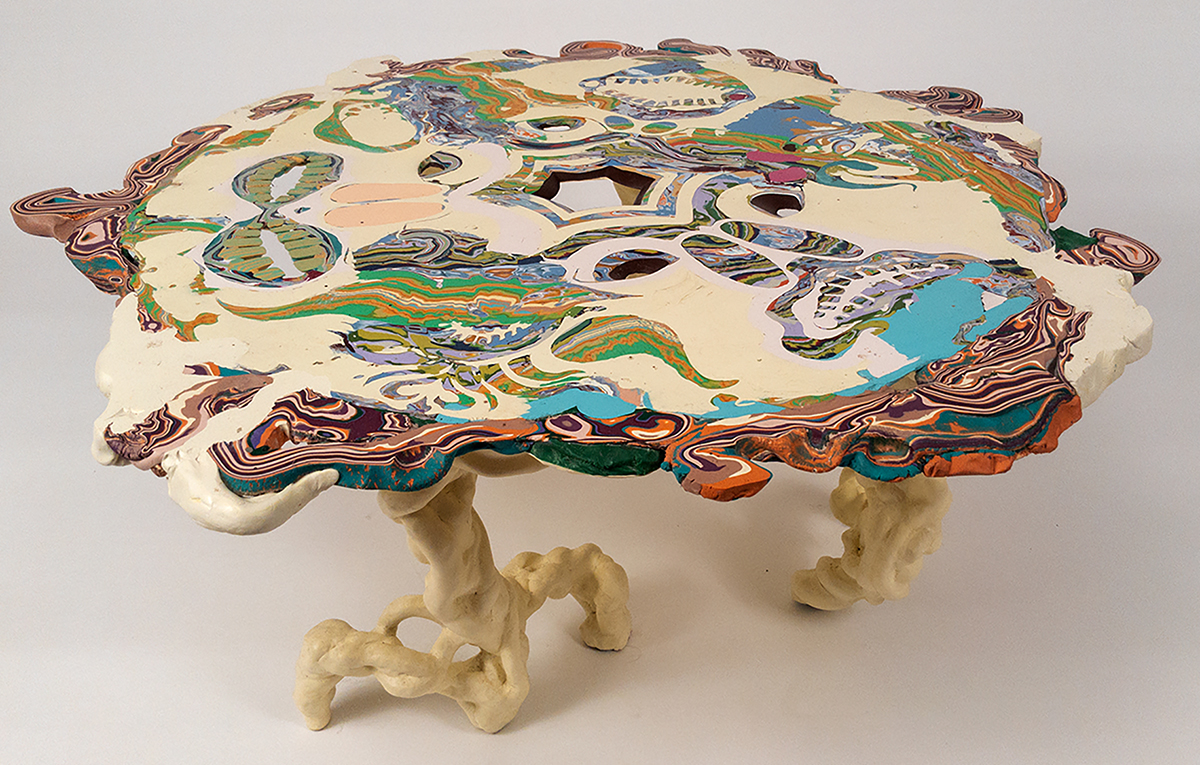
Daniel Wiener, Six Custodians, 2021, Apoxie-Sculpt and dispersed pigments, 12.5” x 29” x 29”, photo courtesy of Daniel Wiener
The exhibition, At Home with Scallywags and Raspcallions, brings together Daniel Wiener’s work from the past 12 years. It focuses on his sculptures which also have a practical domestic use. As he says—the tables, stool, benches and bowl are familiar objects but in my hands, as with all of my work, they still uncover subconscious inner demons.
Hedwig Brouckaert, Flesh of Light (I), 2017, Mixed media on archival inkjet print on paper, 33.8 x 43.34 inches, photo courtesy of Hedwig Brouckaert.
The artworks featured in the group show The Sky is higher hereat Transmitter in Brooklyn reference the subtle boundaries between what is free of the physical and what is not—how can we mirror what we find in the sky and what does it reveal in us? Through a variety of mediums such as painting, textile, photography, textile weaving, and mixed media, Hedwig Brouckaert, Simone Couto, Edi Dai, Saba Farhoudnia, Victoria Martinez, and Ingrid Tremblay explore the vastness of the sky and find refuge in this great space with no borders. The curator of the show, Leila Seyedzadeh sheds some light on the curatorial vision and process.
Gabriela Vainsencher in the studio with “Mom”, 2021
Gabriela Vainsencher works in photography, video and drawing, while merging all of these forms in her porcelain sculptures. Her sculptures and wall reliefs are as far off the smooth perfection we traditionally associate with porcelain – twisted forms merge into each other or repel, forming a fiery existential dance that sometimes invokes symbiosis and sometimes pulling apart.
Portrait of Brenda Zlamany with the Davenport Dining Room Scene, 2018. Oil on panel. Left panel: 58 x 42 in. Right panel: 58 x 39 in. Photo courtesy of Robert Lowell.
In recent years we have been experiencing a major re-examination of iconographies and narratives portrayed in historical paintings and sculptures—portraits of male figures re-evaluated and removed, portraits of females and people of color, added. Working within the context of historical portrait painting, till surprisingly quite recently, has implied working within a mostly male dominated territory, for both artist and subjects. Additionally, depicting Historical figures requires the artist to develop their own research approach, which typically differs from the process of depicting living subjects. Painter Brenda Zlamany, who has been commissioned to paint several substantial group portraits of historical women, among them—Yale’s First Seven Women PhDs and Rockefeller University’s five women scientists—elaborates on these issues and describes her approach to historical portrait paintings.
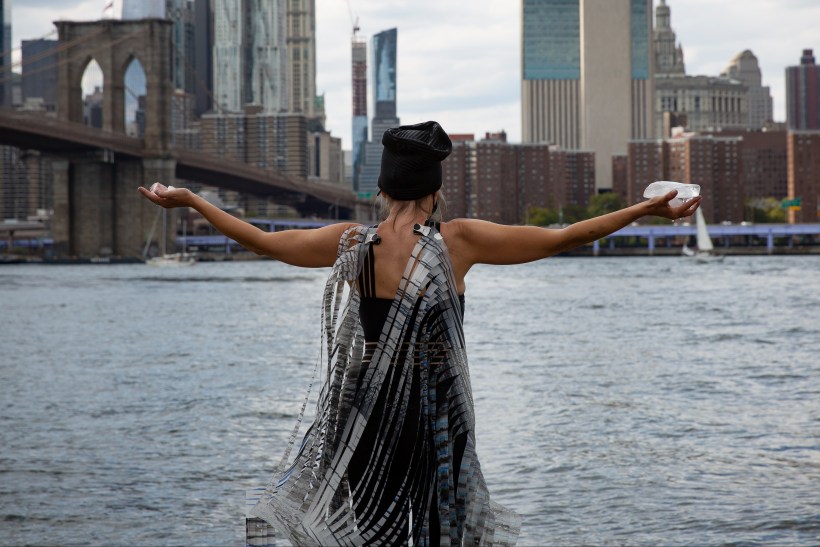
Glacier Elegy Brooklyn, performance in public space with three performers and audience members, one block of ice, two sculptural elements, took place at the Brooklyn waterfront, New York City, October 20, 2020
New York-based artist and educator Jaanika Peerna grew up in Estonia during the Soviet era. Her drawings, installations, and performances all embody a sense of constant movement and change, either chaotic or orderly, that personifies the elements of water, ice, wind, air, and light. Peerna attributes many of the choices she has made about the materials she uses as well as her working methods to her childhood in her native land of ice and greyscale colors along the Baltic Sea. It was there where her body learned to embrace the movements specific to gliding on ice, where she observed the varied lines that skates made on the surface of ice, and where she mastered the use of the limited art materials available in the local Soviet-style school system – especially drawing with pencils on paper. To this day, she sees all of her work as drawing, “whether it is video or light installations, placing works in a room, drawing in space, leaving lines on paper, traces of movement and now performance.”
From line drawings and cutouts to wall reliefs and sculptures, lines shift forms throughout the group exhibition Drawing a Line at Five Myles. Curator Klaudia Ofwona Draber says she was inspired by the gallery founder Hanne Tierney’s vision to organize a drawing exhibition. Ofwona Draber’s interest in social justice and post-colonialism guided her choice of artists as well as the theme of the exhibition – drawing a line as an action of drawing boundaries, whether to protect personal boundaries in the quietude of one’s own home, or at the heart of a political conflict. “By drawing a line, we protect ourselves, our families and our communities from the violence and inequalities that are happening around us,” says Ofwona Draber.
“Brie Ruais: Movement at the Edge of the Land”, installation of exhibition, courtesy The Moody Center for the Arts and albertz benda gallery. Photo by Nash Baker
Brie Ruais [b. 1982, Southern California] lives and works in Brooklyn, New York. She received her MFA from Columbia University’s School of the Arts in 2011. Ruais’ movement-based practice is legible through the scrapes, gouges, and gestures embedded in the surfaces and forms of the ceramic works. Each sculpture is made with the equivalent of her body weight in clay, resulting in human-scale works that forge an intimacy with the viewer’s body. Through her immersive engagement with clay, Ruais’s work generates a physical and sensorial experience that explores a new dialogue between the body and the earth.
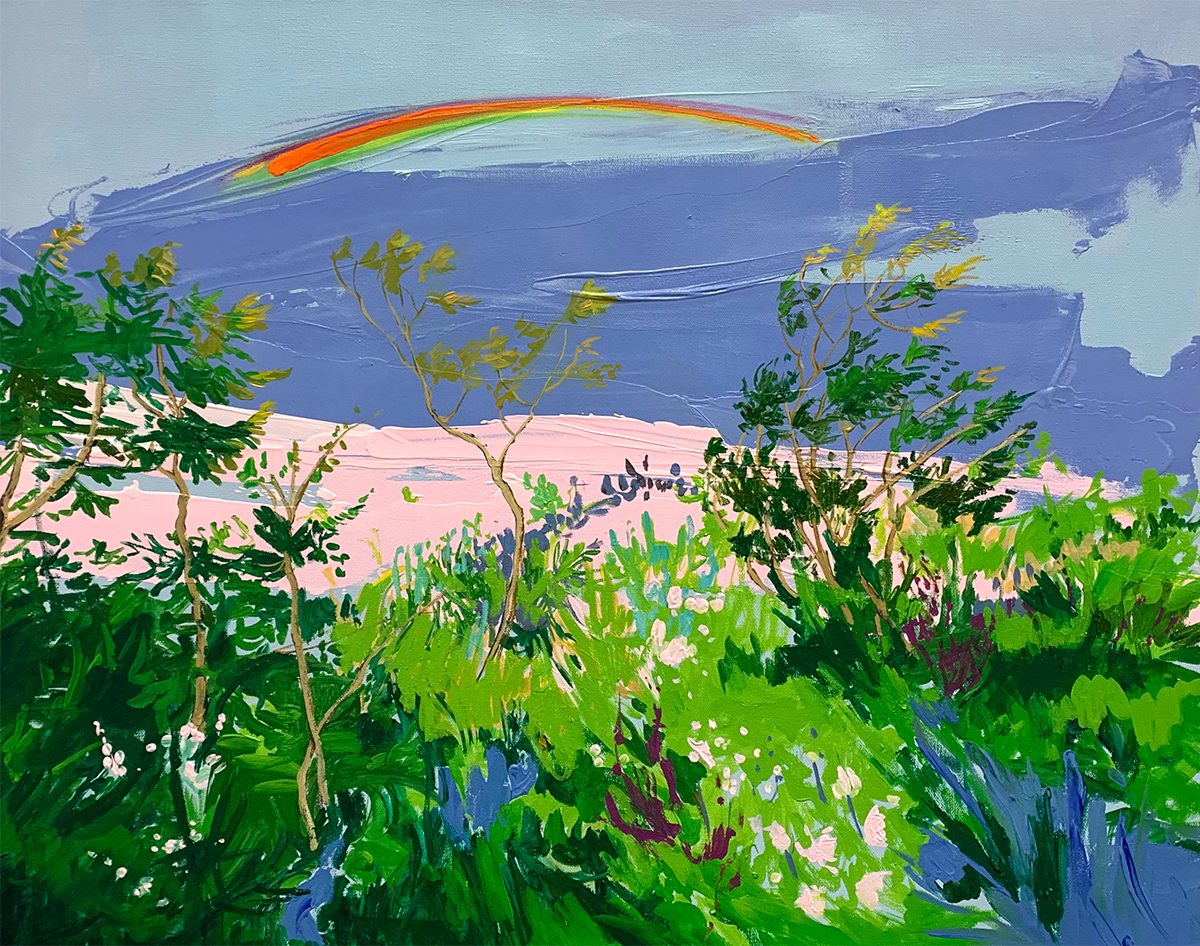
Delicate Rainbow, 2021, 24”x30”, oil on canvas, photo courtesy of the artist
In her solo show at 490 Atlantic Gallery, New York based painter Claire McConaughy features landscapes depicted in vivid colors and expressive linear marks. In Delicate Rainbow for instance, the painting plays on tension between horizontal, vertical, and diagonal orientations – an unexpected pale pink flow becomes a backdrop horizon to green vegetation spreading its limb-like branches diagonally upwards; on the top, blue-purple brush strokes depicting sky or water, lead the eye sideways, and then right above, a surprising orange linear brush stroke with the other rainbow colors hinted, stretch across the middle top.
Paul Loughney and Halona Hilbertz. Photo credit: Renée Ricarrdo
Paul Loughney’s collages resemble daydreams where seemingly unrelated elements coalesce into a fantastic mindscape where body parts, typography, geometric shapes, and hints of architectural elements scramble into unique environments that are oddly believable despite their quirky nature.
Kris Grey (NYC) and Barbara Maria Neu (Austria), Miss(ing), 2021. Video (runtime: 4 minutes, 8 seconds), performance (15 minutes) and sculptures. Photos: un/mute team
How can artists unmute themselves and make work in creative dialogue with each other while they experience forced solitude at faraway places? How can collaborative practices be reinvented in social isolation? And how can virtual and chance encounters between strangers can lead to the making of jointly authored images and objects? The un/mute project, initiated by EUNIC New York and Undercurrent, the independent exhibition space in DUMBO, was an attempt to probe these questions by inviting 32 artists to work across borders, languages, and media, while sharing the global experience of the Covid-19 pandemic at distant locations, under varied social circumstances, and in cultural contexts.