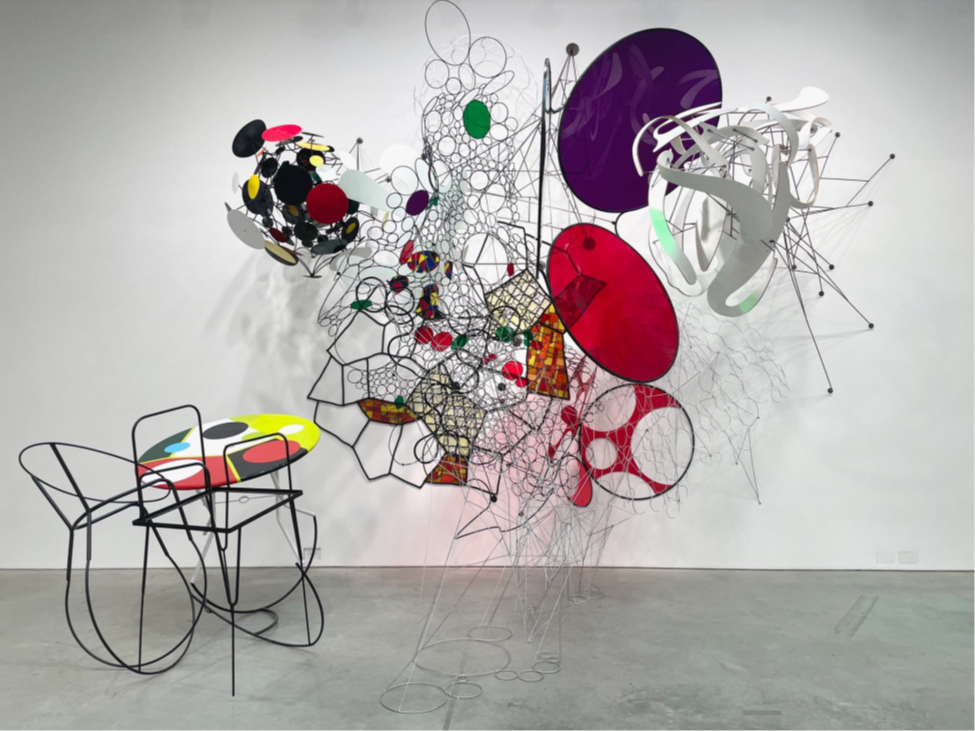
Judy Pfaff, Barcelona, 1990, steel, plastic, glass, table and chairs, 168 x 168 x 168 inches
It began, as many enduring ideas do, over wine and conversation. Michael David, painter, curator, and gallerist of M. David & Co., was speaking at a dinner with Judy Pfaff about her close friend and early champion Al Held. The talk drifted to another dear friend, Elizabeth Murray, and then to her admiration for Frank Stella. From that exchange evolved the idea for Singing in Unison, Part 12: Painting in Space, curated by Michael David, and now on view at Art Cake in cooperation with The Brooklyn Rail.
Judy Pfaff has never played by the rules—her art bends them, her teaching breaks them, and her career is proof she never needed them. A MacArthur “Genius” who reshaped installation art, she has spent five decades throwing order out the window in favor of energy, movement, and sheer creative force. That ethos is on full display at Art Cake in Brooklyn, where Pfaff and three former students have reunited—not in a classroom, but as equals in a space that refuses to sit still.
Lou Reed’s song All Tomorrow’s Parties, featured on the Velvet Underground & Nico’s debut studio album, was allegedly inspired by the musician’s observation of Andy Warhol’s ‘Factory,’ an epicenter where camp, craze, and creativity flowed in abundance. With a tangible sense of energetic exploration, M. David & Co.’s mega-scale group show at Art Cake echoes this creative exchange by articulating the dynamic intergenerational connections between emerging and established artists across media.
Installation view, Jim Condron: Collected Things at Art Cake, photo courtesy of Etty Yaniv
Collected Things, Jim Condron’s terrific solo exhibition at Art Cake in Brooklyn prompts us to question our relationship with the objects we interact with—objects that we use, discard, and transform through memory and art process. At the heart of this exhibition are Condron’s recent series of sculptures, which brings together everyday objects and ephemeral materials he has collected from artists, writers, and thinkers who participated in the project—these individuals include personal acquaintances like Graham Nickson, Lucy Sante, Rebecca Hoffberger, Carl E. Hazlewood and Cordy Ryman. Among them is the pioneering painter Grace Hartigan, who was Condron’s teacher and for whom he also worked as a graduate assistant in 2004, four years before her death. This body of work highlights how Condron’s process of collecting, editing, and adding other materials, activates the lineage and history of everyday objects, transforming them into playful art objects with renewed vitality and psychological presence.