Notice: Function WP_Object_Cache::add was called incorrectly. Cache key must not be an empty string. Please see Debugging in WordPress for more information. (This message was added in version 6.1.0.) in /www/artspiel_344/public/wp-includes/functions.php on line 6131
Jac Lahav, Immersive blue vine installation on the hardship and beauty of being a foster parent
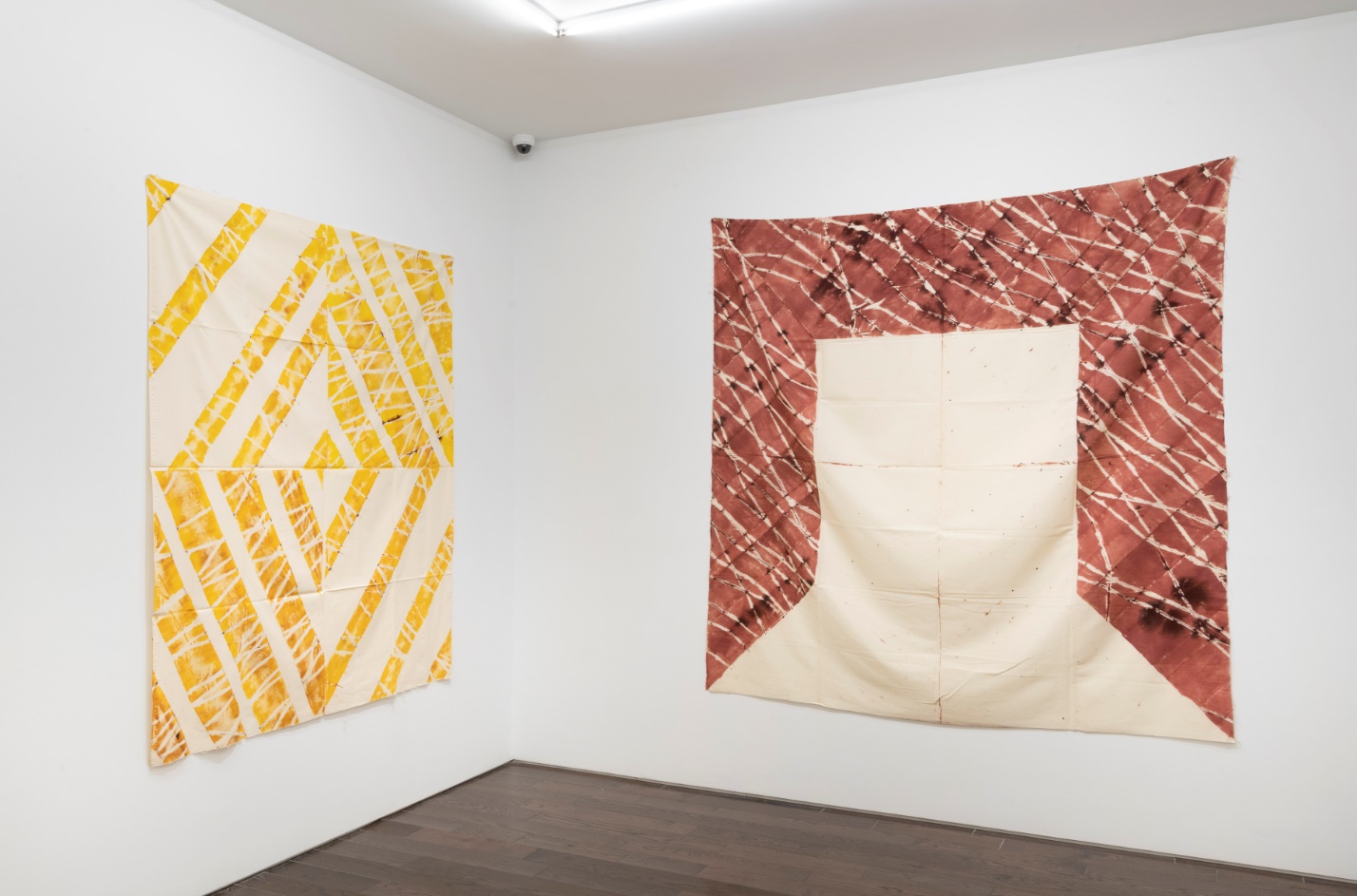
Jac Lahav: The Saffron Thief at Sugarlift is an immersive installation about the artist’s experience as a foster parent. At the center, a large sculpture titled 29, references 29 points of contact that the artist has had with different foster children. The lines of saffron and gold leaf across abstracted canvases, and a site-specific wall drawing allure visitors to enter Lahav’s world.
Gail Winbury’s multidisciplinary art exhibition The Girl Who Drew Memories at the Elizabeth de C. Wilson Museum on the campus of the Southern Vermont Art Center in Manchester, Vermont, addresses the intersection of art and psychology, specifically “vulnerability and creativity”. Winbury proposed to include poetry as a component of the exhibition and curator Alison Crites brought together Winbury’s paintings and collages, with poetry by living poets. The exhibition altogether raises the question “how do we tell the stories of our early childhood when at times there may be no words, or we dare not utter the words aloud?”
Installation view, André-Pierre Arnal at Ceysson & Bénétière New York. Photo courtesy of Ceysson & Bénétière New York
With the advent of Modernism in the late 19th – early 20th century, differing movements, schools, and networks sprang up internationally—some were generative and sustainable, others dead-ended, though unbeknownst to most of us, traces of these persist or return. This cross-fertilization drove Modernism’s evolution until the post-World War II era the new art made in the U.S. came to dominate the narrative. The triumph of the NY School (AbEx) corresponded to the new political and economic order. In this scenario the vanguards that emerged from the rubble and detritus of the War such as C.O.B.R.A., Nouveau Realisme, Lettrist, Zero, Arte Povera, etc. were trivialized, marginalized, or came to be appropriated. To this day, the European artists whose works come to be acknowledged in the States tend to be those whose works are used to typify the whole of a critical discourse, or style. This has reduced post-War European art to a short list that includes Pierre Soulages, Antonio Tapies, Lucio Fontana, Yves Klein, Francis Bacon, Joseph Beuys, Gerhardt Richter, Anselm Keifer, etc. In this manner, the illusionary status of the U.S. as the cultural leader of the free world is sustained, while European art is made to appear to be broken, fragmented, or at best sporadically relevant, rather than constituting a network of competing histories, practices, and critical discourses.
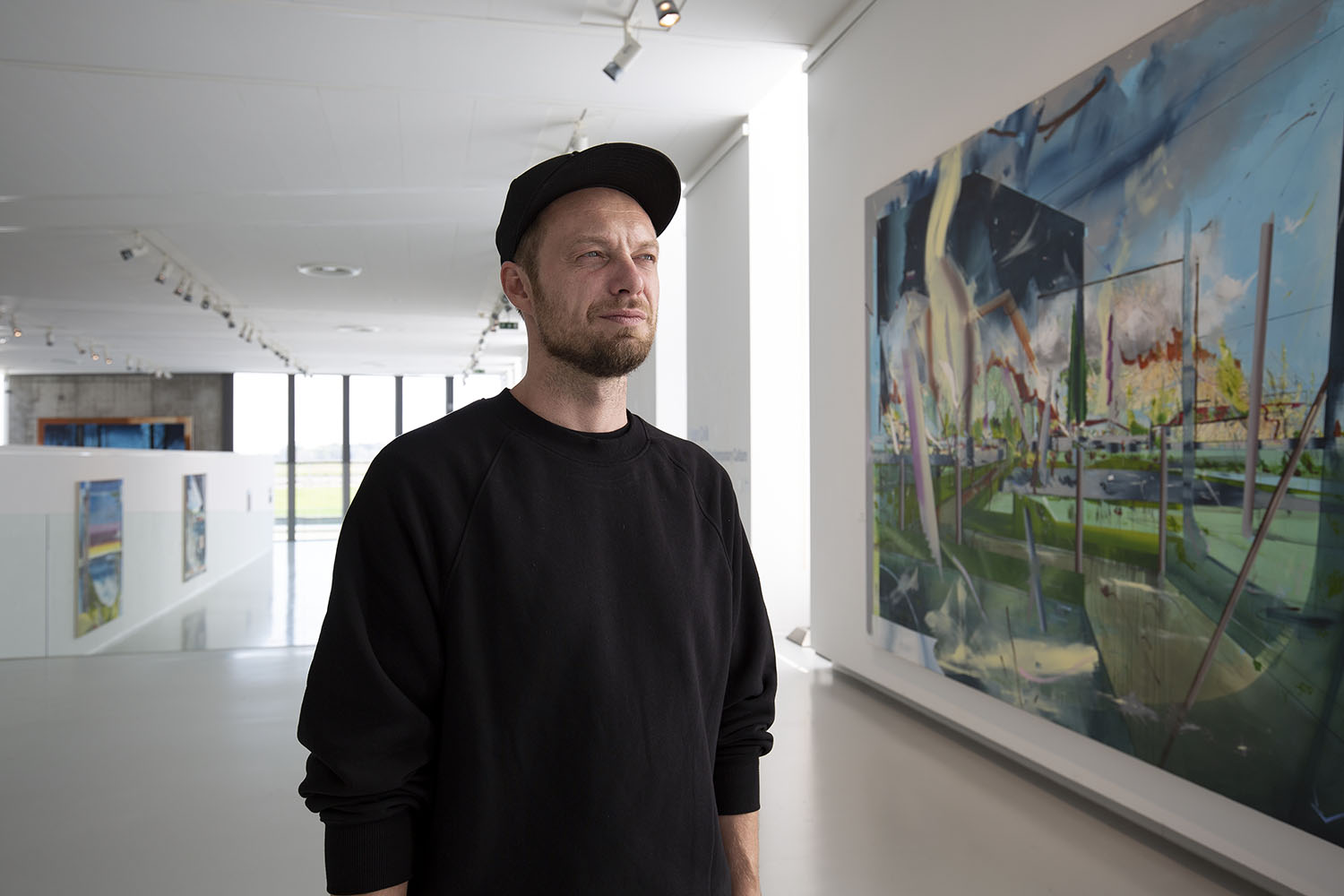
Portrait in Zoya Private Museum Solo Show “semagdniM”. Photocredit: Juraj Fifik
For the last few years the Slovak painter Peter Cvik has been layering different experiences and stories out of sheer visual memory. Without using photos or any other found imagery, Cvik builds new positions of “synthetic” reality that reminds us of something real or experienced within a flux of time where memories float. His landscapes evoke a sense of collision between opposing worlds without evoking the sense of a specific place. Peter Cvik equates his paintings to a sentence that ends with three dots which viewers can complete on their own.
Gallery view, East End Arts, Riverhead, NY. Courtesy East End Arts and the artist.
In Double Take, Rainer Gross’ solo show at East End Arts through November 5, 2022 in Riverhead, NY, the artist invites the viewer to take a step closer to his abstract, intensely colorful paintings. Gross offers the viewer the satisfying experience of engaging intellectually with the underlying organizing principle of his compositions while savoring a sumptuously layered array of the results. His paintings are comprised of two (sometimes four) identically sized, stretched rectangular canvases shown side-by-side. He applies pools, bands, bars and patches of saturated hues of oil paint on one canvas and water-based pigment on the other. While the colors are still wet, the paired canvases are then placed together, face to face. When pulled apart, the forms on one canvas imprint on the other creating a shared Rorschach-like result. The artist refers to his paintings as “twins.” The side-by-side canvases are nearly identical, yet their differences become an intriguing puzzle to recognize, trace and sort. This easy-to-grasp concept offers a frisson of delight for the viewer as they experience the variety of its execution.
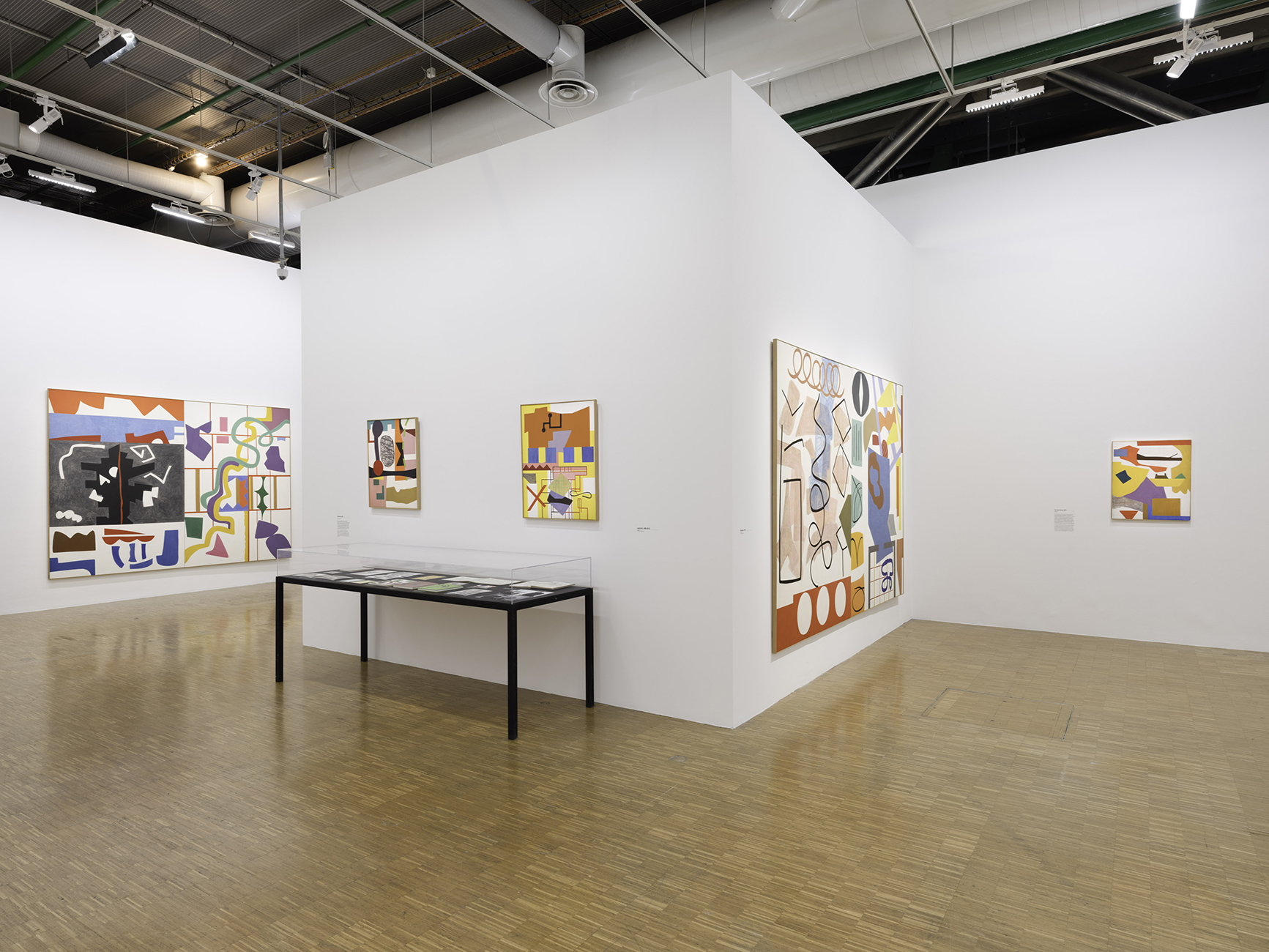
Shirley Jaffe, installation view, Pompidou Center, photo courtesy of Helene Mauri
It might be said for the most part, given the dominant ideology of Modernism, Shirley Jaffe has been overlooked for the standard reasons—her work was out of step with the times, it was derivative of Henri Matisse and Stuart Davis, it was too French, or too American—all according to who you speak with. Yet the gorilla in the room is she was an American woman of the post-war generation who had stayed on after almost everyone had gone home, who sought to get a foothold in the male dominated Parisian art world. Despite this, she persisted and gained respect and support among multi-generations of artists. As such she developed a reputation as an artists’ artist, yet despite her boosters and the fact that she is now being acknowledged with a retrospective exhibition at the Pompidou, Jaffe remains one of the best kept secrets of post-War abstract painting in France and remains unacknowledged in the States.
Installation view of Pauline Decarmo: Exit at LABspace, 2022, photo courtesy LABspace
Some artists paint stunning abstractions, some artists deftly execute exquisite realistic images, while others ingeniously develop astute conceptual work, but the truly magical art is work that can intelligently create the aura of time, space, and experience. Fortunately Pauline Decarmo, by using any means necessary, does exactly that in her exhibition, Exit, on view at LABspace in Hillsdale NY through May 29.
Portrait of Paul Behnke in the studio with Gloria’s Guardian, 2020, acrylic on canvas, 62 x 60 inches, photo courtesy of Robin Stout.
Paul Behnke is a champion of painting – and he does it with evident gusto. His paintings come from idiosyncrasies, life experience, and a process that begins as intuitive, mixed with periods of sharp critical gaze. His paintings have evolved from early contained and minimalistic bold-color geometries, to more recent chaotic forms and layered complexity, at times almost explosive.
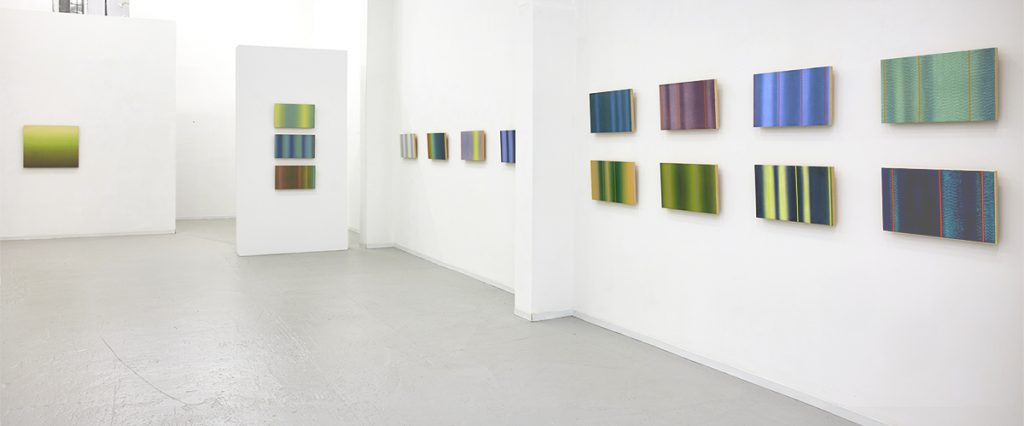
Nishiki Sugawara-Beda, Installation view of Somewhere Around There, 2022. Photo courtesy of Maggie Pavao
It is perhaps in this state of “not knowing” that we first encounter the works in artist Nishiki Sugawara-Beda’s current solo exhibition Somewhere Around There, on view at the Amos Eno gallery. The exhibition, which presents works from the artist’s KuroKuroShiro series (‘black-black-white’ in Japanese), features dynamic shapes in shaded monochrome that seem to alternately emerge and recede from view. Faced with this shifting visual field, the viewer gradually develops a kind of intimacy with these unknown forms, opening up new possibilities for interpretation and engagement.
Gallery View. Photo courtesy of David Richard Gallery
Vigil, Ellen Kozak’s first solo painting exhibition with David Richard Gallery, featured two fully realized series of abstract oil paintings on panel. The painter, with studios in New York City and beside the Hudson River in Greene County, explores the relationship between the fluidity of paint and river surfaces affected by the intersection of natural and manmade phenomena. Altogether the paintings activated the gallery space into a cohesive site-responsive installation.